
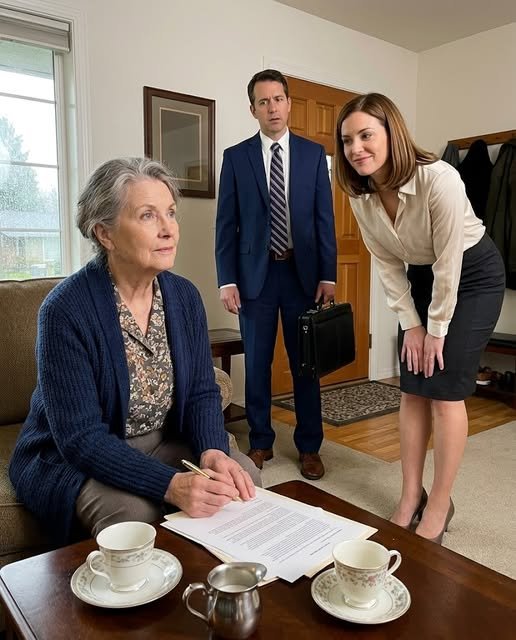
Part 1: The Secret I Never Told My Son
When my son got married, I deliberately kept one important secret from him.
I never told Matthew that after my husband, Harold, died, I inherited his family ranch.
I never mentioned the nearly five hundred acres in eastern Washington, the cattle, the grazing leases, the water rights, or the houses standing on land valuable enough to change a person’s life.
I did not bring it up during holidays.
I did not casually mention it in conversations.
And whenever people assumed I was simply a sixty-nine-year-old widow living in a modest Seattle house, I allowed them to believe it.
For a long time, I wondered whether keeping that secret made me dishonest.
One week after Matthew’s wedding, I realized it had protected me.
Brooke, my new daughter-in-law, arrived at my front door shortly after noon.
She wore a cream blouse, narrow heels, and pearl earrings. Everything about her looked polished and carefully controlled, as though she were entering a business meeting instead of visiting her husband’s widowed mother.
Beside her stood a man in a navy suit, holding a briefcase.
Brooke smiled before I had fully opened the door.
“Mom, this is Paul,” she said. “He’s a notary.”
The word struck me immediately.
A notary?
“We’re here to help you with some paperwork for the house,” she continued.
I gripped the edge of the door.
I was not confused.
I was not frightened.
I simply understood, in that instant, that all the vague concerns I had tried to dismiss were real.
They had moved faster than I expected.
I stepped aside and allowed them to enter.
Seattle was gray and wet that afternoon. My living room smelled faintly of lemon cleaner and the coffee I had made that morning.
Brooke’s eyes moved quickly around the room, examining the curtains, the framed photographs, the antique sideboard, and the belongings Harold and I had collected during our marriage.
Paul gave me a professional nod.
“Thank you for meeting with us, Ms. Calloway.”
“Of course,” I replied.
I offered them coffee.
Brooke declined, but Paul accepted.
He looked slightly surprised when I served it in a china cup with a silver spoon resting on the saucer.
Some people see an older woman living alone and assume she has become part of the furniture.
I have learned that such people reveal more when you allow them to underestimate you.
Brooke placed a stack of documents on my coffee table.
“This is only the first step,” she said lightly. “Matthew and I have been discussing your future. We’re worried about you managing everything by yourself.”
I sat across from her.
“I’ve managed this house for thirty years.”
“Yes, but circumstances change,” she replied. “You shouldn’t have to worry about repairs, bills, taxes, and maintenance. We found a beautiful assisted living community. It’s very upscale.”
“I’m not interested in assisted living.”
Her smile did not move.
“You may not need it immediately. This is simply smart planning.”
Paul opened his briefcase and removed a folder.
“These documents would authorize the sale of the property and allow temporary management of the proceeds,” he explained. “If you decide to proceed.”
Property.
Proceeds.
Management.
The words were clean and professional, but their meaning was obvious.
They wanted control of my house and my money.
What they did not know was that my Seattle home was only a small part of what I owned.
Part 2: Harold’s Final Protection
Harold’s family had never possessed flashy money.
They possessed land.
There is a difference.
Land is quiet wealth. It survives bad markets, droughts, family conflicts, and careless generations. It does not need to announce itself.
When Matthew was young, he loved hearing Harold’s stories about the ranch.
He asked about the cattle, the fences, the irrigation ditches, and the snow that covered the eastern fields during winter.
Harold sometimes took him there.
Perhaps not often enough, but enough for Matthew to know the ranch existed.
Then Harold became ill.
Cancer took him slowly.
First, it stole his energy. Then his appetite. Finally, it weakened his voice until every sentence became difficult.
On his better days, he asked me to read reports from the ranch files. On his worst days, he held my hand and gave me instructions.
“Never let anyone rush you,” he told me.
“Never sign anything when you are frightened.”
One rainy night in the hospital, he looked directly into my eyes.
“Never let them walk over you,” he whispered. “You are stronger than you know. You have more than you think.”
At the time, I believed he was speaking only about emotional strength.
The morning after Matthew’s wedding, I learned he had meant something more.
I had gone into my bedroom, still emotionally exhausted from the wedding. While searching my safe for an insurance document, I discovered a leather folder hidden behind several older files.
Harold’s handwriting was on the front.
Inside were final property transfers, letters from his attorney, tax maps, bank documents, and completed probate records.
The ranch had passed entirely to me.
Nearly five hundred acres.
A main house.
Three smaller residences.
Cattle.
Equipment.
Grazing leases.
Water and mineral rights.
Everything was legally registered in my name.
I sat on the edge of my bed and read every page twice.
Then I cried.
Not because I suddenly considered myself wealthy, although the value of the property was impossible to ignore.
I cried because Harold had known that one day I might need protection.
He had built a wall around me that no one else could see.
Soon after the wedding, Matthew began calling more often.
At first, his questions sounded casual.
Had I considered downsizing?
Did I know how valuable Seattle property had become?
Wouldn’t life be easier if I moved somewhere with professional support?
A few days later, Brooke began sending links to senior living communities.
She described the meals, transportation, medical assistance, and social activities.
She referred to my house as an “aging asset.”
“I like my home,” I told her.
She laughed softly, as though I had admitted to enjoying something embarrassingly old-fashioned.
Then Matthew called again.
“You shouldn’t have to manage repairs alone, Mom,” he said. “Brooke and I could help protect your money.”
Protect it from whom? I wondered.
A week later, Brooke asked whether I had established a power of attorney.
That question ended my denial.
I may have been sixty-nine, but I was not helpless.
I could recognize patterns.
I could hear rehearsed language.
I could tell when someone was approaching a subject they did not want to address directly.
I made an appointment with an elder-law attorney named Denise Mercer.
Denise was calm, observant, and direct. She listened while I described the wedding, the phone calls, the assisted living suggestions, and the sudden interest in my finances.
I handed her a legal pad containing dates, times, and summaries of every conversation.
After reading it, she looked at me seriously.
“You were right to come now.”
I told her about the ranch.
Her expression changed only slightly, but I could see that she understood the danger.
“Do Matthew and Brooke know about it?”
“I never told them.”
“Good.”
Denise helped me create a trust and establish legal protections around every major asset.
We added restrictions on access, selected an independent fiduciary from Harold’s side of the family, updated my estate documents, and strengthened fraud protection on my accounts.
Then Denise said something that made my skin go cold.
“If they are attempting to isolate you, pressure you into signing documents, or misrepresent what those documents contain, this can become financial exploitation.”
Financial exploitation.
Hearing those words connected to my own son felt unbearable.
Denise contacted Adult Protective Services for guidance.
“Do not confront them yet,” she instructed. “Let them show you what they intend to do. But do not sign anything.”
I began preserving every message.
I printed text conversations.
I backed up voicemails.
I wrote down Brooke’s favorite phrases:
“Streamlining assets.”
“Reducing cognitive load.”
“Professional oversight.”
“Efficient liquidation.”
Each phrase sounded helpful on its own.
Together, they formed a plan to take control.
One Tuesday morning, Brooke sent me a message.
Paul the notary is available Saturday. We can stop by and make everything easy.
I forwarded it to Denise.
Her reply arrived within minutes.
Do not cancel. Do not sign. Keep them talking. We will be ready.
End Part Here: THEY CAME WITH A NOTARY TO TAKE MY HOME