
Part 3: The Papers on My Coffee Table
Saturday arrived cold, gray, and damp.
I cleaned the house even though it was already clean. I wiped the kitchen counters, straightened the mail, and arranged the cushions.
Then I put on a blue cardigan Harold used to love.
He once told me it made me look “too dignified to argue with.”
At exactly noon, the doorbell rang.
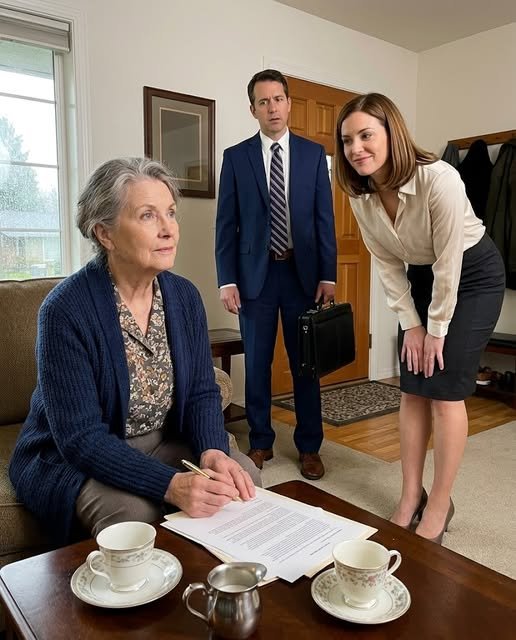
Brooke entered first.
Paul followed behind her.
Matthew was not with them.
His absence hurt more than I expected.
Part of me had hoped that if he stood in my living room and looked into my face, something inside him might stop the plan.
Perhaps Brooke believed the meeting would be easier without him.
It is easier to pressure a widow when her son is not present to witness it.
We sat in the living room.
Brooke placed the documents on the table and began explaining them in a bright, managerial voice.
Sale authorization.
Temporary relocation agreement.
Financial administration.
Recommended property disposition.
Her fingernail tapped the colored tabs where I was supposed to sign.
“It’s all standard,” she assured me. “This simply gives us flexibility.”
“Us?” I asked.
She smiled.
“Family.”
Paul kept his attention on the folder.
“Would you like me to summarize the documents?” he asked.
“Yes.”
As he read, I listened carefully.
The language was complicated and deliberately vague.
The papers did far more than Brooke had described.
They would allow my house to be listed for sale almost immediately.
They would permit other people to manage some of my accounts.
They would authorize selected professionals to evaluate whether I was medically suitable to continue living independently.
These were not simple planning documents.
They were a net designed to remove me from my own life before I could fully object.
“This seems like a great deal of authority,” I said.
“It only means you won’t have to worry,” Brooke replied. “You become overwhelmed by paperwork.”
I had never told her that.
“And Matthew agrees with this?”
“Of course.”
Something in her tone suggested she enjoyed telling me that my son had chosen her side.
I went to the kitchen and returned with coffee for Paul and sparkling water for Brooke.
My hands were trembling, but not from fear.
I was angry.
It was a quiet, clear anger that made every detail sharper.
I sat again.
“All right,” I said softly. “Show me where to sign.”
Brooke’s expression changed instantly.
For one brief second, her polished mask disappeared.
She looked excited.
Hungry.
Paul turned the first page and pointed toward a line.
“Sign here, Ms. Calloway.”
I picked up my gold pen.
Brooke leaned closer.
Then the doorbell rang.
No one moved.
The sound echoed through the hallway.
Brooke frowned.
“Are you expecting someone?”
I placed the pen on the table.
“Yes.”
“Who?”
I stood and walked to the front door.
Through the glass, I saw Denise Mercer standing on the porch in a charcoal coat.
Beside her stood Ms. Ortiz from Adult Protective Services.
A uniformed police officer stood with them.
I opened the door.
Denise gave me a small nod.
“Good afternoon, Suzanne.”
“Come in.”
Behind me, Brooke rose so quickly that her chair scraped across the floor.
The police officer entered last and closed the door.
The atmosphere in the room changed immediately.
“What is this?” Brooke demanded.
Denise looked at me first.
“Are these the individuals you told me about?”
“Yes.”
Then she faced Brooke and Paul.
“My name is Denise Mercer, and I represent Ms. Calloway. This is Ms. Ortiz from Adult Protective Services. Officer Leland is present because concerns were raised about possible coercion and attempted financial exploitation.”
Paul stepped backward.
Brooke laughed, but the sound was unsteady.
“That is absurd.”
Ms. Ortiz opened her folder.
“We received documentation showing repeated efforts to pressure Ms. Calloway into relocating, transferring control of her assets, and signing documents that were not accurately described to her.”
“We are family,” Brooke replied. “We’re trying to help.”
Officer Leland’s expression remained neutral.
“Then explaining your actions should be simple.”
Paul cleared his throat.
“I was told this was a routine estate-planning matter. I was only asked to notarize signatures if they were voluntarily given.”
Brooke turned toward him.
“It is routine.”
Denise lifted the first document.
“This gives extensive authority over real property, financial administration, and living arrangements. It was described to my client as basic paperwork concerning her house.”
Brooke’s face reddened.
“She understood what she was signing.”
I looked directly at her.
“No, Brooke. I understood you.”
For the first time, uncertainty appeared in her expression.
Then it transformed into anger.
“This is ridiculous,” she said. “Matthew told me you were becoming paranoid. He said you had started forgetting things.”
The words struck deeply.
My son had helped create a story in which I was mentally incapable.
Denise looked at me, silently asking permission.
I nodded.
She removed several printed screenshots from her bag and placed them on the table.
Some were messages between Brooke and Matthew.
Others came from conversations Brooke had with a friend who became disturbed by what she was saying and saved the evidence.
Brooke looked down.
Her own words were printed clearly.
Once we get her out of the house, everything opens up.
Matthew says there’s family land, but she never talks about it.
If she signs before she begins asking questions, we’re set.
Matthew needs to stop feeling guilty and do what makes sense.
Paul inhaled sharply.
Brooke’s face turned pale.
“Those messages are being taken out of context.”
“Then explain the context,” Ms. Ortiz said.
Brooke could not.
Instead, she looked at me with open contempt.
“You were sitting on all that property while pretending to be poor?”
The room became completely silent.
She realized too late what she had admitted.
“I never pretended to be anything,” I said. “You made assumptions.”
“You set us up,” she whispered.
“No,” I replied. “You walked into my home voluntarily.”
“This is because you never liked me.”
“This is because you tried to take my house.”
At that moment, my phone began ringing.
Matthew’s name appeared on the screen.
Denise asked quietly, “Would you like to answer?”
I pressed the speaker button.
“Hey,” Matthew said casually. “Did Brooke get you to sign?”
No one in the room spoke.
He continued, unaware.
“The realtor can start Monday if she did. Once the Seattle place is listed, we can finally handle the ranch situation too.”
The ranch situation.
He knew.
My son had known about the property.
I sat down in Harold’s old chair.
“Matthew,” I said.
There was silence.
Then his voice changed.
“Mom?”
“My attorney is here,” I said. “Adult Protective Services is here. A police officer is here. And your wife has explained exactly why she came.”
The silence on the line felt endless.
“Mom, let me explain.”
Explain.
So many betrayals begin with that word.
He said Brooke had pressured him.
He said they were struggling financially.
The wedding had cost too much. They had credit card debt, condo debt, and business expenses.
Brooke had convinced him that I possessed resources I did not need and that helping me “transition” would solve everyone’s problems.
“The family’s problems,” he called them.
I listened until he finished.
Then I asked one question.
“When were you planning to tell me that you knew about the ranch?”
He did not answer.
That silence told me everything.
Part 4: The Son I No Longer Recognized
By the time the call ended, Officer Leland had enough information to file an official report.
Adult Protective Services opened a formal case.
Denise instructed me not to communicate with Matthew or Brooke except through her office.
Brooke left without looking at me.
The sound of her heels on the porch no longer seemed confident.
It sounded panicked.
Paul remained long enough to give a statement. He later confirmed in writing that he had been misled about the purpose of the meeting.
The evidence continued to grow.
There were text messages.
Recorded voicemails.
Statements describing me as confused, forgetful, and ready for “transition.”
There was also Matthew’s phone call, witnessed by everyone in the room.
During the following weeks, Denise sent cease-and-desist letters.
I changed the locks.
I updated my emergency contacts.
My bank added additional fraud protections to every account.
The police did not arrest Brooke that day, but the incident report created a permanent legal record.
Matthew called thirty-one times in two weeks.
I answered none of them.
Then came the emails.
His apology was long and emotional.
He blamed financial pressure, stress, Brooke’s influence, and his own weakness.
Brooke’s message was shorter.
She claimed she regretted “any distress caused by misunderstandings.”
Misunderstandings.
As though they had accidentally arrived at my house with a notary and documents marked with tabs for my signature.
Denise handled every response.
I did not owe them my voice while they were still trying to transform their betrayal into language they could live with.
Three months later, Matthew filed for separation from Brooke.
I learned about it from one of Harold’s relatives.
Apparently, their financial problems were worse than I had known.
Brooke had expected fast access to my property. When that plan failed, their marriage began collapsing too.
I did not feel victorious.
I felt old.
I felt deeply sad.
There is a unique pain in watching the child you raised reveal a character you do not recognize.
Eventually, Matthew asked to meet me.
Denise said the decision was mine.
I agreed, but only in her office.
Not in my home.
When he arrived, he looked thinner and exhausted.
He sat across from me, staring at his hands.
He wanted forgiveness.
He began crying before I did.
“Brooke kept changing the way I thought about it,” he said. “After a while, helping you and using your money stopped feeling like different things.”
He admitted that every time he felt guilty, he told himself they were simply making decisions I would eventually need.
Then Brooke discovered references to the ranch among some of Harold’s old documents.
After that, they began imagining numbers.
Debt disappearing.
A better house.
Financial freedom.
A different life.
“And you let those things become more important than I was,” I said.
Matthew looked down.
“Yes.”
I hated needing that answer.
But I respected that he finally gave it honestly.
“I will always love you,” I told him. “That is the cruel part of being a mother.”
He began crying again.
“But love and trust are not the same thing,” I continued. “Love can survive after trust dies.”
He nodded.
I did not remove him from my heart.
But I removed him from every legal and financial matter in my life.
The trust remained exactly as Denise had created it.
The ranch stayed protected.
My Seattle house remained mine.
I hired people to help with repairs and maintenance, but I did it on my own terms.
Choosing assistance is not the same as surrendering control.
That difference matters.
Part 5: The Line They Could Not Cross
The following spring, I visited the ranch for the first time since Harold’s death.
The main house needed new paint.
A section of fencing required repair.
But near sunset, the light still turned the eastern pasture gold.
I stood on the porch with the wind moving through my hair.
I thought about how close I had come to being erased from my own life by people who smiled while attempting it.
Harold had been right.
I was stronger than I knew.
And I had more than I thought.
Not only because of the land.
The land protected me in a practical way, but it was not the most valuable thing I possessed.
I still had my judgment.
My memory.
My name on every deed.
A hand steady enough to refuse a signature.
Enough pride to ask for professional help before family manipulation became family theft.
Matthew still writes to me.
Sometimes I answer with one or two sentences.
Sometimes I do not answer at all.
I believe he is trying.
Whether that is enough is a more complicated question than most people understand.
People prefer simple endings.
The villain is exposed.
The victim wins.
Justice arrives.
Everything becomes clean again.
Real life is rarely that simple.
Brooke was greedy.
She was calculating and cold.
But when I lie awake at night, the face that hurts me most is not hers.
It is my son’s.
Some people believe Matthew was manipulated and deserves forgiveness.
Others believe that a grown man who helps pressure his widowed mother into surrendering her home and property has already shown exactly who he is.
I do not yet know which answer is right.
I only know what happened.
The papers were never signed.
My house remained mine.
The ranch remained protected.
And on the day they came to take my life using polite smiles and carefully prepared legal language, they walked directly into the one thing they never believed I still possessed:
A boundary I would not allow them to cross.
THE END