Want to tell you what it feels like to hear a bailiff call a courtroom to order when you already know, in your gut, that the next fifteen minutes will decide whether you keep the thing you built with your own two hands.
It feels like standing on a lift with the car still running.
My name is Henry Cole. I am twenty-nine years old. For three years I have owned, well, leased, a garage called Cole Auto Repair on the edge of Pittsburgh, and on the Monday morning this story really turns, I sat at a scratched wooden table in the Allegheny County courthouse with my lawyer, a good and tired man named Daniel Clark, and I waited to find out if a millionaire named Grant Harrington was going to erase my name from my own block.
But to understand how I ended up in that room, and why the two young women sitting in the family row behind the bench made my stomach drop the second I saw their faces, you have to go back three days, to a Friday night, to rain, and to a decision I almost did not make.
The Block Grant Harrington Wanted
My apartment sits above a row of old shops at the edge of the city, the kind of block that real estate people call “underutilized” and everyone who actually lives there calls home. Downstairs is my shop. One old lift that groans when it rises. Two tool chests I bought used from a retiring mechanic named Pete who taught me half of what I know. A cracked concrete floor I have poured patch cement into more times than I can count. A faded American flag sticker in the front window, left there by the man who owned the place before me, that I have never once thought about scraping off. A crooked sign over the bay door that rattles every time a truck goes by.
It was not much.
It was mine.
Next door was Ricci’s Barbershop, run by a man named Sal Ricci who had been cutting hair on that corner since before I was born. On the corner past him sat an old thrift store that smelled like mothballs and better days. Three small businesses, three families who depended on them, on one short block that nobody downtown had thought about in decades.
Then, three months before that Friday night, Harrington Properties bought the whole block.
Grant Harrington wanted to level it. In its place: a retail plaza with a coffee chain, a boutique gym, and apartments that nobody who actually lived in that neighborhood could ever afford. He sent his people around with buyout offers, and one by one, the other tenants took the money and left. Sal held out the longest. In the end even he signed, worn down, scared, telling himself it was the smart thing to do.
I did not sign.
My lease still had fourteen months on it, and the language was plain. If Harrington Properties wanted me out early, they owed me fair compensation for the remaining term. I was not trying to be a hero about it. I just could not afford to walk away from the one thing that was actually mine for whatever number his people scribbled on a check.
Grant Harrington did not like that.
So instead of paying me what the lease required, he sued me. His lawyer’s filing claimed I had violated my lease with noise complaints from neighbors, late rent, illegal disposal of waste oil, and property damage to the building. Every single one of those claims was a lie. I had never missed a rent payment in three years. I disposed of used oil through a licensed hauler, and I kept the receipts in a folder because my father raised me to keep receipts. No one had ever complained about noise, because a garage that closes at six most nights does not exactly rattle windows at midnight.
But lies printed on legal letterhead look expensive. And expensive lies can crush a working man a lot faster than the truth can rescue him. That is a thing nobody tells you until you are living it.
My hearing was set for Monday morning.
The Night I Almost Drove Past
That Friday, I worked fourteen hours. Eight of them at the garage, elbow deep in somebody’s transmission. Six more slinging coffee and burgers at a highway diner off Route 51, because Daniel Clark was giving me a steep discount on his hourly rate, and “discount” still meant more money than I had sitting in my account.
By ten thirty that night the rain was coming down hard enough to blur the road into a smear of taillights. I drove home in my old Honda, two hundred and thirteen thousand miles on it, one headlight noticeably dimmer than the other, wipers screaming across glass that needed replacing. My shirt smelled like fryer grease. My hands ached in that deep, permanent way a mechanic’s hands ache by Friday. And in my head, on a loop, I kept hearing Grant Harrington’s voice from three days earlier, standing outside my garage in a suit that cost more than my truck, smiling like he had already spent my future.
Keep walking, mechanic. Nobody with dirty hands wins against people like us.
That was when I saw them.
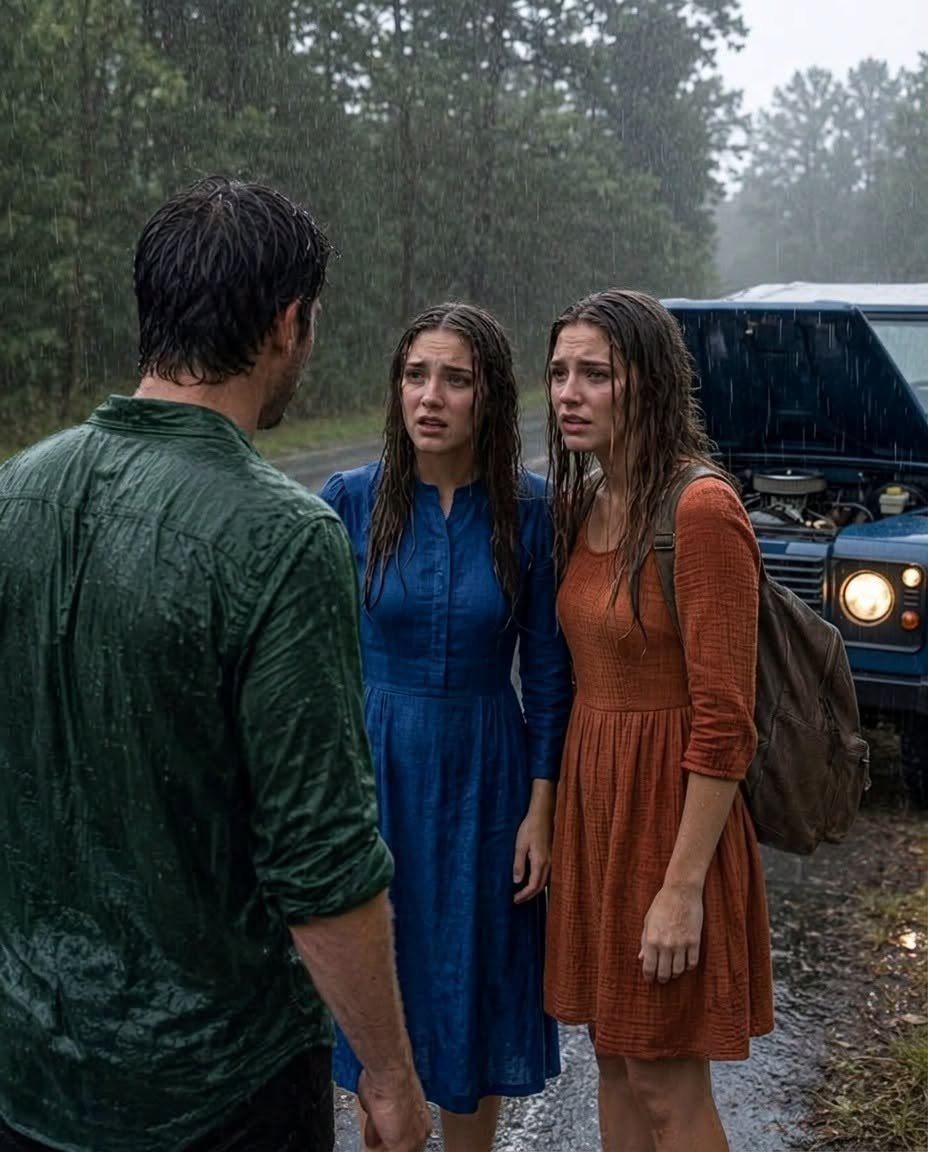
A black Mercedes sat half on the shoulder, hazard lights blinking weak and orange through the downpour. Two young women stood beside it, soaked to the skin, one of them waving at every car that passed. And every car passed. A pickup truck. An SUV. A man in a shiny Audi who swerved wide around a puddle and sent a wave of dirty water straight across their legs and kept going like they were traffic cones.
I drove by them too. Got maybe twenty feet past before I hit the brakes.
I sat there in the middle of the road with both hands on the wheel, arguing with myself. I had my own court papers riding on the passenger seat. I had maybe four hours of sleep waiting for me if I was lucky, and a hearing that could end everything I had built. I told myself I was not anybody’s hero, that somebody else would stop, that I did not have room in my week for one more problem that was not mine.
Then I looked in the rearview mirror and watched one of them wrap her arms around herself, shaking.
I cursed under my breath, threw the Honda into reverse, and backed up through the rain.
When I stepped out, the cold hit me like a slap. “Car trouble?” I shouted over the storm.
The blonde one turned first. Her mascara had run in long streaks down her face, but she was not crying, not exactly. She looked more furious than scared, and more scared than she wanted to let on. “It just died,” she called back. “We’ve been out here almost an hour. Our phones are dead. Nobody will stop.”
The other one stood a step behind her, arms wrapped around a soaked purse like it was the only solid thing left in the world. They had the same eyes, the same set to their jaw. Sisters, I figured, before either of them said a word.
“I’m Henry,” I said. “I’m a mechanic. Pop the hood.”
The blonde blinked at me like I had spoken a foreign language. “Seriously?”
“No,” I said. “I just enjoy standing in traffic during thunderstorms.”
That almost got a laugh out of her. Almost.
She popped the hood. I leaned in with a flashlight clenched between my teeth and found what I expected: corroded battery terminals, a loose connection made worse by the rain working its way into places it should not be. Not a disaster. Just not something two soaked twenty somethings were going to fix on the shoulder of a dark highway with no tools.
“This car isn’t moving tonight,” I told them.
The brunette swallowed hard. “Can you fix it?”
“At my shop, yes. Out here, in this? No.”
They looked at each other, some silent conversation passing between them the way it does between people who have known each other their whole lives. The blonde said, “We could call our dad.”
Then she stopped herself.
I caught the pause. “But what?”
The brunette gave a short laugh that had no humor anywhere in it. “He’s busy.”
“He’s always busy,” the blonde added, staring off at the wet highway like she had said that sentence a hundred times before and stopped expecting it to change anything.
I knew that particular tone. It was not spoiled kids complaining about a parent who would not drop everything for them. It was the sound of two people who had quietly stopped expecting to matter to somebody who was supposed to matter to them most.
“There’s a motel about fifteen minutes from here,” I said. “I’ll drive you. You can charge your phones, get dry, call a tow in the morning.”
They stared at me like I had offered them something rarer than it should have been.
“You’d really do that?” the blonde asked.
“I’m not leaving you standing on a highway in a thunderstorm.”
They grabbed their bags, locked up the Mercedes, and climbed into my Honda, which looked even sorrier with them inside it. Court filings on the floor mat. A toolbox wedged in the back seat. My diner apron balled up on the passenger seat, which the blonde had to move before she sat down.
“I’m Sophie,” she said, buckling in. “This is Maya. We’re twins.”
“Henry,” I said again.
“You already told us that,” Maya said quietly from the back.
“I’m tired.”
That one got a real laugh out of Sophie.
We drove in the rain for a while without talking. Then Sophie glanced over at my work shirt, the name patch, the grease worked permanently into the fabric. “You’re really a mechanic?”
“Last I checked.”
“You own a shop?”
“Lease one. Cole Auto Repair.”
Maya leaned forward between the seats. “You sound sad when you say that.”
I should have kept my mouth shut. But there is something about rain and darkness and strangers you will likely never see again that loosens a man’s tongue more than he intends.
“I’m being sued,” I said. “A development company bought my whole block. They want me gone, and I wouldn’t sign away my lease for nothing, so now they’re claiming I violated it.”
Sophie turned toward me. “Did you?”
“No.”
“Then how can they win?”
I laughed once, and it came out bitter in a way I did not love hearing out loud. “Because they have money.”
“That’s not fair,” Maya said softly.
“Fair costs money,” I told her. “People like me usually can’t afford it.”
The car went quiet except for the wipers. Then Sophie said, “Our dad works in law.”
I glanced over. “A lawyer?”
“No,” Maya said from the back seat. “A judge.”
I did not ask his name.
I want you to understand that. I did not ask, because it did not occur to me that it mattered, because at eleven o’clock on a rain soaked Friday night the last thing on my mind was the private lives of two strangers I had pulled off a highway shoulder. If I had asked, maybe I would have panicked at the coincidence sitting three days out. Maybe I would have said too much, or too little, or looked at them differently for the rest of the drive.
But I did not know. So I just drove them to the motel.
Under the awning, Sophie turned to me before opening her door. “Can we get your number? For the car tomorrow.”
I handed her one of my bent business cards, the corner creased from riding in my back pocket for months.
She read it out loud. “Henry Cole. Cole Auto Repair.”
Maya looked at me through the open back door. “Thank you for stopping.”
“It’s nothing,” I said, because that is what you say.
Sophie shook her head. “Good people always say that.”
Then she added something I did not understand the weight of until much later. “We want to see you again.”
They disappeared into the motel lobby, and I drove home soaked through, exhausted, and strangely wide awake. For the first time in weeks, maybe months, I felt like I had done one thing right in a life that had mostly felt like it was slipping out of my hands.
I had no idea that by Monday morning, those two girls would be sitting in a row reserved for family, directly behind the man who held my entire future in his.
Sunday, And A Business Card That Got Used
Sophie called the number on that bent card at nine the next morning.
End Part Here: The Mechanic Who Saved The Judge’s Daughters