
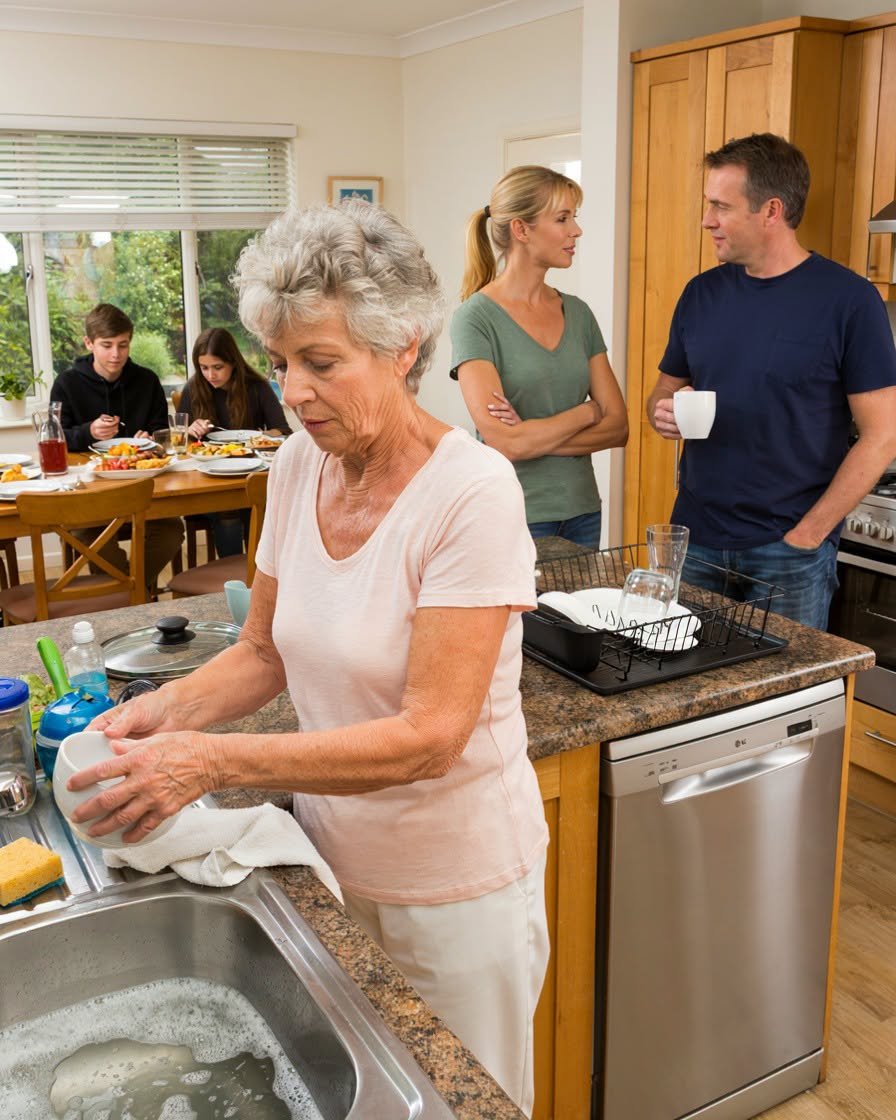
I shut the door and sat on the edge of the bed Walter and I had bought for our first apartment, my fingers finding the scratch on the footboard he had always meant to sand out and never got around to. My hands were shaking. Not from fear. From the fact that the last thread had finally, cleanly snapped.
That afternoon, once the house had emptied out, I went into the garage. The filing cabinet was nearly walled off behind a bin of Diane’s decorations, Craig’s golf shoes, a box of Madison’s old grade-school projects. Top drawer. Third folder back. Blue label. PROPERTY DOCUMENTS. Inside were the original closing papers from 1979, the mortgage payoff, the full deed history, Walter’s death certificate, and the survivorship filing that had transferred the house entirely, cleanly, into my name. Rosalind Anne Hartley. No Diane. No Craig. No misunderstanding. No favor. Just mine.
I drove to the copy shop and made copies of everything, then copies of the copies. One set in my safe deposit box, one in my purse, one into Louise’s hands, one beneath the spare tire in my trunk, because Walter always said redundancy is how careful people stay lucky.
Then I called Harold Bishop, who had retired from the firm three years earlier but whom retirement had done nothing to soften. “Harold, I need help. Legal advice, and discretion.”
His tone changed at once. “Then come now.”
He was still tall and white-haired and precise, still allergic to nonsense. His wife, Eleanor, opened the door before I had finished knocking, and her smile fell away the moment she saw me. “Oh, honey.” I hadn’t cried yet, not in the kitchen, not in the garage, not at the copy machine, but standing in her front hall I cried hard enough that she took the purse out of my hands and steered me into a chair.
Harold waited until I could speak. Then I told him everything, not in a rush, not with drama. I had spent too many years in law offices to confuse feelings with evidence. Dates, amounts, bills, the room changes, the dinner I’d eaten alone off a tray, the business mail addressed to Craig’s company. And the sentence. Lucky we even let you sleep here.
He took notes, and when I finished he set down his pen. “Do you want them out of the house,” he asked, “or do you want to be out of the house?”
The question went straight through me. “I thought those were the same.”
“They don’t have to be.”
“I don’t think I can live there anymore,” I said. It hurt to admit.
Harold nodded. “Then let’s get you free of that property. Safely, legally, cleanly. Every step done correctly. No angry texts. No threats. No conversations with them that don’t have a witness present. I’m not worried about you. I’m worried about them provoking you into a mistake.”
“They already provoked me.”
“Yes,” he said, and something almost like a smile touched his mouth. “But from here on, they don’t get the satisfaction of knowing it worked.”
Over the next week, we built the file. That was the part Diane never understood about power. She thought power was volume, a louder voice, a daughter saying “Mother, be reasonable” until the mother wore out and gave in. But real power is usually quiet. A certified letter. A property record. A dated photograph. A witness. A signature in blue ink.
I wrote out a timeline, pulled bank statements and utility bills, dug up checks I had written for repairs Craig had promised to split, and photographed the dining room buried under his paperwork. Louise signed a statement about what she had seen: the two trucks, Diane speaking as though she controlled the property, the way I had been pushed into the smallest room in my own house.
Harold also turned up that Craig had registered his consulting company at my address, using the business mail to make my home look like his professional base. “They got careless,” he said, “because it never once crossed their minds that you might push back.”
“People get careless,” I said, “when they’ve decided the other person is weak.”
He smiled at that. “I always did like working with you, Rosalind.”
Then came the second part. The sale. For several evenings I walked through the house alone after everyone had gone to bed, laying my hand on things the way you might touch a dying friend. The master bedroom, which I had not slept in for six months, cracked me wide open. Their laundry hamper stood in the exact spot where Walter’s oxygen machine had hummed through his final weeks. My husband had drawn his last breath there while I held his hand and whispered, “You can rest now, love. I’ve got everything from here.” Now my daughter kept a yoga mat rolled up in the corner. Standing in that doorway, I understood something almost shameful to admit. The house was already gone. The deed still carried my name, but the home Walter and I had built had been dismantled and renamed without my permission. I would not be selling my home. I would only be selling the shell they had left of it.
Harold put me in touch with a buyer named Daniel Cho, courteous and direct and younger than I’d expected, who came by on a morning when everyone was out and did me the courtesy of not pretending sentiment came without a price. “Your corner lot sits in a very desirable corridor. A recent zoning change has made it especially valuable. My client is prepared to move quickly. Three weeks, if the title is clean.”
“The title is clean.” Then he named a figure that made me sit down. A great deal of money, all cash, a fast close, no strangers filing through Walter’s workshop. I said I needed one night.
That evening I sat at the kitchen table with Walter’s photograph propped in front of me. “I’m sorry,” I whispered, though for what I could not have said. For selling the house. For letting them take it before I sold it. For finally needing to choose myself. The old house creaked around me, and I could almost see him across the table, still in his work shirt. He had been a gentle man, but never a foolish one. Roz, honey. You already know what to do.
The next morning I called Harold. “Accept the offer,” I said. He didn’t sound surprised.
The notice to vacate was delivered on a Thursday. I handed it over in the living room, because that room had once been the beating heart of the house, and I wanted them to feel the full distance between what they had assumed and what was true. Harold stood near the fireplace. Louise waited by the front door. Diane was sprawled on the couch, scrolling. Craig had his feet up, watching a ball game.
“I need you to read this,” I said, and handed Diane the envelope. “A formal notice to vacate. You have thirty days.”
She gave a short laugh with no humor in it, then read, and her face changed the way weather changes over the marsh. Confusion. Anger. Something like fear. “You hired a lawyer?”
Craig stood. “You can’t just kick us out. We live here.”
“You have been permitted to stay here temporarily. That permission has ended.”
“Permitted? We moved in to help you.”
“No,” I said. “You moved in because it benefited you, and you stayed because it benefited you more.”
Craig took a step forward, and Harold shifted his weight, calm and unmistakable. “Mr. Prentiss, I’d advise you not to escalate this.”
“And who exactly are you?”
“Harold Bishop. Mrs. Hartley’s attorney.” That word landed beautifully. Not a family friend. Not an old coworker. An attorney.
Diane looked back at the notice. “Where are we supposed to go? We have children.”
“You had children when you told me I was lucky to sleep in my own house.”
Her mouth opened, then closed. She remembered. Craig looked baffled, which told me she had never told him how deeply that sentence had cut.
“I was upset,” Diane said.
“You were honest.” For a moment I saw my little girl flicker behind her eyes. Then the grown woman returned. “You’re going to regret this.”
“I regret a great many things,” I told her. “This isn’t one of them.”
The thirty days that followed showed me every version of Diane except an accountable one. First came the tears. “Mother, I’m sorry. I’ve been so stressed. I just snapped.”
“I accept that you’re sorry you’re facing consequences.”
“That is not fair.”
“Neither was making me eat supper alone in my bedroom.” And there it was, the great pivot, the need to make my reaction the true crime. Then came the promises. Craig cornered me by the mailbox, offering rent he had never once thought to pay while he lived there. “Family doesn’t do this to each other,” he said. “Family doesn’t move into a widow’s home and call it help,” I answered. Then came the anger. Diane took to talking loudly on the phone about how “my mother just isn’t herself anymore,” how “the grief did something to her.” One afternoon I walked in mid-sentence. She froze. “Be careful,” I said quietly, “about telling people I’ve lost my mind simply because I stopped being convenient.” She did not make that particular call within my hearing again.
And then, hardest of all, came the grandchildren. Madison brought me tea one evening and lingered in my doorway. “Grandma, are we going to be homeless?”
The question struck me in the chest. “No, sweetheart. Your parents have jobs and savings and choices. You are not going to be homeless.”
“Mom says you hate us.”
“I could never hate you.” I patted the bed beside me, and she sat. “This is between me and your parents. You and your brother are loved. That hasn’t changed, and it never will.” She cried, softly, and I held her, because she was still my granddaughter and none of this was her fault. But after she left, I wrote the conversation down, because manipulation so often wears a child’s face when the adults have run out of arguments.
My son Michael called from out west after Diane got to him first, certain I was throwing them onto the street. So I told him everything. Michael didn’t interrupt once; he had his father’s patience. When I finished, he let out a long breath. “I had no idea. Do you need money? Do you want to come stay with us?” The fact that he asked that before he asked me to soften made me shut my eyes. “No, honey. For the first time in a very long time, I’m all right.” My youngest, Beth, needed far less convincing. She had seen Diane taking advantage; she just hadn’t known how bad it had gotten, and she was sorry she hadn’t checked on me more. It wasn’t an excuse, but it was human, and I forgave it easily.
As the deadline crept closer, I grew very busy in ways nobody in that house understood. I changed my mailing address, opened a new account at a different bank, scheduled the utility transfers, and arranged storage for the pieces that still mattered: Walter’s reading chair, his rolltop desk, the photo albums, the lumpy ornaments the children had made in grade school, back before they ever learned contempt. The movers came on a Wednesday, after Craig had left for work and Diane had gone to a salon appointment she called self-care.
That evening Diane stopped me in the hall. “Where’s Dad’s desk?”
“In storage. Because it belongs to me.”
Her eyes narrowed. “You’re really doing this. You’re tearing this whole family apart.”
“No, Diane,” I said. “I’m refusing to keep being the floor everyone else stands on.” She stared at me as though she had never heard that voice come out of me. Maybe she hadn’t. Maybe motherhood trains people to hear your service so clearly that they forget your own self makes any sound at all.
The deadline arrived. Nobody moved. Not a box. Not a suitcase. Craig came into the kitchen dressed for work, wearing the calm of an arrogant man who believes he’s found his leverage. “We’re not leaving. You can start whatever legal process you want. We’ll drag it out for months. You’re going to end up all alone, Rosalind.” There it was, the real threat under all the others. Not court, not legal fees, but loneliness, the one thing they were certain a widow feared badly enough to swallow anything.
I looked at him over the rim of my cup. “I’ve been alone in this house with four other people living in it. At least now the quiet will be honest.” He had no answer.
The closing came a few days later. Louise drove me to Harold’s office with two suitcases in her trunk. As we crossed the tall bridge over the river, the whole city looked lovely, all steeples and marsh, the kind of beauty that hides how much suffering goes on behind closed doors.
“I keep waiting to feel like a terrible mother,” I said.
Louise kept her eyes on the road. “And do you?”
“I feel like a mother who ran out of quiet places to bleed.” She reached over and squeezed my hand.
At the office, everything was ready. I signed my name twenty-three times. I counted. Each one loosened another knot in my chest. And then it was finished. The house on Chestnut Row no longer belonged to me. Daniel shook my hand. “My team takes possession this afternoon. The ownership notice goes up, the locks change, and we’ll give your family supervised access to remove their belongings.” He hesitated. “I know this is personal.”
“It stopped being personal,” I said, “the day they forgot I was a person.” Afterward, Harold and Eleanor took me to lunch. I ordered shrimp and grits because Walter had loved them, and because I needed to do something ordinary while my whole life shifted under my feet. Early that afternoon my phone began to ring. Diane, then Craig, then Diane again, then the texts. Something is happening at the house. There are men on the porch. Why is there a notice taped to the door? My hand trembled, but I did not pick up. Eleanor laid her hand over mine. “Breathe, honey,” she said.
A little later, Harold’s phone rang. He stepped toward the window, his voice perfectly level. “No, Mr. Prentiss. You do not own the property. Your wife does not own the property. And residing there temporarily did not transfer ownership to you.” He hung up and returned to his seat. “Well,” he said, unfolding his napkin. “They understand the locks, at least.” For the first time in months, I laughed. Not loudly, not happily, but honestly.
My voicemail filled up fast, fury giving way to panic. “Mom, please. You sold the house? You sold our home?” Our home. Then, her voice shaking, “Mom, where are you? Just tell me where you are.” And behind her, smaller than I had ever heard him, Craig: “She actually did it. She sold it right out from under us.” As if they hadn’t spent a year standing squarely on my back. Daniel allowed seventy-two hours of supervised access to clear out. For three days they carried boxes out of a house they had been certain would bend around them forever.
“Did Diane ask about me?” I asked Louise. She went quiet for half a second too long. “She looked angry,” she said gently. “Not ready.”
The old house stood empty by the end of the week. Within a month, construction fencing went up around the lot, and not long after, a demolition notice. When Louise called the day the porch came down, I sat by the window a long while afterward. A house is only wood and wire and plaster. I know that. But it is also birthday candles and Sunday coffee, the smell of rain in old floorboards, a husband laughing because the turkey came out dry again. It is where ordinary days add up into a whole life while nobody is paying attention. Letting go of that hurt more than I can say. But staying would have hurt far more.
I moved into my new condominium across the water a couple of weeks later. Two bedrooms, a balcony over the marsh. The first morning I woke there, I lay very still and listened. No Craig banging cabinets. No thump of Tyler’s music. No Diane sighing outside my door. Nobody informing me where my mugs belonged. Just quiet, and not the old grief-quiet that had pressed against my ears after Walter died. This quiet had air in it. Room to breathe.
I set Walter’s reading chair by the window and put his chipped bowling mug on the shelf, dent and all. I hung our wedding photo in the front hall, and I stood the little porch flag in a ceramic vase by the balcony door, because I could not bring myself to throw it away.
Beth was the first to visit, with takeout and grocery-store tulips because, she said, the place needed something alive in it. We sat on the balcony at sunset watching egrets pick their way through the marsh grass. “It’s beautiful, Mom,” she said.
“It feels like I can breathe again.”
Her eyes filled. “I hate that I didn’t see it sooner.”
“You saw exactly what your sister wanted you to see. I protected the idea of her,” I said. It was the most honest sentence I had spoken in years.
The gossip reached me the way it always does in a town this size, charming and merciless, and I suspect that stung Diane nearly as much as the house did. The grandchildren didn’t speak to me for a while. I sent birthday cards anyway. Madison returned one unopened, Tyler kept the money but never called. It hurt, but I did not chase them. Love offered from a place of desperation is only another kind of surrender.
Then, some months after the sale, Madison texted a single line. Did you really make Mom leave over one thing she said? I stared at the screen a long while, then wrote back. No, sweetheart. I asked your parents to leave because of how they treated me for more than a year. What your mother said that morning was only the moment I stopped pretending it was love. She didn’t answer until the next day. I didn’t know. That was all. But it was something.
By that fall I had built myself a life with edges and shape. Book club on Thursdays, water aerobics twice a week, lunch with Louise every Tuesday. Beth and her family came once a month, and Michael called every Sunday evening, asking about recipes he had ignored his whole childhood.
And Diane? Diane did not apologize. Not then. Not properly. What she did was send a Christmas card with only the names printed inside. No note. No “Mom.” Nothing in her own hand. I looked at it a good while, then put it in a drawer. Not the trash. Not the mantel. A drawer. That felt about right.
In January, nearly ten months after the sale, Diane called while I was walking out of the pharmacy. I sat in my car and let it ring twice before I answered.
“Mom?” She sounded older. Not softer, exactly. Just less sure of herself. “I heard Madison texted you. She said I made it sound like you just snapped over one sentence.” A pause. “I guess that wasn’t fair of me.”
There are apologies that arrive like flowers, and there are apologies that arrive like tax bills. This one was the second kind. “No,” I said. “It wasn’t.”
“I was under so much stress. Craig’s business was falling apart and we were scared, and that house felt like the only steady thing we had.”
“My house,” I said.
She went quiet. “Yes,” she said at last. “Your house.” It was the first true thing she had handed me in a long time.
“I loved you enough to share it with you,” I said. “You mistook that for permission to take it from me.”
She made a sound that wasn’t quite a sob. “I’m sorry.” And this time the words landed differently. Not enough to rebuild the bridge, but perhaps enough to mark the spot where it had once stood.
“Do you forgive me?”
There was the old Diane, reaching for the clean ending before she’d done the dirty work to earn it. “I’m not ready to answer that yet,” I said. She cried, quietly, and for once I did not rush to comfort her. She told me they were renting a smaller place now, out past the county line, Craig’s business hobbled by some licensing trouble that forced him to finally clean up paperwork he should have sorted years before. Ordinary consequences. Not ruin. Just the plain cost of standing on their own feet without my floor underneath them.
Before we hung up, Diane said, “I really didn’t think you’d actually do it.”
“I know,” I said. “That was always the problem.”
A full year has gone by now. The house on Chestnut Row is gone entirely, and in its place stands a bright new building with shops along the ground floor and apartments stacked above. Louise says there’s a coffee shop right about where my kitchen used to be, and she offered to take me there once. I said no. Not because I’m afraid to see it. Because not every part of the past deserves a visit.
My life is smaller now in square footage and larger in every way that counts. Nobody tells me which room to use. Nobody rearranges my mugs. Nobody uses the word help while quietly making off with my peace.
On Sunday mornings I fry bacon if I feel like bacon. I drink my coffee out of Walter’s chipped old mug. I sit by the window and watch the marsh turn to gold, though I’ve learned not to romanticize every sunrise. Some mornings my knees ache. Some mornings I miss my old fig tree something fierce. Some mornings I miss the daughter I raised so poorly that I press my hand to my chest and remind myself she isn’t gone. Just different. Just accountable now. Just farther away than I ever imagined a daughter of mine would be. But I am not disappearing anymore, and that matters more than most people understand.
When you get older, people start reaching for soft words to take hard things away from you. Concern. Safety. Help. Practical. Reasonable. They say these gentle words while they move your chair and claim your room and spend your money, and they call the whole business love, because love is a prettier word than control. I learned, late but not too late, that love without respect curdles into ownership. And I had already buried one good man. I was not about to bury myself while I was still breathing.
I am Rosalind Hartley, a widow and a mother and a grandmother, and a woman who signed every last paper in silence while the people who underestimated her kept right on sleeping beneath a roof they never owned a shingle of. They told me I was lucky they let me sleep there. So I sold the house. I transferred the bills into my own name. I changed my address. And I let the locks be changed without ever standing on that porch to explain myself to anyone.
And when they finally understood whose name had been on the deed the entire time, I was sitting at a quiet table downtown with a plate of shrimp and grits, my attorney at my side, and the first honest breath of freedom filling my lungs.
I lost a house. I did not lose my life. I took that back.