
THE MERCEDES MY GRANDFATHER BOUGHT ME
Part 1: The Truth in the Snow
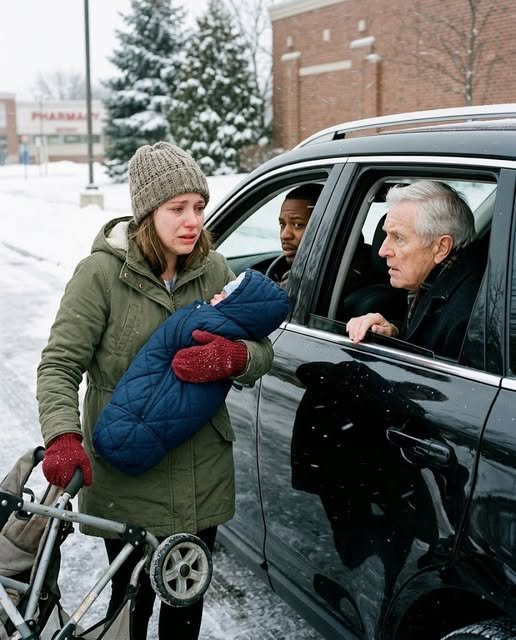
Snow burned my lungs as I stumbled along the icy sidewalk with my newborn daughter pressed against my chest.
My mother’s final message still glowed on my phone:
We’re broke. Stop asking.
The stroller beside me had one crooked wheel. I barely needed it for Lily, but it carried the diapers, wipes, formula, and the small pharmacy bag I was desperately trying to collect before the store closed because of the storm.
Then a black SUV slowed beside me.
It moved smoothly through the snow before stopping at the curb.
The passenger window lowered.
My grandfather looked out.
First, he saw me.
Then he saw Lily wrapped against my chest.
Finally, he noticed the broken stroller and my soaked shoes.
His entire expression changed.
“Emily,” he said sharply, “why aren’t you driving the Mercedes I bought you?”
I should have lied.
I should have told him the car was being repaired.
I should have repeated the excuse my parents had forced me to use for months.
But the cold had stripped away every layer of pride I had left.
I was exhausted, sleep-deprived, humiliated, and still grieving the life I thought I would have with my husband.
I could not carry another lie.
“My sister has it,” I whispered.
Grandpa Howard’s face went still.
He looked at the driver.
“Marcus, take us to the police station.”
That was how the truth began.
Five months earlier, my husband Daniel had died from cancer.
He never got to meet Lily.
When Daniel first became ill, my parents stepped forward before I even asked for help.
My mother handled the paperwork.
My father answered phone calls and spoke with the insurance company.
They told me not to worry about money because Grandpa Howard had created a trust for me. They said the inheritance distributions and medical reimbursement fund would cover whatever insurance did not.
I believed them.
Then Daniel died, and everything changed.
Hospital bills began arriving.
My mother sat at my kitchen table with envelopes spread in front of her and told me the situation was far worse than expected.
“Your grandfather’s money isn’t available right now,” my father explained. “Most of it isn’t liquid.”
My mother sighed.
“You’ll have to learn to live more simply. Life doesn’t owe anyone luxury.”
I stared at her.
Luxury was not the word I would have used for Daniel’s medication or hospice care.
But grief makes people easy to control.
I was recovering from childbirth, waking every ninety minutes to feed Lily, and trying not to cry while packing Daniel’s clothes into donation boxes.
When my parents offered to manage my finances, I allowed them.
When they said documents were delayed, I believed them.
When they said Grandpa was becoming confused with age, I believed that too.
Their control did not happen all at once.
That was what made it so effective.
First, they redirected my mail so I would not be “stressed” by bills.
Then they convinced me to leave my townhouse because the expenses were supposedly too high.
They moved Lily and me into a cheap rental apartment with an unreliable furnace and black mold behind the bedroom wall.
When I sent my mother photographs of the mold, she responded with a lecture about resilience.
Then the Mercedes disappeared.
Grandpa had given the car to Daniel and me after our wedding.
My younger sister, Ava, arrived one afternoon wearing oversized sunglasses and holding a new set of keys.
“Mom said you weren’t using it,” she told me.
“You took my car?”
She shrugged.
“It makes more sense for someone with a social life to use it. You’re not going anywhere with a newborn and no money.”
When I called my mother crying, she became offended by my tone.
She said the registration had been temporarily transferred for insurance purposes.
Then she told me I should be grateful that the family was “absorbing my burdens.”
That phrase stayed with me.
Absorbing my burdens.
As though my daughter and I were unwanted debris.
My mother also made contacting Grandpa Howard seem impossible.
“Your grandfather doesn’t need more stress,” she warned me.
“He signs anything your uncle puts in front of him these days.”
“You don’t want to confuse him with problems you don’t fully understand.”
I had loved my parents long enough to walk carefully through every lie they created.
Then Lily developed a fever during the worst snowstorm of the winter.
By morning, I had almost no formula left.
The buses were delayed, so I bundled Lily in several layers, placed our supplies in an old stroller from the church basement, and started walking toward the pharmacy.
By the time Grandpa’s SUV found me, my shoes and socks were soaked.
Marcus helped me into the back seat.
He adjusted the warm air away from Lily’s face without being asked.
Grandpa removed his coat and placed it over my knees.
For nearly a minute, no one spoke.
Then he asked quietly:
“What do you mean Ava has your Mercedes?”
The truth came out before I could stop it.
I told him about the bills.
The townhouse.
The moldy apartment.
The missing trust distributions.
The messages telling me the family was broke.
The car.
The warnings not to contact him.
I told him that Ava drove my Mercedes to restaurants while I pushed Lily through a snowstorm to buy formula.
Grandpa did not interrupt.
He listened with one hand resting flat against the polished wooden panel of the door.
His face became dangerously calm.
At a traffic light, he called his attorney.
“Sandra,” he said, “I need every trust distribution, title transfer, emergency medical reimbursement, and financial authorization connected to Emily’s accounts for the last eighteen months.”
He paused.
“No, I’m not at the office. I’m sitting beside my granddaughter, who has apparently been told she has no money while walking through a blizzard with my great-granddaughter.”
He listened again.
“Yes,” he replied. “It is that kind of emergency.”
After ending the call, he looked at me.
“Did you sign anything?”
I swallowed.
“My mother brought documents to the hospital while Daniel was receiving treatment. She said they were for insurance coordination and temporary account access.”
“How many?”
“Six or eight. I don’t remember.”
“Did you read them?”
My silence answered him.
Grandpa closed his eyes briefly.
Then he instructed Marcus to continue toward the police station.
He wanted me somewhere warm.
But he also knew that if fraud had occurred, every document needed to be preserved properly.
Inside the station, an officer found a warm blanket for Lily and water for me.
Grandpa requested a private conference room.
Twenty minutes later, Sandra arrived carrying a laptop and a leather file case.
Her expression told me the truth would be worse than any of us expected.
Part 2: The Accounts They Emptied
I sat at the end of the conference table with Lily sleeping in my arms.
Sandra opened the trust portal.
“There have been regular distributions,” she said cautiously.
Grandpa turned toward her.
“To Emily?”
“They were originally scheduled for Emily,” Sandra replied. “But thirteen months ago, they were redirected to a managed household-support account under temporary family fiduciary supervision.”
I stared at her.
“What does that mean?”
Sandra clicked through several documents.
“It means someone submitted an authorization appointing your mother as financial caretaker over your trust distributions during a period described as emotional distress and medical instability.”
“I never agreed to that.”
“There is a notarized authorization.”
My mouth went dry.
The hospital documents.
Grandpa’s voice became colder.
“Show me the signature.”
Sandra turned the laptop.
The signature looked like mine.
But not exactly.
The letters leaned in the wrong direction, and the first letter of my name was far more elaborate than anything I had ever written.
It was close enough to fool a quick review.
But not close enough to fool me.
Sandra opened the transaction history.
Money had been removed month after month.
Each withdrawal carried a professional-sounding description:
Housing support.
Vehicle adjustment.
Lifestyle stabilization.
Household reimbursement.
Emergency family bridge transfer.
Nearly every transfer went into an account connected to my parents’ limited-liability company.
Other payments went directly to luxury businesses.
Sandra pointed toward one line.
“Vehicle adjustment. Forty-eight thousand nine hundred dollars.”
Grandpa looked at me.
“That was the Mercedes.”
I felt cold again despite the heated room.
“There’s more,” Sandra said.
She opened the records from Daniel’s medical reimbursement fund.
Grandpa had created the account privately when Daniel began cancer treatment.
It had been intended for medication, transportation, home care, and other costs not covered by insurance.
The account was nearly empty.
Ten thousand dollars had been removed here.
Six thousand there.
Twelve thousand was labeled as palliative transportation.
Other payments went to a contractor, a luxury furniture store, and a resort.
During the same month my mother told me the family could not afford diapers, she had used four thousand dollars from Daniel’s treatment fund at a spa in Arizona.
My hands began shaking.
Lily stirred against my chest.
Grandpa pushed his chair backward and stood.
He did not shout.
That frightened me more than shouting would have.
“Call them,” he told Sandra.
“Now?”
“Now.”
My father answered first on speakerphone.
He sounded irritated.
“Howard, this had better be urgent.”
Grandpa’s voice remained calm.
“Come to North District Station. Bring your wife and Ava. Bring every card, key, and document connected to Emily’s finances.”
My father laughed.
“What is this about?”
“It is your opportunity to explain everything before possible felony charges make explanations more difficult.”
The call ended.
No one moved for several seconds.
Then my mother began calling me.
I let the first call ring.
She immediately called again.
Grandpa held out his hand.
“Put her on speaker.”
The moment I answered, my mother’s voice filled the room.
“Emily, what have you done?”
I almost laughed.
“What have I done?”
“You involved your grandfather without understanding the situation. You’re exhausted and emotional. You always misunderstand things when you’re overwhelmed.”
Grandpa leaned closer to the phone.
“Come repeat that in front of the financial records, Linda.”
My mother stopped speaking.
Then she recovered.
“Howard, she is manipulating you. We sacrificed everything to keep Emily and her child afloat. She has no idea how expensive her life has become.”
Sandra turned the laptop toward Grandpa.
One highlighted transaction followed another.
Designer purchases.
Resort stays.
Ava’s condominium deposit.
A transfer labeled educational advancement that had paid for Ava’s destination engagement photographs.
My grief began changing into anger.
“Did you take money from Daniel’s treatment account?” I asked.
My mother did not answer.
That silence told me everything.
They arrived forty-three minutes later.
My father entered first wearing an expensive camel-colored coat.
My mother followed, dressed in gloves she had once claimed were too old to donate.
Ava came last, carrying a handbag worth more than several months of my rent.
When she saw Lily and me sitting inside the police station, her expression changed.
She did not look ashamed of what had happened.
She looked embarrassed that the setting made the family look bad.
My father immediately took control of the conversation.
“This situation has been blown wildly out of proportion.”
Grandpa remained seated.
“Then put it into proportion for me.”
Sandra arranged the documents across the table.
The false fiduciary authorization.
The forged signature.
The diverted trust payments.
The Mercedes title transfer.
The money removed from Daniel’s medical fund.
The payments into family accounts.
The luxury purchases.
The records formed a wall between my parents and their lies.
My mother spoke first.
“We transferred the money to protect Emily from herself. She was grieving and incapable of functioning.”
I stared at her.
“I was nursing a newborn while planning my husband’s funeral.”
She lifted her chin.
“Exactly.”
Something in Grandpa’s expression hardened.
My father began using financial language to make theft sound strategic.
Temporary financial control.
Asset preservation.
Tax-sensitive redistribution.
Risk management.
It might have convinced someone else.
But Grandpa had spent decades protecting his money and recognizing manipulation.
“Did Emily consent?” he asked.
“She signed.”
“Did she understand what she was signing?”
“She trusted us.”
“That is not the same answer.”
Ava crossed her arms.
“Can everyone stop acting as though I stole a car? Mom said Emily couldn’t afford the insurance and would lose it anyway. I was helping.”
I looked at her carefully.
Her polished boots.
Her diamond bracelet.
Her perfect hair.
Nothing about my car had ever looked like charity on her.
“Did you know they told me there was no money?” I asked.
Ava hesitated.
It lasted less than a second.
But I saw it.
“You knew.”
“I knew the finances were complicated.”
Grandpa turned toward Sandra.
“Is there enough here for a criminal referral?”
“Yes,” Sandra replied.
The confidence immediately drained from my father’s face.
Then from my mother’s.
My mother sat down as though her knees had weakened.
Ava looked at our parents instead of me.
That told me where her loyalty had always been.
Then my mother began crying.
She spoke about sacrifice, family, responsibility, and misunderstandings.
She even claimed they had been trying to create stability after Daniel’s death.
I had imagined that when the truth was finally exposed, they would show shame.
Perhaps remorse.
Instead, they thought only about protecting themselves.
“Did you take the money because you thought I was too weak to stop you?” I asked. “Or because you believed I would never discover it?”
My mother looked at me through her tears.
Then she said the cruelest words I had ever heard from her.
“You would have wasted it on him anyway.”
The room became so silent that I could hear the overhead lights buzzing.
Him.
Not Daniel.
Not my husband.
Not Lily’s father.
Just him.
As though the man I loved had been a reckless expense instead of a dying human being.
Grandpa stood so quickly that his chair scraped across the floor.
“You’re finished,” he said.
He did not shout.
He pronounced judgment.