
Part 3: What They Really Stole
Grandpa instructed Sandra to file emergency reversals on every possible transaction.
He ordered every account connected to the false authorization frozen.
He demanded civil action to recover the money.
He requested an immediate criminal referral.
Then he told Marcus to recover the Mercedes.
Ava’s access to the family’s leased vehicles was canceled before she left the room.
Grandpa asked the officer to begin taking a formal report immediately.
My father began protesting.
He threatened lawsuits, public embarrassment, and family destruction.
Grandpa looked him directly in the eyes.
“You destroyed this family when you stole from a widow and her child.”
My father had no answer.
The legal process continued for weeks, but the decisive moment occurred inside that police conference room.
The forged authorization was challenged and suspended.
Funds still sitting in connected accounts were frozen.
The vehicle transfer was flagged.
My parents left the station separately.
Even while everything collapsed, they found time to blame each other.
Within ten days, I regained legal control of my trust distributions.
Within three weeks, a portion of Daniel’s medical fund had been recovered.
Grandpa moved Lily and me into the guesthouse behind his home while I decided what to do next.
On our first evening there, he had a crib delivered.
He stood awkwardly in the doorway while two workers assembled it, as though he were trying to repair months of betrayal with wood, screws, and clean blankets.
He could not undo what had happened.
But he stayed.
He held Lily while I slept during the afternoon.
He filled the freezer with meals.
He sat beside me at the kitchen table while I relearned how to open my own mail without fear.
When the Mercedes was finally returned, it was clean and filled with fuel.
I stood in the driveway and cried until I had to sit on the porch steps.
I was not crying because I valued the car so deeply.
I cried because its return proved I had not imagined what happened.
My parents had taken it.
They had taken my money.
They had taken Daniel’s treatment funds.
They had moved Lily and me into an unsafe apartment while using my trust to pay for vacations, furniture, and Ava’s lifestyle.
The Mercedes was simply the first thing returned.
Ava sent two messages during the following month.
The first said she had never known the entire story.
The second said she was sorry for “how everything looked.”
I did not answer.
My mother sent a handwritten letter asking for forgiveness.
It was six pages long.
It contained excuses, grief, explanations, and reminders that she was still my mother.
It did not contain one complete apology.
My father sent nothing.
By spring, the legal case had become the kind of family scandal relatives discussed quietly at expensive restaurants.
Some said my parents had crossed an unforgivable line.
Others claimed grief had caused everyone to act irrationally and that family problems should have remained private.
That season taught me an ugly truth:
Many people can look directly at theft and still ask whether exposing it was too cruel.
Lily celebrated her first birthday beneath white lights in Grandpa’s backyard.
She toddled between folding chairs with cake covering both hands.
People who had failed to protect me suddenly called me strong.
Grandpa watched Lily with tears in his eyes that he claimed were caused by allergies.
When she fell laughing into my lap, I looked at her and felt complete certainty.
The money mattered.
The betrayal mattered more.
But the deepest wound could not be measured in dollars.
After Daniel died, my family should have wrapped themselves around Lily and me.
Instead, they reached into the darkest moment of my life and took whatever they could carry.
I still remember my mother’s face inside the police station.
Not the regret.
There was none.
I remember the panic that appeared when she realized she no longer controlled the story.
I think about how concern can disguise possession.
How help can become a locked door when the wrong person holds the key.
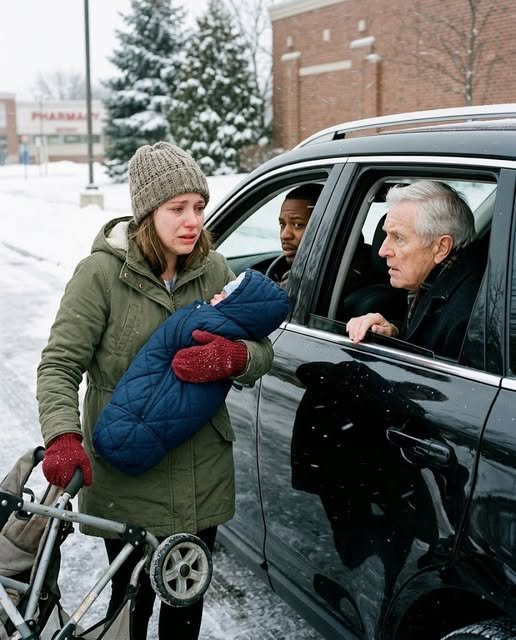
Grandpa believes that our chance meeting during the snowstorm saved me.
But I know that is not completely true.
What saved me was the moment I finally stopped repeating the lie.
When he asked about the Mercedes, I could have protected my parents again.
I could have said the car was being repaired.
I could have pretended the cold apartment was temporary.
I could have hidden my empty accounts, my soaked shoes, and the shame they had taught me to carry.
Instead, I told the truth.
And once the truth was spoken, everything they had built began collapsing.
Even now, people disagree about what should happen next.
Some say blood should earn forgiveness because part of the money was returned.
Others say the real theft was never about the trust, the car, or Daniel’s medical account.
The real theft was the winter morning when a grieving young mother believed she had been left with nothing—because the people she trusted most had worked carefully to make her believe it.
My parents stole money.
They stole security.
They stole the final months I should have spent focused only on my dying husband.
But they did not steal everything.
I still had my voice.
I still had my daughter.
And on a frozen road with snow filling my shoes, I finally told the truth loudly enough for someone to hear it.
That was the moment my life began returning to me.
THE END