
Part 1: Eight Words That Changed Everything
My name is Abigail Martin. I’m thirty-two years old, and last year my parents sent me a text that shattered my holiday plans in eight simple words:
We think it would be best if you skip Thanksgiving.
Then came another message, polite and cold:
We need some space.
I was standing in the kitchen of my newly purchased farmhouse in Vermont, slicing apples for a pie. Warm sunlight stretched across the counter, and outside the window, the bare branches of my small orchard swayed in the November wind.
I read the message once.
Then twice.
Then a third time.
I kept hoping the words would somehow change—that I had misunderstood them or that my parents had made some terrible mistake.
But the message remained the same.
For fifteen years, I had been the dependable daughter. I earned excellent grades, remembered every birthday, attended every family gathering, and rarely caused trouble. My mother often introduced me as her “beautiful, responsible daughter,” as though my worth could be summarized by my appearance and willingness to cooperate.
My parents, Eleanor and James Martin, owned a successful insurance agency in suburban Connecticut. They valued tradition, appearances, and what they called a respectable life.
My younger brother, David, fit their expectations perfectly.
He earned an accounting degree, found a stable job, married Pamela—the daughter of one of my father’s golf friends—and bought a house fifteen minutes away from our parents. Then he gave them their first grandchild, Thomas.
I had chosen a different path.
Since childhood, I had dreamed of becoming a chef. The kitchen was the one place where I felt free to create something that belonged entirely to me.
When I told my parents I wanted to attend culinary school, my mother frowned.
“Cooking is a hobby, Abby,” she said. “It isn’t a real career.”
My father was gentler, but his message was the same.
“Restaurants are difficult,” he warned. “People who have better choices usually don’t work in them.”
I enrolled in the Culinary Institute of America anyway.
I worked in demanding New York kitchens, slowly climbed the ranks, and eventually became the executive chef of a respected farm-to-table restaurant. Later, I created a cooking channel that unexpectedly became successful. My first cookbook became a bestseller, and strangers began recognizing me in grocery stores.
Still, no matter how much I achieved, I continued trying to earn my parents’ complete approval.
I drove hours for Sunday dinners. I called my mother almost every day. I planned birthdays, anniversaries, Christmas meals, and every Thanksgiving menu.
Thanksgiving was especially important.
My mother claimed she was “passing the torch,” which usually meant I cooked most of the meal while she stood nearby correcting everything I did.
My father insisted on his traditional oyster stuffing.
My mother complained about the amount of garlic I used.
My role was to smile, swallow my frustration, and keep everyone happy.
Then, at thirty-one, I bought my dream home—a farmhouse on five acres in rural Vermont. It had a large kitchen, a vegetable garden, and a small apple orchard.
My parents were not impressed.
“Vermont is so isolated,” my mother complained.
What she really meant was that I had moved farther away from her.
After the move, I called less often. I missed one Sunday dinner because my basement flooded, and my mother reacted as though I had betrayed the family.
Meanwhile, David and Pamela remained nearby. Pamela was expecting their second child, and my mother constantly reminded me how wonderful it was to have family living close.
Even then, I never imagined they would exclude me from Thanksgiving.
I called my mother immediately after receiving the message.
She answered with a voice that sounded far too cheerful.
“Abby, dear! How are you?”
“Mom, I received your text. What is going on?”
She paused.
“We’re fine. We simply want something smaller and more intimate this year.”
“But Thanksgiving is our tradition,” I said. “I already requested time off.”
“Well, you live so far away now,” she replied. “We thought we’d save you the trouble.”
My stomach tightened.
“Who will be there?”
“Just your father, David, Pamela, and Thomas,” she said. “Pamela isn’t feeling well because of the pregnancy. A quiet family dinner would be better.”
A quiet family dinner.
With the entire family except me.
“So this isn’t about having fewer people,” I said. “It’s about not wanting me there.”
“Don’t turn this into something it isn’t,” my mother snapped. “You’ve been pulling away since you moved. We need space.”
Then my father came onto the phone.
“It’s only one Thanksgiving, Abby,” he said dismissively. “Don’t make it into a major problem. We’ll see you at Christmas.”
After the call ended, I sat on my kitchen floor and cried.
I cried for every mile I had driven, every holiday I had organized, and every time I had ignored my own feelings to make my parents happy.
When the tears finally stopped, I looked around my beautiful farmhouse kitchen and realized something.
I had built a life I loved.
Why was I still begging for permission to enjoy it?
I stood, wiped my face, and typed a reply.
Have a lovely, quiet Thanksgiving.
Then I pressed send.
My parents had asked for space.
They had no idea I was about to fill mine with people who genuinely wanted me there.
Part 2: Creating My Own Table
After sending the message, I grabbed a pint of Rocky Road ice cream and sat on my couch.
For ten minutes, I allowed myself to feel completely miserable.
Then my phone rang.
It was Sarah, my best friend from culinary school. She lived in Boston and had a gift for telling the truth without softening it.
“You sound like you were hit by a truck,” she said as soon as I answered.
“My parents uninvited me from Thanksgiving.”
There was a moment of stunned silence.
“What do you mean they uninvited you?”
I told her everything—the text, the phone call, the request for space, and the small family dinner that included everyone except me.
When I finished, Sarah sounded furious.
“That is cruel,” she said. “Who tells their own daughter not to come to Thanksgiving?”
“Maybe they’re right,” I said weakly. “I have been calling less. Maybe I haven’t been a good daughter.”
“Stop,” Sarah replied firmly. “You have spent your entire life bending over backward for them. You moved somewhere that makes you happy, and now they’re punishing you for becoming independent.”
Her words cleared some of the guilt from my mind.
Then her voice brightened.
“Host your own Thanksgiving.”
I laughed bitterly. “A Thanksgiving dinner for one?”
“Not for one,” she said. “Invite friends. Invite anyone who doesn’t have plans. You own a farmhouse, and you are a professional chef. You could host the best Friendsgiving in Vermont.”
The idea landed like a spark.
I looked toward my large dining room, which I had barely used because I was always driving back to Connecticut for family gatherings.
I imagined it filled with laughter, candles, food, and people who didn’t criticize every decision I made.
By the time Sarah ended the call, I was already scrolling through my contacts.
I invited Miguel, my former sous chef who had recently moved to Burlington. I contacted Jasmine and Tyler, a couple who owned a small local vineyard. I called Frank, my elderly neighbor and a widower who had welcomed me to Vermont with homemade jam.
I also contacted former colleagues, friends from culinary school, and people who had casually mentioned that they had nowhere special to go for the holiday.
My message was simple:
I’m hosting Friendsgiving at my Vermont farmhouse. Good food, good company, and no drama. Anyone without plans is welcome.
I sent it to fifteen people and expected five replies.
My phone began buzzing almost immediately.
Miguel responded first.
I’m coming. I’ll bring my knives and a ridiculous amount of butter.
Jasmine and Tyler promised wine and decorations.
Frank called me.
“Holidays become very quiet when you’re alone,” he said softly. “I’d be honored to join you.”
By the following morning, twelve guests had confirmed. Several asked whether they could bring friends or partners.
I said yes to everyone.
What began as a desperate alternative slowly became something exciting.
I planned the meal with the same focus I used for a restaurant opening.
The menu included a heritage turkey soaked in cider brine, cornbread stuffing with local sausage and mushrooms, maple-roasted vegetables, creamy garlic mashed potatoes, homemade rolls, and three desserts.
I would make an apple pie using apples from my orchard, a maple pecan pie, and a cranberry curd tart that looked like stained glass.
I ordered ingredients from local farms. I found a twenty-three-pound turkey that had never been frozen. I borrowed folding tables, purchased extra chairs, and found a long antique farmhouse table that could seat sixteen people if everyone sat close together.
Every choice was mine.
There would be no arguments about oyster stuffing.
No criticism about my garlic.
No one standing behind me telling me how I should cook.
I posted a photograph of my dining room on my personal social media page.
I cannot wait to fill this table with friends, old and new.
The response was overwhelming.
A food stylist offered to help decorate. A wine distributor sent bottles to pair with the meal. Friends shared the invitation with people who might otherwise spend the holiday alone.
One week before Thanksgiving, my guest list had grown to twenty-two.
Standing in my kitchen surrounded by recipes, schedules, and boxes of ingredients, I realized something that surprised me.
If my parents had not rejected me, I would never have created this.
They wanted space.
I was about to fill that space with people who chose me.
Part 3: A Thanksgiving Built by Choice
The Monday before Thanksgiving, my mother sent another message.
Just checking that you’re comfortable with the arrangements. Have you made other plans?
It sounded like concern, but I knew what she really wanted.
She wanted reassurance that I wasn’t angry. She wanted to believe that excluding me had caused no damage.
I replied with the same words I had used before.
Have a lovely, quiet Thanksgiving.
I did not tell her about my gathering.
The next two days were filled with preparation.
Sarah arrived from Boston on Tuesday evening with several bags, a bottle of wine, and a detailed plan. Together, we made cranberry sauce, prepared pie dough, chopped vegetables, and placed the turkey in its cider brine.
Halfway through making a pie, Sarah looked at me.
“Are you still hurt?”
“Yes,” I admitted. “But I’m also grateful. Without what they did, I never would have created something that feels this good.”
“Their loss,” she said.
On Wednesday, the farmhouse became even busier.
Frank arrived to help carry in the enormous turkey. Miguel came with his boyfriend, Luis, and enough cooking equipment to operate a small restaurant. Jasmine and Tyler brought wine, candles, miniature pumpkins, and handmade decorations.
By the afternoon, my home smelled of citrus, herbs, butter, and anticipation.
It did not smell like tension.
That evening, while everyone ate pizza around the kitchen island, my phone rang.
It was Aunt Catherine, my mother’s sister.
“Your mother told me you decided not to attend Thanksgiving,” she said. “She claimed you were too busy with work.”
I stepped onto the porch and told her the truth.
When I finished, she sighed.
“I suspected something was wrong,” she said. “Your mother has always been controlling, but this is unacceptable.”
“I don’t want to create drama,” I replied.
“Well,” Aunt Catherine said, “perhaps I do.”
I laughed despite myself.
Then she asked, “Is there room at your table for one more?”
“You would come?”
“Absolutely. I would rather spend Thanksgiving with you than sit through another dinner where everyone pretends the family is perfect.”
My eyes filled with tears.
“There is always room for you.”
Thanksgiving morning, I woke before sunrise.
Sarah was sleeping upstairs. Miguel and Luis were on air mattresses in my office. Frank had stayed in the guest room because he did not like driving at night.
I made coffee and began preparing the turkey.
Cooking has always been my language. When emotions become confusing, recipes still make sense. Ingredients follow rules. Heat transforms things honestly.
By eleven o’clock, guests began arriving.
They brought rolls, wine, desserts, flowers, photographs, and stories.
My dining room filled with mismatched chairs, benches, folding tables, and quilts placed over hay bales for extra seating. It was not elegant in the way my mother would have demanded.
It was better.
It was warm, imperfect, and alive.
Aunt Catherine arrived with flowers and a bottle of expensive bourbon.
“Your mother has no idea what she is missing,” she whispered as she hugged me.
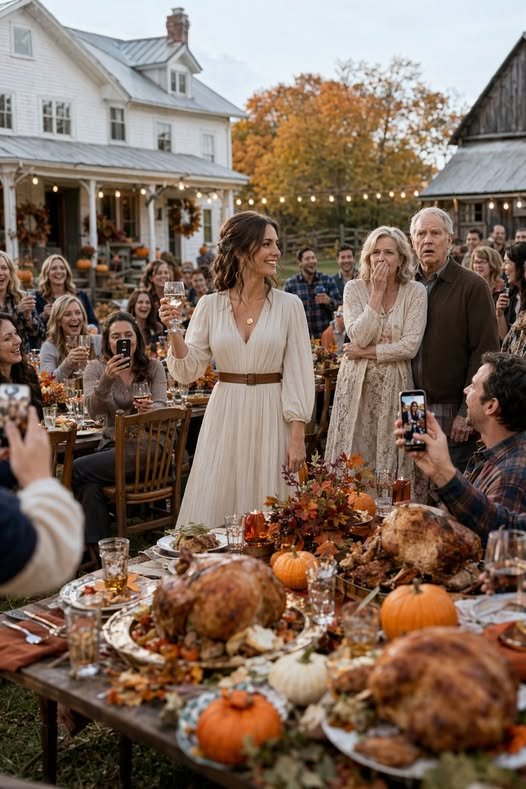
By two o’clock, twenty-six people had gathered inside my farmhouse.
Before we began eating, I stood at the head of the table.
“A month ago, I expected to continue traditions that were never truly mine,” I said. “Instead, I’m surrounded by people who are here because they want to be. That means more to me than I can explain.”
Aunt Catherine raised her glass.
“To chosen family.”
“To chosen family,” everyone repeated.
We ate, laughed, told stories, and passed plates until the table looked like abundance itself.
For the first time in my adult life, Thanksgiving did not feel like a performance I had to survive.
It felt like something I had created.
Part 4: Their Regret Arrived Quickly
After dinner, the celebration continued late into the night.
Some guests washed dishes while others gathered around the fireplace. Miguel attempted to teach salsa dancing after several glasses of wine. Frank shared stories from his fifty years as a teacher, and Aunt Catherine entertained everyone with embarrassing stories from my childhood.
People took photographs of the turkey, the pies, and the entire group standing together on the porch.
Jasmine posted one photograph online with the caption:
Best Thanksgiving ever.
I did not think much about it.
For once, my parents were not at the center of my thoughts.
The following morning, I woke to sunlight streaming across a house filled with evidence of happiness—empty bottles, stacked dishes, blankets, and sleeping guests.
We made breakfast from the leftovers and gathered around the kitchen island.
Then I checked my phone.
There were thirty-seven messages and twelve missed calls.
One message from David stood out.
Mom is having a complete meltdown about your Thanksgiving party. Call her immediately.
Below it were messages from my mother.
We need to talk.
Call me now.
Apparently, someone had shared Jasmine’s photograph with David. From there, it reached my parents and several of their friends.
My phone rang again.
“You don’t have to answer,” Sarah said.
“I think I do.”
I placed the call on speaker.
“Hello, Mom.”
“Abigail Jean Martin,” my mother said sharply. “Would you like to explain the photographs I’m looking at?”
She sounded as though I had betrayed her.
“You told us you were fine spending Thanksgiving quietly,” she continued. “Instead, you hosted an enormous party.”
“I never said I would spend it alone,” I replied. “I said I hoped you had a lovely, quiet Thanksgiving.”
“Don’t play word games with me. You invited Aunt Catherine, posted everything online, and embarrassed us.”
“How did hosting friends in my own home embarrass you?”
“Our friends are asking why we weren’t invited,” she snapped. “What are we supposed to tell them? That our own daughter excluded us?”
The irony was almost unbelievable.
“You told me not to attend your Thanksgiving,” I reminded her. “You said you needed space.”
“We wanted a small family meal,” she argued. “That didn’t mean you should host an elaborate dinner for strangers instead of your own parents.”
“If you were hurt,” she added, “you should have told us.”
My old instinct appeared immediately.
I wanted to calm her, apologize, and accept responsibility for the consequences of her decision.
But my friends were standing nearby, listening.
For once, I did not bend.
“You specifically told me to skip Thanksgiving,” I said. “The small family gathering included David, Pamela, and Thomas, but not me. I respected your request, even though it hurt. Then I created plans of my own.”
My father took the phone.
“Several people saw those pictures,” he said. “Do you understand how this makes us look?”
There it was.
They were not concerned about how I had felt.
They were concerned about how they looked.
“I’m sorry you feel embarrassed,” I replied. “But you excluded me. I found another way to celebrate.”
“If you were hosting such an event, you should have invited us,” he said.
I stared at the wall.
“You told me not to come to your Thanksgiving because you needed space,” I said slowly. “Now you’re angry because I didn’t invite you to mine?”
“Don’t use that tone with me.”
“What tone would you prefer? The one where I apologize for something that isn’t my fault? I’ve used that tone for years, Dad. I’m tired of it.”
There was a long silence.
“Perhaps we really do need space,” he said coldly.
“Perhaps we do,” I replied.
Then I ended the call.
My brother contacted me later, claiming he wanted to make peace.
“Couldn’t you have gone along with their decision for one year?” he asked. “You know how Mom and Dad are.”
“Why am I always expected to accommodate them?” I asked. “Why didn’t you defend me when they excluded me?”
David had no answer.
He had always benefited from the family dynamic. Challenging it would have required him to surrender his comfortable position.
Over the next few days, my mother sent messages filled with anger, guilt, and denial.
She accused me of disrespecting them.
She reminded me of everything they had supposedly done for me.
Then she claimed it had only been one holiday and that I was overreacting.
For the first time, I responded without apologizing.
They told me to skip Thanksgiving.
They wanted space.
They received it.
They simply had not expected to notice how empty that space would feel.