
Part 1: The Bus Driver I Was Ready to Fire
I was about to fire our oldest school bus driver for making the entire elementary school late almost every morning.
Then I followed his route myself.
What I saw on the steps of one small house made me ashamed of every warning I had ever written against his name.
“Harold, this is the fourth complaint this month,” I said, sliding the folder across my desk.
Harold Mercer sat across from me with both hands folded over his worn brown cap.
He was sixty-seven years old, with silver hair, tired eyes, and the kind of quiet face that made people assume he had nothing to say.
He had driven buses for our district longer than I had been principal.
But lately, Bus 14 had become a problem.
Parents were calling.
Teachers were frustrated.
The front office was tired of recording late arrivals.
And I was tired of explaining why Harold’s bus pulled into the parking lot nearly eight minutes late almost every morning.
“We have a schedule for a reason,” I told him. “When your bus is late, breakfast is delayed. Attendance is delayed. Morning announcements are delayed. The whole school feels it.”
Harold looked down at his cap.
“I understand, Principal Ellis.”
“Do you?” I asked. “Last week you said traffic was bad. The week before that, you said the roads were icy. Yesterday the weather was perfectly clear, and you were still late.”
He nodded.
“Yes, ma’am.”
That was Harold’s problem.
He never argued.
He never defended himself.
He simply accepted the blame.
I opened the folder and removed another official warning.
“One more incident,” I told him, “and I’ll have no choice but to recommend suspension. Possibly termination.”
For the first time, Harold looked up.
There was no anger in his face.
Only sadness.
“Some mornings,” he said quietly, “take a little longer than others.”
I stared at him.
“That isn’t an answer.”
“No, ma’am. I suppose it isn’t.”
I waited for an explanation.
None came.
So I signed the warning and watched him walk out of my office with his cap pressed against his chest.
At the time, I thought I was simply doing my job.
Rules were rules.
Schedules mattered.
One driver could not disrupt an entire school.
That was what I told myself.
Until the next morning.
At 6:42 a.m., my phone buzzed.
A message from our front office secretary appeared on the screen.
Bus 14 is running behind again.
I closed my eyes.
That was it.
I had warned him.
I grabbed my coat and drove toward Harold’s route.
The sky was still dark blue. Frost covered the grass, and porch lights glowed along the quiet streets.
I found Bus 14 near the edge of town.
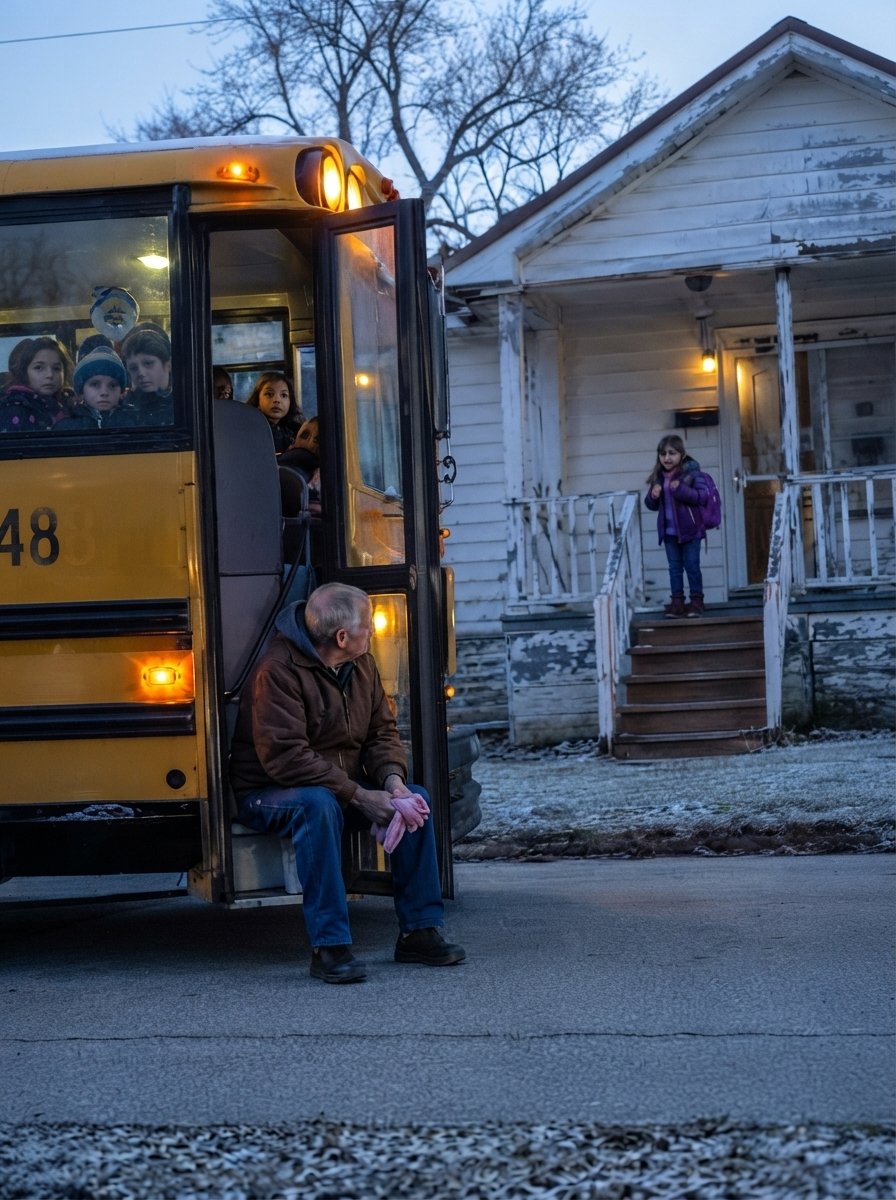
It was stopped in front of a small white house with peeling paint and a broken porch railing.
The red lights were flashing.
But no child was boarding.
I parked half a block away and watched.
Then I saw Harold.
He was not behind the wheel.
He was standing outside the bus in his heavy winter jacket, holding a tiny pair of pink mittens.
On the porch stood an eight-year-old girl.
Mia Caldwell.
Second grade.
Small frame. Dark hair. Purple backpack almost as large as her body.
Mia had transferred to our school three months earlier after her mother died unexpectedly.
I knew the basics from her file.
Her father worked double shifts.
Her grandmother was the emergency contact.
Her teachers described her as polite but painfully quiet.
Some days, she did not speak at all.
That morning, Mia stood frozen on the porch in a thin coat, staring at the bus as though it were a river she did not know how to cross.
Harold did not honk.
He did not shout her name.
He did not wave impatiently.
Instead, he walked to the bottom step of the bus and sat down.
Right there in the freezing cold.
He placed the pink mittens beside him.
Then he waited.
One minute passed.
Then two.
Then three.
Every instinct in me wanted to get out of my car and remind him about the schedule.
But something stopped me.
Harold was not lazy.
He was not careless.
He was watching that little girl the way someone watches a candle struggling against the wind.
Carefully.
Patiently.
As if rushing her might extinguish something inside her.
Finally, Mia took one step down from the porch.
Then she stopped.
Harold did not move.
She took another step.
Then another.
Inside the bus, the other children had become completely quiet.
No teasing.
No shouting.
No complaints.
When Mia reached the walkway, Harold held out the mittens.
She did not take them.
So he placed them gently on the bus step and turned his eyes away, giving her the dignity of not being watched.
Finally, Mia picked them up.
She pulled them onto her hands and climbed aboard.
Then she paused beside Harold.
She did not smile.
She did not say thank you.
She simply tapped the metal handrail twice.
Tap. Tap.
Harold smiled faintly.
“Morning, Miss Mia.”
Then he closed the door and drove away.
I remained in my car, unable to move.
For weeks, I had seen numbers.
Eight minutes late.
Four complaints.
Three warnings.
One problem employee.
Harold had seen something completely different.
A grieving child who wanted to go to school but could not make her feet leave the porch.
When I returned to school, Bus 14 was already unloading.
Harold saw me waiting.
He knew.
“How long has this been happening?” I asked.
“About six weeks.”
“Six weeks? Harold, why didn’t you tell me?”
He rubbed the back of his neck.
“Because it wasn’t my story to tell.”
That sentence stopped me.
He explained that Mia’s father left for work before dawn. Her grandmother helped her get ready but could not safely walk her down the steps.
Every morning Mia came to the porch alone.
Some mornings she could walk to the bus.
Other mornings she froze.
“And you wait?” I asked.
“I wait.”
“Even if everyone else is late?”
Harold looked toward the school doors.
“Ma’am, those children on my bus know something adults sometimes forget.”
“What?”
“That people are worth waiting for.”
He told me that at first, some children had complained.
Then he gave Bus 14 a rule.
On this bus, we don’t leave people behind.
After that, one little boy started saving Mia the first seat.
Another girl reminded everyone to stay quiet when the bus reached Mia’s house.
The children understood.
Standing there, I realized that I had spent years measuring success by clocks.
Children seated before the bell.
Breakfast served on time.
Attendance entered before 8:15.
But I had never asked how many quiet emergencies were happening in front of me while I was busy protecting the schedule.
That afternoon, Mia’s teacher showed me something.
During quiet time, Mia had been drawing the same picture again and again.
A yellow school bus.
A little girl standing on a porch.
Snowflakes falling around her.
And an old man sitting at the bottom step.
In every picture, Harold was smiling.
The next morning, I called Harold into my office.
He entered looking as though he had already prepared himself to lose his job.
I opened his file.
Inside were the warnings I had written.
Late arrival.
Failure to maintain route schedule.
Repeated delay without proper explanation.
They looked painfully cold now.
I removed them one by one, tore them in half, and dropped them into the trash.
Harold stared at me.
“Ma’am?”
“I owe you an apology.”
His hands trembled slightly over his cap.
“I should have told you,” he said.
“Maybe. But I should have asked better questions.”
That day, we officially changed the schedule.
Bus 14 would arrive seven minutes later.
Breakfast service would adjust.
Teachers would adjust.
Parents would receive a simple notice saying that transportation times had changed for student safety and wellbeing.
No private details.
No turning Mia’s grief into gossip.
Just room.
Room for a little girl who needed a few extra minutes to face the world.
A week later, I rode Bus 14 myself.
Not as a supervisor.
Not to inspect Harold.
Just to understand.
When we reached Mia’s house, the whole bus became quiet.
Harold sat on the bottom step.
No pressure.
No hurry.
Just presence.
After a moment, one of the older boys whispered from the back:
“Take your time, Mia.”
Nobody laughed.
Nobody complained.
Slowly, Mia walked down the porch.
She boarded the bus.
Tap. Tap.
Then, as Harold prepared to close the door, she turned toward him.
Her voice was so quiet I almost missed it.
“Thank you, Mr. Harold.”
The bus became completely still.
Harold looked down at the steering wheel.
“You’re welcome, Miss Mia.”
He drove the rest of the way without saying anything.
But I saw him wipe his eyes twice.
So did I.
We live in a world obsessed with speed.
Faster service.
Faster answers.
Faster schedules.
Faster everything.
But sometimes the most important thing a person can do is stop.
Wait.
Notice.
Make room.
Harold Mercer had not been late because he was careless.
He had been late because he understood something the rest of us had forgotten.
Sometimes a grieving child does not need a speech.
Sometimes she simply needs one steady person sitting at the bottom of the steps, showing her that the world will not leave without her.
Part 2: When Kindness Became “Unfair”
By the following Friday, everyone in town seemed to have an opinion about Bus 14.
Some called Harold a hero.
Others called him unprofessional.
The seven-minute schedule adjustment had solved one problem but revealed several others.
One parent, Aaron Lyle, wrote to me because his son Carter now had less time to eat breakfast before morning reading support.
His message was polite.
And he was not wrong.
That was the difficult part.
Another child also had needs.
Soon one email became four.
Then twelve.
One parent wrote:
“My tax money does not pay for a bus driver to run a therapy program.”
Another wrote:
“If one child needs special help, provide it separately.”
But the message that stayed with me most was this:
“My daughter has anxiety too. Nobody holds the whole school for her.”
That sentence revealed what was underneath much of the anger.
People were tired.
Parents were tired.
Teachers were tired.
Children were tired.
Everyone was carrying a private storm.
And when one child’s storm became visible, those drowning quietly began wondering why nobody had noticed theirs.
Then the situation became worse.
Some children overheard their parents discussing “the girl who makes Bus 14 late.”
Mia heard them.
The next morning, Bus 14 arrived exactly on time.
But Mia was not on it.
She had been standing on the porch.
Harold had waited only two minutes because he was afraid of creating more complaints.
She never moved.
Later her grandmother called and said Mia had a stomachache.
I knew what that sometimes meant.
Children have many names for fear.
Stomachache.
Headache.
Tired.
Not feeling well.
Sometimes the body says what the heart is too embarrassed to explain.
I called Mia’s father, Daniel Caldwell.
He told me Mia had asked him the night before:
“Are people mad at me?”
Daniel sounded exhausted.
He left for his warehouse job at 4:50 every morning and worked a second job afterward.
“If I quit one job,” he later told me in my office, “we can’t keep the house. If I keep both jobs, I’m gone before she wakes up. My mother’s knees are too bad to walk her down those steps. And now my daughter thinks the whole town is angry because she needs a few minutes.”
Then he told me what Mia had been like before her mother died.
She used to run toward the bus.
She talked constantly.
She would pat the side of Bus 14 every morning and say, “Good morning, Bus 14.”
After her mother died, the words disappeared.
Daniel said something that changed the way I thought about routine.
“Everybody tells me children need routine. And they do. But routine shouldn’t be like a train track.”
He paused.
“It should be like a handrail.”
Something steady enough to hold onto.
Not something dragging a child forward when her feet cannot move.
That evening, the school board room was packed.
Parents stood along the walls.
Harold sat in the back with his brown cap in his lap.
Daniel arrived with Mia and her grandmother.
Aaron Lyle sat near the front with Carter.
The board opened public comment.
Mr. Lyle spoke first.
He said he respected Harold.
But he also asked a fair question.
If his son needed breakfast and reading support, did those needs matter too?
“Who decides which child’s need is important enough to change the system?” he asked.
Other parents spoke.
A mother whose daughter had diabetes said breakfast timing mattered.
Another parent said his son needed morning speech support.
One father said rules only mattered if they applied to everyone.
Then a grandmother stood and replied:
“Rules that cannot bend for children are not rules. They are excuses.”
The room divided.
Finally, I walked to the microphone.
“The parents who are concerned about breakfast, academic support, and fairness are not wrong,” I said.
Several people looked surprised.
“Seven minutes can matter. For a hungry child, it matters. For a child receiving extra reading help, it matters.
“But a child needing additional time to enter a bus is not an inconvenience either. It is also a need.”
I refused to discuss Mia’s private circumstances.
Instead, I reminded them that children arrived at school carrying grief, illness, hunger, instability, disability, fear, and problems they had never chosen.
“Our schedules are important,” I said. “But schedules are tools. They are not children. Schedules do not stand cold on porches. They do not miss their mothers. They do not wonder whether the world is angry because they need help.”
Then I looked toward Harold.
“Mr. Mercer did not break the spirit of his job. He honored it.”
But I also admitted something else.
We could not build compassion on the sacrifice of one bus driver.
And we could not help one child by accidentally hurting others.
So I proposed a new plan.
The school would open earlier.
Breakfast carts would be moved near the bus entrance.
Reading intervention would begin after the final buses arrived.
Transportation employees would receive guidance for supporting children having difficult transitions.
No child’s private situation would be publicly disclosed.
Then Daniel unexpectedly stood.
“My name is Daniel Caldwell,” he said. “My daughter rides Bus 14.”
The room became silent.
He told them his wife had died.
He told them that Mia struggled in the mornings.
He explained how Harold had waited for her.
Then his voice broke.
“When I found out, I felt grateful. Then I felt ashamed. Because another man was standing where I wanted to stand.”
Even Mr. Lyle lowered his eyes.
Daniel continued.
“Maybe my daughter is getting special treatment. But I hope every child gets special treatment when life knocks them flat.
“I hope your child gets waited for when they freeze.
“I hope your child gets fed when they are hungry.
“I hope your child gets extra help when they fall behind.
“And I hope my daughter’s help never takes help away from yours.”
Then Carter Lyle raised his hand.
His father tried to stop him.
But Harold spoke from the back.
“Let him speak.”
Carter walked to the microphone.
He had to stand on his toes to reach it.
“I don’t like being late for breakfast,” he admitted, “because sometimes they run out of the square potatoes.”
A few people laughed.
Then Carter became serious.
“But I don’t want Mia to get left.”
He reminded everyone that Harold had waited for him once when he forgot his backpack.
He had waited when another child got sick.
He had waited when a girl cried because her dog died.
“Bus 14 waits sometimes,” Carter said. “Not only for Mia.”
Then he repeated Harold’s rule.
“On this bus, we don’t leave people behind.”
The room fell silent.
And then Mia stood.
She walked slowly toward the microphone.
Harold almost rose to help her.
But he stopped himself.
Sometimes love means helping.