
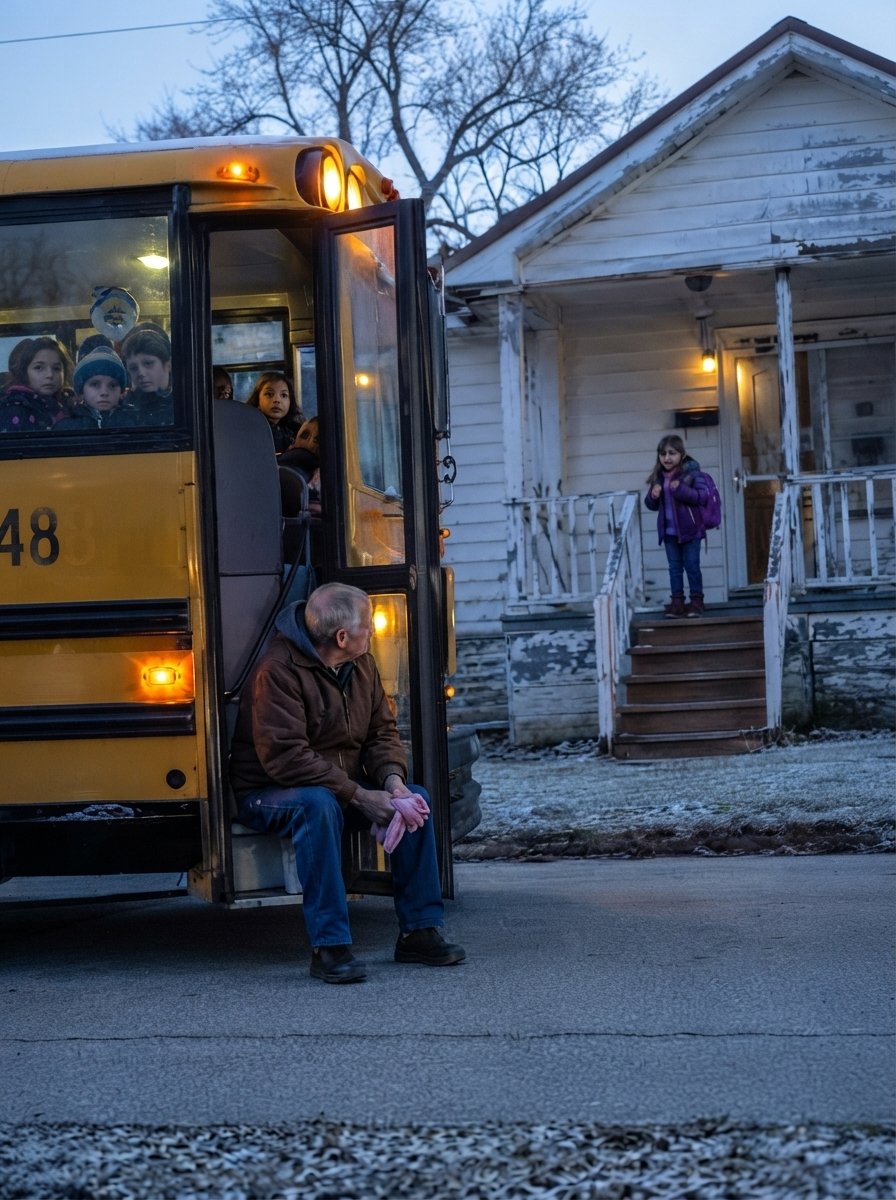
Sometimes it means waiting long enough for someone to discover they can take the step themselves.
Mia reached the microphone.
Mrs. Donnelly lowered it for her.
Mia looked down.
Then she tapped twice on the wooden podium.
Tap. Tap.
Harold pressed his cap against his chest.
“I’m sorry I made people mad,” Mia whispered.
The room changed.
Every adult suddenly understood what their conversations had placed on one little girl’s shoulders.
“I try to walk faster,” Mia continued. “But some mornings my legs don’t listen.”
Daniel covered his mouth.
“Mr. Harold doesn’t yell. He just waits.”
Then she removed a folded drawing from her sweater.
A yellow bus.
A porch.
Snow.
An old man waiting.
“This is how I get to school,” she said.
Nobody applauded.
Applause would have been too easy.
Instead, everyone simply sat with the truth.
The board voted that night.
Not unanimously.
Four to two.
Beginning the following Monday, Oakridge Elementary would open fifteen minutes earlier.
Breakfast would be available near the bus entrance.
Morning intervention would begin after buses arrived.
Transportation staff would receive support guidelines.
No driver would be expected to carry a struggling child’s needs alone.
And no family would have to expose its pain publicly just to receive compassion.
It did not solve grief.
It did not make Daniel’s jobs easier.
It did not remove Mia’s porch.
But it created room.
And sometimes room is where healing begins.
Part 3: The Rule That Spread Beyond Bus 14
The changes did not magically make everything perfect.
Some parents remained angry.
Some teachers complained.
There were staffing problems.
The breakfast cart occasionally ran out.
But something else happened.
After we invited families to tell us what their children needed, stories began coming through the door.
A first grader cried every morning because her mother had been deployed.
A child moving between two homes often arrived without breakfast.
A kindergartner froze when he heard loud noises after a car accident.
A fifth grader acted tough because he was embarrassed that he could not read the morning announcements.
One by one, the children we had assumed were “fine” became visible.
Mrs. Bennett changed her classroom routine.
Every morning, she asked students for a simple check-in.
Thumb up.
Thumb sideways.
Thumb down.
One morning, Mia lifted her thumb halfway.
“Porch morning,” she whispered.
Mrs. Bennett did not make a scene.
She simply said:
“Thank you for telling me.”
That became an important phrase in our school.
Not:
“Don’t worry.”
Not:
“You’re fine.”
Not:
“Hurry up.”
Just:
“Thank you for telling me.”
Harold changed too.
He still made the same slow turns.
The same careful stops.
Both hands remained steady on the wheel.
But now he was not alone.
Staff waited near the bus entrance.
The counselor appeared some mornings.
Breakfast was ready.
Reading schedules were adjusted.
Eventually even Mr. Lyle came to me.
“I owe you half an apology,” he said.
“Only half?”
He smiled awkwardly.
“I still think parents had the right to ask questions.”
“They did.”
“But I should have asked mine better.”
Then he told me something Carter had said.
“Dad, you always tell me to be a leader. But when Mia needed everyone to be patient, you wanted me to be on time instead.”
Mr. Lyle sighed.
“That one hurt.”
“Children have a way of doing that.”
He looked toward Bus 14.
“That’s the difficult part, isn’t it? Wanting compassion for your child can make it sound like you’re against compassion for somebody else’s.”
He was right.
By winter break, Mia had begun speaking more.
Not loudly.
Not often.
But enough.
She said good morning to the cafeteria manager.
She participated in reading group.
She even told Carter that his drawing of a dinosaur looked like a sick chicken.
Carter insisted it was an artistic choice.
Mia smiled.
A small smile.
But small things are not small when they return after grief.
Before winter break, Mia gave Harold another drawing.
This time Bus 14 was parked outside the school.
At the bottom she had written:
Our bus waits for people.
Harold taped it inside the bus.
“Not where it blocks the mirror,” Mia reminded him.
“Safety first,” Harold replied.
Before taking her seat, she tapped the rail.
Tap. Tap.
Harold tapped the steering wheel back.
Tap. Tap.
Soon the other children were doing it too.
It became their greeting.
A small way of saying:
I made it.
I see you.
We are here together.
Then, in January, Harold slipped on ice beside the bus.
He badly bruised and sprained his knee.
The doctor ordered him to stop driving for at least two weeks.
Harold hated the idea.
“I’m not leaving my kids with a stranger,” he complained.
When Mia saw him sitting injured on the bus steps, fear immediately appeared on her face.
She walked toward him and pulled the familiar pink mittens from her pocket.
“For waiting,” she whispered, offering them to him.
Harold’s face crumpled.
“I’m only getting my knee checked,” he promised.
“Will you come back?”
That question meant far more than it seemed.
Will you come back?
Will the people I care about disappear?
Will everything change again without warning?
Harold chose his words carefully.
“I’ll do everything I can.”
Mia stared at him.
So he added:
“And if I can’t drive for a while, I’ll still be here.”
That was a promise he could keep.
The next morning, Mr. Dale drove Bus 14.
He was a good driver.
Punctual.
Careful.
Professional.
But he was not Harold.
When he reached Mia’s house, she stood frozen on the porch.
Mr. Dale looked at the clock.
Then at Mia.
Then back at the clock.
Carter leaned forward.
“Mr. Dale, you have to sit on the bottom step.”
“What?”
“That’s how Mr. Harold does it.”
Mr. Dale hesitated.
Then one of the older children reminded him:
“On this bus, we don’t leave people behind.”
Another child repeated it.
Then another.
Mr. Dale set the brake and sat awkwardly on the bottom step.
Mia watched him.
Eventually she took one step.
Then another.
And she boarded.
Later that afternoon, Mr. Dale came to my office.
“I thought Mercer was being dramatic,” he admitted.
He had believed he could prove that a driver could be kind and still remain perfectly on schedule.
Then he saw Mia standing on the porch.
“That child was trying with everything she had,” he said quietly.
He also told me the children had corrected him.
“They told me Harold looks away so she doesn’t feel watched.”
Mr. Dale shook his head.
“Those kids are better than we are.”
Three weeks later, Harold returned on light duty.
The children covered his desk with get-well cards.
Carter drew a bus filled with square breakfast potatoes.
Harold stared at it.
“I don’t understand modern art.”
“It’s breakfast,” Carter explained.
“Ah. Of course.”
Mia did not give Harold a card immediately.
She waited near the office door until she was ready.
Then she walked to his desk.
“You’re not driving yet.”
“No, ma’am.”
“But you came back.”
“Yes, ma’am.”
She handed him a drawing.
It showed Harold behind the front office desk.
Mia stood next to him.
Underneath she had written:
People can wait in different places.
Harold read it twice.
“I think you may be the wisest person in this building.”
Mia considered that.
“Carter says he is.”
“Carter says many things,” Harold replied.
Mia laughed.
It was the first time I heard her laugh in the front office.
Nobody clapped.
Nobody made a big celebration out of it.
We had learned not to make too much noise when courage arrived quietly.
Part 4: The Handrail Award
Spring finally came.
Harold returned to driving Bus 14.
On his first morning back, the children had taped together sheets of notebook paper to make a sign:
WELCOME BACK MR HAROLD
When the bus reached Mia’s house, the porch was empty.
For a moment, fear crossed Harold’s face.
Then the door opened.
Mia stepped outside.
Behind her came her grandmother, carefully holding the railing.
Step by step, the two of them walked down together.
When they reached the bus, Mia smiled.
“Grandma wanted to meet Bus 14.”
Harold removed his cap.
“Well, Bus 14 is honored.”
Mia’s grandmother looked into his eyes.
“You waited for my girl when I couldn’t get down those steps.”
“Yes, ma’am.”
She touched his sleeve.
“I prayed somebody would.”
Mia climbed aboard.
Tap. Tap.
This time, the entire bus answered.
Tap. Tap.
On windows.
Seats.
Lunchboxes.
Metal rails.
It sounded like rain.
By May, Bus 14 had become famous inside our school.
Not online.
Not because anyone wanted attention.
The story simply traveled quietly.
New families heard the rule:
On this bus, we don’t leave people behind.
Soon it spread beyond the bus.
Teachers used it.
Cafeteria workers used it.
Even the custodian used it one evening when he found a teacher crying alone after a difficult day.
Harold hated the attention.
“I didn’t invent kindness,” he told me.
“No. You just practiced it where people could see.”
“I preferred when they couldn’t.”
“I know.”
He looked toward Bus 14.
“You think we made too much of this?”
I thought carefully.
“No,” I said. “I think we made too little of it for too long.”
During the final week of school, we held our awards assembly.
That year, we created something new.
The Handrail Award.
I chose the name because of something Daniel had said months earlier.
Routine should be like a handrail.
Something steady.
Something a child can hold onto while learning to move forward.
The award would recognize someone who helped others keep going.
Nobody knew who the first recipient would be.
Not even Harold.
I stepped to the microphone.
“This year, we learned that schedules matter. Breakfast matters. Reading support matters. Rules matter.”
I paused.
“But we also learned that people matter more than any system we build to serve them.”
Then I announced:
“Our first Handrail Award goes to Mr. Harold Mercer.”
The auditorium erupted.
Bus 14 stood first.
Then Mrs. Bennett’s class.
Then the older students.
Then the teachers.
Within moments, everyone was standing.
Harold remained seated, staring at us with his cap in his hands.
The transportation supervisor finally nudged him forward.
He slowly walked to the stage.
His face was red.
His eyes were wet.
I handed him a small wooden plaque.
It read:
For helping us remember not to leave people behind.
Harold stared at it.
Then he leaned toward the microphone.
“I’m not much for speeches.”
A child near the front whispered:
“We know.”
The room laughed.
Harold smiled.
“I suppose most of you know Bus 14 has a rule.”
The children answered together:
“We don’t leave people behind!”
“That’s right.”
Then Harold became serious.
“I appreciate this award. But I didn’t teach that rule by myself. You children taught it back to me every time you waited without complaining. Every time you saved a seat. Every time you stayed quiet because somebody needed quiet. Every time you remembered that getting there together matters too.”
His voice trembled.
“Sometimes people think kindness means being soft. It doesn’t.
“Kindness can be hard.
“It can cost time.
“It can make people angry.
“It can force you to explain yourself.
“It can make you choose between what is easy and what is right.”
Then Harold looked over the auditorium.
“I’ve driven a bus for a long time, and I can tell you something.
“A bus is not successful because it arrives empty and on time.
“It is successful because it brings the children with it.”
The room fell completely silent.
Then the applause returned.
This time, Harold allowed himself to accept it.
After the assembly, Mia found him in the hallway.
She carried one final drawing.
It showed a long road.
A yellow bus driving toward the sunrise.
Children filled the seats.
Harold sat behind the wheel.
And in the first seat, Mia had drawn herself looking forward.
Not toward a porch.
Not toward the past.
Forward.
At the bottom she had written four words:
I can go now.
Harold read them.
His mouth trembled.
He crouched carefully so he could look into her eyes.
“You always could,” he told her softly. “You just needed time to remember.”
Then Mia hugged him.
Harold froze for half a second.
Then gently hugged her back.
When she stepped away, she tapped twice on his plaque.
Tap. Tap.
Harold tapped his cap.
Tap. Tap.
That summer, the district asked me to present what we had learned at a regional meeting.
At first, I refused.
I did not want Mia’s grief turned into a program.
I did not want Harold turned into a mascot.
But Harold changed my mind.
“You should go,” he told me.
“Why?”
“Because somewhere there’s another porch.”
I looked at him.
“And somewhere there’s another driver getting written up because he stopped long enough to see it.”
So I went.
I never used Mia’s name.
I never showed her drawings.
I simply told the truth.
Schools are not factories.
Buses are not merely vehicles.
Attendance is not the same thing as belonging.
Children can be physically present and still feel completely left behind.
And sometimes the first step toward helping them is not creating a new policy.
Sometimes it is one adult asking:
What am I not seeing?
After my presentation, another principal approached me.
She told me about a middle-school boy who missed first period twice a week.
“I thought his mother just wasn’t trying,” she admitted.
Then she paused.
“Maybe I need to follow the route.”
I remembered the morning I followed Harold.
How certain I had been.
How wrong I had been.
“Yes,” I told her.
“Maybe you do.”
In August, Mia returned for third grade.
She was taller.
Not much.
But enough that her backpack no longer seemed capable of knocking her over.
On the first morning of school, Bus 14 pulled into the parking lot at 7:48.
Right on schedule.
The doors opened.
Children poured out.
Then Mia stepped down.
She wore yellow sneakers.
Her pink mittens were clipped to her backpack even though the weather was warm.
Before walking into school, she turned toward Harold.
Tap. Tap.
Harold answered on the steering wheel.
Tap. Tap.
Then Mia walked inside.
Not quickly.
Not perfectly.
But on her own.
And that was enough.
People still ask me whether kindness should matter more than the schedule.
I tell them that is the wrong question.
The better question is:
What is the schedule for?
If a schedule exists to help children arrive safely, eat breakfast, learn, and begin their day with dignity, then kindness is not the enemy of that schedule.
Kindness is the reason the schedule exists.
Harold Mercer never intended to make a statement.
He never intended to start a debate.
He was simply an old bus driver sitting in the cold with a pair of pink mittens, giving one grieving little girl enough time to take another step.
Some people saw wasted time.
Some saw special treatment.
Some saw unfairness.
Some saw mercy.
They were all looking at the same seven minutes.
But Harold was looking at a child.
And once you truly see a child, it becomes much harder to leave them behind.
One day, every child will stand on some kind of porch.
Afraid.
Grieving.
Hungry.
Different.
Behind.
Unsure whether the world has room for them.
When that day comes, they will not remember the policy number.
They will not remember the board vote.
They will not remember whether breakfast began at 7:35 or 7:42.
They will remember who waited.
They will remember who gave them dignity.
They will remember who made room.
They will remember whether the bus left without them.
And if we are lucky, they will grow up knowing how to wait for someone else.
That was Harold’s lesson.
That was Mia’s courage.
That was Bus 14’s rule.
On this bus, we don’t leave people behind.