After My Husband’s Funeral, I Learned About His $8.5M Estate. Then Heard My Parents Claiming It
What I Recorded
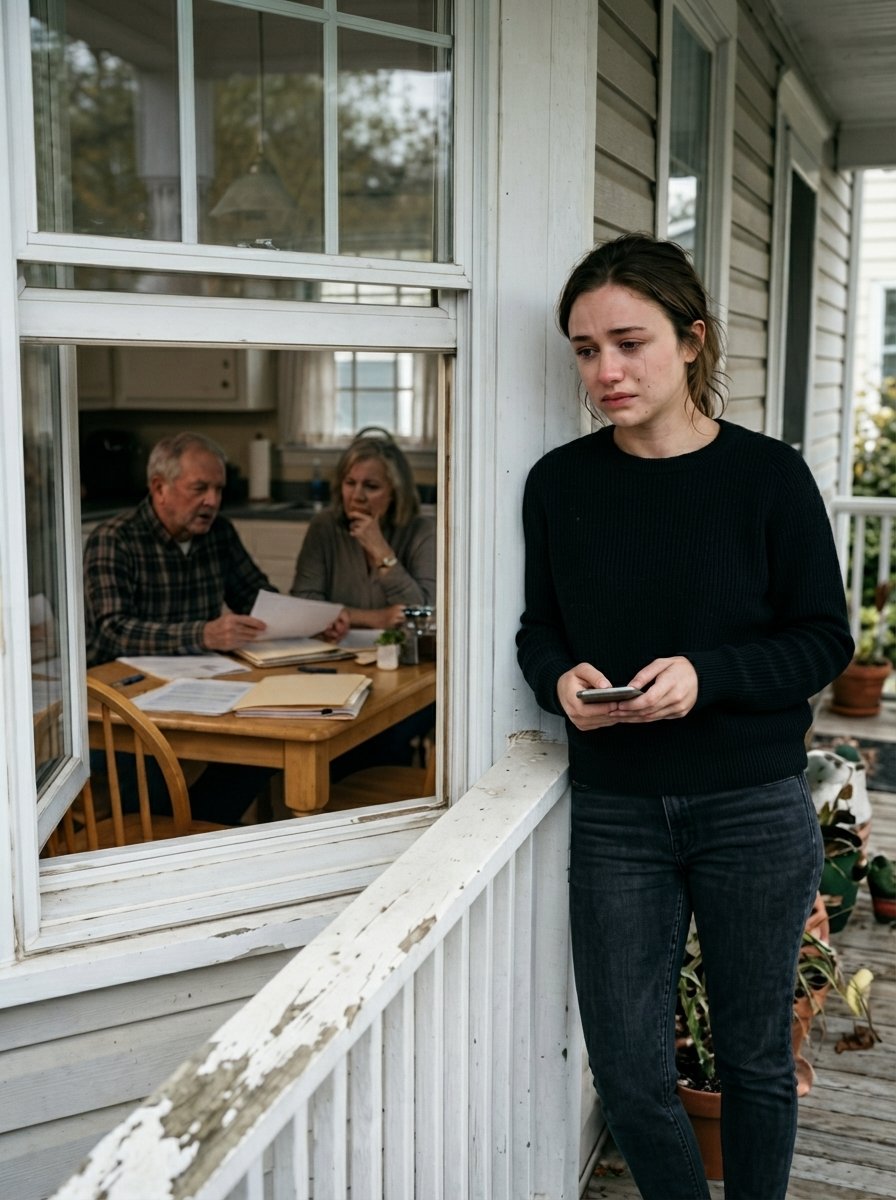
The kitchen window was open.
That was the only reason I heard my mother planning to take my dead husband’s estate before I even knocked.
I had driven two and a half hours from Manhattan to Ridgewood with funeral clothes still folded in the back seat and Nathan’s will tucked inside my bag.
Eight and a half million dollars.
Six Manhattan lofts.
A future Nathan had protected for me because he knew my family better than I wanted to admit.
I stood on the porch of the house where I grew up, one hand on the railing, one foot still on the step.
Inside, my mother’s voice came through the screen—sharp and organized.
“She’s not thinking straight,” Patricia said. “She hasn’t been right since the wedding. Once Voss signs the papers, we file before she even knows what happened.”
My father answered, low and impatient.
“And the money?”
“Chloe becomes guardian,” my mother said. “We manage the accounts. Simple.”
Then my sister’s voice, on speakerphone. Small. Eager. Almost cheerful.
“Tell Dad to make sure she doesn’t talk to that lawyer. Nathan’s lawyer gave me a weird vibe at the wedding.”
I stopped breathing.
Three days earlier, I had stood in St. Andrew’s Chapel on 9th Avenue and buried my husband in front of fourteen people.
My mother’s chair was empty. My father’s chair was empty. Chloe’s chair was empty.
I had called them the morning Nathan collapsed. My mother said, “Oh, Fay, that’s terrible,” in the same voice she used for a broken appliance. Then she told me Chloe had a dress fitting for her engagement and things were hectic.
My husband was gone.
My sister had a fitting.
Now I was standing outside their kitchen, listening to them discuss how to have me declared unable to manage my own life so they could take control of everything Nathan had left me.
Patricia kept talking.
“She’ll cry for a week, and then she’ll sign whatever we put in front of her. She always does what she’s told.”
A moth tapped against the screen. My hands shook so hard I had to press my phone against my coat to steady it.
Then I remembered something from a compliance seminar at the museum, where I’d worked as a registrar for nine years.
New York is a one-party consent state.
I tapped record.
The red dot glowed while my mother planned my future like a grocery list.
My father agreed. My sister laughed softly.
I stood there until I had enough.
Then I stopped the recording, slid the phone into my pocket, and rang the doorbell like I had just arrived.
Patricia opened the door.
Her face changed in less than a second.
Calculation became grief. Grief became warmth.
“My poor baby,” she said, pulling me into her lavender perfume. “We’re here for you now.”
Now.
That word felt different when I’d just heard her try to strip away my rights before Nathan’s body was even cold.
Gerald stood behind her with his hands in his pockets.
“You should stay a few days, Fay,” he said. “Rest. There’s no rush to go back to the city.”
No rush. Because they needed seventy-two hours for Dr. Voss.
I smiled.
“Thanks, Dad. I think I need to be home for a while.”
Upstairs, my old bedroom looked exactly the same. Twin bed. Faded quilt. One Columbia graduation photo pinned to the wall.
Down the hallway, Chloe had forty-seven framed memories. Prom. Cheerleading. Sorority formal. Engagement party.
I locked my door and called James Whitfield, Nathan’s attorney.
Voicemail.
“James, it’s Fay. I need to see you Monday. It’s urgent.”
Then I sat on the edge of my childhood bed and played the recording through my earbuds. Every word was clear. My mother’s voice. My father’s voice. My sister’s voice. All calm. All practical. All discussing how to erase me.
I did not sleep.
The next morning, there was a man in the living room.
Silver hair. Wire-rim glasses. Soft cardigan. Safe smile.
Patricia introduced him over coffee.
“This is Dr. Raymond Voss. An old friend of your father’s. We thought it might help you talk to someone after everything.”
Dr. Voss shook my hand.
“I’m sorry for your loss, Fay. Your parents are very worried.”
We sat in the den. My mother stayed on the love seat beside me like a chaperone.
Voss opened a leather notebook.
“Do you find it difficult to make decisions right now?”
“No.”
“Do you feel detached from reality?”
“No.”
“Are you having trouble understanding financial matters?”
“No.”
Each question was dressed like concern. Each one had teeth.
I had spent half the night reading about temporary guardianship on my phone. I knew what he was building.
Not care. A file. A reason. A door my parents could walk through with a judge and come out holding Nathan’s money.
Patricia leaned forward. “She’s been so shut down since Nathan died,” she whispered. “Not herself.”
I answered calmly. Clearly. Gave him nothing.
After twenty minutes, I excused myself for water, walked to the back porch, and called James again.
This time he answered.
“Don’t leave that house yet,” he said. “Nathan set something up before he died. Come to my office tomorrow morning.”
For the first time since the funeral, my pulse rose from something other than fear.
“What did he set up?”
James paused.
“Protection.”
The next day, I drove to his office in Glendale.
James was waiting at the door. Inside, he slid Nathan’s will across the desk. Then a sealed envelope. Nathan’s handwriting.
For Fay.
My fingers went numb before I opened it.
The first line read: I know your family.
I pressed my palm against the desk. The room blurred.
Then James opened another folder.
“Nathan was afraid they would come for you. So he built a trust they cannot touch.”
I looked up. James did not smile.
“And Fay, there’s something else. Your father has been asking Nathan for money. Four times. I think we need to look at the church accounts before the gala.”
That was when I realized this was no longer just about my inheritance.
And I had already recorded the first confession.
I want to tell you about Nathan, because the letter—and what came after—doesn’t make sense without him.
I met Nathan Brooks nine years ago, at a fundraiser for the museum where I worked. He was an architect, soft-spoken, the kind of person who listened more than he talked and who noticed things—the specific quality of someone who paid attention to the world rather than performing attention to it. We were married for six years before a heart condition no one had caught in time took him at fifty-three, three weeks ago, on a Tuesday afternoon in our apartment while I was at work.
Nathan had met my family exactly four times in nine years. Each time, he had said very little, and afterward, in the car, he would be quiet in a particular way—not sulking, but processing, the way he processed everything, carefully and without rushing to conclusions.
After the third visit—a Christmas, four years ago, where my father had spent forty minutes describing a “business opportunity” he was hoping Nathan might “look into”—Nathan had said, in the car on the way home: “Your father asked me for money tonight. Twice. In two different ways.”
“He does that,” I’d said. “It’s not really about the money. It’s just how he—engages.”
“Does it work? When he does it to you?”
“I don’t have the kind of money he’s asking about,” I’d said. “So it’s never really come up.”
Nathan had been quiet for a while.
“You will, someday,” he’d said. “Have that kind of money, I mean. Eventually. Through me, if nothing else.” He’d glanced at me. “I think about what happens then.”
I hadn’t thought much about it at the time. It had seemed like an abstract concern, the kind of thing you say in a car on a long drive without expecting it to become relevant.
Nathan, apparently, had thought about it considerably more than I realized.
The letter, which I read in James’s office with my hands not entirely steady, explained what he had done.
Fay—
If you’re reading this, it means I’m gone, and I’m sorry for that more than I can put into a letter. But I want you to know that even at the end, I was thinking about you, and about what happens to you after, and specifically about what happens to you after where your family is concerned.
I know your family. I’ve spent nine years watching them ask you for things—small things, mostly, the kind of things that seem reasonable individually and only add up to something when you look at the pattern. I’ve watched your mother speak to you in a voice that manages rather than loves. I’ve watched your father position himself for opportunities with people he’s decided are useful. And I’ve watched your sister occupy a space in your parents’ attention that you’ve never occupied, through no failure of yours—just because that’s the shape your family decided to take, a long time before I arrived.
I don’t say any of this to hurt you. I say it because I think, somewhere, you already know it, and you’ve spent years managing around it the way people do with families they can’t choose and don’t want to lose entirely.
But I’m gone now, and what’s left is substantial, and I know—I know, Fay, the way I know things, by watching carefully for a long time—that the size of what’s left will change how your family behaves toward you. Not because they’re uniquely terrible people. Because money changes the math for people who’ve already shown you what their math looks like.
So I built something. James will explain the details, but the short version is this: everything that’s yours is structured so that no court, no guardianship proceeding, no “concerned family member” can access it, regardless of what they claim about your state of mind. I built it specifically anticipating that someone might try exactly that—because I’d thought about your family enough, over nine years, to believe it was possible.
I hope I’m wrong. I hope you read this letter at some point decades from now, an old woman, having never needed any of it, laughing at how cautious I was.
But if I’m right—if this letter matters in the way I built it to matter—then I want you to know that everything is protected, and that you are not alone in this, even though I won’t be there.
I love you. I always will, in whatever way the dead manage to love the living.
End Part Here: I came home from the funeral to tell my parents and sister that my husband had left me $8.5M and six Manhattan lofts