
Nathan
James gave me a few minutes after I finished reading.
Then he explained the structure.
Nathan had established an irrevocable trust eighteen months before his death—not in response to any specific event, James said, but as part of what Nathan had described to him as “long-term planning,” the kind of unremarkable phrase that conceals enormous foresight.
The trust held the $8.5 million and the six Manhattan properties. I was the sole beneficiary. The trustee was not a family member, not me, but an independent fiduciary—a trust company that managed exactly this kind of structure for exactly this kind of situation, with no relationship to my family and no incentive to respond to anything except the trust’s own terms.
Crucially: the trust had a specific provision, which James said Nathan had insisted on adding after their second meeting about the structure, addressing exactly the scenario I had walked into.
“If any party petitions for guardianship or conservatorship over the beneficiary,” James read, “the trust automatically transfers administrative authority to a secondary independent trustee, removes all discretionary distribution authority during the pendency of any such proceeding, and the trust’s legal counsel”—he tapped his own chest—”is authorized and directed to actively oppose any such petition using trust resources, regardless of the outcome’s effect on the beneficiary’s access to funds during the proceeding.”
“What does that mean in practice?” I asked.
“It means,” James said, “that if your parents file for guardianship, the money becomes completely inaccessible—to them, and temporarily to you—until the petition is resolved. And it means I’m obligated, by the trust’s terms, to fight that petition with everything available, which is considerable, because Nathan funded a separate litigation reserve specifically for this purpose.” He looked at me. “Nathan didn’t just protect the money, Fay. He built a structure that makes attacking the money pointless. There’s nothing to gain. The moment they file, everyone loses access, and they’re now fighting a trust company with unlimited resources and a mandate to win.”
I sat with this.
“He really thought about this,” I said.
“For eighteen months,” James said. “He came back to this office four times to refine it. He was very specific about your family. He used the word ‘pattern’ a lot.”
The second thing James told me—the thing about my father and the church accounts—required its own explanation.
“Your father approached Nathan four times over the past three years,” James said, “each time with a different framing—an investment opportunity, a loan, a ‘temporary’ need related to the church where he’s on the finance committee. Nathan declined each time, but he kept records. Detailed records, because—” James paused, “—because Nathan suspected something was happening with the church’s finances and didn’t feel it was his place to investigate directly, but he also didn’t want the information to disappear if it turned out to matter.”
“What kind of records?”
James turned the folder around.
Inside were copies of correspondence—emails from my father to Nathan, each one requesting money for slightly different stated purposes, each one declined. And alongside them, financial documents that Nathan had apparently obtained through channels James didn’t specify in detail—statements from the church’s finance committee, where my father had served as treasurer for the past six years.
The statements showed a pattern.
Small discrepancies, at first—a few hundred dollars here, unaccounted for in a quarterly reconciliation. Then larger ones. Then, over the past eighteen months, a pattern of transfers from the church’s building fund to an account that the documentation linked, through a chain of records I won’t detail here, to my father’s personal accounts.
The total, across three years, was approximately $94,000.
“This is—” I looked at James. “This is theft. From a church.”
“It appears to be,” James said carefully. “I want to be precise about what I can and can’t say. I’m not an investigator, and Nathan’s records, while detailed, would need to be verified independently before anyone could make formal allegations. But the pattern is—” he paused, “—the pattern is consistent with what you’d expect to see if someone with access to those accounts had been gradually diverting funds.”
I thought about my father, asking Nathan for money four times over three years—the same period, apparently, during which he’d also been quietly diverting funds from his church’s building fund.
“Why didn’t Nathan say anything? To me, or to anyone?”
“He told me he wasn’t certain,” James said. “And he said something else, which I think is relevant now.” He consulted his notes. “He said: ‘If I’m wrong, I’ve accused my wife’s father of something terrible, on suspicion, and it destroys her relationship with her family forever, even if her family doesn’t deserve the relationship. If I’m right, the information will still be there if it’s ever needed—and if it’s ever needed, it’ll be needed for a specific reason, and that reason will make the decision about whether to use it much clearer than it is right now.’”
I understood, sitting in James’s office with the recording from the kitchen window still on my phone, what that specific reason was.
Over the following two weeks, several things happened, and I want to describe them in the order they happened, because the order mattered.
First: I did not return to my parents’ house after the appointment with Dr. Voss. I called Patricia and told her I needed to go back to Manhattan to handle “some things with Nathan’s estate,” which was true, and which she accepted with a brightness that suggested she believed her own timeline was still intact.
Second: James filed, on my behalf, a formal notification to the trust company confirming that no guardianship proceeding had yet been initiated, but documenting—through the recording, which I gave to James in full, along with the date and circumstances of how it was obtained—that such a proceeding appeared imminent. This put the trust’s protective provisions on alert, without yet triggering them, and created a contemporaneous record establishing my parents’ stated intentions before any petition was filed.
Third: James, with my authorization, retained a forensic accountant to review the church financial documents Nathan had gathered—not as part of any proceeding involving my inheritance, but as a separate matter, because what my father had apparently done was, regardless of anything happening with me, a serious problem that the church’s leadership had a right to know about.
Fourth—and this is the part that required the most thought on my part—I decided what to do about the guardianship threat itself.
I could have simply waited. The trust’s provisions meant that if my parents filed, they would lose, comprehensively, and the litigation reserve meant I wouldn’t bear any personal cost in the fighting. Nathan had built something that would simply absorb the attack and neutralize it.
But waiting meant living with the threat hanging over me—meant going through a guardianship proceeding, however certain its outcome, with the accompanying stress and the public nature of such proceedings, which can become part of court records that people can find.
I decided, instead, to be direct.
I called a family meeting.
Not at my parents’ house—at James’s office, which I described to Patricia as “a meeting about the estate that involves all of you,” which was vague enough to be true and specific enough to ensure they’d come.
They arrived together—Patricia, Gerald, and Chloe, all dressed with the specific care of people attending something they expected to be significant, though I don’t think any of them anticipated what kind of significant.
James sat beside me. On the table between us: a laptop, a folder, and my phone.
“I want to start,” I said, “by playing something.”
I played the recording.
Patricia’s voice. Gerald’s voice. Chloe’s voice on speakerphone. The kitchen window. Every word, clear, exactly as I’d heard it on the porch three weeks ago.
She’ll cry for a week, and then she’ll sign whatever we put in front of her. She always does what she’s told.
The room was silent when it ended.
Patricia’s face went through the same sequence I’d watched at the door three weeks ago—but in reverse this time, and slower. Calculation, attempting to find footing. Something that wanted to be outrage but couldn’t quite locate its justification.
“That’s—” she started. “Fay, that’s a private conversation. You can’t just—”
“New York is a one-party consent state,” I said. “I can record any conversation I’m a party to, and I was standing on the porch, which means I was present for that conversation whether you knew it or not. It’s legal. James confirmed it.”
“We were worried about you,” Gerald said. “After everything that happened—”
“You were planning to have me declared incompetent,” I said, “three days after I buried my husband, so that Chloe could become my guardian and you could manage the accounts. Those are the words you used. I have them recorded.”
Chloe, who hadn’t said anything yet, looked at the phone like it might do something else.
“I didn’t mean—” she started. “It wasn’t really—”
“You said Nathan’s lawyer gave you a weird vibe,” I said. “And that I shouldn’t talk to him. That’s also recorded.”
The room was very quiet.
“Here’s what’s going to happen,” I said. “Nathan anticipated this. Everything he left me is in a trust structure that makes a guardianship petition not just unsuccessful, but actively counterproductive for anyone who files one—it triggers a freeze, removes all of you from any possible role, and activates a legal response with essentially unlimited resources. If you file, you will lose, completely, and the proceeding will become part of the public record.”
“We’re not going to—” Patricia started.
“I know you’re not,” I said. “Not anymore. Because I’m telling you what would happen if you did, and because of something else.”
I looked at my father.
“James found Nathan’s records,” I said. “About the four times you asked him for money. And about the church’s building fund.”
My father went very still.
“I don’t know what you think you—” he started.
“$94,000,” I said. “Over three years. Transferred from the building fund to accounts linked to you. James has a forensic accountant reviewing the documentation now—not connected to my estate, separately, because what’s in those records is its own problem, regardless of anything happening with me.”
Gerald’s face had gone the specific gray color of someone watching a structure they’d believed was solid reveal itself to be much less solid than they’d assumed.
“Fay,” he said, “whatever you think you found—”
“I’m not asking you anything,” I said. “I’m telling you what exists. The records exist. The forensic review is happening. What happens with that information depends on what the church’s leadership decides to do once they’re informed—which they will be, separately from anything involving me, because that’s not actually my decision to make. It’s theirs.”
I want to be honest about what happened in the weeks that followed, because I don’t want to present this as a clean, satisfying resolution where everyone got what they deserved in proportion to what they’d done. Real situations are messier than that.
My parents did not file for guardianship. The recording, combined with James’s explanation of the trust’s provisions, made clear that doing so would accomplish nothing except formalize, publicly, exactly what they’d been recorded planning.
The church’s finance committee, once informed of the forensic accountant’s findings—which confirmed the pattern Nathan had documented, with additional detail the accountant uncovered during the review—removed my father from his position and referred the matter to the church’s broader leadership for a decision about further steps. As of the writing of this, that decision is ongoing; I don’t know what the outcome will be, and it’s genuinely not mine to determine.
My relationship with my parents and Chloe is, at this point, essentially over. Not through any dramatic final conversation—just through the absence of contact, the specific quiet of a relationship that has reached its actual conclusion after years of postponing the conclusion through habit and obligation.
I think about this sometimes—whether I should feel more about it than I do. What I feel, mostly, is something like relief mixed with a grief that isn’t quite about them specifically. It’s grief for the family I’d told myself I had, for years, despite evidence that should have made the truth clearer earlier. Nathan saw it in four visits over nine years. I’d had a lifetime and still needed the recording to fully accept it.
The trust is functioning the way Nathan designed it to function—quietly, without drama, managing the properties and the funds with the specific competence of professionals who do this work for a living and have no stake in anything except doing it correctly.
I kept my job at the museum. Not because I needed the income—I genuinely don’t, not anymore—but because the work matters to me, and because Nathan, in nine years of marriage, had never once suggested that money should change what I did with my days.
I read his letter often.
I hope I’m wrong. I hope you read this letter at some point decades from now, an old woman, having never needed any of it, laughing at how cautious I was.
He was wrong about that part—I needed it within three weeks, not decades. But he was right about everything that mattered: the pattern, the timing, the specific shape of what my family would do once there was something worth taking.
He built something that held.
I think about that phrase—something that held—because it’s what Nathan was, in the marriage itself: steady, attentive, the kind of person who thought about contingencies not because he expected the worst but because he loved someone enough to prepare for it anyway.
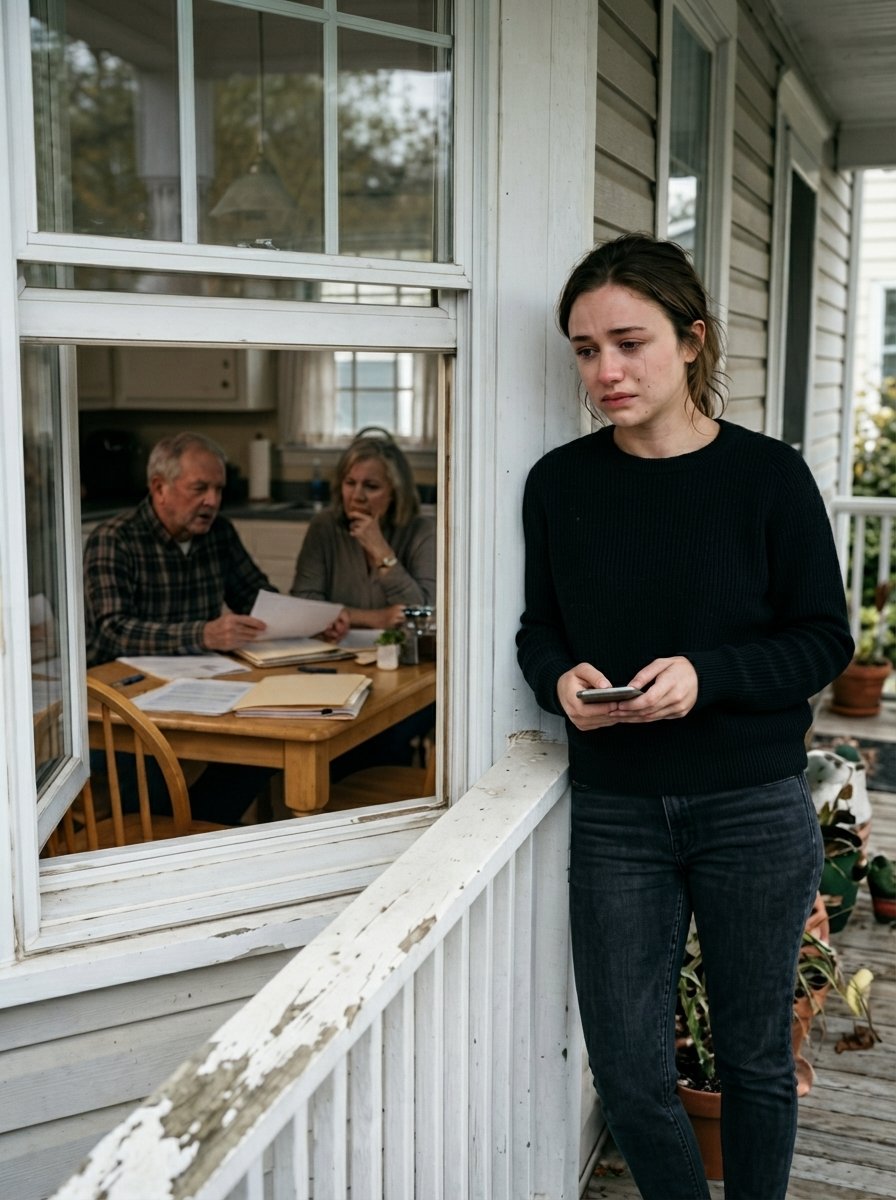
The kitchen window was open that day.
I think about that too—how easily it could have been closed, how I could have knocked, walked in, been embraced by lavender perfume and “we’re here for you now,” and never known what was actually being planned three feet away from where I would have been sitting.
But the window was open.
And Nathan, eighteen months before he died, had already made sure that whatever I heard through it wouldn’t be able to take anything from me.
That was the whole of it, in the end.
Not revenge. Not even justice, exactly, though some justice followed.
Just a man who paid attention, and loved someone enough to build something that would hold—even after he couldn’t be there to hold it himself.
THE END.