
Everyone Thought the New Mother Was Hallucinating—Until Her Baby’s Heart Really Stopped
PART 1 — The Fourth Visit
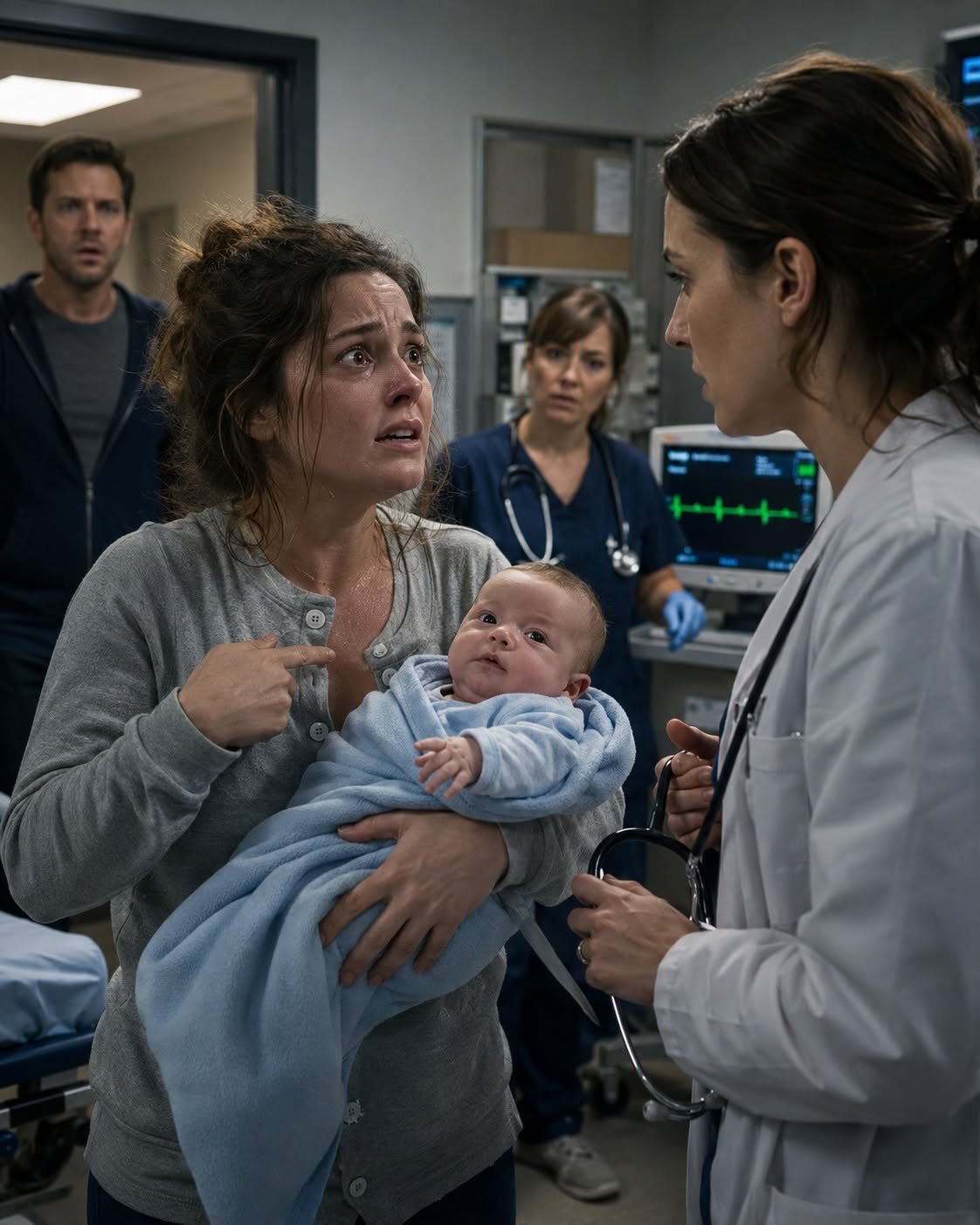
At 2:17 in the morning, the emergency-room doors opened and Claire Bennett rushed inside barefoot.
Her six-week-old son was pressed tightly against her chest beneath a pale blue blanket. Claire’s hair was tangled, her sweatshirt was buttoned incorrectly, and a dark stain of breast milk had dried across the front.
She reached the reception desk, struggling to breathe.
“Please check him.”
The nurse looked at the infant.
“What happened?”
Claire pulled the blanket away from his face.
“Make sure he still has a heart.”
The nurse stared at her.
Behind the desk, another employee slowly raised her head.
Claire leaned forward and began speaking faster.
“It disappears when I close my eyes. I can hear it beating, and then it suddenly stops. When I look at him again, there’s nothing inside his chest.”
The baby opened his mouth and made a small irritated sound.
His skin was pink. His eyes moved toward the fluorescent lights, and his chest rose and fell normally.
The nurse typed Claire’s name into the computer.
Then she saw the red note attached to the file.
This was Claire Bennett’s fourth visit in less than forty-eight hours.
During the first visit, she claimed her baby’s heartbeat became silent after he cried.
The second time, she said his chest looked hollow.
On the third visit, she demanded an ultrasound because she believed his heart had “slipped behind his ribs.”
Every examination had been normal.
A pediatrician had listened to the baby’s heart. A chest X-ray had shown nothing concerning. Blood tests were normal, and an electrocardiogram showed no obvious problem.
Claire had been discharged each time with instructions to rest, contact her obstetrician and seek treatment for severe postpartum anxiety.
Now she was back again.
The triage nurse attached a pulse oximeter to the baby’s foot.
“His oxygen level is one hundred percent.”
“That doesn’t prove his heart is still there.”
“His heart rate is one hundred fifty-two.”
“Then prove it.”
The nurse took a slow breath.
“We’ll have a doctor examine him.”
Claire nodded, but she did not relax.
She carried the baby into an examination room and refused to place him inside the crib.
When a nurse tried to attach cardiac leads to his chest, Claire watched every movement.
“Don’t cover him.”
“I need to place the stickers.”
“I have to see his chest.”
“You’ll still be able to see him.”
“If I can’t see it, it disappears.”
Dr. Maya Chen had been standing in the doorway long enough to hear the last sentence.
Maya was a pediatric emergency physician with twelve years of experience. She had treated parents who misunderstood symptoms and parents whose fear made every newborn sound seem dangerous.
But Claire did not appear dramatic.
She appeared terrified.
Maya entered the room.
“Claire, tell me exactly what happened tonight.”
Claire held the baby even closer.
“His name is Eli.”
“All right. Tell me what happened to Eli.”
“He woke up crying at 1:43. I picked him up, and I heard his heart inside my head.”
“Did you hear it through your ear?”
“No. Inside.”
Claire pressed two fingers against her temple.
“It was loud, like someone knocking from inside a wall. Then I closed my eyes because I was tired, and the knocking stopped.”
“What did Eli look like?”
Claire hesitated.
“He became quiet.”
“Did he stop breathing?”
“I don’t know.”
“Did his lips turn blue?”
“No.”
“Did his body become stiff or limp?”
“I don’t know. When I opened my eyes, his chest looked empty.”
Maya examined the baby.
His heartbeat was rapid but regular. There was no murmur. His lungs were clear, his circulation was normal, and he reacted strongly when Maya touched his cold foot.
Everything about him appeared healthy.
The door opened, and a man wearing jeans and a wrinkled dress shirt entered.
“Claire.”
She immediately turned away from him.
Daniel Bennett stood inside the doorway, breathing heavily as though he had run across the parking lot.
He looked at Maya.
“I’m her husband.”
“Where were you tonight?”
“At my mother’s house. Claire told me she needed space.”
Claire stared down at Eli.
“I told you not to come.”
“You took him without his car seat.”
“I held him.”
“You drove here while holding a newborn?”
“I couldn’t strap him in while his heart was gone.”
Daniel closed his eyes.
Maya saw exhaustion in his face, but there was something else too.
Fear.
Not fear for the baby.
Fear of his wife.
“I’m sorry,” Daniel said. “She hasn’t slept properly since Eli was born. Maybe an hour at a time.”
“I sleep,” Claire protested.
“You stand over his crib all night.”
“Because no one else checks him.”
“I check whether he’s breathing.”
“You don’t check whether everything is still inside him.”
Daniel looked helplessly at Maya.
“This started about two weeks after we brought Eli home. Claire says parts of him disappear. His chest, his mouth—once she said his eyes were gone.”
“They were gone,” Claire whispered. “For several seconds.”
Dr. Aaron Blake, the senior emergency resident, entered while reading Claire’s chart.
He glanced at the monitor and then at the infant.
“Normal heart rate. Normal oxygen. Normal temperature. Normal ECG yesterday and a normal chest X-ray the day before.”
Claire tightened her arms around Eli.
“You don’t believe me.”
Blake kept his voice controlled.
“I believe what you’re experiencing feels real.”
“That’s what people say when they think someone is insane.”
“No one used that word.”
“You wrote postpartum anxiety.”
“That is a medical condition.”
“You think I’m going to hurt him.”
Daniel looked downward.
Claire noticed.
“You do.”
“Claire—”
“You think I’m dangerous.”
“I think you need help.”
“I brought our son to a hospital.”
“Four times.”
“Because you kept telling me to ignore what was happening.”
Blake stepped closer.
“Claire, have you ever thought about hurting yourself?”
“No.”
“Have you ever thought about hurting Eli?”
Her expression changed instantly.
“No.”
“Have you ever believed Eli was possessed, replaced or not really your child?”
“No.”
Daniel spoke quietly.
“Yesterday, she said someone had switched him.”
Claire looked at him as though he had struck her.
“For three seconds. His face looked wrong.”
Blake nodded.
“I would like a psychiatric evaluation.”
Claire stood so quickly that the monitor wire pulled tight.
“You are not taking him.”
“No one said we were.”
“You’ll lock me somewhere and give him to Daniel.”
“Claire, please sit down.”
She backed against the wall.
Eli began crying.
Claire tried to soothe him.
Then her body suddenly became still.
Her eyes remained open.
Her right hand stopped halfway across Eli’s back, and her lips moved twice in a small chewing motion.
Maya watched closely.
“Claire?”
There was no response.
“Claire, can you hear me?”
Her fingers twitched.
Eight seconds passed.
Then Claire blinked.
She looked around the room.
“Why is everyone staring at me?”
Daniel moved toward her.
“You did it again.”
“Did what?”
“You disappeared.”
Maya gently took Eli from Claire’s arms before she could object.
“What is the last thing you remember?”
“Him crying.”
“Do you remember me asking whether you could hear me?”
“No.”
“Do you remember Daniel walking toward you?”
“No.”
Blake’s expression changed.
This was not only a frightened mother refusing reassurance.
Claire had just experienced a brief episode of impaired awareness.
Possibly a focal seizure.
Maya looked toward Blake.
“Stop the psychiatric transfer.”
“Why?”
“Because this may be neurological.”
Claire reached toward her baby.
At that exact moment, Eli suddenly stopped crying.
His entire body softened for less than a second.
Then he inhaled sharply and began screaming again.
No one noticed.
No one except Claire.
She pointed at him with a trembling hand.
“There.”
Her voice broke.
“It happened again.”
PART 2 — Two Patients
Claire was admitted to the neurological observation unit before sunrise.
Eli remained in the pediatric emergency department with Daniel.
For the first time since entering the hospital, Claire was separated from her son.
She fought the transfer until Maya promised that Eli would remain connected to a cardiac monitor.
“You cannot let anyone turn it off,” Claire said.
“We won’t.”
“Not even when he sleeps.”
“We’ll keep him monitored.”
“You have to watch him when he cries.”
Maya paused.
“Why when he cries?”
Claire looked confused by the question.
“Because that’s when it happens.”
Maya reviewed all four emergency-room visits.
In every report, Claire had mentioned crying, feeding, waking suddenly or becoming upset immediately before she believed Eli’s heart had disappeared.
Blake had dismissed the pattern as part of her obsession.
Maya was not certain it meant anything either.
But she wrote it down.
Upstairs, neurologist Dr. Lena Ortiz examined Claire.
Claire knew the name of the hospital and the current month, but initially gave the wrong year. She could repeat three words immediately but remembered only one several minutes later.
During the examination, she suddenly stared at the wall.
“What do you see?” Ortiz asked.
“A door.”
There was no door.
“What is behind it?”
“My bedroom.”
Claire tilted her head.
“Eli’s crib is empty.”
Then the image disappeared, and Claire began crying.
“I know that isn’t real.”
Ortiz sat beside her.
“Knowing something might not be real does not make it less frightening.”
“My husband thinks I’m going to hurt my baby.”
“Have you?”
“No.”
“Have you felt commanded to harm him?”
“No. I only have to keep checking him.”
Claire pressed her palm against her own chest.
“When I was pregnant, I could feel where he was. After he was born, I couldn’t tell where he was unless I touched him. Then I started hearing the heartbeat.”
“Inside your head?”
“Yes.”
“Only Eli’s heartbeat?”
“At first.”
“What do you hear now?”
Claire listened.
“The lights.”
Ortiz looked at the ceiling.
“What about them?”
“They are buzzing in a pattern.”
The fluorescent lights made a faint electrical hum, but Claire appeared to hear something more complex.
“What pattern?”
Claire whispered, “Stop, stop, stop, stop.”
Ortiz ordered an EEG, brain MRI, lumbar puncture and a full autoimmune and metabolic workup.
The first EEG did not capture a clear seizure.
The MRI showed a faint area of inflammation near the temporal lobe. The finding was subtle enough that it might have been dismissed as an imaging artifact.
Ortiz did not dismiss it.
Claire’s symptoms had appeared rapidly after childbirth:
Insomnia.
Memory gaps.
Visual distortions.
Auditory hallucinations.
Paranoia.
Episodes of impaired awareness.
Postpartum psychosis was possible.
So was epilepsy.
So was autoimmune encephalitis.
Downstairs, Eli slept in Daniel’s arms while the monitor displayed a steady rhythm.
Dr. Blake brought Daniel a cup of coffee.
“How long has Claire been like this?”
Daniel looked toward the crib.
“She was anxious during pregnancy, but normal anxious. She counted his kicks. She called the obstetrician whenever he didn’t move for an hour.”
“What happened after the delivery?”
“She stopped sleeping.”
“Even when Eli slept?”
“She said someone had to stay awake in case his organs stopped working.”
Blake entered information into the chart.
Daniel noticed.
“What are you writing?”
“That she is experiencing fixed false beliefs about the baby’s health.”
“She is not a bad mother.”
“I didn’t say she was.”
“She loves him.”
“I believe that.”
“Then why did social services contact me?”
“Because untreated postpartum psychiatric or neurological illness can place both mother and child at risk. Claire drove here while holding Eli. That alone could have killed him.”
Daniel covered his face with both hands.
“I know.”
“Until we understand what is happening, she should not be left alone with him.”
Daniel looked down at his sleeping son.
“Yesterday, I found her pressing on his ribs.”
“How hard?”
“Not hard. She said she was trying to feel the shape of his heart.”
Blake’s expression remained neutral, but Daniel saw the concern.
“She would never hurt him intentionally.”
“Intent is not the only thing that matters.”
Maya entered the room.
“I want to keep Eli overnight.”
Blake turned toward her.
“Based on what?”
“Four reported episodes of sudden silence after crying.”
“Reported by a mother experiencing hallucinations.”
“Reported consistently.”
“His tests are normal.”
“A resting ECG captures only a few seconds.”
Blake lowered his voice.
“We cannot admit every healthy infant because a parent describes impossible anatomy.”
“I’m not admitting him because she says his heart disappears. I’m admitting him because she repeatedly describes abrupt behavioral changes triggered by distress.”
Daniel looked between the two doctors.
“What kind of changes?”
“Becoming silent, pale or suddenly limp.”
“He is six weeks old. Babies sometimes do that.”
“Sometimes.”
Blake crossed his arms.
“The mother is medically unstable. The father is here. The baby has had a complete examination. We are turning a psychiatric emergency into a cardiac investigation.”
Maya looked at Daniel.
“Has Eli ever fainted?”
“He’s a baby.”
“Has he ever gone limp?”
Daniel hesitated.
“Maybe once.”
Blake looked at him.
“When?”
“Three nights ago. Claire handed him to me because she said he felt wrong. He became quiet for a second, then cried again.”
“How long?”
“One or two seconds.”
“Did his color change?”
“The room was dark.”
“Is there any family history of abnormal heart rhythms, unexplained fainting, seizures or sudden death?”
“No.”
Daniel answered quickly.
Too quickly.
Maya looked toward the doorway.
Daniel’s mother, Helen, stood there holding an overnight bag.
She had heard the question.
All the color had disappeared from her face.
Maya addressed her directly.
“Mrs. Bennett, has anyone in your family died suddenly while young?”
Helen looked at Daniel.
Then at the baby.
“No,” she said.
But her hand tightened around the bag until her knuckles turned white.
PART 3 — The Family Secret
By morning, Claire had experienced two more episodes of impaired awareness.
During one episode, she stopped speaking in the middle of a sentence and repeatedly picked at the edge of her blanket.
During another, she stared toward the corner and whispered that someone had removed the walls.
The EEG detected abnormal electrical activity over the left temporal region, although it did not capture a complete seizure.
Dr. Ortiz began anti-seizure medication while waiting for more results.
Claire cared little about the tests.
She only wanted information about Eli.
“Is his monitor still connected?”
“Yes.”
“Did he cry?”
“Babies cry, Claire.”
“Did his heartbeat change?”
Ortiz sat beside the bed.
“Your brain may be taking real sounds and sensations and interpreting them incorrectly.”
“So you think I imagined everything.”
“I think your brain is ill.”
Claire looked toward the closed door.
“An ill brain can still notice things.”
“Yes,” Ortiz answered without hesitation.
Claire finally turned toward her.
“Everyone else acts as though everything I say became worthless the moment I saw something that wasn’t there.”
“That is not how medicine should work.”
“But it is how people work.”
Ortiz had no answer.
Downstairs, Maya found Helen alone in the family waiting area.
Daniel had taken Eli into another room to feed him.
Helen stood beside the window, staring into the parking lot.
“You lied to me,” Maya said.
Helen did not turn around.
“I was tired.”
“You understood the question.”
Helen’s shoulders dropped.
“My husband died at thirty-six.”
Maya waited.
“In his sleep,” Helen continued. “There was no warning. He played tennis the afternoon before. The autopsy said sudden cardiac arrest.”
“How old was Daniel?”
“Four.”
“Was there anyone else?”
Helen closed her eyes.
“I had another son.”
Daniel had never mentioned a brother.
“His name was Michael. He was seventeen. He collapsed during basketball practice.”
“What did the doctors say?”
“His heart stopped.”
“Did they identify a cause?”
“No.”
“Was Daniel evaluated?”
Helen turned sharply.
“He was five when his father died and fifteen when Michael died. He had already spent his childhood believing death was waiting in every room. I refused to turn him into a patient too.”
“A cardiac evaluation would not have turned him into a patient.”
“You don’t know what it was like then.”
“What year did Michael die?”
“Two thousand and four.”
“Genetic testing was available.”
“So were insurance companies.”
Maya understood.
“You were afraid a diagnosis would follow Daniel for the rest of his life.”
Helen’s eyes filled with tears.
“My husband’s life-insurance claim took nearly a year. After Michael died, people asked whether we had hidden a disease. Daniel was applying to college and wanted to play sports. I thought that if he had no symptoms, perhaps he had escaped it.”
“What about when Eli was born?”
“I told myself it affected men only when they were older.”
“Michael was seventeen.”
“He was not six weeks old.”
Maya looked through the glass.
Daniel held Eli against his shoulder.
The baby appeared peaceful.
But inherited electrical disorders could occur in hearts that looked completely normal. Some rhythm conditions appeared only during physical or emotional stress.
For an infant, intense crying could act like a stress test.
Maya ordered continuous telemetry, electrolyte tests, a pediatric cardiology consultation and genetic testing for inherited rhythm disorders.
Blake objected.
“The genetic panel will not return today.”
“I know.”
“The baby has a normal QT interval.”
“Not every inherited arrhythmia causes a prolonged QT.”
“You think this is CPVT?”
“Possibly.”
Catecholaminergic polymorphic ventricular tachycardia was rare. It could cause dangerous heart rhythms during exercise, fear, pain or intense emotion, when adrenaline made the heart’s electrical system unstable.
A resting ECG could appear completely normal.
Blake looked through the glass at Eli.
“He is six weeks old.”
“Rare does not mean impossible.”
“We have a family history revealed only now and observations from a neurologically impaired mother.”
“We have a father whose brother and father both died suddenly.”
“That still does not prove the baby has the same condition.”
“No. But it proves we should not send him home.”
Blake lowered his voice.
“You are allowing Claire’s obsession to control the investigation.”
“And you are allowing her illness to discredit every observation she made.”
Neither doctor spoke for several seconds.
Then Eli began crying.
Daniel had placed him in the crib while preparing a bottle.
The baby’s face reddened.
His arms moved outward.
The monitor showed a fast but normal rhythm.
One hundred sixty.
One hundred seventy.
One hundred eighty.
Then Daniel picked him up, and the rate slowed.
Blake gestured toward the monitor.
“Normal response.”
Maya nodded.
But she did not cancel the monitoring.
Upstairs, Claire asked for a piece of paper.
She tried to draw what she saw when Eli’s heart disappeared.
The drawing did not show a missing organ.
It showed a jagged line.
Sharp peaks twisted across one another before falling into empty space.
When Ortiz saw it, she assumed Claire had drawn a picture of fear.
But when Maya visited later, Claire pushed the paper toward her.
“It doesn’t really disappear,” Claire said.
Maya sat beside her.
“What happens instead?”
“It becomes lost.”
“Where?”
Claire pointed toward the tangled lines.
“It beats too quickly to remain in one place.”
Maya studied the drawing.
“Did you see this on a monitor?”
“No. Inside my head.”
“How do you know it beats quickly?”
“I don’t know.”
Claire pressed her palms against her temples.
“I know my brain is broken. I know the doors aren’t real and the walls don’t disappear. But before my mind became this bad, Eli did something.”
“What?”
“When he cried hard, he would suddenly stop. Not calm down. Stop.”
Claire looked directly at Maya.
“Like someone had unplugged him.”
“What did he look like?”
“Pale. His mouth was open. His body felt heavy.”
“For how long?”
“One or two seconds.”
“Why didn’t you explain it that way before?”
“I tried.”
Claire began crying.
“But every time I said his heart disappeared, everyone stopped listening to the rest.”
That evening, Daniel signed a safety agreement stating that Claire would not be left alone with Eli until her condition stabilized.
He hated himself for signing it.
But when he visited her, she did not recognize him.
Claire stared at his face and backed against the raised hospital bed.
“Where is my husband?”
“It’s me.”
“No.”
“Claire, it’s Daniel.”
“You are wearing his eyes.”
Daniel stopped.
A nurse asked him to leave.
He returned downstairs and found Helen sitting beside Eli’s crib.
“You told them,” he said.
“I had to.”
“You should have told me twenty years ago.”
“I was trying to protect you.”
“My father and brother died from something that might be inside my son, and you protected me by hiding it?”
“I didn’t know.”
“You made sure no one could know.”
Helen’s face crumpled.
“I had already lost my husband and one child. I could not spend the rest of my life waiting to lose you.”
Daniel looked toward Eli.
“You made sure I never knew what signs to watch for.”
At 11:08 that night, a technician entered to draw blood from the baby’s heel.
Eli woke screaming.
His heart rate increased.
The technician finished quickly, covered his heel and left.
Daniel picked up his son.
Eli’s crying suddenly stopped.
For three seconds, his body sagged.
The monitor flashed an irregular pattern.
Then the rhythm returned to normal.
By the time the nurse entered, Eli was crying again.
“The lead came loose,” Daniel said.
The nurse checked all three stickers.
They were firmly attached.
PART 4 — The Three Seconds Everyone Almost Ignored
The monitor alarm had lasted less than four seconds.
The bedside nurse documented it as an artifact.
Dr. Blake agreed.
Infants moved frequently. Leads shifted. Electrical interference could produce strange patterns that looked dangerous even when they were not.
Daniel desperately wanted to believe that explanation.
Ten minutes later, Eli was feeding normally.
Maya refused to believe anything until she examined the stored tracing.
She opened the monitor record and enlarged the segment.
The rhythm began as ordinary sinus tachycardia.
Then the beats changed shape.
The pattern became chaotic, with the electrical direction alternating from beat to beat.
Three-point-two seconds later, it ended.
Maya immediately contacted pediatric cardiology.
Dr. Samuel Reed arrived twenty minutes later, still carrying a bicycle helmet clipped to his backpack.
He studied the tracing silently.
“It could be artifact,” Blake said.
Reed enlarged the image.
“The baseline is stable.”
“The baby was moving.”
“Movement usually distorts the entire tracing. Here, the individual complexes are changing while the baseline remains clean.”
Maya pointed toward the alternating pattern.
“Bidirectional ventricular tachycardia?”
“Possibly.”
Daniel stood behind them.
“Is that dangerous?”
Reed turned toward him.
“It means the lower chambers of Eli’s heart may have briefly taken control with an abnormal rhythm.”
“Did his heart stop?”
“No. But it may have been beating in a way that did not pump blood properly.”
Daniel looked at Maya.
“Is this what Claire was seeing?”
“We do not know.”
“But it happened after he cried.”
“Yes.”
The room became silent.
Blake stared at the baby.
“We need a longer episode to confirm it.”
Daniel’s face hardened.
“You need his heart to fail for longer?”
“That isn’t what I meant.”
“It is what you said.”
Reed ordered Eli transferred to the pediatric intensive care unit. He requested continuous high-resolution heart monitoring and began medication to reduce adrenaline’s effect on the heart.
Blake remained uncertain.
“One brief event.”
“With two unexplained sudden deaths in the father’s family,” Reed said.
“That history could support several conditions.”
“Exactly. That is why we do not send this child home.”
For the first time, Daniel understood why Claire had refused to leave the hospital.
He went upstairs to visit her.
Claire was awake but had soft restraints around her wrists after attempting to remove her IV during a confused episode.
She looked at Daniel.
This time, she recognized him.
“Where is Eli?”
“In intensive care.”
Her face became still.
“What happened?”
“The monitor recorded an abnormal heart rhythm.”
She closed her eyes.
A tear moved down her cheek.
“I told you.”
Daniel sat beside the bed.
“I know.”
“No. You thought I was dangerous.”
“I was afraid.”
“You let them take him away.”
“I believed I was protecting him.”
“From me.”
Daniel looked downward.
Claire’s voice softened.
“I was afraid of myself too.”
That confession hurt more than anger.
Daniel reached toward her hand, stopping before he touched it.
“Do you know who I am right now?”
“Yes.”
“Are you certain?”
“No.”
He covered his mouth.
Claire looked at him.
“Sometimes your face changes. Sometimes Eli’s face changes. Sometimes I hear his heartbeat in the pipes. I know those things are not real.”
She lifted her restrained wrist slightly.
“But I also knew something was happening to him.”
Daniel took her hand.
“I’m sorry.”
“You cannot make this only about being sorry.”
“I know.”
“You must believe the doctors when they say my brain is sick.”
“I do.”
“And you must believe that I am still his mother.”
Daniel nodded with tears in his eyes.
“I do.”
Claire squeezed his fingers.
“Then go watch him.”
After Daniel left, Dr. Ortiz entered with the first meaningful laboratory result.
Claire’s spinal fluid showed signs of inflammation.
Additional antibody testing was still pending, but the combination of seizures, hallucinations, cognitive changes and temporal-lobe abnormalities strongly suggested autoimmune encephalitis triggered during the postpartum period.
Claire’s immune system appeared to be attacking proteins involved in brain signaling.
Her fear was not a character flaw.
Her hallucinations were not intentional.
Her brain was misfiring.
Ortiz recommended immediate treatment with high-dose steroids and intravenous immunoglobulin.
“Will I recover?” Claire asked.
“We believe you can.”
“Will I remember my son?”
“Recovery may take time.”
“How long?”
“Weeks, perhaps months.”
Claire stared toward the window.
“What if he learns who I am while I’m gone?”
“What do you mean?”
“What if the version of me he knows is the mother who keeps checking whether his heart exists?”
Ortiz pulled her chair closer.
“He is six weeks old. He knows your voice, your smell and the way you hold him.”
“I don’t trust the way I hold him.”
“Then other people will help until you do.”
Claire swallowed.
“You won’t tell me I am imagining everything?”
“No.”
“Even when I am?”
“We will tell you what we can confirm. But we will not stop listening.”
Downstairs, Eli remained stable for twelve hours.
His echocardiogram was normal.
His electrolytes were normal.
Repeated ECGs showed no prolonged QT interval, conduction abnormality or structural defect.
Daniel began hoping the brief monitor event had been a mistake.
Helen sat beside him in the intensive care unit.
“I should go home,” she said.
Daniel did not answer.
“I know you hate me.”
“I don’t hate you.”
“That is worse.”
“I don’t have enough energy to hate you.”
Helen looked into the crib.
“Your father used to look at you like that.”
Daniel’s jaw tightened.
“Don’t.”
“I thought silence would keep the past buried.”
“Silence is why we almost took him home.”
“I know.”
A metal cart crashed in the hallway.
Eli startled.
His arms spread wide.
The monitor alarm began before he could cry.
End Part Here: Everyone Thought the New Mother Was Hallucinating—Until Her Baby’s Heart Really Stopped