
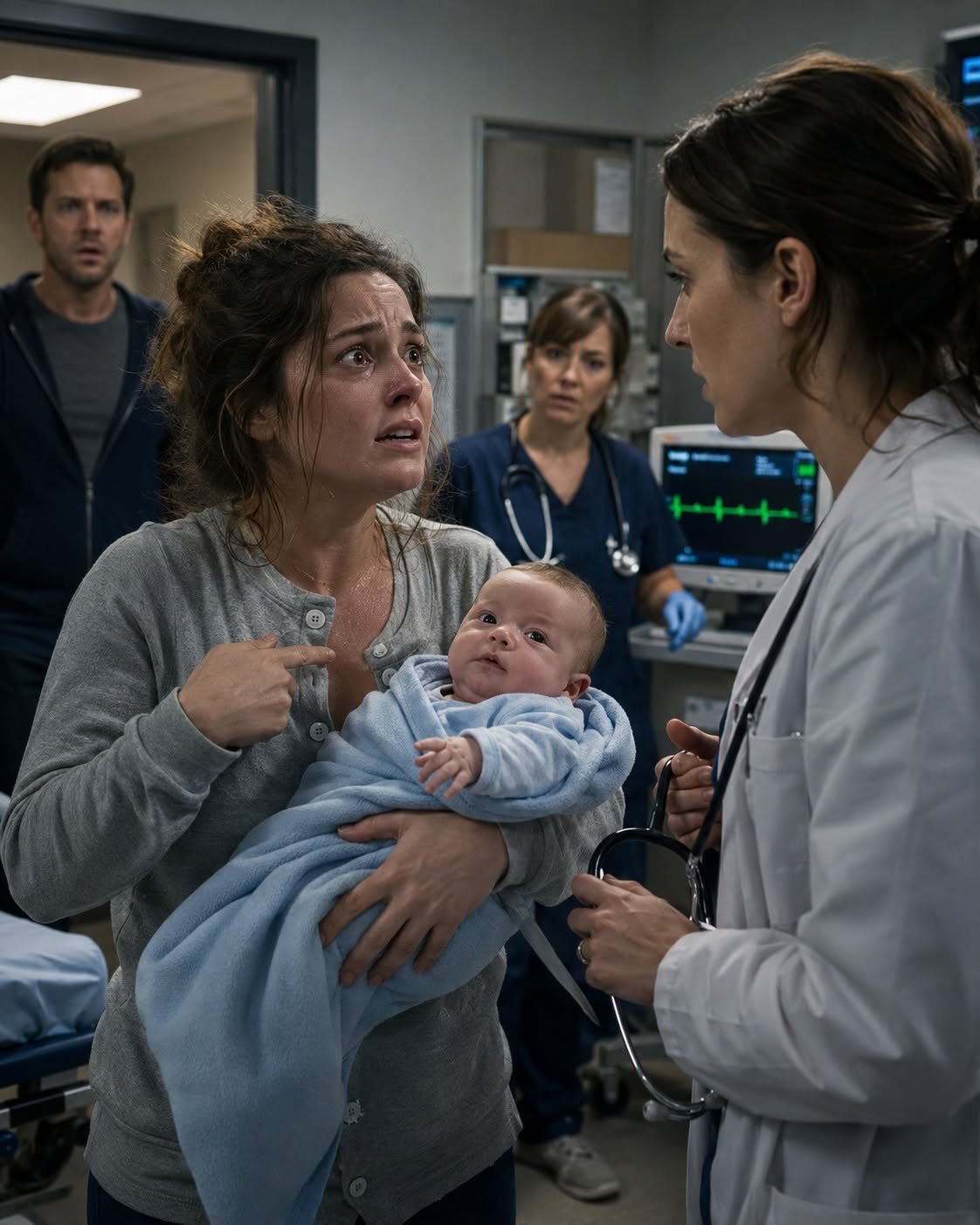
PART 5 — The Heart That Stopped
Eli’s heart rate jumped from one hundred forty to more than two hundred twenty within seconds.
Then the rhythm changed.
The monitor displayed alternating wide complexes twisting in opposite directions.
Daniel stood so quickly that his chair fell backward.
“What is that?”
Helen lifted Eli from the crib.
The baby opened his mouth, but no sound came out.
His skin turned gray around the lips.
“Put him down!” the nurse shouted.
Helen froze.
The nurse took Eli and placed him flat inside the crib.
“Call the emergency team.”
Daniel moved toward his son, but another nurse blocked him.
“What is happening?”
“His heart is in a dangerous rhythm.”
Eli’s eyes remained open.
His body became limp.
The rhythm deteriorated further.
Dr. Reed rushed into the room with Maya and the intensive-care team.
“Check for a pulse.”
“I cannot feel one.”
“Begin compressions.”
Daniel made a sound Maya would remember for years.
It was not a word.
It was the sound of a father watching his worst fear become real.
A nurse began chest compressions using two fingers.
Reed ordered the defibrillator.
“Charge to two joules per kilogram.”
The gel pads were already attached to Eli’s chest.
The machine charged.
“Clear.”
The shock lifted the baby’s body slightly from the mattress.
The monitor continued showing ventricular tachycardia.
“Continue compressions.”
Helen stood against the wall with both hands over her mouth.
“I did this.”
Daniel turned toward her.
“You picked him up.”
“I startled him.”
“The cart startled him.”
“I picked him up.”
“Stop.”
“I killed him.”
“He is not dead!”
Daniel shouted so loudly that the room became silent for half a second.
Then Reed ordered another shock.
Upstairs, Claire was receiving intravenous immunoglobulin when she suddenly turned toward the doorway.
A nurse adjusted the infusion pump.
“What is it?”
Claire stared into the hall.
“The knocking stopped.”
The nurse looked at the monitor attached to Claire.
Her own heart rhythm was normal.
“What knocking?”
“Eli.”
“Claire, Eli is downstairs.”
“His heart is gone.”
Claire began pulling at the bedrail.
“No. No. No.”
Her eyes rolled upward.
Her right arm stiffened, followed by her left.
The seizure spread through her entire body.
The nurse turned her onto her side and activated the emergency alarm.
Two floors apart, mother and son were surrounded by medical teams.
Claire’s brain was convulsing.
Eli’s heart was failing.
In the intensive care unit, Reed delivered the second shock.
For one terrible moment, the monitor showed no organized rhythm.
Then a narrow heartbeat appeared.
Another followed.
The numbers slowly increased.
Seventy.
Ninety.
One hundred twenty.
“I have a pulse,” the nurse announced.
No one moved.
They waited to make sure the rhythm remained stable.
Eli made a small gasping sound.
Daniel’s knees gave way.
Maya caught his arm before he fell.
“Is he alive?”
“Yes.”
“Is he alive?”
“Yes, Daniel. His heart is beating.”
Reed ordered medication to stabilize the rhythm and prepared for intubation.
Eli began breathing more effectively before the breathing tube was inserted, but the team continued oxygen and close monitoring.
Daniel pressed both hands against the glass wall.
His son lay beneath wires, pads and blankets.
The baby looked impossibly small.
“Claire knew,” Daniel whispered.
Maya remained silent.
“She knew every time.”
“She noticed something.”
“She heard his heartbeat.”
“Not literally.”
“How do you know?”
“Because her neurological illness can create sounds and sensations that feel completely real.”
“So she imagined it.”
“She may have imagined the way it appeared. But she may have been reacting to a real change in his behavior.”
Daniel looked at Maya.
“What is the difference?”
“Her interpretation was distorted. Her observation was not necessarily false.”
He looked through the glass.
“We acted as if nothing she said mattered.”
Maya remembered every phrase written in Claire’s chart.
Anxious mother.
Repeat visitor.
Fixed delusion.
Reassurance unsuccessful.
“No,” Maya said. “We acted as though her diagnosis erased her credibility.”
Upstairs, Claire’s seizure stopped after emergency medication.
When she regained consciousness, Dr. Ortiz was beside her.
Claire’s first word was Eli’s name.
Ortiz hesitated.
That was enough.
“What happened to him?”
“He developed an abnormal heart rhythm.”
Claire began sobbing.
“Is he dead?”
“No.”
“Do not lie to me.”
“He is alive. The medical team restored his normal rhythm.”
Claire closed her eyes.
“I cannot hear him anymore.”
“That may be a good thing.”
“How?”
“Because the sounds inside your head are part of the illness.”
“What if they were the only thing connecting me to him?”
Ortiz held Claire’s hand.
“They were not.”
“I want to see him.”
“When you are medically stable.”
“I am his mother.”
“Yes.”
“Then don’t say it like that is a reason to keep me away.”
Ortiz leaned closer.
“You are his mother. That is why we need you alive, treated and able to hold him safely.”
Claire’s anger slowly faded.
“Did Daniel stay with him?”
“Yes.”
“Tell him not to leave.”
“I will.”
“And tell him no one can turn off the monitor.”
Ortiz almost smiled.
“No one is turning it off.”
PART 6 — Sick, but Not Wrong
Three days later, the cardiology team confirmed Eli’s diagnosis.
He had catecholaminergic polymorphic ventricular tachycardia, an inherited electrical disorder that caused dangerous rhythms during sudden surges of adrenaline.
Crying, pain, fear or startling could trigger an episode.
His resting ECG had appeared normal because his heart’s electrical activity returned to normal between attacks.
Genetic testing revealed a mutation that affected calcium movement inside the heart muscle cells.
Daniel carried the same mutation.
So did Helen.
Daniel’s father and brother Michael had never been tested, but their sudden deaths strongly suggested that the disorder had existed in the family for generations.
Eli began medication designed to reduce adrenaline’s effect on his heart.
The team discussed additional treatment and arranged close follow-up with a pediatric heart-rhythm specialist.
Daniel also began medication and was instructed to avoid intense physical exertion until his own evaluation was complete.
Helen listened silently throughout the entire family meeting.
When Reed finished, she asked one question.
“If I had told someone earlier, would Michael still be alive?”
Reed did not offer false reassurance.
“I cannot know.”
“What about my husband?”
“We cannot know that either.”
Helen looked at Daniel.
“I thought that not knowing was the same as being safe.”
“It wasn’t,” Daniel answered.
“No.”
“It only meant we were unprepared.”
Helen began crying.
Daniel did not comfort her.
But he did not leave.
Upstairs, Claire’s antibody results supported the diagnosis of autoimmune encephalitis.
Doctors explained that her immune system had likely become dysregulated after childbirth, causing inflammation in parts of her brain involved in perception, memory, emotion and seizure control.
Treatment slowly began helping.
The hallucinations became less frequent.
The periods of lost awareness became shorter.
But recovery was uneven.
One morning, Claire knew the exact date and remembered every nurse’s name.
That afternoon, she asked why she was still pregnant.
Another day, she believed the IV line was carrying another person’s memories into her body.
Then the confusion would clear, leaving her horrified by what she had said.
Daniel visited whenever the medical team believed it was safe.
He brought printed photographs of Eli because Claire was not yet allowed inside the intensive care unit.
In one photograph, Eli slept with his fist beside his cheek.
In another, he stared directly at the camera.
Claire studied the pictures.
“Were these taken today?”
“The second one was.”
“His face looks different.”
“He has gained a little weight.”
“No. I mean different from how I remember him.”
Daniel waited.
Claire touched the edge of the photograph.
“I don’t know whether my memory is wrong or the photograph is wrong.”
“The photograph is real.”
“Are you sure?”
“Yes.”
Claire nodded.
“Then I will borrow your certainty.”
Daniel sat beside her.
“I need to tell you something.”
“You believed I was dangerous.”
“Yes.”
“I know.”
“I signed the safety plan.”
“I know that too.”
“I should have listened to you.”
Claire looked directly at him.
“You should have listened to the details. You should not have believed the impossible parts.”
He frowned.
“What?”
“I told you his heart disappeared. That was impossible.”
“But something was wrong.”
“Yes. Both things can be true.”
Daniel lowered his head.
“I don’t know how to forgive myself.”
“This is not about forgiving yourself.”
“What is it about?”
“Learning what to do the next time I say something frightening.”
“What should I do?”
“Ask what I saw before deciding what it means.”
Daniel nodded.
“And if you believe I might hurt him?”
“You protect him.”
Claire’s voice trembled.
“But tell me the truth. Do not whisper about me outside the room as if I have already disappeared.”
Daniel took her hand.
“I promise.”
One week after Eli’s cardiac arrest, Dr. Blake visited Claire.
He remained near the doorway, visibly uncomfortable.
“I owe you an apology.”
Claire said nothing.
“I reviewed your previous visits. You repeatedly reported that Eli became pale, silent and limp after crying. Those details were in the notes, but they were overshadowed by your statements about his heart disappearing.”
“You wrote some of those notes.”
“Yes.”
“You believed I wanted attention.”
“I considered that possibility.”
“Did you consider that I was exhausted because something happened every night?”
“Not enough.”
Claire looked toward the window.
“Would you have believed Daniel if he brought Eli here four times?”
Blake’s expression changed.
“I don’t know.”
“That means yes.”
He accepted the accusation without defending himself.
“I was wrong.”
“You were partly wrong.”
Blake looked at her.
“I was sick. I drove while holding Eli. I was not safe.”
“That does not justify dismissing the medical information you gave us.”
“No.”
Claire looked directly at him.
“Then write that in my chart.”
Blake opened the medical record.
“What should I write?”
“That the mother’s interpretation was distorted by neurological illness, but her repeated observations of sudden pallor, limpness and silence were medically significant.”
He typed the sentence.
Claire watched until he finished.
“Anything else?”
“Yes.”
He waited.
“Write that having a mental illness does not make someone incapable of noticing when another person is sick.”
Blake typed that too.
PART 7 — FINAL: The Heartbeat Between Them
Claire saw Eli again twenty-three days after his cardiac arrest.
By then, the worst hallucinations had faded.
She still occasionally lost words. Sometimes she woke without knowing whether she was at home or in the hospital.
Sudden sounds frightened her because they sometimes triggered flashes of images that were not real.
But she recognized Daniel every day.
She remembered Eli’s birth.
She remembered the shape of his ears, the small birthmark near his left knee and the way his lower lip trembled before he cried.
The medical team arranged their reunion inside a quiet family room.
Daniel entered carrying Eli, who was connected to a portable heart monitor.
The baby was awake.
Claire stood beside the window with Dr. Ortiz and Maya.
When she saw him, she did not move.
Daniel stopped several feet away.
“Claire?”
Her hands began shaking.
“Is that him?”
“Yes.”
“Are you certain?”
Daniel’s eyes filled with tears.
“Yes.”
Claire stared at the monitor.
A green line moved steadily across the screen.
“Is that his heart?”
“It is his rhythm.”
“Is it real?”
“Yes.”
She took one step forward.
Then another.
Eli turned toward her voice.
Claire made a small sound and covered her mouth.
“He recognizes me.”
Daniel smiled through his tears.
“I told you he would.”
Claire reached out, then stopped before touching the baby.
“What if I hold him incorrectly?”
“We will help you,” Maya said.
“What if I see something that is not there?”
“Tell us.”
“What if I hear his heart stop?”
“We will check the monitor.”
“What if the monitor is wrong?”
“Then we will examine him.”
Claire looked at Maya.
“You will believe me?”
“We will listen to you. Then we will verify everything we can.”
Maya removed a stethoscope from her pocket and placed it in Claire’s hands.
Claire sat in a chair.
Daniel carefully lowered Eli into her arms.
For several seconds, Claire held him without breathing.
Eli moved against her chest.
His small hand closed around the fabric of her hospital gown.
Claire began crying.
“I’m sorry,” she whispered.
Daniel knelt beside her.
“You do not need to apologize to him.”
“I left him.”
“You were sick.”
“I frightened him.”
“He is six weeks old. His own hands frighten him.”
Claire laughed softly through her tears.
The sound startled Eli.
His face tightened.
Claire immediately looked toward the monitor.
The rhythm remained normal.
She looked back at her son.
“He is going to cry.”
“Yes,” Daniel said.
“What should I do?”
“Hold him.”
Eli began to fuss.
Claire’s body tensed, but she did not hand him away.
She placed the stethoscope against his chest.
At first, her shaking hand made it difficult to hear anything.
Then the sound came through.
Fast.
Soft.
Steady.
A real heartbeat.
Not inside the walls.
Not beneath the lights.
Not inside her head.
Inside her son.
Claire closed her eyes.
Daniel watched her carefully.
Maya watched the monitor.
The heartbeat continued.
Claire opened her eyes.
“It is still there.”
“Yes,” Maya said.
For the first time since Eli’s birth, Claire did not check again immediately.
She simply held him.
Over the following months, Claire continued neurological rehabilitation.
She attended therapy, took anti-seizure medicine and received additional immune treatment.
Daniel handled the nighttime feedings while Claire rebuilt a healthy sleep routine.
Helen completed genetic counseling and began volunteering with an organization that encouraged medical screening after unexplained sudden deaths in families.
Eli required frequent appointments and careful monitoring.
His parents learned how to recognize dangerous symptoms and how to respond during an emergency.
They also learned that they could not raise him as though every cry would become another cardiac arrest.
Some nights, Daniel still woke to find Claire standing beside the crib.
But she no longer pressed her fingers against Eli’s ribs.
She watched the monitor, breathed slowly and reminded herself that fear was not the same as evidence.
One night, Daniel joined her.
“What do you hear?” he asked.
Claire listened carefully.
The air conditioner.
A car passing outside.
Eli making a small sound in his sleep.
“Nothing else,” she answered.
“Does that frighten you?”
“A little.”
Daniel took her hand.
They stood together beside the crib.
The monitor’s green light blinked steadily.
Claire looked at her sleeping son.
Months earlier, silence had meant his heart was gone.
Now silence meant he was resting.
She turned off the hallway light.
Then she closed her eyes.
There was no pounding inside her head.
No invisible door opened.
No voice told her that her baby was empty.
When Claire opened her eyes again, Eli was still there.
She smiled and whispered into the darkness:
“I don’t need to hear your heart every second to know you have one.”
END
Thank you for reading this story. I’d love to hear your honest opinion below.