Everyone Thought She Had Lost Her Mind—Until Her Eyes Spelled “HELP”
PART 1 — The Message in Her Eyes
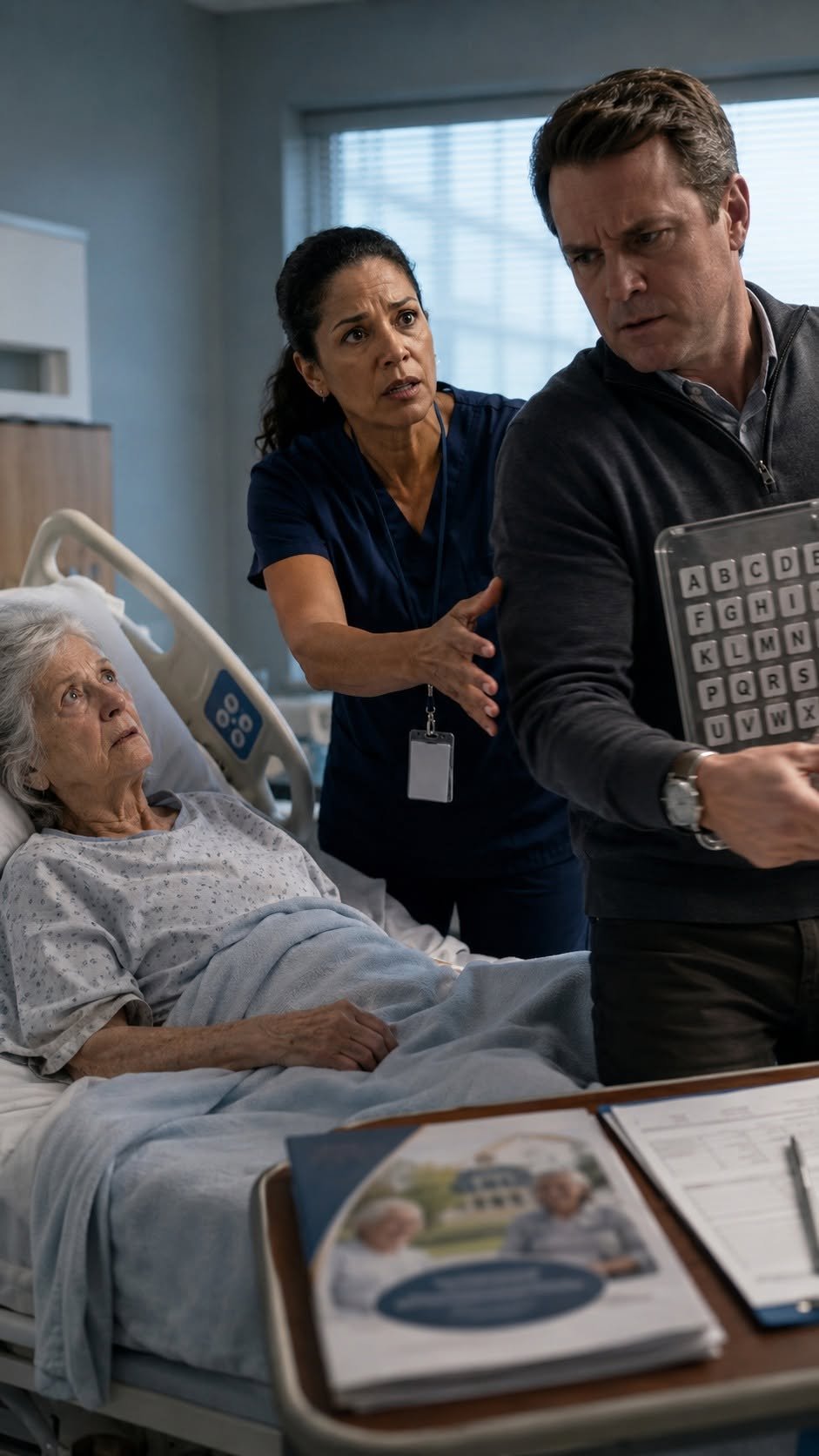
Dean Shaw tore the transparent alphabet board from my hands just as his mother’s eyes reached for the final letter.
“Stop upsetting her,” he snapped.
Margaret Shaw lay motionless beneath a pale hospital blanket. Her face remained turned toward the board now pressed against her son’s chest.
A stroke had taken away her speech and most of the movement on the right side of her body.
According to Dean, it had also taken her ability to understand anything.
“She doesn’t know what she’s doing,” he said. “The doctors already told you she has severe dementia.”
My name is Elena Ruiz, and I was the occupational therapy assistant assigned to Margaret’s rehabilitation sessions.
For three mornings, I had watched doctors, nurses and family members ask her questions, wait only a few seconds, then turn to Dean for the answers.
Dean told them what she wanted to eat.
He told them she no longer recognized her children.
He told them she had willingly given him control over every medical decision.
Now he had arranged to move her the following morning to a locked memory-care facility.
He had also canceled the rest of her rehabilitation before anyone had properly tested whether she could communicate in another way.
“She needs safety,” Dean said, placing the transfer papers beside her bed. “Not false hope.”
But I had seen where Margaret’s eyes were moving before he interrupted us.
H.
E.
L.
She had been straining toward the letter P.
After Dean left the room, I brought in another communication board.
Before asking Margaret anything emotional, I needed to determine whether her eye movements were intentional.
“Look up for yes,” I told her. “Look down for no.”
Then I began with simple questions.
“Is your name Margaret?”
Her eyes moved upward.
Yes.
“Is my name Susan?”
Her eyes moved down.
No.
“Is the cup beside you blue?”
Up.
Yes.
“Was the television playing when I entered?”
Down.
No.
I changed the positions of the answer cards and repeated the questions.
Margaret continued responding correctly, though every answer required painful effort.
During the final question, her eyes closed.
For a moment, I thought she had fallen asleep.
Then she opened them and slowly looked toward the correct answer.
She had not been confused.
She had been exhausted.
I raised the alphabet board again.
“If you were trying to tell me something earlier, try again.”
Her gaze moved carefully across the letters.
H.
E.
L.
P.
A tear slipped from the corner of her eye toward her ear.
“Are you afraid of the place Dean wants to send you?”
Her eyes moved upward.
Yes.
“Is there someone you want us to call?”
Yes.
The next message took nearly twelve minutes.
C-A-L-L.
Then:
A-N-N-A.
Dean returned before I could ask who Anna was.
The moment he saw the alphabet board, his face hardened.
“I told you to stop this.”
“Margaret asked me to call Anna,” I said. “Who is she?”
For one brief second, Dean looked frightened.
Then his expression changed back into the exhausted concern everyone trusted.
“Anna was my sister.”
“Was?”
“She died six years ago.”
I turned the YES and NO cards toward Margaret.
“Margaret, is Anna alive?”
Her eyes shot upward.
Yes.
Dean reached for the board again.
But Margaret continued staring at the letters, forcing out the same message with every ounce of strength she had left.
C-A-L-L A-N-N-A.
And the son who claimed she understood nothing suddenly looked terrified that someone might finally listen.
PART 2 — The Calls No One Connected
Before the end of my shift, Dean filed a formal complaint against me.
He told the hospital that I had planted ideas in his mother’s mind, confused a helpless woman and interfered with a transfer he had arranged “for her dignity.”
Then he opened a thick folder filled with medication lists, insurance letters, appointment records and old medical notes.
The records showed that Margaret had occasionally forgotten her keys, missed a payment and repeated questions during appointments.
“I gave up seven years of my life to care for her,” Dean said. “Anna left. I stayed.”
His sacrifice was real enough to make the rest of his story believable.
But one detail would not leave my mind.
If Anna had been dead for six years, why had Margaret remembered her name so clearly?
At the nurses’ station, I asked whether anyone had received telephone calls for Margaret.
The night nurse became quiet.
Then she pulled out the unit’s handwritten call log.
The same number appeared again and again.
“A woman named Anna calls almost every day,” she whispered. “Dean said she was a scammer. He told us never to connect her.”
With Margaret’s eye-gaze consent, Kendra Moss, the hospital social worker, called the number.
Anna answered on the first ring.
“I’ve been calling my mother every day,” she said, already crying. “My brother told me she never wanted to hear my voice again.”
Across the room, Margaret stared at the transfer papers that would send her away the next morning.
But Dean was still legally speaking for her.
Unless we could prove that Margaret’s eye movements were deliberate and reliable, he would continue controlling every decision.
PART 3 — One More Day
I brought the call log to Dr. Priya Nair, Margaret’s rehabilitation physician, and Kendra Moss.
Dr. Nair opened Margaret’s medical chart.
“She scored extremely low on the cognitive screening,” she said.
“She couldn’t speak or point,” I replied. “Most of that test required her to do one or the other.”
“Her responses have been inconsistent.”
“Because people stop waiting,” I said. “Sometimes she needs twenty seconds before her eyes move.”
Kendra studied my notes.
I had documented every question, the exact position of the YES and NO cards and how long each response took.
“Could you have unintentionally guided her answers?” Kendra asked.
“It’s possible,” I admitted. “That’s why someone else needs to repeat the assessment.”
Dean entered the room before we could continue.
He dropped his thick folder onto the table.
“This is what caring for my mother looks like,” he said. “Not fifteen minutes with a plastic board.”
He showed them records documenting Margaret’s forgotten keys, missed payments and repeated questions.
“I gave up my job to care for her,” Dean continued. “My marriage fell apart. Anna left, and I stayed.”
That was what made him convincing.
His sacrifices were not entirely invented.
But neither was the fear I had seen in Margaret’s eyes.
“Even if she had memory problems before the stroke,” I said, “that does not prove she cannot understand what is happening now.”
Dean turned toward me.
“You have known her for three days.”
“And during those three days, she answered questions no one had given her enough time to answer before.”
He looked toward Dr. Nair.
“The facility is expecting her tomorrow. If we delay the transfer, she could lose the bed.”
Kendra examined the placement forms.
“Why does she need a locked memory-care unit instead of continued neurological rehabilitation?”
“Because rehabilitation has failed.”
“She has been here for only eleven days,” I said.
Dean’s face hardened.
“You are not the physician.”
“No,” I replied. “But I will not sign a report saying Margaret cannot participate when I have watched her participate.”
For the first time, Dean stopped pretending I was merely an overenthusiastic therapist.
“You could lose your job over this.”
Maybe I could.
But I placed my name beneath my observations and formally reported my concern that a vulnerable patient might be transferred before receiving an accessible communication assessment.
Dr. Nair closed Margaret’s file.
“I am placing a twenty-four-hour clinical hold on the transfer,” she announced. “An independent specialist will assess her first.”
Dean stared at her as though she had betrayed him.
Then he looked through the conference-room window toward his mother’s bed.
The locked facility would have to wait one more day.
But if Margaret failed the next assessment, Dean would control everything again.
End Part Here: Everyone Thought She Had Lost Her Mind—Until Her Eyes Spelled “HELP”