
PART 4 — No One Rushed Her
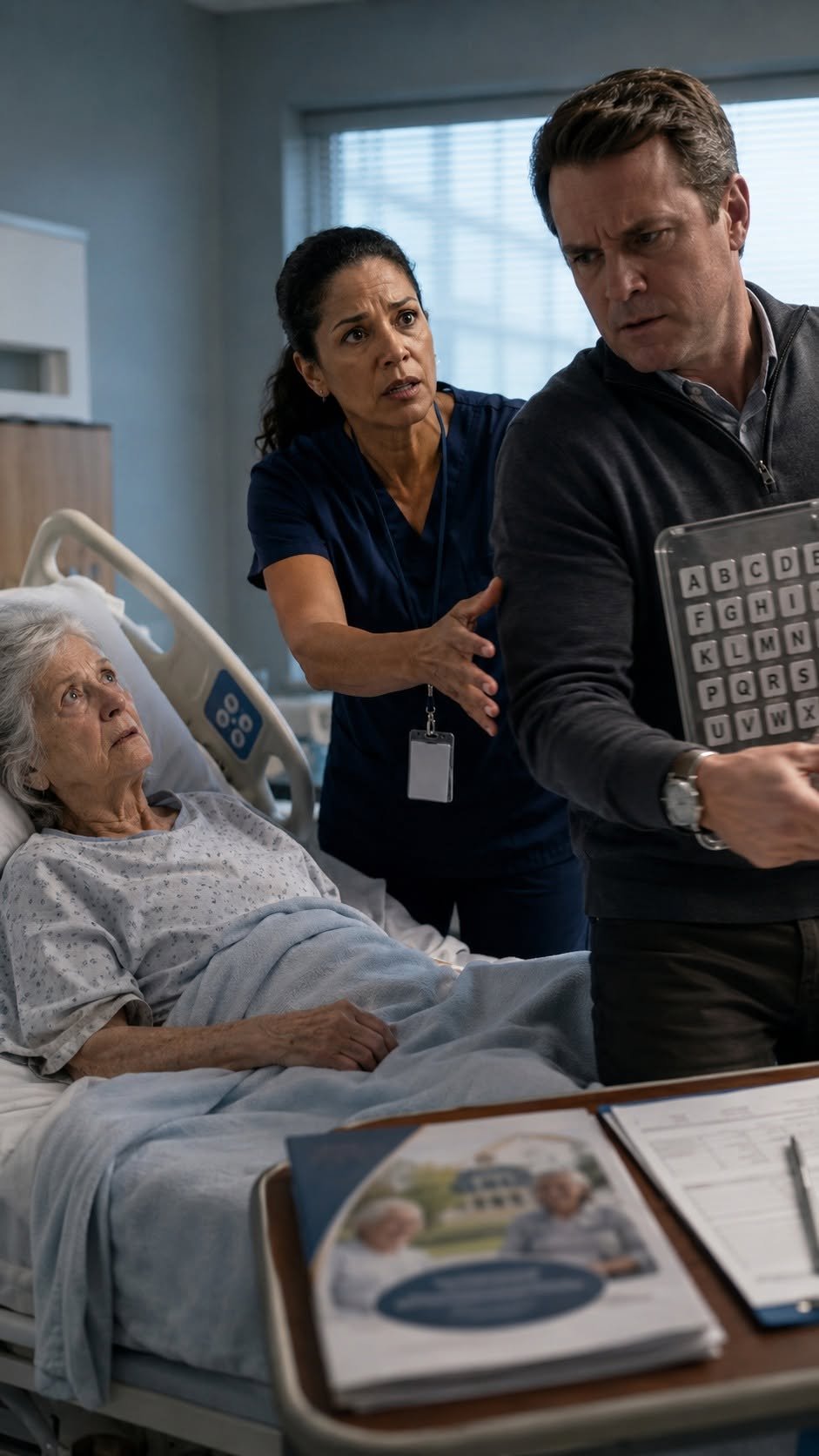
The following morning, Marcus Lee, a speech-language pathologist, entered Margaret’s room carrying unfamiliar picture cards and a different communication board.
He had not read my detailed notes.
He did not know which answers Margaret had given me.
That was intentional.
I positioned Margaret upright, adjusted the support beneath her head and moved behind her shoulder so she could not see my face.
Marcus began with simple choices.
After each question, he changed the position of every possible answer.
Margaret correctly identified a spoon, a blue cup and a photograph of the garden outside the rehabilitation wing.
Then Marcus showed her two family photographs.
“Look at your son.”
Her eyes selected Dean.
“Look at your daughter.”
She selected Anna.
Dean watched from behind the glass with his arms folded tightly across his chest.
Marcus gave Margaret three words to remember:
Garden.
Silver.
Sunday.
He then spent ten minutes asking unrelated questions.
When he returned to the three words, Margaret identified all of them correctly.
Her answers were slow.
At times, her eyes closed and sweat gathered near her hairline.
But no one rushed her.
No one treated silence as proof that her mind was gone.
Marcus then explained two possible placements in simple language.
The first was the locked memory-care facility Dean had selected.
The second was a neurological rehabilitation center where Margaret could continue receiving therapy.
“Do you understand that both places provide nursing care?” Marcus asked.
Yes.
“Do you understand that the locked facility would restrict when you could leave?”
Yes.
“Do you want to be moved there?”
No.
“Do you want continued rehabilitation?”
Yes.
Dean demanded to enter the room, claiming his mother was becoming exhausted.
Dr. Nair told him the assessment would end when Margaret asked for it to end.
Marcus placed the alphabet board in front of her.
“Tell us where you want to go.”
Margaret’s gaze traveled slowly across the letters.
N-O M-O-V-E.
After resting for several minutes, she began again.
A-N-N-A Y-E-S.
Then her eyes moved one final time.
D-E-A-N N-O.
No one in the room celebrated.
The message was far too painful for that.
Dr. Nair knelt beside Margaret’s chair.
“You have shown that you understand these questions and can communicate consistent choices,” she told her.
The transfer to the locked facility would not proceed that morning.
But before anyone could decide what happened next, Kendra’s telephone rang.
Anna Shaw had arrived at the hospital.
PART 5 — The Daughter Who Was Never Dead
Anna stopped just inside Margaret’s doorway.
She appeared to be in her mid-forties. She wore mismatched shoes and carried a purse she had forgotten to close.
She looked like someone who had driven too quickly and cried at every red light.
“Mom?”
Margaret’s eyes found her immediately.
Her face could barely move, but recognition passed across it so clearly that Anna covered her mouth with both hands.
“I didn’t know if you wanted me here,” she whispered.
Margaret looked toward the NO card.
Anna’s knees nearly gave way.
“Dean said my calls upset you. He said you blamed me for moving away.”
Margaret looked down again.
No.
“Then he told me you didn’t recognize me anymore.”
No.
“And last year, he said hearing my voice caused you so much distress that I needed to stop calling.”
A tear slipped from the corner of Margaret’s eye.
Anna took one step closer, then stopped.
“Can I touch your hand?”
Yes.
Anna placed her palm beside Margaret’s left hand instead of grabbing it.
After several seconds, Margaret moved one finger against her daughter’s skin.
It was the smallest movement in the room.
Somehow, it was also the most powerful.
“I should have come anyway,” Anna whispered. “I should have seen for myself.”
Margaret looked toward her daughter and then toward the word NO.
Dean had done more than block telephone calls.
He had convinced both women that the other had chosen the silence.
Kendra showed Anna the hospital call log.
Anna opened her telephone and displayed months of unanswered messages and daily call records.
Then she explained why she had been trying so urgently to contact her mother before the stroke.
“Mom said money was disappearing from her caregiver-benefit account,” Anna said. “She wanted me to review the statements.”
Dean had told Anna that Margaret was becoming paranoid.
A preliminary review revealed that someone had continued claiming paid caregiving hours even after Margaret entered the hospital.
There were also unexplained withdrawals that required investigation.
The money helped explain why Dean was desperate to control his mother’s transfer.
But Margaret was not a bank account.
The real issue was no longer only what Dean might have stolen.
It was whether caring for his mother had made him believe he had the right to own her voice.
A formal care conference was scheduled for the following morning.
Dean agreed to attend.
His complaint against me remained active, and he now claimed that Anna and I had worked together to manipulate Margaret.
When he entered the conference room, he placed his folder on the table and looked directly at his mother.
“Before anyone makes a decision,” he said, “you need to hear what this family was really like.”
PART 6 — “I Am Still Here”
Dean began speaking before Dr. Nair could open the meeting.
“My sister disappears for years, then returns the moment money is mentioned,” he said. “Now she wants everyone to believe she came here out of love.”
Anna stiffened beside Margaret.
Kendra raised one hand.
“We are not deciding which of you is the better child. We are determining what Margaret wants.”
“I know what she wants,” Dean replied. “I have known for years.”
Margaret sat at the head of the table in a supportive chair.
The transparent alphabet board rested in front of her.
Dean leaned toward her.
“Mom, you know I took care of you. I bathed you. I cooked every meal. I sat beside you through every appointment.”
Margaret’s eyes remained fixed on the board.
“Anna wasn’t there,” he continued. “These people don’t understand what we went through.”
Margaret looked downward.
No.
Dean’s voice sharpened.
“You’re tired. They have been testing you for two days.”
“The question was for your mother,” Kendra reminded him.
For the first time, Dean was trapped inside a room where no one accepted speed, volume or sacrifice as a substitute for Margaret’s answer.
Dr. Nair faced Margaret directly.
“Do you want Anna involved in planning your care?”
Yes.
“Do you want to continue neurological rehabilitation?”
Yes.
“Do you agree to the locked memory-care placement Dean arranged?”
No.
“Do you want Dean to continue receiving your private medical information?”
No.
Dean pushed his chair backward.
“This is absurd. She does not understand the consequences.”
Marcus calmly reviewed the assessments Margaret had completed.
The randomized answer positions.
The delayed-memory questions.
Her consistent understanding of both placement options.
Then Dr. Nair asked the most difficult question.
“Margaret, do you want Dean to visit you?”
Margaret hesitated.
Dean stared at her.
After a long rest, she looked toward the alphabet board.
F-O-R N-O-W.
Then:
N-O.
Dean’s expression collapsed inward.
Not because someone had publicly humiliated him.
Because his mother had made a decision without asking his permission.
“You don’t understand what will happen without me,” he said. “You need me.”
Margaret closed her eyes for several seconds.
When she opened them again, everyone waited.
No one completed her sentence.
No one turned toward Dean for an interpretation.
No one treated the delay as proof that she had disappeared.
Her eyes began selecting letters.
I.
A-M.
S-T-I-L-L.
H-E-R-E.
Dean opened his mouth.
But no one in the room was willing to hear his voice in place of hers again.
PART 7 — FINAL: They Waited for Her Answer
The transfer to the locked memory-care facility was canceled before the meeting ended.
Margaret chose to continue neurological rehabilitation.
Anna was added as her support person, but she was not given permission to replace Margaret’s choices with her own.
Dean’s access to Margaret’s medical information was removed.
The adult-protection office and the state caregiver program began investigating the payments, withdrawals and caregiving hours he had claimed while Margaret was hospitalized.
Dean was not arrested inside the conference room.
There was no dramatic confession.
Instead, he gathered his folder and insisted that everyone would regret turning his mother against the only person who had truly cared for her.
Margaret watched him leave.
She did not look victorious.
She looked exhausted, heartbroken and finally free to feel both.
The complaint Dean had filed against me remained open for another week.
My supervisor reviewed every note I had written, every question I had asked and every answer position I had recorded.
Marcus’s independent assessment matched my findings.
The complaint was closed without disciplinary action.
There was no award waiting for me.
No administrator publicly apologized.
No one called me a hero.
That was fine.
Three weeks later, I visited Margaret at a specialized neurological rehabilitation center.
She still could not speak.
Her right hand remained curled against her chest, and she needed assistance moving from her bed into her wheelchair.
But an eye-tracking tablet had been mounted beside her chair.
The transparent alphabet board rested nearby as a backup.
Anna sat beside the window, reading the mail aloud.
After each envelope, she stopped and asked whether Margaret wanted it opened, saved or thrown away.
Then she waited.
She waited for every answer.
Before lunch, sunlight moved slowly across Margaret’s face.
Anna glanced toward the window.
“Would you like me to open it?”
Margaret focused on the eye-tracking tablet.
A single word appeared on the screen.
YES.
Anna opened the window.
A warm breeze entered the room and lifted one silver strand of Margaret’s hair.
No one asked Dean.
No one checked whether Margaret’s choice was convenient.
No one answered for her.
They simply waited for Margaret’s yes.
And when it came, they honored it.
Because Margaret had never truly disappeared.
She had been there the entire time.
All anyone needed to do was stop speaking for her and give her enough time to be heard.