
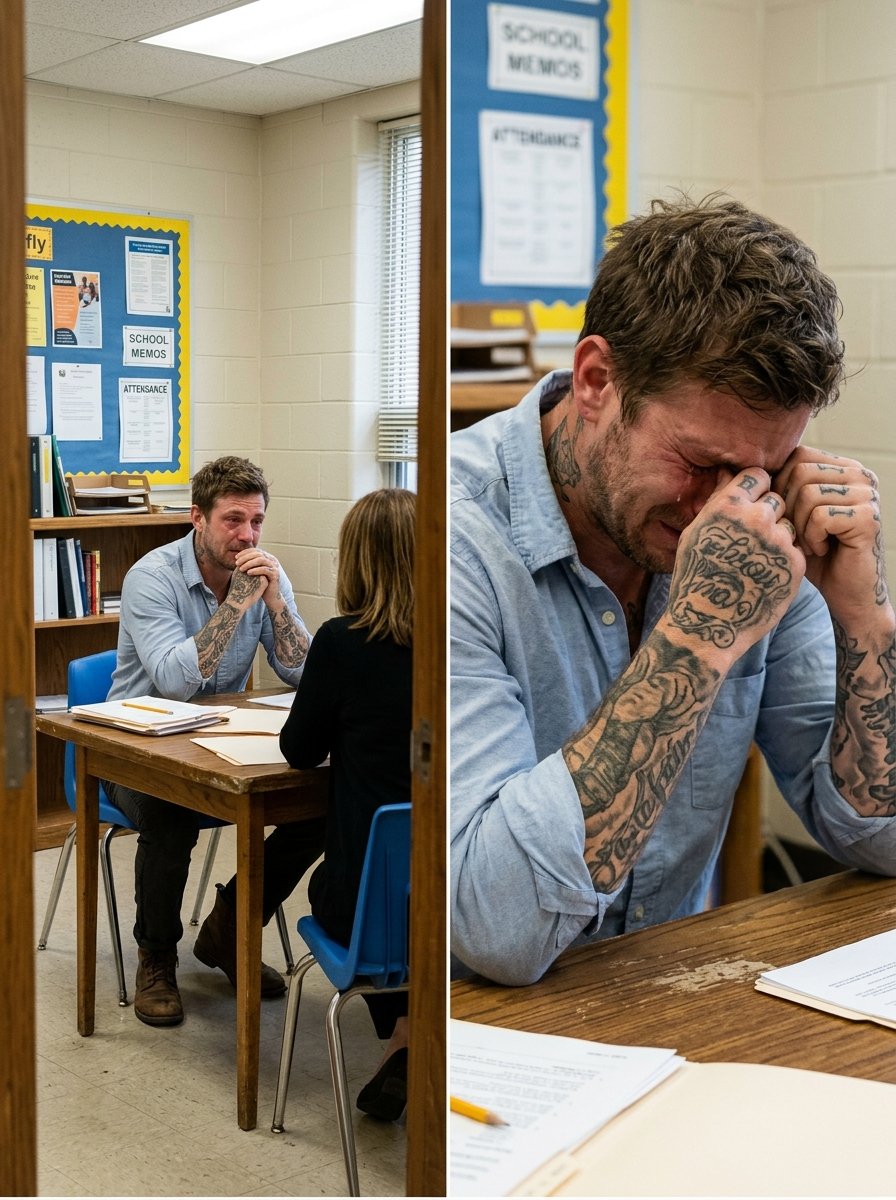
My husband had spent two years trying to get into a classroom. Then an interviewer looked at his tattooed arms and gave him one condition for the job: remove them. Instead, my husband started crying. Why was losing the tattoos something he couldn’t even consider?
My husband is 43. In 11 years I have seen that man cry twice, and I was there for both of them.
The second time happened in a school conference room on a Tuesday afternoon.
He was interviewing for a part-time teaching assistant position in history, something he’d wanted for two years.
He’d made it through the application, the background check, a phone interview, and finally an interview with three people from the school.
I was there because we’d planned to get lunch afterward.
Instead, I watched one of the people in that room look at my husband’s hands and say, “Do you honestly think anyone’s going to let you work with children looking like that? If we were to go forward, that’s the condition. You get rid of them.”
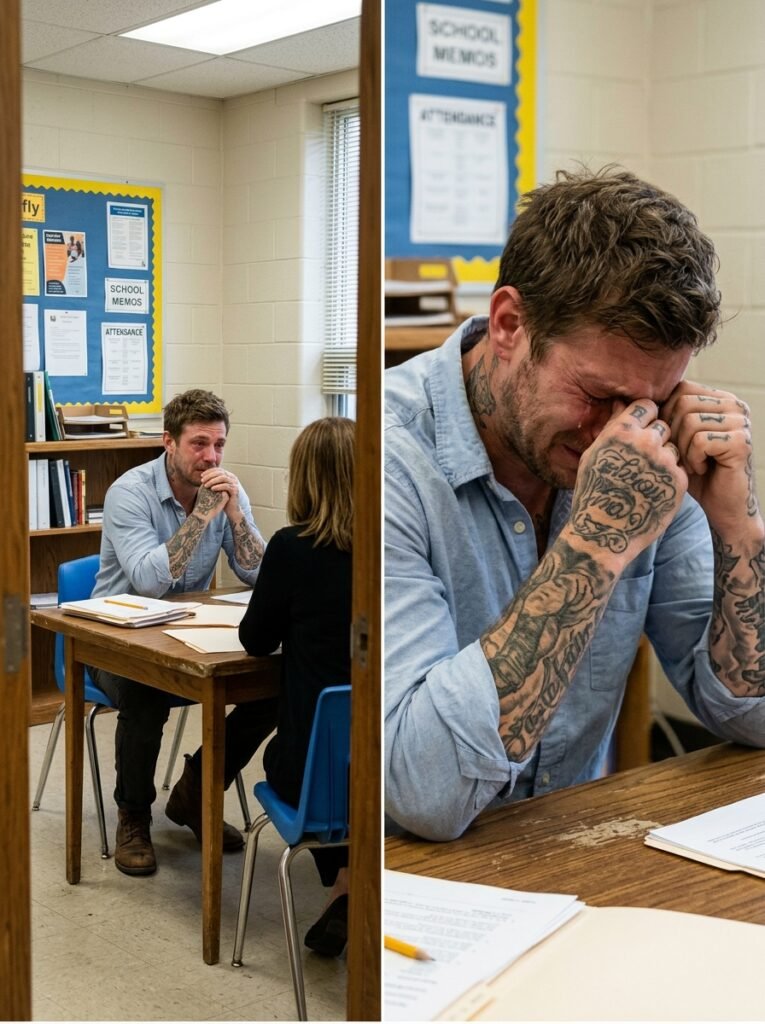
And my husband started to cry.
The room went completely silent, and it stayed silent, because not one of them could understand it…
A grown man, crying over tattoos. And if he could just get them removed, what’s the problem? Why wouldn’t he?
He wiped his face with the back of his hand and asked if they could give him two minutes — then he started unbuttoning his shirt cuff.
But to understand what happened next, you need to know who this man is.
We have three children.
The oldest came to us at nine. Then a brother and sister, six and four, who had to be placed together and who had been waiting because nobody wanted two at once.
We said yes. We were the only ones who said yes.
My husband reads to all three every night.
I say “reads,” but that’s generous.
Five minutes into any book, he starts correcting it.
If there’s a picture of the pyramids, he’ll stop and explain who actually built them and why the popular version people repeat isn’t accurate.
If there’s a knight, we’re getting a ten-minute discussion about armor.
If someone mentions an ancient battle, bedtime is over.
Our youngest once yelled downstairs, “Mom, Dad is doing history again.”
I yelled back, “Tell him it’s a school night.”
My husband called, “This is educational.”
“It is 9:15 p.m.”
“History doesn’t stop at nine.”
The kids love it.
That’s why he started talking about teaching.
He’d worked different jobs over the years, mostly whatever fit around the children’s needs. When our oldest first came to us, school was difficult for him. My husband became the person who could sit beside him for an hour without making him feel stupid.
He could explain the same thing six different ways.
Eventually I said, “You know people get paid to do this.”
He laughed.
Then he stopped laughing.
He began looking into classroom-support jobs. He took courses. He volunteered. He collected references.
And he kept getting rejected.
Sometimes nobody said why.
Sometimes they suggested he might be “a better fit” somewhere else.
Once, a person interviewing him spent more time staring at his wrists than reading his résumé.
Because my husband has tattoos.
A lot of them.
Both arms are covered. They continue far enough toward his hands that even a buttoned shirt doesn’t hide everything, and some ink rises past his collar.
He doesn’t look frightening to me.
He looks like my husband.
But I understood what strangers saw.
What I didn’t understand was why nobody seemed willing to look past it.
He has passed every background check three different agencies could put him through.
Ask our neighbors about him.
Ask the woman next door whose driveway he shovels before he does ours.
Ask the father down the street who once found my husband in his garage at 10:00 p.m. fixing a bicycle because his son needed it the next morning.
Ask our children.
None of that seemed to matter once people saw his arms.
Meanwhile, I was carrying us on my income.
I don’t say that bitterly. We made choices together, and there were years when having him available for the kids mattered more than a second full-time salary.
But children grow.
Shoes get bigger and grocery bills become ridiculous.
Our oldest was starting to talk about college.
We needed another income.
More than that, my husband needed something that belonged to him.
So when this school invited him for an interview, he prepared like he was defending a thesis.
He bought a new shirt. Long sleeves, of course.
On Tuesday morning, he stood in our bedroom pulling at the cuffs.
“Too obvious?” he asked.
“What?”
“That I’m hiding them.”
“They already know you have tattoos.”
He’d disclosed them.
He’d even asked whether visible tattoos violated school policy.
He’d been told there was no blanket prohibition, although appearance would be discussed at the interview.
“They’ve seen your qualifications,” I reminded him.
He nodded.
Our youngest wandered in and asked why Dad looked “like a bank manager.”
That helped.
By the time we reached the school, he was nervous but excited.
For most of the interview, it went beautifully. They asked how he would handle a child who refused to participate. He talked about giving the child a way back into the lesson without publicly embarrassing them.
They asked why history.
He said, “Because kids think history is a list of dead people and dates until somebody shows them it was real people making decisions without knowing how things would turn out.”
I remember thinking, Hire him.
Then one interviewer asked about his sleeves.
My husband answered calmly.
Yes, the tattoos were permanent.
Yes, he would dress professionally.
No, there was nothing obscene, hateful, violent, or inappropriate on his body.
The interviewer looked at the ink near his knuckles.
Then came the question.
“Do you honestly think anyone’s going to let you work with children looking like that? If we were to go forward, that’s the condition. You get rid of them.”
My husband’s face changed.
He looked at me.
Then tears filled his eyes.
That was when he asked for two minutes.
He rolled his left sleeve above his elbow.
The interviewer nearest him leaned forward.
The first tattoo, just above his wrist, was tiny compared with everything around it.
A baby’s footprint.
Not a stylized one.
A real footprint, copied exactly from a hospital card.
Underneath was a name.
And underneath that were two dates.
Thirteen months apart.
The woman across from him stared at them.
“Is that your daughter?”
“Yes,” he said.
That was the first time I had seen my husband cry.
Not in that conference room.
Eleven years earlier.
Our daughter was born too early.
People like to say premature babies are fighters, and she was. But sometimes I think we use words like that because admitting how helpless everyone is feels unbearable. She had complications from the beginning.
For 13 months, our life became hospitals, appointments, medication schedules, good days that made us hopeful and bad days we pretended weren’t as frightening as they were.
My husband sang to her.
The same song every night.
He couldn’t sing.
Our daughter didn’t care.
When she was strong enough to come home, he’d walk around the house with her against his chest, singing those same lines until she slept.
Then one day we went back to the hospital.
And she didn’t come home.
Eleven days after her funeral, my husband got the footprint tattooed on his wrist.
I hated it at first.
Not because it was ugly.
Because looking at it hurt.
I remember saying, “Why would you want to see that every day?”
He answered, “Because I want to see her every day.”
I couldn’t argue with that.
In the conference room, he touched the footprint with one finger.
“This was the card they made at the hospital,” he said. “They stamped her foot on it.”
Nobody interrupted.
He showed them the name beside it.
The handwriting was mine.
Months after our daughter died, he’d asked me to write her name on a piece of paper.
I hadn’t known why.
He’d taken it to the tattoo artist.
Farther up his arm were the dates.
Then a few lines from the song he’d sung to her.
Then small things whose meaning nobody outside our family would recognize.
I watched the interviewers’ faces change.
But my husband wasn’t finished.
“After she died, we were told my wife shouldn’t get pregnant again,” he said.
I looked down at my hands.
That part still had the power to pull the air out of me.
The doctors didn’t say another pregnancy would be difficult.
They said it could kill me.
So in the same year, we buried our daughter and lost the future we’d assumed would follow her.
For a long time, we barely talked about children.
People suggested adoption.
They meant well.
I hated hearing it.
Adoption isn’t a replacement child, and grief isn’t a vacancy you fill.
We weren’t ready.
Then, slowly, we became ready to talk.
There was one thing neither of us could imagine.
A baby.
I was ashamed of that for years.
I couldn’t picture holding something that small without remembering monitors. My husband couldn’t hear a newborn cry without his whole body changing.
So when we finally met with an adoption agency, we said we were open to an older child.
The woman working with us asked if we were sure.
Older children often waited longer.
We said we were sure.
That’s how our oldest came to us at nine.
My husband moved his sleeve higher.
There was another name.
Our son’s.
“He was nine when he came home with us,” my husband told them.
The first months were not some beautiful montage.
Our son tested everything.
Rules, food, promises, us.
If my husband said he’d pick him up at 4:00 p.m., our son would be standing at the window at 3:45 p.m., waiting to see whether the car actually appeared.
One night, after he’d been with us for months, he asked my husband, “Are you going to send me back if I’m bad?”
My husband sat on the floor beside his bed.
“No.”
“What if I’m really bad?”
“Still no.”
Our son didn’t believe him immediately.
Trust took longer than paperwork.
But eventually he started calling our house home.
Later, he started calling us Mom and Dad.
My husband added his name to his arm only after asking him.
Our son pretended not to care.
Then he went into his bedroom and cried.
Years later, we got another call.
A brother and sister needed a home.
Six and four.
They had to stay together.
We were told that this requirement made placement harder.
Two children meant two beds, two sets of appointments, two histories, and two frightened little people arriving at once.
My husband looked at me.
I knew what he was going to say before he said it.
“We have two bedrooms.”
I said, “We also have two jobs’ worth of laundry already.”
“We have a washing machine.”
“That’s your argument?”
It wasn’t.
His real argument was that they’d already lost enough.
They shouldn’t lose each other too.
We said yes.
We were the only ones who said yes.
My husband turned his other arm toward the interviewers.
Two more names.
Our younger children’s.
The woman who’d asked about our daughter covered her mouth.
My husband looked at the interviewer who had told him to remove the tattoos.
“I understand this is a school,” he said. “I understand you have rules.”
His voice shook.
“But you’re asking me to get rid of my children.”
The interviewer started to speak.
My husband shook his head.
“Please. You gave me two minutes.”
The room went quiet again.
He pointed to the footprint.
“This is my daughter.”
Then the first name.
“This is my son.”
Then the other two.
“These are my children.”
He pulled his sleeve higher and showed them the rest.
Every part had a reason.
Not every tattoo was a name. Some were dates. Some were symbols connected to private family memories. Some were pieces of the life we’d had before our daughter died and the life we’d somehow built afterward.
His body carried our entire family.
Including the child who wasn’t there.
“I can cover them,” he said. “I can wear long sleeves every day. I can follow whatever reasonable dress code you have. But I can’t remove them.”
His eyes filled again.
“I buried my daughter once. I’m not erasing her.”
Nobody spoke for several seconds.
Then the woman across from him started crying.
She apologized and reached for a tissue.
The interviewer who’d made the comment looked down at the table.
I wish I could tell you I felt triumphant. I didn’t. I felt tired.
My husband hadn’t wanted pity. He’d wanted a job.
He shouldn’t have had to open the worst year of our lives in front of strangers just to prove that ink on his skin didn’t make him dangerous to children.
Eventually, the interview continued.
It was awkward.
They asked two more questions.
My husband answered them.
Then we left.
In the parking lot, he sat behind the wheel without starting the car.
“I blew it,” he said.
“You didn’t.”
“I cried in a job interview.”
“So did one of them.”
That almost made him smile.
Then he looked at his arms.
“Maybe I should’ve just said no.”
“You did say no.”
“No. I mean before all of that.”
I knew what he meant.
He felt as if he’d used our daughter’s death to defend himself.
I reached across the console.
“You told them why the answer was no.”
For nine days, we heard nothing.
By day four, he stopped checking his email every hour.
By day six, he started looking at other jobs.
On the ninth day, my phone rang while I was working.
It was my husband.
He didn’t say hello.
“They offered it to me.”
I stood up so quickly my chair rolled backward.
“What?”
“The school. They called.”
I made him repeat it.
Part-time teaching assistant. History.
He would start the following month.
There was no requirement that he remove his tattoos.
He’d agreed to wear professional clothing, the same expectation applied to everyone else.
That night, we told the kids over dinner.
Our youngest screamed.
Our daughter asked whether this meant Dad would start giving history lectures to other people’s children instead of them.
Our oldest looked at his father’s arms.
Then he said, “They finally figured you out.”
My husband laughed.
I looked at the four names written across the man sitting opposite me.
For years, strangers had seen those tattoos before they saw him.
Some saw bad judgment.
Some saw a past they assumed must be questionable.
That school saw a reason he might not belong around children.
They were wrong.
Those arms told the story of almost every important thing he’d ever done.
They had held our daughter while he sang her to sleep. They had carried a nine-year-old’s boxes into our house without promising him everything would magically be okay.
They had held a frightened six-year-old on one side and her four-year-old brother on the other because neither wanted to sleep alone their first night with us.
And every child who made him a father was still there.
Three of them could run into his arms whenever he came through the door.
One could not.
That was why he couldn’t remove the tattoos.
They weren’t something he’d chosen instead of his family.
They were his family.