
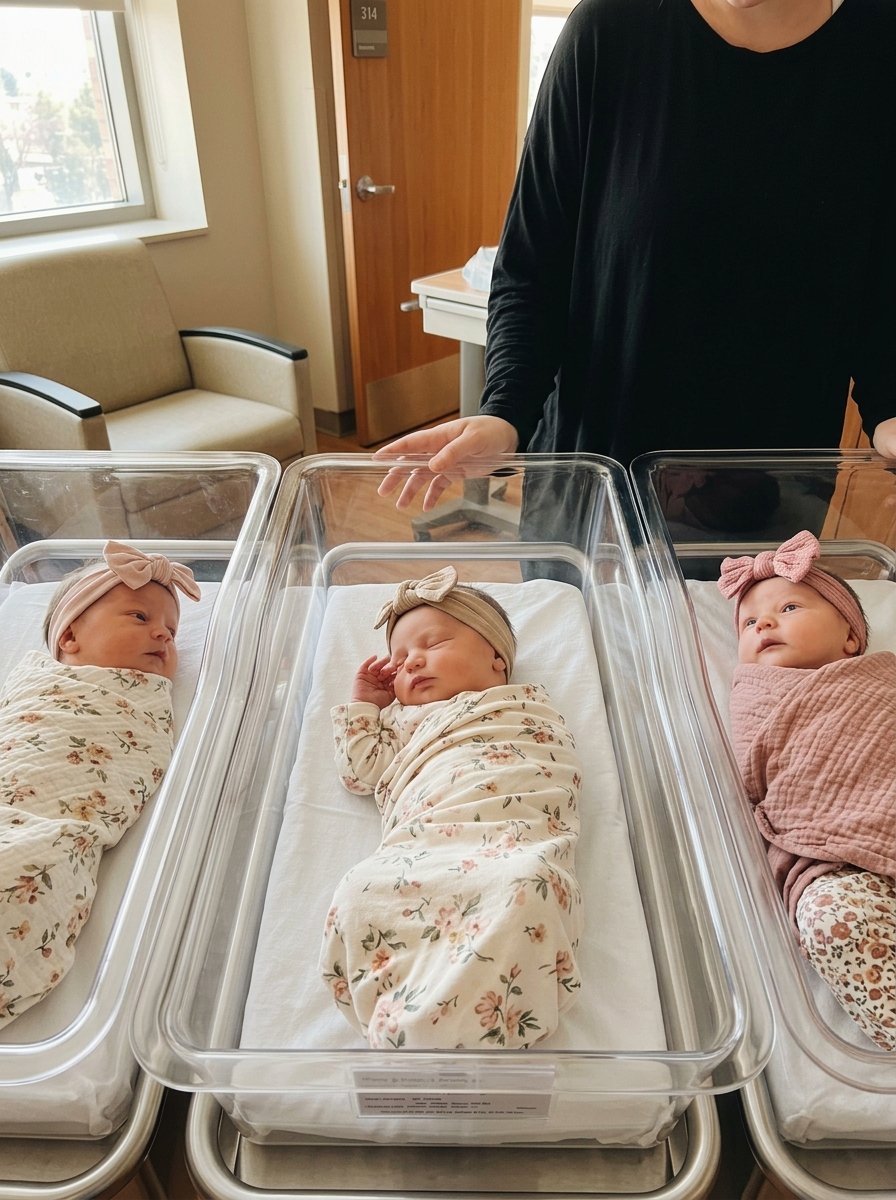
After years of trying, a woman finally brought her healthy triplet daughters home to a pink-and-white celebration. But when her mother-in-law arrived in a long black cape and opened it for the family photo, everyone went silent. What was she hiding underneath?
We tried for a long time.
Years.
At some point you stop telling people you’re trying.
You stop answering questions about when you’re going to have children. You stop smiling when somebody tells you to “just relax.” Eventually, you learn how to change the subject before anyone notices your face.
And then it worked.
And it was three.
Three girls.
I’m still not over that part, honestly.
My husband stared at the ultrasound screen like the doctor had announced we’d won something.
“Three?”
The doctor smiled.
“Three.”
He squeezed my hand.
“All ours?”
I laughed so hard I cried.
He laughed too.
The pregnancy was rough.
Three babies, and they were big. By the end I was eating constantly and still starving, and I couldn’t walk to the mailbox without stopping. Nobody prepares you for that.
They all came out healthy.
Chunky, actually.
The nurses kept commenting on it.
One nurse looked at the three bassinets and said, “You weren’t growing babies. You were running a bakery.”
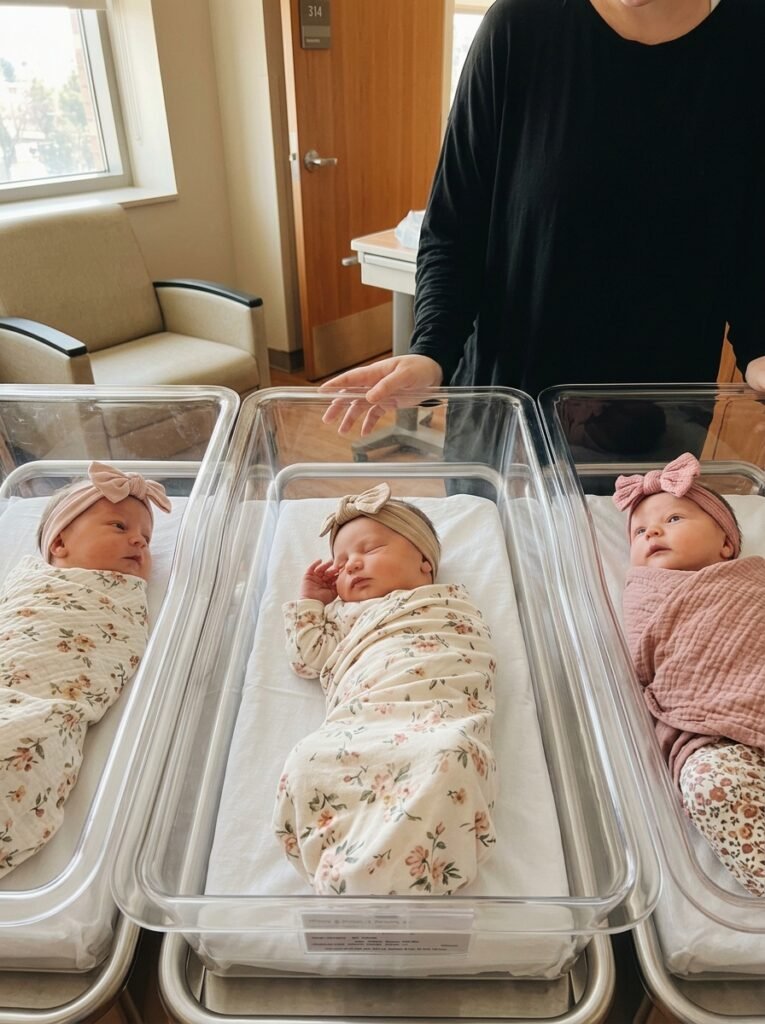
I was too tired to laugh properly.
They kept us in the hospital for a while. The girls needed monitoring and I was wrecked. Some days I couldn’t sit up on my own.
My husband was there every day.
Every single day, with a list of questions for the doctors in his phone.
“What did they say about Ava’s feeding?”
“Did they check Mia’s weight again?”
“Does Sophie need another test?”
At one point, I asked, “Do you have a spreadsheet?”
He looked offended.
“Of course not.”
Then I saw his phone.
He had a spreadsheet.
His mother never came.
Not once.
She wanted a grandson.
She’s been saying it for years.
“Every family needs an heir.”
Three granddaughters apparently don’t count as anything in her head.
When we first told her we were expecting triplets, she’d been thrilled.
Then she asked:
“Surely one is a boy?”
“We don’t know yet,” my husband said.
When we found out they were all girls, her reaction lasted maybe three seconds.
“All three?”
“All three,” I said.
She looked at my husband.
“Well, perhaps next time.”
Next time.
I was carrying three babies after years of trying, and she was already thinking about the child I hadn’t made.
My husband told her to stop.
She claimed she was joking.
She always claimed she was joking.
So when she didn’t visit the hospital, I wasn’t surprised.
My husband was.
He called her twice.
The first time, she said hospitals made her uncomfortable.
The second time, she said she didn’t want to disturb us.
Meanwhile, my mother practically knew the nurses’ schedules.
My sister brought food.
His dad came quietly every few days, held each granddaughter like she was made of glass, and cried when he thought nobody was looking.
His mother stayed away.
So when we finally got the discharge date, my husband wanted to make a whole thing of it.
And I wanted that too.
Balloons, cake, everyone at the house, then dinner at a restaurant after.
We asked people to wear pink or white.
Three girls.
It was for the photos.
He invited his mother.
She didn’t say yes and she didn’t say no for two weeks.
We kept asking each other whether she’d show up.
“I think she will,” my husband said.
“You’ve said that four times.”
“I mean it this time.”
“Based on?”
“Hope?”
I looked at him.
“Terrible evidence.”
He smiled, but I could tell it bothered him.
He wanted his mother there.
Not because he needed her approval.
Because these were his daughters.
He wanted their grandmother to look at them and understand what everyone else already did.
They were enough.
Discharge day finally came.
Getting three newborns out of a hospital should qualify as a competitive sport.
By the time we got home, I was exhausted.
Then I saw the house.
Pink and white balloons covered the porch.
There was a banner across the railing.
My mom was there.
My sister.
His dad.
My aunt was crying before we’d even gotten the car doors open.
“Oh, look at them!”
“You haven’t even seen them yet,” I called.
“I know!”
My husband laughed.
For the first time in weeks, I felt almost normal.
Then his mother arrived.
In a long black cape.
Buttoned up to the throat, in October, standing on the path.
Everyone noticed.
It was impossible not to.
She didn’t say hello to anyone.
Not to me, not to my mother, not to the girls.
She just stood there holding it closed.
You could see there was something under it.
It didn’t sit right.
My sister leaned toward me.
“What’s she wearing?”
“I have absolutely no idea.”
Somebody offered to take it.
She said no.
My husband walked over.
“Mom, aren’t you hot?”
“I’m fine.”
“Come meet the girls.”
“In a minute.”
That bothered me more than the cape.
She hadn’t seen her granddaughters since they were born.
They were finally home.
And she hadn’t even looked into the carriers.
Then the photographer started getting us together for the first family picture.
My husband had one of the girls; my sister had another.
I held Ava carefully against my chest.
His dad stood beside me.
Everyone squeezed together beneath the balloons.
His mother walked into the middle of the group.
And that’s when she opened the cape.
Underneath, she was wearing blue.
Head to toe.
A blue dress.
Blue shoes.
Even a blue ribbon pinned near her shoulder.
For a second, nobody understood.
Then I saw the small blue gift bag hanging from her wrist.
My stomach sank.
My husband stared at her.
“Mom.”
She smiled.
Not warmly.
Almost proudly.
“What?”
“What are you doing?”
She looked down at herself.
“I dressed for the occasion.”
My mother made a tiny sound beside me.
My husband said, “We asked everyone to wear pink or white.”
“I know.”
That was when I understood.
She hadn’t misunderstood or forgotten.
She had hidden the blue outfit beneath the cape because she knew exactly what it meant.
The photographer slowly lowered the camera.
My husband looked at the cape.
“You covered it.”
His mother shrugged.
“It was chilly.”
“No, it wasn’t.”
“Why are we making a scene over a color?”
He stared at her.
“If it’s only a color, why did you hide it?”
She didn’t answer.
My sister moved closer to me.
I could feel anger building in my chest, but I was too tired for it.
I had spent weeks recovering enough to bring my daughters home.
I didn’t want my first afternoon there to become a fight.
Then my mother-in-law lifted the blue bag.
“I brought something.”
My husband didn’t take it.
“For who?”
She sighed like he was being difficult.
“For later.”
She reached inside and pulled out a tiny blue baby outfit.
It had little white buttons down the front.
Nobody spoke.
She held it up.
“I bought it months ago. There’s no reason to waste it.”
My husband stared at the outfit.
“What exactly are we supposed to do with that?”
“Keep it.”
“For what?”
She looked at me.
“For next time.”
I actually thought I’d misheard her.
My husband didn’t.
“There isn’t a next time.”
“You don’t know that.”
“Mom.”
“What? I’m simply saying there’s no harm in keeping it.”
She looked around at everyone as though somebody might support her.
Nobody did.
Then she said the sentence I still remember perfectly.
“Someone had to acknowledge what this family is still missing.”
My husband handed Mia to my sister.
Very carefully.
Then he walked toward his mother.
I had never seen his face look like that.
Not furious.
Worse.
Finished.
He took the edges of the black cape and closed them over her blue dress.
She jerked backward.
“What are you doing?”
“You hid that outfit because you knew exactly what you were doing.”
“Oh, please.”
“You knew.”
“It’s a dress.”
“It’s a message.”
She scoffed.
“Everyone is being oversensitive.”
My husband glanced toward our daughters.
“You haven’t even said hello to them.”
“Of course I was going to.”
“You’ve been here 15 minutes.”
“I didn’t want to crowd her.”
She pointed vaguely toward me.
My husband asked, “What’s her name?”
His mother frowned.
“Whose?”
He pointed toward the baby in my arms.
She hesitated.
I felt my heart drop.
“That’s Ava,” she said.
I was holding Sophie.
My husband closed his eyes briefly.
“No.”
His mother looked embarrassed.
“They’re newborns. They look alike.”
“They don’t.”
“I haven’t had a chance to learn.”
“You haven’t tried.”
That landed harder than anything else he’d said.
She lowered the blue outfit.
“I love my granddaughters.”
“Then celebrate them.”
“I do.”
“No. You’re standing at their homecoming dressed for a child who doesn’t exist.”
His mother stiffened.
“You are my only son.”
“So?”
“You know exactly what I mean.”
“The family name.”
She didn’t answer.
She didn’t need to.
My husband looked back at the three babies.
Then at his mother.
“My family didn’t end. It just arrived three times.”
His dad smiled.
My mother started crying again.
His mother looked furious.
“You’re twisting everything I say.”
“No. I’m finally listening to it.”
She shoved the blue outfit back into the bag.
“So what do you want me to do? Go home and change because everyone is offended by blue?”
“Yes.”
She blinked.
I think she’d expected him to soften.
He didn’t.
“Go home. Change. Come back in pink, white, green, orange, I don’t care. Just come back ready to celebrate the three children who are actually here.”
“And if I don’t?”
“Then you’re not in the picture.”
Her face changed.
“You’d exclude your own mother?”
“You’re excluding my daughters at their own homecoming.”
Silence.
Then she looked at me.
I knew that look.
Somehow, this was going to become my fault.
I didn’t give her the chance.
“I just got home,” I said quietly. “I’m not fighting with you.”
That was all.
Maybe she expected more.
I didn’t have more.
I had stitches that hurt, three babies who needed feeding, and about four hours of sleep scattered across two days.
My husband stepped between us.
“This is between me and you.”
His mother stared at him.
Then she turned around and left.
She didn’t change.
She didn’t come back.
For several seconds after her car disappeared, nobody moved.
Then Ava started crying.
A second later, Mia joined her.
My sister looked down.
“Oh no.”
Sophie heard them and completed the trio.
Everyone burst out laughing.
Even me.
My husband came over and took Ava.
“I’m sorry.”
“Don’t.”
“I wanted today to be perfect.”
“It still can be.”
He looked toward the road where his mother had disappeared.
The photographer approached carefully.
“Do you still want the picture?”
My husband looked at me.
I nodded.
“We’re taking the picture.”
So everyone gathered again.
Pink.
White.
Three screaming babies.
My hair hadn’t been properly brushed. My husband had spit-up on his shirt. My aunt was still crying.
It was perfect.
Right before the photographer took the first picture, my husband leaned toward me.
“Don’t let the one person who couldn’t celebrate them become the thing you remember about today.”
I looked down at Sophie.
Then at Mia in my sister’s arms and Ava with my husband.
“I won’t.”
The photographer raised the camera.
“Everybody ready?”
Nobody was.
She took the picture anyway.
Dinner happened later than planned.
I barely ate because one baby always seemed to need something.
My husband cut my food for me while holding Mia.
His dad fed Ava a bottle.
My mother spent half the evening telling strangers we had triplets.
His mother wasn’t there.
And eventually, I stopped noticing.
The photograph from that afternoon arrived two weeks later.
My husband framed it.
It’s still in our living room.
His mother called three days after the homecoming.
He didn’t answer.
She called again.
Then she texted him that things had “gotten out of hand.”
He replied, “They got exactly as far as you took them.”
She asked to visit the girls.
He said no.
Not yet.
That surprised even me.
“Are you sure?”
“Yes.”
“She’s their grandmother.”
“And they’re not consolation prizes.”
A week later, she asked again.
This time, my husband called her.
I wasn’t in the room for the whole conversation, but I heard enough.
“There is no missing baby, Mom.”
Silence.
“No. Listen to me. There is no fourth child we’re supposed to keep trying for.”
More silence.
“These are my children. All three of them.”
She finally came over almost a month after the homecoming.
No cape.
No blue baby clothes.
She brought three small gifts.
She stood in our living room looking more nervous than I’d ever seen her.
Then she looked at me.
“I’m sorry.”
I waited.
She continued.
“What I did was cruel. I made their homecoming about what I wanted instead of what you had both been through.”
That mattered.
Not enough to erase everything.
But enough for me to listen.
Then she turned toward the bassinets.
“Ava. Mia. Sophie.”
All correct.
My husband noticed too.
He didn’t smile, but his shoulders relaxed.
She didn’t become the world’s perfect grandmother overnight.
Trust doesn’t work like that.
But she started showing up.
And slowly, she learned that three granddaughters weren’t something she had to settle for.
They were three entirely different little people who demanded to be known.
Ava screamed if her socks came off.
Mia could sleep through almost anything.
Sophie somehow always knew the exact moment my husband sat down with hot food.
His mother learned all of it.
And eventually, the blue outfit disappeared from conversation completely.
The girls are still too young to understand the photograph in our living room.
One day, they’ll notice who’s there.
And who isn’t.
Maybe they’ll ask why Grandma missed their first big family picture.
I don’t know exactly what I’ll say.
My husband already does.
“She wasn’t ready for you yet.”
I once asked what he’d say if they wanted to know why.
He looked at our three daughters scattered across the living room and smiled.
“You were a lot to handle.”
I laughed.
Then Mia threw a toy at him, Sophie started crying because Ava had her blanket, and Ava somehow removed one sock.
He looked at me.
“See?”
And in that moment, surrounded by the three little girls someone once dared to call not enough, I couldn’t imagine our family missing a single thing.
So, here’s the real question: If a grandparent treated your children like they weren’t enough, would an apology be enough to give them another chance?