
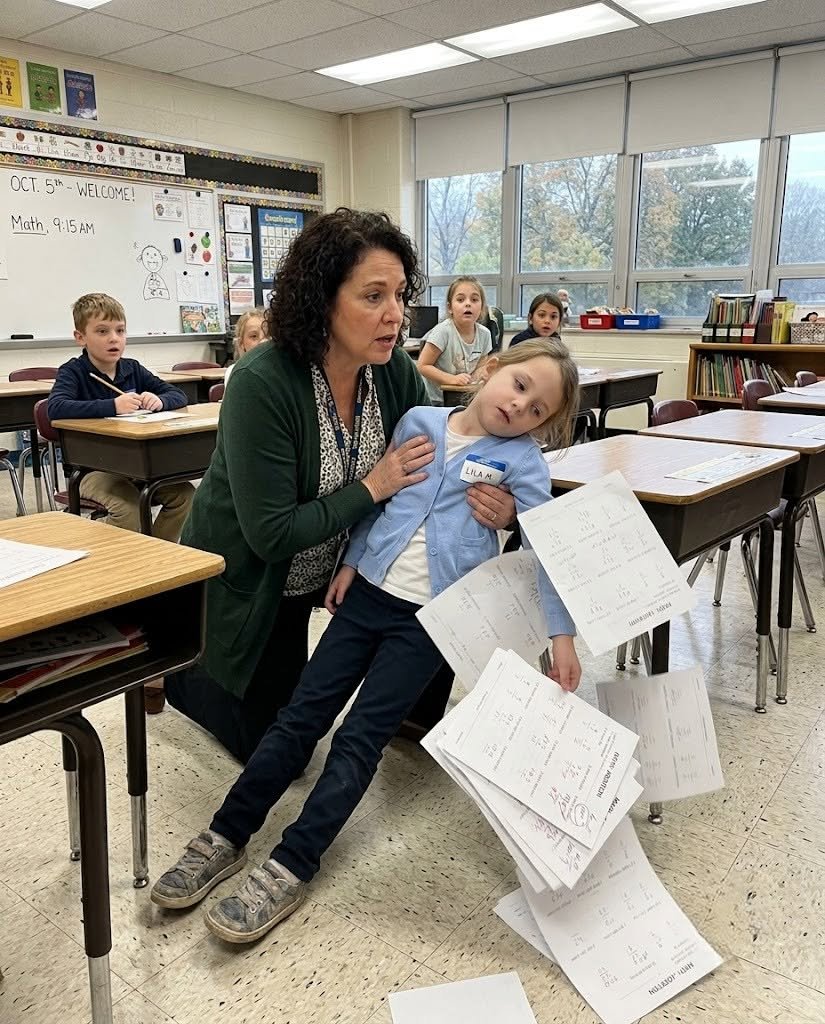
“Dad Said It Wouldn’t Hurt… But It Does”
A Teacher Noticed the Way a Little Girl Moved — and What She Heard That Morning Stayed With Her
Part 1: The Morning Ms. Kincaid Noticed
It was a gray Thursday morning in early October, the kind that made western Pennsylvania feel washed clean and cold.
Inside Room 204, fluorescent lights hummed overhead while second graders scraped chairs across the floor, clicked pencils, whispered to friends, and settled in for math.
Ms. Valerie Kincaid stood at the front of the classroom holding a stack of worksheets when she noticed seven-year-old Lila Mercer.
Not because Lila was making noise.
Because she was working so hard not to.
Lila sat in the third row beside the windows, wearing a pale blue cardigan buttoned neatly over her uniform. Her hands rested in her lap whenever they were supposed to. She never interrupted, never grabbed supplies from other children, and never demanded attention.
Most adults described her as wonderfully well-behaved.
But Valerie had been teaching long enough to know there was a difference between being quiet and being careful.
Lila was careful.
She shifted in her chair once.
Then again.
Each time, her shoulders tightened and her knees pressed together beneath the desk.
Whenever she moved, pain flashed across her face for half a second before she quickly forced her expression back to normal.
This was not ordinary second-grade fidgeting.
It looked as though every position hurt.
At 8:17 a.m., Valerie marked Lila present.
At 8:42, the class bent over their math worksheets.
By 8:56, students were lining up to place their finished papers on Valerie’s desk.
Lila waited until nearly everyone else had gone first.
When she finally stood, she placed one hand firmly against the edge of her desk and remained there for a moment before taking her first step.
That tiny movement made Valerie’s stomach tighten.
Lila walked slowly toward the front.
One foot.
Pause.
Then the other.
Around her, the classroom continued as usual.
A boy whispered excitedly about his loose tooth.
Two girls quietly traded crayons.
A pencil rolled across the tile floor and disappeared beneath a table.
No one else seemed to notice the little girl carefully measuring every step.
“Lila,” Valerie said gently, “are you feeling okay this morning?”
The girl looked up.
For just a moment, fear crossed her face.
Then came a small, practiced smile.
“I’m fine, Ms. Kincaid. I just need to sit up straight.”
Valerie frowned slightly.
The answer sounded too polished for a seven-year-old.
She had heard children lie about unfinished homework, missing markers, playground arguments, and who had started a fight.
This felt different.
It sounded like something Lila had been taught to say.
Valerie opened her mouth to ask another question.
Then the color suddenly drained from Lila’s face.
Her lips parted.
The worksheets slipped from her hands and scattered across the floor.
Then her knees gave way.
Valerie rushed forward and caught her before her head struck the tile.
The entire classroom froze.
One child remained standing with his worksheet clutched in both hands.
Another was halfway out of his chair.
The boy with the loose tooth covered his mouth.
“Please call the nurse,” Valerie told the classroom aide. “Right now.”
She kept her voice calm because twenty frightened children were watching her.
Inside, she was anything but calm.
By 9:03 a.m., Lila was lying on the narrow cot in the nurse’s office.
The room smelled faintly of antiseptic.
A blood pressure cuff wrapped around one thin arm while Nurse Patel checked the monitor.
“Her blood pressure is a little low,” she said. “She may simply be dehydrated.”
Valerie desperately wanted that explanation to be true.
Then she noticed Lila’s hands.
The girl was gripping the edge of the blanket so tightly that her knuckles had turned white.
Her cardigan was also buttoned incorrectly.
One button had missed its hole.
Another pulled strangely across her waist.
Beneath the fabric, something appeared stiff.
Valerie sat beside the cot.
“Lila, sweetheart, can you tell me what hurts?”
The little girl stared at the ceiling.
Her breathing became shallow.
For several seconds, she said nothing.
Then she slowly turned toward her teacher.
“My dad said it wouldn’t hurt,” she whispered.
Her eyes filled with tears.
“But it does.”
The nurse’s pen stopped moving.
In that single moment, the meaning of the entire morning changed.
Lila had not simply arrived at school feeling sick.
Something had happened before she came.
And whatever it was, she was frightened to explain it.
Under Lila’s cardigan was a stiff posture-correction brace wrapped tightly around her ribs and waist.
It was so tight that Nurse Patel could barely slide two fingers beneath one of the straps.
She stopped examining it immediately.
“Lila,” she asked gently, “who put this on you?”
The girl stared at the paper covering the cot.
“Dad.”
The heating system clicked on behind the wall.
For several seconds, that was the only sound in the room.
“He says I slouch,” Lila whispered. “He says this helps me remember.”
Then she repeated the sentence Valerie had heard in class.
“I just need to sit up straight.”
Valerie and Nurse Patel exchanged a look.
Neither woman pressured Lila for more details.
The nurse simply documented exactly what the child had said.
They learned that Lila had not eaten breakfast.
She had also avoided drinking much water because using the bathroom meant removing the brace, and her father had told her not to take it off while she was at school.
At 9:16 a.m., the front office phone rang.
Lila’s father was calling.
He said his daughter was “sensitive.”
He claimed she sometimes exaggerated discomfort.
Then he announced that he would come to school and take her home so he could handle the situation himself.
The principal stopped writing.
Valerie looked toward Lila.
“No,” she said quietly.
The nurse added the time of Lila’s statement, the condition of the brace, and the father’s exact words to the health-office record.
Then Valerie made the report she was required to make.
At 9:21 a.m., while Lila’s father was still on his way to school, Valerie gave the county intake worker her own name, Lila’s name, and the sentence that had stopped the nurse’s pen.
“My dad said it wouldn’t hurt, but it does.”
The situation was no longer something her father could quietly take home and explain away.
The case was now outside his control.
Part 2: What Lila Was Afraid to Say
At 9:27 a.m., the principal moved Lila into a small counseling room across from the nurse’s office.
The room had soft chairs, a low bookshelf, crayons, and children’s drawings on the walls.
Nothing about it looked official.
That was intentional.
Lila sat quietly with both hands in her lap.
Nurse Patel remained nearby.
Valerie stayed close enough that Lila could see her through the open doorway.
No one wanted the child surrounded by strangers.
More importantly, no one wanted her to believe she had done something wrong.
The brace had been loosened enough for her to breathe comfortably while they waited for proper medical evaluation.
At 9:34, county child protection worker Dana Mills called the school.
She asked Valerie only for what she had personally observed.
Not guesses.
Not assumptions.
Facts.
Valerie explained how Lila had struggled to stand.
How slowly she had walked.
How she had collapsed.
How tightly the brace appeared to be fastened.
And exactly what she had said.
Dana listened carefully.
“Has she said anything else?”
“She said her father makes her wear the brace because she slouches,” Valerie explained. “She also said she isn’t supposed to take it off at school.”
“Do not question her more than necessary,” Dana said. “Someone is heading there now.”
At 9:41, another call came from the front office.
Lila’s father had arrived.
His name was Daniel Mercer.
Valerie had met him before.
He was forty-one, neatly dressed, polite, and usually early for parent conferences.
Teachers liked him.
He had brought coffee during Teacher Appreciation Week.
He had donated books to the classroom.
At open house, he had shaken Valerie’s hand and talked proudly about how seriously his family took education.
Now he stood at the front desk demanding his daughter.
“I’m her father,” Daniel said. “I’m taking her home.”
The secretary remained calm.
“The principal will speak with you.”
“There is nothing to discuss. Lila has a medical device she is supposed to wear.”
Mrs. Delaney stepped into the office.
“Mr. Mercer, Lila became unwell this morning.”
“I was told.”
“She collapsed.”
Daniel barely reacted.
“She can be dramatic.”
Valerie heard him from down the hall.
A cold feeling settled in her stomach.
He had said almost the same thing over the phone.
“She needs medical evaluation,” Mrs. Delaney continued.
“I will take care of that.”
“At this point, we need you to wait.”
Daniel’s expression hardened.
“Why?”
“We are following school procedure.”
The pleasant father Valerie remembered disappeared.
“I am her father. You cannot keep my daughter from me.”
His voice carried down the hallway.
Lila heard him.
Valerie knew because the child’s entire body changed.
She had been coloring quietly.
Suddenly, her crayon stopped moving.
Her shoulders rose.
Her fingers tightened around the crayon.
“Is Dad mad?” she whispered.
Nurse Patel crouched beside her.
“You don’t need to worry about the adults right now.”
Tears filled Lila’s eyes.
“He said if I tell people, they’ll think he’s bad.”
The nurse did not ask her to explain.
She simply recorded the exact sentence.
A short time later, Dana Mills arrived with another county worker.
A police officer also came because tensions in the front office were rising and Lila needed medical attention.
Daniel’s face changed when he saw them.
“This is ridiculous.”
Dana introduced herself.
“We need to speak privately with Lila and arrange for a medical examination.”
“No.”
Daniel answered immediately.
Dana remained calm.
“Mr. Mercer, the school reported concerns involving your daughter’s health and safety.”
“There is no safety concern.”
“She collapsed while wearing a brace that school staff report was extremely tight.”
“It’s therapeutic.”
“Was it prescribed by a doctor?”
Daniel hesitated.
Only for a second.
But Valerie noticed.
“It was recommended.”
“By whom?”
“That is none of your business.”
Dana’s expression remained unchanged.
“Right now, it is.”
Daniel crossed his arms.
“My daughter has terrible posture. I’m trying to help her.”
Then he looked down the hallway at Valerie.
“You did this?”
Valerie stepped closer.
“I reported what I observed and what Lila told us.”
“You misunderstood her.”
“She collapsed in my classroom.”
“She exaggerates.”
Valerie thought about the little girl gripping the nurse’s blanket until her knuckles went white.
“No,” Valerie said quietly.
“She hides it.”
Daniel’s jaw tightened.
Dana stepped between them.
“That’s enough.”
Lila was transported to a pediatric hospital for evaluation.
Valerie remained at school.
Professionally, she knew that was where she needed to be.
Emotionally, staying behind was difficult.
For the rest of the morning, she taught twenty children while wondering what was happening to the twenty-first.
At lunchtime, she sat alone at her desk.
Lila’s unfinished math worksheet was still there.
Eight addition problems.
Seven completed correctly.
The eighth unanswered.
At 2:18 p.m., Mrs. Delaney entered the classroom.
“Can we talk?”
Valerie immediately stood.
“What happened?”
Mrs. Delaney closed the door.
“Lila is stable.”
Valerie finally breathed.
“The hospital found pressure marks and bruising around her ribs and waist.”
Valerie closed her eyes.
“The brace wasn’t prescribed by a doctor either.”
“Where did it come from?”
“Her father bought it online.”
“For posture?”
“That’s what he says.”
Valerie heard the hesitation.
“But?”
Mrs. Delaney lowered her voice.
“Lila told the hospital social worker that the brace wasn’t the only thing her father used when she didn’t sit, stand, or behave exactly the way he expected.”
Valerie felt sick.
“What else?”
“I don’t know all the details, and we shouldn’t speculate.”
Valerie nodded.
Then Mrs. Delaney added something else.
“They contacted Lila’s mother.”
Valerie frowned.
“I thought her mother wasn’t involved.”
“That is what the school records say.”
“Is it wrong?”
Mrs. Delaney looked at her.
“Her mother says she has been trying to see Lila for nearly two years.”
According to Daniel, Lila’s mother had abandoned them.
According to school records, Daniel had sole physical custody.
But another version of the story was beginning to emerge.
Court orders.
Missed visits.
Canceled meetings.
Unanswered phone calls.
And repeated claims that Lila’s mother was unstable.
Valerie noticed the pattern immediately.
Daniel used similar words whenever anyone challenged him.
Sensitive.
Dramatic.
Unstable.
That evening, Valerie went home but could not stop thinking about Lila.
At 7:42 p.m., an email from Mrs. Delaney appeared.
Lila will not return tomorrow. She is currently in temporary protective placement while the investigation continues. Please do not discuss the case with staff or families.
Valerie read it twice.