Three days later, Dana called again.
Lila had asked a question.
Not about her father.
Not about the hospital.
Not even about the investigation.
She wanted to know whether she was in trouble because she had not finished her math worksheet.
Valerie turned away from her classroom before answering.
“No,” she said softly.
“Please tell her she is absolutely not in trouble.”
Dana was quiet.
Then she said, “There is something else.”
Valerie tightened her grip on the phone.
“When Lila spoke with the interviewer again, she finally explained why she was so frightened of sitting incorrectly.”
Valerie waited.
“The brace wasn’t the punishment.”
Valerie stopped breathing.
Dana continued.
“It was what her father made her wear afterward.”
Part 3 — Final: The Child Everyone Thought Was Fine
For several seconds, Valerie could not speak.
“What do you mean afterward?”
Dana chose her words carefully.
“I can’t discuss the details of an active investigation. But investigators believe the brace was part of a larger pattern of excessive physical discipline and control.”
Valerie slowly sat down.
Across the classroom, twenty children quietly read their books.
Someone dropped an eraser.
A girl turned a page.
The clock continued ticking.
Ordinary sounds.
Ordinary children.
And until only days earlier, everyone had believed Lila was simply another quiet, well-behaved child.
No one had understood how much energy she spent trying not to make mistakes.
Over the following weeks, investigators gathered more information.
Valerie provided the timeline from that Thursday morning and the exact statements she had heard.
Nurse Patel provided her health-office records.
Mrs. Delaney provided school documents and previous communications from Daniel.
Investigators also contacted Lila’s doctors.
That was when another pattern appeared.
Daniel had repeatedly canceled routine appointments.
He had changed pediatric practices more than once.
Whenever questions arose about Lila’s anxiety, weight, or unexplained discomfort, there always seemed to be an explanation.
She was clumsy.
She was sensitive.
She disliked doctors.
She exaggerated.
Each explanation sounded possible on its own.
Together, they looked very different.
Then investigators spoke with Lila’s mother, Hannah Mercer.
Hannah had never abandoned her daughter.
Two years earlier, after a bitter divorce, Daniel had convinced a court that Hannah was emotionally unstable.
Some of the documents supporting those claims were now being questioned.
Hannah said Daniel had gradually limited her contact with Lila.
First by changing schedules.
Then canceling visits.
Then claiming Lila did not want to see her.
Hannah had repeatedly gone back to court trying to restore contact with her daughter.
But Daniel always seemed to have another explanation.
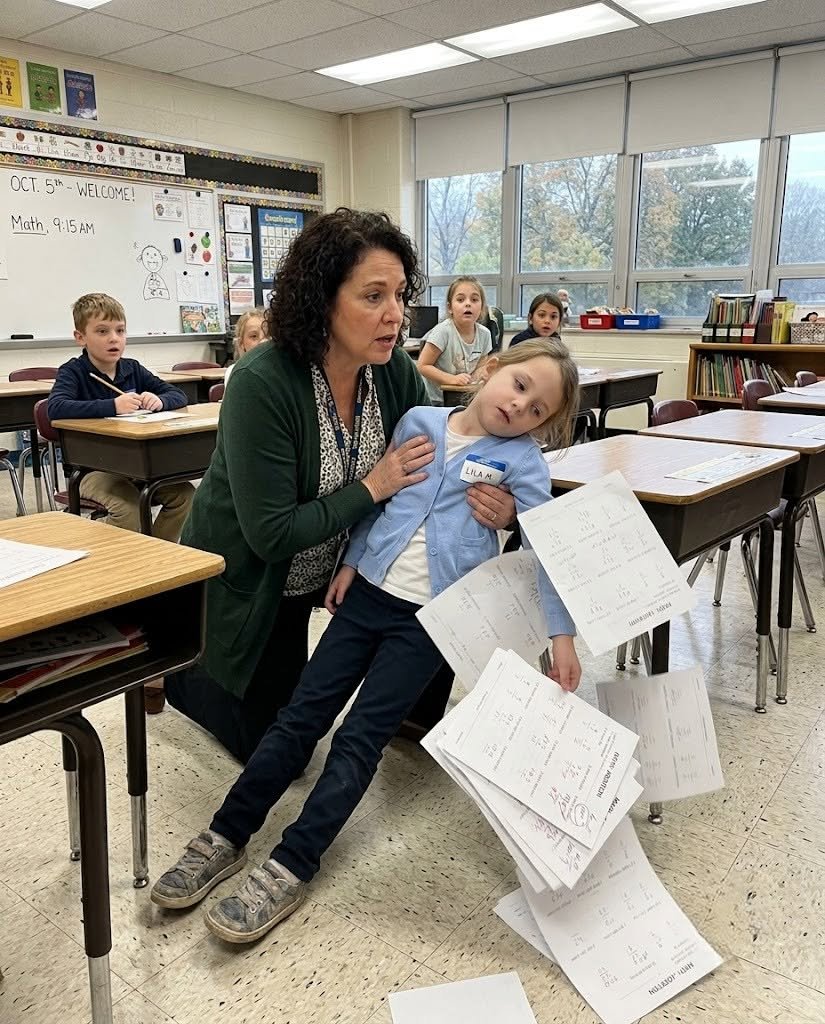
Then one Thursday morning, a teacher noticed the way Lila stood up from her desk.
And everything began to change.
A judge reviewed the new medical information and ordered that Lila remain away from Daniel while the investigation continued.
Hannah was permitted supervised contact with her daughter.
Their first visit lasted less than an hour.
Lila stood in the doorway of the family-services room and stared at her mother.
Hannah did not rush toward her.
She did not reach for her.
She simply knelt.
“Hi, sweetheart.”
Lila’s lower lip trembled.
For several seconds, she remained where she was.
Then she asked a question that broke the hearts of everyone in the room.
“Are you still my mom?”
Hannah covered her mouth.
“Yes.”
Lila looked confused.
“Dad said you stopped wanting me.”
Hannah’s face crumpled.
“No, sweetheart. Never.”
Slowly, Lila crossed the room.
Hannah instinctively wrapped her arms around her daughter.
Lila immediately stiffened.
Hannah let go.
“I’m sorry.”
Lila looked surprised.
“For what?”
“For hugging you without asking first.”
Lila stared at her.
Then tears began rolling silently down her cheeks.
“People can ask first?”
Hannah closed her eyes.
“Yes.”
From that day forward, she did.
Every hug.
Every time she brushed Lila’s hair.
Every gentle touch.
“Is this okay?”
And little by little, Lila learned that she was allowed to say yes.
She was also allowed to say no.
Back at school, Valerie told the class only that Lila had been sick and needed time to recover.
The children made cards for her.
One boy drew a dinosaur.
Another wrote:
I SAVED YOUR BLUE CRAYON.
The girl beside Lila’s desk wrote:
YOU CAN HAVE MY WINDOW SEAT IF YOU WANT.
Valerie carefully saved every card.
Six weeks after Lila collapsed, Mrs. Delaney entered Room 204 before school.
“She’s coming back Monday.”
Valerie looked up.
“Really?”
“Half days at first.”
Monday morning arrived cold and bright.
At 8:11 a.m., Lila walked into Room 204 holding Hannah’s hand.
She wore jeans, sneakers, and a yellow sweater.
No tightly buttoned cardigan.
No brace.
No slow, careful steps.
She was still nervous.
But something about the way she stood was different.
Not straighter.
Freer.
Valerie crouched beside her.
“Welcome back.”
Lila looked around the classroom.
“Is my desk still here?”
“Of course.”
“What about my math?”
Valerie smiled.
“We have plenty of math.”
Lila thought for a moment.
“Okay.”
Within minutes, the other children surrounded her with drawings, cards, crayons, and stories about everything she had missed.
The boy with the loose tooth proudly announced that it had finally fallen out.
Lila laughed.
Valerie suddenly realized how rarely she had heard that sound before.
The following months were not always easy.
Lila continued counseling.
Sometimes a raised voice still made her freeze.
Sometimes she asked permission for things other children never thought twice about.
“Can I sharpen my pencil?”
“Can I get some water?”
“Can I move my chair?”
“Can I take off my sweater?”
Whenever she could, Valerie gave her the same answer.
“Yes.”
“You’re allowed.”
The legal case moved slowly.
Daniel denied many accusations and insisted he had simply been a strict parent trying to correct his daughter’s behavior.
But medical records, school documentation, Lila’s consistent statements, previous canceled appointments, and testimony from other adults created a pattern that could no longer be dismissed.
Eventually, Daniel lost unsupervised custody.
Further restrictions and legal consequences were handled through the court.
For Valerie, one thing mattered more than anything else.
Lila was safe.
Almost one year later, Valerie was teaching another group of second graders.
Lila had moved on to third grade.
One afternoon, someone knocked on Room 204’s door.
Valerie looked up.
Lila stood in the doorway holding a folded piece of paper.
She was taller.
Her hair had grown longer.
And she no longer studied every adult’s face before speaking.
“My teacher said I could give you this.”
Valerie opened the paper.
It was a drawing.
Room 204.
A teacher.
A little girl.
And a huge yellow sun above them.
At the bottom, Lila had carefully written:
Thank you for noticing me.
Valerie read the words twice.
Her throat tightened.
“You drew this?”
Lila nodded.
“My mom says you helped me.”
Valerie crouched beside her.
“Your mom helped you too.”
Lila thought about that.
“And Nurse Patel.”
“Yes.”
“And Mrs. Delaney.”
“Yes.”
“And Dana.”
“Yes.”
Lila quietly counted them on her fingers.
Then she smiled.
“That’s a lot of people.”
“It is.”
For a moment, Lila looked down at her hands.
“I thought there was only Dad.”
Valerie’s heart tightened.
“There are always people you can talk to.”
Lila nodded and started walking back toward her classroom.
Halfway down the hallway, she stopped and turned around.
“Ms. Kincaid?”
“Yes?”
“I don’t have to sit up straight all the time anymore.”
Valerie smiled.
“No, you don’t.”
Lila laughed and disappeared around the corner.
Valerie remained in the hallway holding the drawing.
For years, she had believed the most important part of teaching was understanding how children learned.
Lila taught her something else.
Sometimes the most important thing a teacher can do is simply notice.
Notice the child who suddenly stops talking.
The child who becomes unusually perfect.
The child who flinches when moving.
The child whose explanations sound rehearsed.
The child everyone praises because they never cause trouble.
Because sometimes “well-behaved” does not mean comfortable.
Sometimes “mature” does not mean confident.
And sometimes quiet is not personality.
Sometimes quiet is survival.
Valerie eventually framed Lila’s drawing and placed it beside her desk.
Every October, when western Pennsylvania became gray and cold again, she remembered that Thursday morning.
8:17 a.m.
Attendance.
8:42.
Math.
8:56.
A little girl struggling to stand.
9:03.
A nurse’s cot.
And one sentence spoken by a frightened seven-year-old:
“My dad said it wouldn’t hurt, but it does.”
Valerie had not known exactly what those words meant when she first heard them.
She only knew they mattered.
So she listened.
She documented.
She reported.
And she refused to dismiss a child’s pain simply because an adult tried to explain it away.
Children do not always know how to ask for help.
Sometimes they whisper.
Sometimes their behavior changes.
Sometimes they simply move differently.
And sometimes the person who changes their life is the one who notices.
THE END