
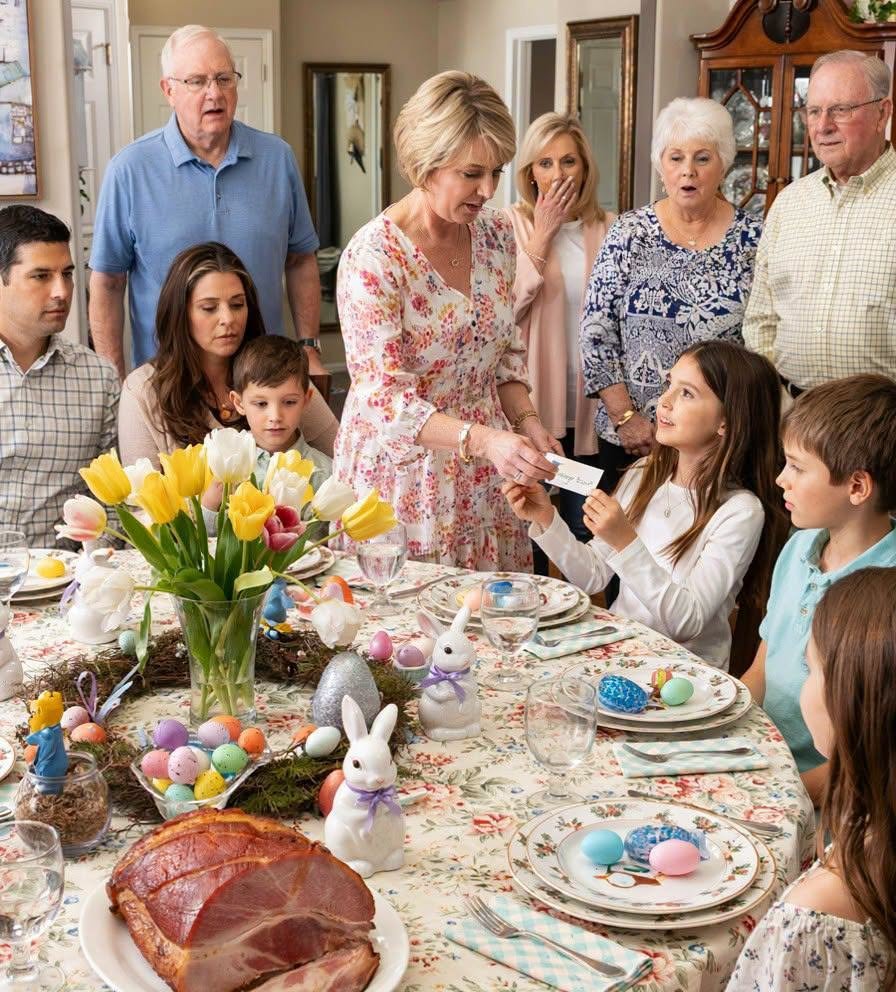
I glanced at her so sharply she stopped. You didn’t do anything wrong, I said.
Her mouth trembled. I know, she said. But she did not sound like she knew. That was the damage Carol had done. She had taken a holiday meal and turned it into a lesson my wife and children never should have had to learn.
At home, I put the kids on the couch with a movie. I gave Lily a piece of Easter chocolate and told Ethan he could pick the next one. He nodded without looking at me. Marianne stood in the living room doorway with her arms wrapped around herself. I kissed her forehead. Then I went into my home office.
The room was small, barely big enough for my desk, two filing cabinets, and the old printer that jammed every third page. On the wall behind my chair was a framed map of the United States that Ethan had once used for a school project. A little sticky note still marked Dallas because he liked the star.
Carol thought she knew what I was. A nephew. A son. A man she could embarrass at dinner and then quiet down with the word trust. But she had forgotten what I did for a living.
I am a senior logistics and commercial zoning consultant. That sounds boring until someone needs a building approved, a freight route cleared, a land use issue solved, or a historic clause interpreted without triggering a penalty large enough to scare off lenders.
Two years before that Easter dinner, Carol had come to me with a folder. The timestamp on the original email was eleven twenty in the morning on a Tuesday. The subject line read, land use guarantor support. She had been trying to rezone the family’s flagship commercial plaza for a luxury high rise redevelopment. It was the biggest project she had ever touched. It was also tangled in my grandfather’s historical land use clauses. Because of the way he had structured the documents, my signature as guarantor mattered. Without it, Carol could not move the project cleanly through the process. With it, she could bypass certain preservation penalties and satisfy the lenders enough to keep the funding alive.
She had sat across from me in a coffee shop with a paper cup in her hand and called it family business. She had said, we all benefit when we work together. I believed her then. That was the trust signal. My signature. My professional name. My willingness to help her because I thought family meant something more than blood when money was not on the table.
At three fourteen that afternoon, I opened my laptop. I pulled the original authorization file. I reviewed the guarantor support language. I opened the trust documents. Then I drafted a formal rescission of guarantor support, citing violation of the trust’s good faith execution clauses. I did not threaten. I did not insult. I did not mention Easter dinner except where the conduct created a documented breach of family beneficiary good faith. I attached the prior authorization file. I copied the city zoning board. I copied the primary commercial lenders funding the redevelopment. I copied the attorney listed on the last acquisition packet Carol had sent me.
Paperwork is not loud. That is why people underestimate it. But paperwork can walk into rooms your anger cannot enter.
Without my guarantor support, the acquisition funds could be frozen. The construction loan could be called into default. The city could review the historical preservation exposure. And if the penalties landed the way the file suggested, Carol could be looking at a hundred and fifty thousand dollar a day code violation clock starting Monday morning.
I read the email twice. Then I checked the names in the carbon copy field. The zoning board. The lenders. The project attorney. Carol. I clicked send.
Then I sat there for a moment with my hand still on the mouse. I expected to feel victorious. I did not. I felt tired. Tired of watching my wife earn a place that should never have been denied. Tired of watching my children learn that adults can smile while being cruel. Tired of money being treated like a crown.
When I went back to the living room, Lily was curled under a blanket, and Ethan was pretending to watch the movie. Marianne looked up at me. I sat beside her and pulled her close. It’s handled, I whispered. She closed her eyes.
Exactly twenty three minutes later, my phone began vibrating on the coffee table. Aunt Carol. I let it ring out. It rang again immediately. Then a text flashed across the locked screen. Ryan, answer the phone right now. Another came before the phone stopped buzzing. What is the meaning of this email from the zoning board. They are freezing the acquisition funds. Call me.
Marianne stared at the screen. What did you send, she asked.
The truth, I said.
My mother called next. Then my father. Then Carol again. The phone looked almost frantic, lighting up over and over on the table like a trapped thing. Lily looked at it and whispered, is she mad?
I turned the phone face down. She’s loud, I said. That’s different.
Ethan looked over at me for the first time since we left my parents’ house. Are we in trouble, he asked.
That question nearly took me out. No, I said. You are not in trouble. Neither of you did anything wrong.
He nodded, but he did not fully believe me yet. Children do not shed humiliation just because a parent tells them to. They need proof. They need time. They need adults to act differently than the ones who hurt them.
Another voicemail appeared from my mother. The transcription came through broken, but enough of it was visible. Ryan, your aunt is crying in the driveway. She says you destroyed everything.
I almost laughed. Not because it was funny. Because Carol had publicly excluded two children from a family gift, insulted my wife, and then discovered consequences existed. To her, that last part was the tragedy.
My father’s voicemail came after that. His voice sounded rough. Son, he said, Carol says there’s another document. She says your grandfather’s name is on it.
That made me sit up. Marianne saw my face change. What, she asked.
I opened my email again. A new message had come from the zoning board clerk. There was an attachment at the bottom. The file name referenced my grandfather’s initials and a trust amendment I had never seen. I downloaded it. The PDF opened slowly. Page one was an old scanned document. Page two had signatures. Page three had a clause that made the room feel smaller.
My grandfather had written that trust distributions for family minors were to include legally adopted children, stepchildren raised in the household, and any child publicly recognized and supported by a family beneficiary.
There it was. In black and white. Carol had not been enforcing the trust. She had been lying about it.
I read the clause twice before I handed the laptop to Marianne. Her hand went to her mouth. She knew, she whispered.
Yes, I said.
Carol had stood in my parents’ dining room and used blood as a weapon while sitting on a document that said the opposite. Not misunderstanding. Not tradition. Not policy. Control.
The next call from Carol came while the PDF was still open. This time, I answered. She did not wait for hello. What have you done, she shrieked.
I looked at the clause on the screen. I think the better question is what you’ve been hiding.
There was a pause. For the first time that day, Carol had no immediate line ready. That document is complicated, she said.
No, I said. It’s three pages.
Marianne looked down at the floor, and for one second, I saw eight years of swallowed hurt move across her face. I put the phone on speaker. Carol heard the shift.
Ryan, she snapped, do not make this worse.
You made my children cry in front of a room full of relatives, I said. You told my wife she was not family. You claimed the trust forced your hand. The trust says the opposite.
My mother’s voice came faintly through the background on Carol’s end. Carol, what is he talking about?
Carol hissed, be quiet.
That was all my mother needed to hear. The line went chaotic for a moment. My father demanded the document. Someone else asked what clause I meant. Carol tried to talk over all of them. I ended the call.
Then I forwarded the PDF to my parents, my siblings, my cousins, and the attorney listed on the trust’s administrative file. Subject line, trust amendment regarding minor beneficiaries. No speech. No insult. No drama. Just the document.
Within ten minutes, my cousin Daniel called me. He was the first person from that house who did not start by defending Carol. Ryan, he said quietly, I am so sorry.
I believed him. That did not fix everything, but it mattered.
My mother called again later that evening. I let it go to voicemail because I was not ready to manage her guilt for her. Her message was short. I should have said something, she said. Yes. She should have.
The next morning, the lenders requested clarification on Carol’s authority to represent the trust. By noon, the project attorney asked for a complete accounting of prior distributions. By Tuesday, Carol was no longer the only person with access to the administrative file. By Friday, the family had retained outside counsel to review the trust.
Carol called me thirty six times that week. I answered none of them. I did respond once by email. I told her all communication could go through counsel until the trust review was complete. That sentence felt better than yelling would have.
A week later, my parents came to our house. They stood on the front porch with a grocery bag full of Easter candy they had bought too late and apologies they should have found sooner. The little American flag by our mailbox moved in the wind behind them. My father looked smaller. My mother looked like she had been crying for days.
Ethan stayed near the stairs. Lily hid behind Marianne. My mother bent down, but she did not reach for Lily. That was the first smart thing she did.
I am sorry, she said. I should have protected you at that table.
Lily looked at me. I nodded once. She did not hug my mother. She did not have to.
Ethan asked the question no adult wanted to answer. Why didn’t you say anything?
My father swallowed hard. Because I was afraid of your aunt, he said. It was not a good excuse. But it was finally the truth.
Marianne stood beside me in a gray sweater with her arms folded, not angry, not soft, simply present. My mother turned to her. You have been family for years, she said. I am sorry I let anyone act like you weren’t.
Marianne’s eyes filled. She nodded. That was all she could give. That was all they deserved that day.
The trust review took months. Carol had not stolen the way people imagine theft in movies. There were no bags of cash hidden under a bed. It was smaller and uglier than that. Selective distributions. Delayed notices. Administrative choices that always seemed to benefit the relatives who praised her and punish the ones who questioned her. The five hundred dollar envelopes were not the biggest financial issue. They were just the moment she accidentally showed everyone the system.
Eventually, Carol was removed from her role as sole manager of the trust. The redevelopment project did not vanish, but it changed. It had oversight. It had signatures she could not control. It had people reading documents before nodding along. Carol hated that more than losing money. She hated being watched.
As for my children, they did get their Easter envelopes in the end. Not from Carol. From the trust, properly distributed, with a written apology attached by the new administrator. Ethan read the apology once and put it in his desk drawer. Lily spent ten dollars on stickers and saved the rest because Marianne told her saving money was also a kind of power.
In the weeks that followed, I noticed small changes in both children that nobody had asked them to make. Ethan started keeping a folder of his own, a plain manila one he found in the supply closet, where he saved report cards and certificates and, eventually, that written apology, as though he had absorbed something from watching me pull a folder out at exactly the right moment and decided folders were a kind of armor worth having. Lily, for her part, began asking Marianne more questions about money, not anxious questions, just curious ones, how a bank worked, what interest meant, why some people had more of it than others, questions that Marianne answered patiently at the kitchen table while stirring dinner, never once making the conversation feel heavier than it needed to be. I watched the two of them from the doorway some evenings and thought about how differently this could have gone if I had simply absorbed the humiliation the way I had absorbed Carol’s smaller cruelties for years, and how much of that absorption I had mistaken, for a long time, as keeping the peace.
The first family gathering after that was awkward. Of course it was. People overcorrected. They asked Marianne if she needed help until it became almost funny. They complimented Ethan’s shoes. They brought Lily extra cupcakes. But nobody used the phrase blood relatives again. Not once. And Carol did not attend. I do not know whether that was pride or strategy. I stopped caring.
Marianne told me once, months later, on an ordinary Tuesday with nothing particular happening, that she had spent years quietly rehearsing what she would say if anyone ever asked her outright whether she felt like she belonged in this family. She said she had never needed to use the speech, because nobody had ever asked directly, they had simply implied it sideways, in comments about real family and our side of things, the kind of remarks you could never quite hold up to the light without sounding oversensitive. She said that watching me put the document in front of everyone, without raising my voice, without making a scene beyond the one Carol herself had already made, was the first time she felt like the question had finally been answered out loud, on the record, in writing, in a way nobody could quietly take back later.
The thing about cruelty at a family table is that it teaches everyone something. That Easter, Carol tried to teach my children they were smaller than the other kids. She tried to teach my wife that eight years of love could be erased by one woman with a purse. She tried to teach me that silence was the price of belonging. Instead, my children learned something else. They learned that family is not proven by envelopes. It is proven by who stands up when someone tries to make you disappear. And eventually, the same room that had taught them to wonder if they belonged had to learn the answer out loud. They did. They always had.