
Then it would be over. I remember looking at her across the table that night, watching her laugh at something small and inconsequential, and feeling something strange settle inside me. Not hatred exactly.
Something closer to grief for a version of her I now understood had never fully existed, alongside a kind of cold clarity about the version that had. They came for her three days later, on a Tuesday morning, while she was finishing her coffee in the kitchen in her robe, completely unaware that the front door was about to open onto the rest of her life. I had been asked to be elsewhere when it happened, partly for my own protection, partly because Reynolds didn’t want her seeing my face the moment she understood what I had done.
I sat instead in an unfamiliar diner three towns over, drinking coffee I didn’t taste, watching the door, waiting for my phone to ring. When it finally did, Reynolds’s voice was steady and almost gentle. They had her.
The operation had gone smoothly. Several other arrests had followed within hours, men whose names I would later see attached to federal indictments involving sums of money so large they stopped feeling like real numbers at all. He told me I could go home now, that agents would need a statement from me in the coming days, but that for tonight I should simply rest.
I didn’t go home that night. I went instead to my brother’s place across town, sat on his couch with a beer I barely touched, and tried to understand how ten years of my life could fold so completely into something I had never been allowed to see. My brother didn’t ask many questions.
He just sat with me, the television murmuring something neither of us watched, until it got late enough that sleep finally took me out of pure exhaustion rather than peace. The weeks that followed were strange in the way grief is strange, because in some sense I was grieving, even though the person I was grieving had never really existed in the form I’d loved. There were depositions, meetings with federal prosecutors, careful explanations of financial documents I had helped collect without ever fully understanding what they meant in the moment.
Sarah’s lawyer reached out once, early on, suggesting we might find some quiet arrangement, some way to keep the worst of it out of public record, but I had nothing left in me for protecting her reputation. I gave the prosecutors everything I had. I saw her once during the proceedings, across a courtroom rather than a kitchen table, and the distance felt right in a way I hadn’t expected.
She looked smaller than I remembered, stripped of the soft authority she’d always carried so easily. She didn’t look at me, not once, and I found that I didn’t need her to. Whatever explanation I might once have wanted from her, some neat accounting of how she had managed to love me, or perform loving me, while building an entire second life in the shadow of our marriage, never came, and eventually I stopped waiting for it.
She was sentenced the following spring to a long stretch in federal prison, the exact number of years feeling almost beside the point by then. The network around her, the men whose voices I had listened to on recordings made in my own dining room, were sentenced alongside her, some for considerably longer. Reynolds called me after the sentencing, not because he had to, but because over those months he had become something closer to a friend than an investigator, the kind of relationship forged only by going through something that strange together.
“You did the right thing,” he told me. “I know it didn’t feel that way most days.”
He was right on both counts. It took the better part of a year to feel like myself again, or perhaps to feel like a slightly different version of myself, one with a clearer, harder edge where there used to be only trust offered freely and without much thought.
I sold the house. There was no way I could keep living inside the stage set of a marriage that had never been entirely real, surrounded by furniture we’d chosen together for reasons I now understood had partly been about appearances. I moved into a smaller place across town, simpler, entirely mine, with nothing in it that carried a history I needed to question.
I started seeing a therapist, something I’d resisted for years out of a kind of stubborn pride, and slowly began to understand that what had happened to me wasn’t a referendum on my own judgment or worth. I had simply loved someone who was extraordinarily good at being loved without ever truly being known. That isn’t a flaw in the person who loved.
It’s a particular kind of cruelty practiced by the person who allowed it. Detective Reynolds and I still talk occasionally, mostly just checking in, the strange camaraderie of two men who had once spent six weeks quietly dismantling the same lie from opposite sides. He told me once, almost in passing, that cases like Sarah’s were rarer than people assumed, that most people swept up in organized financial crime didn’t bother building entire marriages as cover, because most people weren’t patient enough, or cold enough, to commit to a decade long performance.
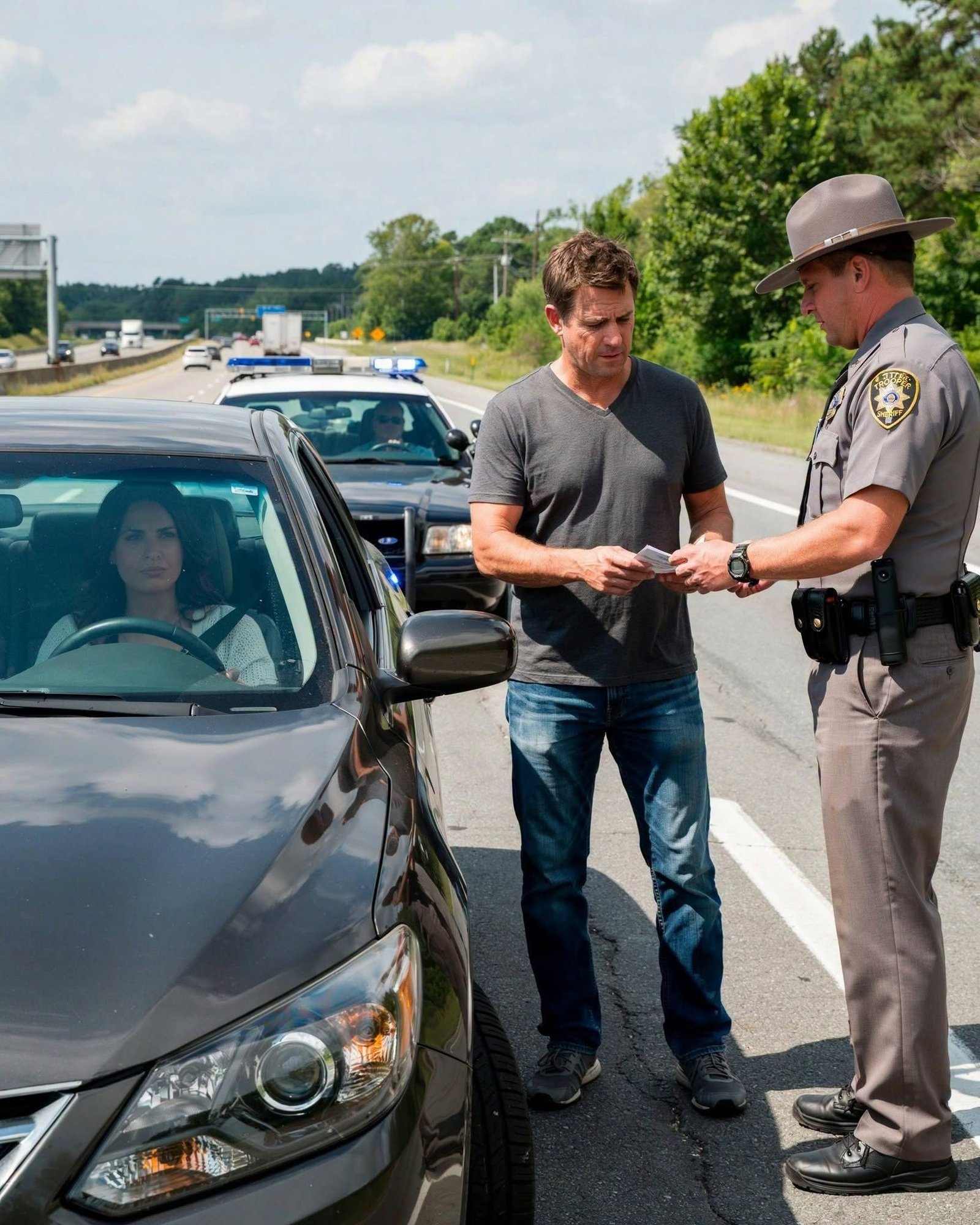
I’m not sure that detail made me feel better exactly, but it did make me feel less foolish, which mattered more than I expected it to. It’s been two years now since that afternoon on Route 35, since Officer Martinez tapped on my window and quietly handed me seven words that ended one life and, eventually, began another. I think about him sometimes, that trooper who had no real obligation to tell me anything at all, who could have simply written the warning and sent us on our way and let the investigation run its course without my involvement.
I never got the chance to properly thank him. I tried once, reaching out through the department, but he had transferred to another county by then, and the message I left never found its way back to me. I like to think he knows anyway, in the way people sometimes do, that the small kindness of a folded note changed the entire shape of someone’s life for the better, even if that someone never got to say so out loud.
These days I live alone in the new place, and I’ve found that I don’t mind it the way I expected to. I cook dinner most nights without an audience to perform for, and there is something quietly restorative in that, in eating a meal that doesn’t require explanation. I’ve started seeing someone new recently, slowly and without urgency, a woman named Claire who teaches middle school and laughs easily and has, as far as I can tell, absolutely nothing to hide, mostly because her life is exactly as unremarkable and visible as she presents it to be.
I don’t say that as an insult. After everything, unremarkable has become the highest compliment I know how to give. Last week Claire asked me, gently, why I sometimes go quiet in the middle of an ordinary evening, staring at nothing in particular.
I told her the truth, or as much of it as felt fair to share so early. I told her that I’d once been married to someone I thought I knew completely, and that I had learned the hard way that love isn’t the same thing as truth, that two people can share a bed and a mortgage and a decade of ordinary Tuesdays and still, somehow, be living in entirely different stories. She didn’t flinch from that, or ask for more than I was ready to give.
She just reached across the table and took my hand, the gesture so plain and uncomplicated that it nearly undid me. There was nothing hidden in it. No second meaning.
No architecture built to disguise some other purpose underneath. I think that’s what I was actually looking for, in the end, more than safety or even justice. Not a guarantee that nothing bad could ever happen to me again, because no one gets that guarantee, but simply the chance to sit across a table from someone and trust that what I was seeing was, finally, the whole and entire truth of who they were.
I still keep the note. It’s folded inside an old wallet I don’t use anymore, tucked into a drawer I rarely open. Seven words in a stranger’s handwriting that gave me back a version of my own life I hadn’t known I was missing.
Some nights, when I can’t sleep, I take it out and read it again, not because I’ve forgotten what it says, but because it still feels important to remember how close I came to walking back into a house that was never really mine to begin with, and how grateful I am, even now, that someone cared enough to stop me at the door.