
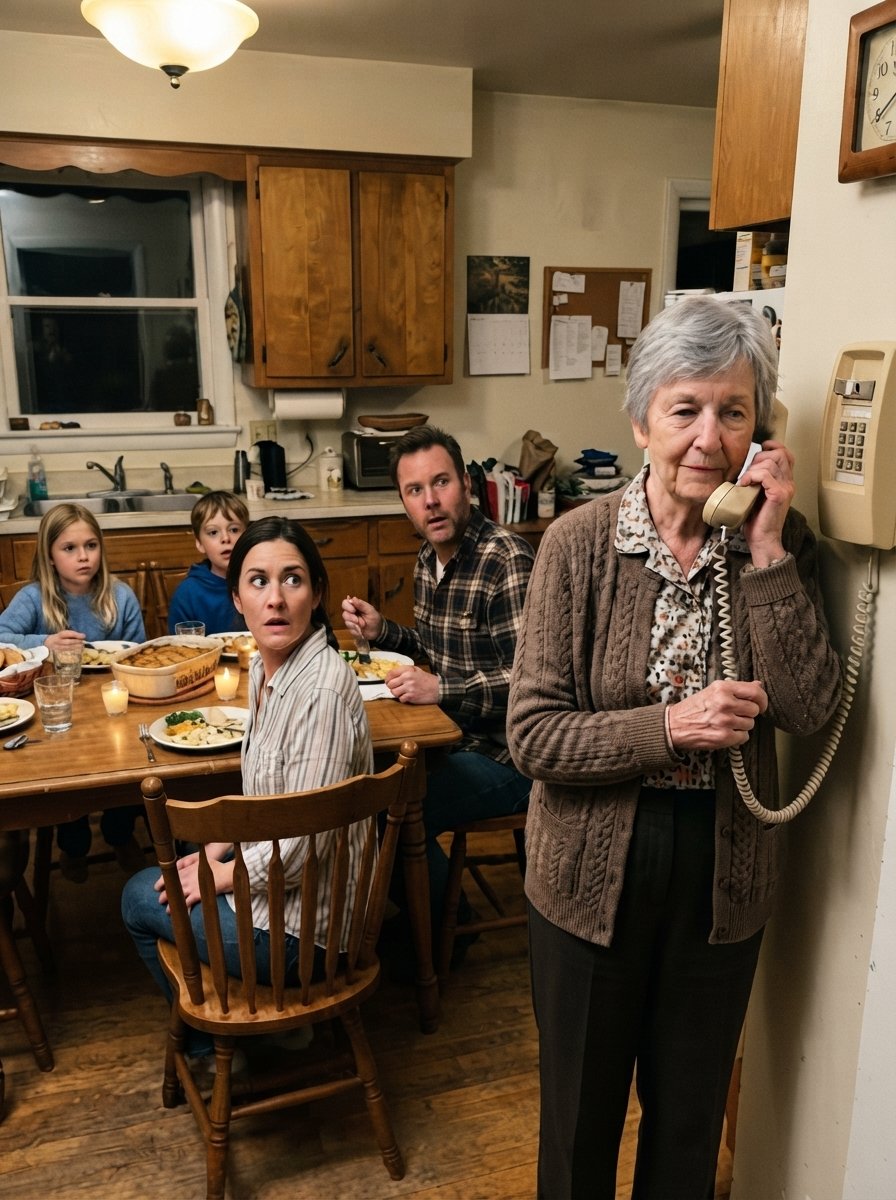
My son’s wife moved into my house. On her very first day, she pointed toward the back porch and said, “This is my house now. Take your plate outside and eat with your little friend.”
For a moment, the entire dining room fell silent.
She thought she had won.
She had no idea that one phone call would change everything.
The dining room still smelled of rosemary, beef stew, warm bread, and melted candle wax when Linda made her announcement.
My son, Edward, froze with his spoon halfway to his mouth.
Sarah, my niece, let out a nervous laugh that disappeared the instant she realized no one else was smiling.
Even the old grandfather clock in the hallway seemed louder than usual.
Linda folded her arms and looked at me with the confidence of someone who believed she already owned everything around her.
“I’ve been patient long enough,” she said. “It’s time this house had one person making decisions.”
She pointed toward the covered patio outside the kitchen window.
“You and your friend can eat out there.”
Her “friend” was Martha.
My neighbor of thirty-eight years.
She had stopped by to return a casserole dish and had accepted my invitation to stay for dinner after learning that Edward and Linda had officially moved in that afternoon.
Martha looked horrified.
“You don’t have to leave,” she said quietly.
Linda ignored her.
“I wasn’t talking to you.”
Edward finally cleared his throat.
“Linda…”
She interrupted him before he could finish.
“We’re starting our life together. Your mother has had this house long enough. Things are going to change.”
I slowly placed my fork on the table.
The china made a soft click against the plate.
Everyone watched me, waiting for an argument.
Instead, I smiled.
Not because her words didn’t hurt.
They did.
This was the same dining room where Edward had celebrated every birthday from the age of five.
The same oak table where I had helped him finish science projects, college applications, and the paperwork for his first job.
Every corner of this house carried memories of sacrifices he would probably never know.
After my husband passed away twenty years earlier, I worked two jobs to keep this home.
I refinanced the mortgage.
Skipped vacations.
Sold my jewelry more than once to make tuition payments.
When Edward graduated from engineering school without a dollar of debt, I considered every sacrifice worthwhile.
Never once did I imagine someone would eventually tell me I no longer belonged under my own roof.
Linda mistook my silence for surrender.
She reached across the table and picked up the serving bowl.
“I’ll decide where everyone sits from now on.”
Martha looked at me with worried eyes.
Edward stared at the tablecloth.
Neither of them noticed what I had already decided.
Without raising my voice, I stood up, picked up my dinner plate, and walked toward the kitchen counter.
Linda smiled triumphantly.
“I knew you’d understand.”
“Oh,” I replied calmly, “I understand perfectly.”
I set the plate down, reached into my purse, and took out my phone.
Linda crossed her arms.
“Calling someone to complain?”
“No.”
I unlocked the screen and selected a contact I hadn’t needed in years.
The call connected after two rings.
“Good evening,” I said pleasantly. “This is Margaret Collins. I’d like to begin the paperwork we discussed regarding my property.”
The attorney recognized my voice immediately.
“Mrs. Collins, are you ready to proceed?”
“Yes.”
I glanced back into the dining room.
Linda’s confident smile had begun to fade.
“I believe it’s time.”
The attorney continued, “Very well. I’ll have the documents prepared first thing tomorrow morning.”
Linda frowned.
“What documents?”
I thanked the attorney, ended the call, and slipped my phone back into my purse.
Then I looked directly at her.
“The documents that determine exactly who owns this house.”
For the first time that evening, Linda’s expression changed.
And across the table, Edward slowly realized there was far more about this home—and about his mother—that he had never bothered to ask.
Final Part: The House She Thought Was Hers
Linda stared at me as though I had suddenly begun speaking another language.
Edward lowered his spoon.
“What paperwork?” he asked.
I walked back to the dining table, but I did not sit down. Instead, I placed both hands on the back of my chair and looked at the two people who had arrived that afternoon with twelve boxes, three suitcases, and the assumption that my life was over.
“The paperwork concerning the Collins Family Trust,” I said.
Edward’s face tightened.
“What trust?”
“The one your father and I created before he died.”
Linda gave a short, dismissive laugh.
“Edward told me this house would eventually belong to him.”
“Eventually is not the same as today.”
“You’re his mother,” she replied. “Who else would you leave it to?”
“That was once the plan.”
The room became quiet again.
Edward finally looked up at me.
“Was?”
I nodded.
For years, I had intended to transfer the house to Edward gradually. My attorney had prepared preliminary documents that would allow me to remain here for the rest of my life while giving my son a future interest in the property.
I had never signed them.
Something inside me had always hesitated.
Perhaps it was the way Edward rarely called unless he needed something. Perhaps it was how quickly he changed the subject whenever I mentioned repairs, taxes, or the increasing difficulty of maintaining the property alone.
Or perhaps some part of me had sensed that the son I loved was becoming comfortable with the idea that everything I owned already belonged to him.
Linda pulled out her chair and stood.
“This is ridiculous. We sold most of our furniture because Edward said we were moving here permanently.”
I turned to my son.
“You told her that?”
Edward’s mouth opened, but no words came out.
Linda answered for him.
“He said you were lonely. He said you wanted us here.”
“I invited you to stay while your apartment building was being renovated.”
“That could take months.”
“Then you should have discussed those months with me before moving into my bedroom.”
Edward’s head snapped up.
“What do you mean?”
I looked toward the hallway.
When I returned from the grocery store that afternoon, I had found three of Linda’s garment bags hanging inside my closet. My dresses had been pushed into the guest room, and the framed photograph of my husband had been placed facedown inside a cardboard box.
I had said nothing.
I wanted to see whether Edward would notice.
He had not.
Linda rolled her eyes.
“Your bedroom is the largest. Edward and I are a married couple. We need privacy.”
“And I don’t?”
“You’re one person.”
The cruelty in her voice was so effortless that even she did not appear to hear it.
Martha reached for my hand, but I gave her a small smile.
I was no longer hurt.
I was certain.
“Linda,” I said, “you arrived in my house this afternoon. Within six hours, you moved my belongings, opened wine from my cellar without permission, placed your name on the household account folder, and ordered me to eat outside.”
“I was establishing boundaries.”
“No. You were testing how much humiliation I would accept.”
Her face reddened.
Edward stood abruptly.
“Mom, no one is trying to humiliate you.”
Martha looked at him in disbelief.
“Edward, your wife just told your mother to take her dinner outside.”
“I know, but everyone is tired. Moving is stressful.”
I studied my son carefully.
For years, I had defended him whenever friends suggested that I did too much for him.
“He works hard,” I would say.
“He has responsibilities.”
“He’ll visit when things settle down.”
But things never settled down.
There was always another project, another bill, another reason he needed my patience.
That evening, I finally understood something painful.
Edward was not silent because he was shocked by Linda’s behavior.
He was silent because speaking would make his life uncomfortable.
“You’re right,” I said.
He looked relieved.
Then I continued.
“Moving is stressful. That is why you should begin moving again tomorrow.”
Linda stared at me.
“You can’t throw us out.”
“I can ask guests to leave.”
“We receive mail here.”
“You changed your mailing address before you arrived?”
She looked away.
That told me everything.
They had not come for a temporary stay.
They had planned this carefully.
Edward stepped toward me.
“Mom, where are we supposed to go?”
“You are forty-two years old.”
“That doesn’t answer my question.”
“No, Edward. For the first time in your life, I am allowing you to answer it yourself.”
His face changed.
I saw anger first, then disbelief, and finally something close to shame.
Linda slammed her palm against the table.
“We put our savings into this move!”
“What savings?” I asked.
Edward’s expression immediately warned her to stop.
I noticed.
“What is she talking about?”
Linda turned toward him.
“She deserves to know.”
“Linda, don’t.”
“Know what?” I demanded.
Linda’s eyes returned to me.
“We paid off Edward’s business debt.”
I looked at my son.
“What business?”
He sat down slowly.
For the past year, Edward had apparently invested in a construction partnership with one of Linda’s cousins. The project failed before the first building was completed. Rather than tell me, Edward used nearly all their savings to cover loans he had personally guaranteed.
They had not moved into my house because their apartment was being renovated.
They had given it up because they could no longer afford the rent.
The renovation story had been a lie.
Linda began speaking faster.
“This house has five bedrooms. You barely use half of them. We thought we could stay here, recover financially, and eventually take responsibility for the property.”
“Take responsibility?”
“It needs modernization. We’ve already spoken with a contractor.”
My voice became very quiet.
“You arranged renovations to my home?”
“The kitchen is outdated, and this dining room is too formal. We thought about opening the wall and turning your sewing room into a larger entertainment area.”
My sewing room.
The room where I had repaired uniforms for extra money after my husband’s death.
The room where I had spent long nights finishing alterations so Edward’s tuition payment would not be late.
Linda saw only an unnecessary wall.
I saw twenty years of survival.
“When is the contractor coming?” I asked.
“Thursday.”
“Cancel him.”
“We paid a deposit.”
“Then consider it the cost of making decisions about property that does not belong to you.”
Linda looked at Edward.
“Are you going to let her speak to me like this?”
Edward rubbed both hands over his face.
“Linda, you shouldn’t have told her to eat outside.”
“That is all you’re going to say?”
“What do you want me to say?”
“I want you to tell her this is our home now.”
He looked at me.
For one brief moment, I saw the boy who used to run into the kitchen after school, drop his backpack beside the door, and ask what I had made for dinner.
Then his eyes moved toward the table, the walls, and the polished cabinet containing my wedding china.
He did not see memories.
He saw security.
“I thought one day the house would be mine,” he said quietly.
“One day, perhaps.”
“So why does it matter if we begin treating it like ours now?”
Martha inhaled sharply.
My niece Sarah stared at him as though she no longer recognized him.
I felt something inside me close.
Not my love for my son.
A mother’s love does not disappear that easily.
But trust can.
And mine did.
“Because I am still alive,” I said.
Edward looked down.
No one spoke after that.
I asked Martha to stay with me in the guest room that night. Edward and Linda carried their suitcases downstairs after I told them they were no longer sleeping in my bedroom.
At seven the next morning, my attorney arrived.
Daniel Reeves had handled our family’s legal matters for nearly thirty years. He entered carrying a briefcase and two thick folders.
Linda came downstairs in a silk robe, looking irritated.
“Why is he here so early?”
“Because I asked him to be.”
Daniel placed the folders on the dining table.
The same table where Linda had ordered me to leave less than twelve hours earlier.
He opened the first folder.
“Mrs. Collins has instructed me to terminate the unsigned transfer plan that would have granted Edward Collins a future ownership interest in this residence.”
Edward’s face went pale.
“I didn’t know there was already a plan.”
“You never asked,” I said.
Daniel continued.
“The house will remain solely under Margaret Collins’s control. It will be placed into a protected living trust. Mrs. Collins retains full occupancy and decision-making authority for the remainder of her life.”
Linda folded her arms.
“And after that?”
Daniel looked toward me before answering.
“That is no longer your concern.”
Her mouth fell open.
Edward whispered my name.
I slid the second folder toward him.
“This contains a formal notice requiring you and Linda to leave. Daniel has ensured that it follows every local requirement. I am not changing the locks while you are inside, and I am not placing your belongings on the street. You will have the time legally required to arrange somewhere else to live.”
Linda grabbed the notice.
“You’re evicting your own son?”
“I am requiring two adults to stop treating my home as an inheritance they can collect before my funeral.”
“This is because of one argument.”
“No. This is because of everything that argument revealed.”
Linda tore the notice in half.
Daniel calmly removed another copy from his briefcase.
“Tearing a document does not cancel it.”
Sarah covered her mouth to hide a smile.
Linda turned on Edward.
“Do something!”
He remained seated.
She pushed his shoulder.
“You promised me this house.”
“I said I would probably inherit it.”
“You said your mother would never refuse you.”
The words remained in the air.
Edward looked at me.
For once, he could not pretend the misunderstanding belonged to someone else.
He had counted on my love being stronger than my self-respect.
He had assumed I would accept anything rather than risk losing him.
Linda rushed upstairs, slamming doors and dragging suitcases from room to room.
Edward stayed at the table.
After several minutes, he spoke.
“I’m sorry.”
I did not answer immediately.
“I really am,” he continued. “I didn’t know she would speak to you that way.”
“You watched her do it.”
“I froze.”
“You also watched her move into my bedroom.”
He closed his eyes.
“I told myself it was temporary.”
“You lied about the apartment.”
“I was ashamed.”
“So you decided it would be easier to take control of my life than admit you had lost control of yours.”
His eyes filled with tears.
“I made a terrible mistake.”
“Yes.”
He looked surprised that I agreed so quickly.
Perhaps he expected me to rush around the table, hold him, and tell him everything would be fine.
That was what I had always done.
Not this time.
“I love you, Edward,” I said. “But loving you does not require me to rescue you from every decision you make.”
He nodded slowly.
“Will you ever forgive me?”
“I hope so.”
His voice broke.
“But not today?”
“Forgiveness is not the same as giving you the house.”
He lowered his head.
Upstairs, Linda shouted that she was leaving immediately.
She packed only her valuables and drove away in Edward’s car before noon.
Edward remained behind to gather the rest of their belongings.
Three days later, he moved into a small furnished apartment near his office.
Linda did not join him.
Within two months, she filed for divorce, claiming Edward had misrepresented his financial future.
Apparently, her love had depended heavily on square footage.
Edward sold his share in the failed company, took a second job, and began paying his debts without asking me for money.
For nearly six months, we spoke only occasionally.
Then, one Saturday morning, he arrived carrying a small toolbox.
“The back porch step is loose,” he said. “May I repair it?”
He did not enter without permission.
He did not mention the trust.
He simply spent the morning replacing the damaged boards.
When he finished, we sat outside with Martha and drank lemonade.
It was the same porch where Linda had ordered me to eat.
But it no longer felt like a place of humiliation.
It felt like proof that a boundary could restore what endless sacrifice had nearly destroyed.
A year later, I finalized the trust.
The house would not pass directly to Edward after my death.
Instead, it would be sold, and the proceeds would be divided between a housing charity for widowed women and an education fund for my future grandchildren.
Edward was named administrator of the education fund—but only if he remained financially responsible and completed counseling.
When I explained my decision, he did not argue.
“I understand,” he said.
That was how I knew he had finally changed.
Not because he apologized.
Because he stopped believing my forgiveness entitled him to a reward.
Linda had entered my house believing age had made me weak.
She thought motherhood meant endless surrender.
She believed the years I had spent giving to my son had erased my right to choose what happened to the life I had built.
But she was wrong.
That house was never merely wood, stone, or property.
It was every night I had worked while Edward slept.
Every bill I had paid when there was almost nothing left.
Every sacrifice I had made without asking for praise.
And the moment Linda told me to carry my plate outside, she reminded me of something I should never have forgotten.
Kindness without boundaries becomes permission.
Love without respect becomes exploitation.
And a home does not belong to the loudest person at the table.
It belongs to the person whose name is on the deed—and whose courage is strong enough to say:
“No. Not this time.”