
Part 1: The Million-Dollar Secret
I quietly moved the $1 million my great-grandmother had left me into an account no one in my family could touch.
One week later, my parents showed up at my house smiling and made a cruel announcement.
“This house isn’t yours anymore, Brooke. You have until Friday to leave.”
My mother said it across my dining table as casually as if she were reminding me to take the trash cans to the curb.
Not telling me to leave the only house where I had ever truly felt safe.
The coffee beside my elbow had already gone cold.
The kitchen still smelled like lemon cleaner because Mom had wiped down my table before sitting, quick and sharp, almost as though even my fingerprints irritated her.
Gray morning light slipped through the blinds and fell across the keys swinging from my younger sister Alyssa’s finger.
She was smiling.
Not nervous.
Not ashamed.
Smiling like the house already belonged to her.
Dad stood near the old dresser with both hands buried in his coat pockets, staring at a framed print on the wall as though it could somehow save him from having to behave like a decent father.
I carefully set down my mug.
My hand had started shaking.
Something hot and bitter rose into my throat, but I forced it back down.
“We’ll see about that.”
That was all they got from me.
No screaming.
No tears.
No scene they could later twist into proof that I was unstable or ungrateful.
My family had always liked me best when I was useful, quiet, and grateful.
My brother Zachary was allowed to need help.
Alyssa was allowed to want things.
I was expected to manage on my own, smile, and apologize for taking up space.
Zachary received help with car payments, rent, and every emergency that somehow appeared with his hand already extended.
Alyssa received clothes, vacations, lessons, and every soft landing my parents could provide.
I received part-time jobs, student loans, overdue bills, and the carefully learned skill of asking for help as though I had done something wrong.
For years, I told myself that was simply how families worked.
Some children were cherished.
Others were taught not to complain.
Then I turned twenty-five.
One week after my birthday, Melissa Greene, the estate attorney who had handled my family’s paperwork for years, called me.
“I need you to come to my office,” she said.
Then she paused.
“Alone.”
I arrived at 2:17 that afternoon.
Melissa closed the office door behind me and placed a beneficiary notice on her desk.
Then she slid a trust statement toward me.
Then another document.
Then copies of annual account reports my parents had received every year since I turned eighteen.
I stared at the papers.
“What am I looking at?”
Melissa folded her hands.
“Your inheritance.”
I looked up at her.
“My what?”
“Your great-grandmother Dorothy created equal trusts for every great-grandchild. Yours was established before you were born.”
My eyes dropped back to the statement.
The trust had been sitting there quietly for twenty-five years.
Growing.
Waiting.
The current balance was just over one million dollars.
My money.
Money that could have helped pay for college.
Money that could have prevented the double shifts, the late fees, and the sleepless nights when I lay awake at three in the morning trying to decide whether rent, groceries, or another bill deserved my last dollar.
I looked at Melissa.
“My parents knew?”
She didn’t answer immediately.
She didn’t have to.
The annual statements were right in front of me.
My parents had known.
They had known the entire time.
Betrayal isn’t always loud.
Sometimes it arrives in black ink.
Neat dates.
Old signatures.
Account statements.
A file tab with your name printed across it.
Melissa explained that Zachary had already received his share.
Alyssa’s inheritance remained protected until she reached the required age.
I was the only one who had been kept in the dark.
The only one trained to be grateful for crumbs while a fortune sat quietly behind a locked door.
I didn’t confront my parents that day.
I didn’t call Zachary.
I didn’t call Alyssa.
Instead, I signed the documents Melissa placed in front of me.
Then I moved the full balance into a protected trust account my parents could no longer access.
I requested certified copies of everything.
Transfer records.
Beneficiary notices.
Account statements.
Trust documents.
Property records.
Every paper connected to my inheritance.
Every paper trail my parents had apparently assumed I would never be smart enough to request.
At 4:49 p.m., the confirmation arrived in my inbox.
The transfer was complete.
I stared at the screen for a long time.
Then I closed my laptop.
And waited.
A week later, my parents arrived for their little performance.
“The house is in Alyssa’s name now,” Mom announced.
Her voice was light and pleasant.
“We want to help her start building equity. You’ve had plenty of time here, Brooke. You need to be out by Friday.”
Alyssa lifted the keys just high enough for me to see them.
Dad said nothing.
I looked at the three of them.
Then I slowly nodded.
They apparently thought I didn’t understand deeds.
Or signatures.
Or county recording stamps.
Or trust documents.
Or the difference between a family story and legal ownership.
Most importantly, they had no idea what I had already learned.
That afternoon, after they left, I made one phone call.
I didn’t tell my parents about it.
I didn’t need to.
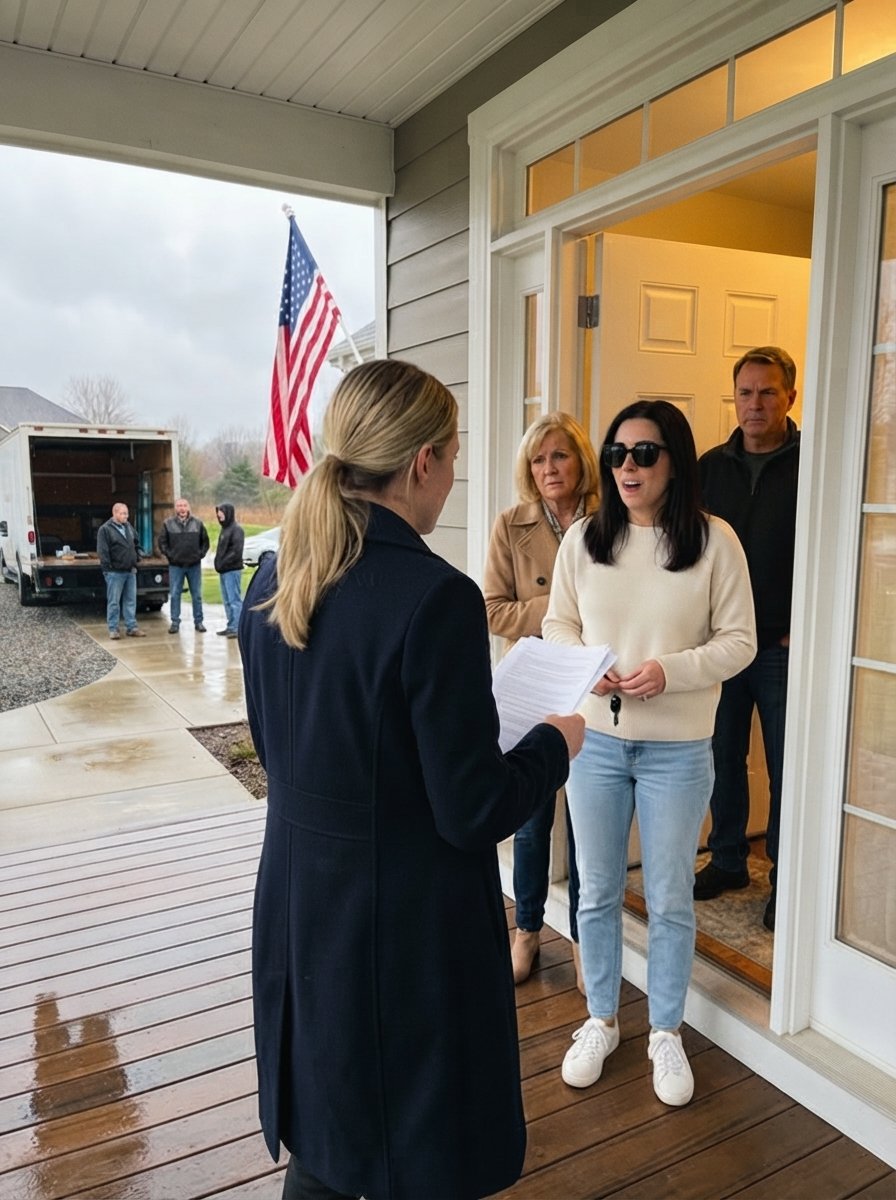
Two days later, at exactly nine in the morning, a moving truck rolled onto my street.
Its brakes hissed beside the wet curb.
Two movers climbed down with clipboards in their hands.
They looked bored.
That changed when they saw my parents walking up the driveway as though they owned the morning.
Mom’s SUV idled behind the truck.
Alyssa stepped out wearing sunglasses.
Those same keys were in her hand.
She walked toward my front door with the confidence of someone who had already decided where her furniture would go.
She stepped onto the porch.
Then she raised her hand toward the lock.
Before she could insert the key, a woman’s voice came from behind her.
“Don’t.”
Alyssa froze.
My parents turned.
I stepped onto the porch.
Beside me stood Melissa Greene, dressed in a dark coat buttoned to her throat.
A thick folder was tucked firmly beneath one arm.
Dad recognized her before anyone else did.
The color drained from his face so quickly that Mom immediately looked at him.
The movers fell silent.
Alyssa slowly lowered the keys.
Mom’s confident smile remained frozen for another second before beginning to crack.
“Who is she?” Mom asked.
I smiled.
“Someone you should have spoken to before telling me to leave my own house.”
Melissa opened the folder and removed the first document.
“Leonard,” she said calmly, looking at my father, “before anyone lays a hand on that door, you need to understand exactly what Brooke owns.”
For the first time in my life, my father had absolutely nothing to say.
Melissa turned the page.
Then she said the words that changed everything.
Part 2: The Document They Never Expected Me to Find
“The deed you filed six days ago is not valid.”
For several seconds, nobody moved.
Even the movers seemed to forget why they were standing in my driveway.
Mom blinked.
“What?”
Melissa didn’t raise her voice.
She didn’t need to.
“The document transferring this property to Alyssa was signed by you, Patricia, under authority you no longer possessed.”
Mom gave a short laugh.
It sounded nervous.
“That’s ridiculous. Leonard and I have managed this property for years.”
“Managed,” Melissa repeated.
Then she looked directly at my mother.
“Not owned.”
The word landed harder than a shout.
Alyssa’s fingers tightened around the keys.
Dad finally stepped forward.
“Melissa, maybe we should discuss this privately.”
“No,” I said.
Everyone looked at me.
I folded my arms across my chest.
“You came to my house with a moving truck. You can hear the explanation in my driveway.”
Dad’s jaw tightened.
For once, I didn’t care.
Melissa removed another document.
“This property was purchased by Dorothy’s estate trust seventeen years ago. Brooke was named the sole beneficial owner. Because she was still a minor, Leonard and Patricia were appointed temporary property trustees.”
I looked at Mom.
She looked away.
Melissa had already explained part of this to me, but hearing it spoken aloud in front of my family made the betrayal feel different.
More real.
“The trusteeship ended automatically when Brooke turned twenty-five,” Melissa continued.
Alyssa frowned.
“But Mom said this was their house.”
Melissa looked at her.
“It never was.”
Alyssa’s expression changed.
Only slightly.
But I saw it.
The first crack.
Mom recovered quickly.
“We paid for repairs. We paid taxes. We maintained it.”
“Using funds from the property reserve account,” Melissa replied.
Dad’s head snapped toward her.
Melissa looked at him.
“Yes, Leonard. I have those statements too.”
The silence became almost unbearable.
My stomach twisted.
For years, I had believed my parents were generously allowing me to live in a family property.
Whenever the roof needed repairs, Mom reminded me how expensive houses were.
Whenever the furnace had problems, Dad told me how lucky I was that they handled things.
When the water heater broke two winters earlier, I thanked them repeatedly.
I had even cooked dinner for them because I felt guilty about costing them money.
Now I understood.
Those repairs had been paid from funds connected to the property.
Funds belonging to the trust.
My trust.
They had made me grateful for things I was already paying for.
Mom’s voice sharpened.
“None of this matters. We transferred the title.”
Melissa calmly removed a certified copy from the folder.
“You attempted to.”
She handed it to Dad.
“The county may have accepted the document for recording, but recording a deed does not make an unauthorized transfer lawful.”
Dad scanned the document.
His face grew paler with every line.
Melissa pointed to the signature block.
“Patricia signed as trustee.”
Mom crossed her arms.
“I was trustee.”
“Until Brooke’s twenty-fifth birthday.”
Melissa paused.
“That authority ended before you signed this.”
Mom’s lips parted.
Nothing came out.
I suddenly understood the timing.
My parents had known exactly when control of my trust would become mine.
That was why everything had happened so quickly.
My birthday.
Melissa’s call.
My transfer of the million dollars.
Then, only days later, my parents suddenly announced that Alyssa owned the house.
It wasn’t random.
They had been racing against something.
I looked at Melissa.
“You said there was more.”
“There is.”
Dad closed his eyes for just a second.
And that was when I knew.
He already understood what was coming.
Melissa removed another packet from the folder.
“Before Brooke turned twenty-five, someone attempted to obtain her signature on a document consenting to a future transfer of this property.”
My mind raced.
“I never signed anything like that.”
“I know,” Melissa said.
Then she looked directly at Mom.
“Because the signature isn’t Brooke’s.”
Alyssa whispered, “What?”
Mom’s expression hardened.
“You can’t prove that.”
Melissa didn’t even blink.
“I don’t have to prove it standing in this driveway.”
She slipped the paper back into the folder.
“But a forensic document examiner can.”
Dad suddenly turned toward Mom.
“You said she signed it.”
Mom glared at him.
“Don’t you start.”
“You told me Brooke signed it!”
“I said I handled it.”
“That is not the same thing!”
Their voices echoed across the quiet street.
One of the movers stared at his clipboard, clearly wishing he could disappear into it.
Alyssa removed her sunglasses.
Her confidence was gone.
She looked from Mom to Dad.
“You told me Brooke agreed to give me the house.”
Mom turned toward her.
“Honey, this is complicated.”
“No.”
Alyssa’s voice shook.
“You said she had her inheritance. You said she didn’t need the house too.”
Something cold settled inside me.
There it was.
The truth beneath everything.
This had never simply been about helping Alyssa “build equity.”
It was about redistribution.
In my parents’ minds, anything I had could be divided among the children they worried about more.
My inheritance wasn’t truly mine.
My house wasn’t truly mine.
My time wasn’t mine.
My sacrifices weren’t mine.
Everything was simply another family resource.
And because I had always been the child who survived without help, they had convinced themselves that taking from me wasn’t really taking.
Mom looked at me.
“You have over a million dollars now, Brooke.”
Her voice softened, as though she were trying to reason with an unreasonable child.
“Alyssa has nothing.”
I stared at her.
“Alyssa has parents who have spent her entire life making sure she never had nothing.”
“That isn’t fair.”
I almost laughed.
“No, Mom. It isn’t.”
She stepped closer.
“Your sister needs somewhere to live.”
“So did I when I was nineteen.”
Mom stopped.
I continued.
“I worked two jobs while going to school because you told me you couldn’t afford to help with rent.”
“We were teaching you responsibility.”
“You knew I had a trust.”
“That money wasn’t available then.”
“You received annual statements.”
Dad looked down.
Mom’s face turned red.
Years of swallowed words pressed against my ribs.
But strangely, I wasn’t angry enough to scream anymore.
I was tired.
Tired of explaining pain to people who benefited from pretending it didn’t exist.
“You watched me choose between groceries and electricity,” I said quietly.
“You knew.”
Dad finally spoke.
“We thought giving you access too early would make you irresponsible.”
I stared at him.
“I wasn’t asking for a sports car.”
He had no answer.
“I was asking for help paying tuition.”
Silence.
“I was asking you to lend me three hundred dollars when my transmission broke.”
More silence.
“I was asking you to stop telling everyone Zachary was the successful one while I worked sixty hours a week just to stay afloat.”
Dad stared at the concrete.
That hurt more than anything he could have said.
Melissa closed the folder.
“As of this morning, a formal notice disputing the attempted transfer has been recorded. Brooke’s counsel has also initiated proceedings to clear the title.”
Mom’s eyes narrowed.
“Counsel?”
Melissa nodded.
“You are no longer dealing with Brooke alone.”
The movers exchanged glances.
One finally cleared his throat.
“Ma’am?”
Mom turned toward him.
He gestured at the truck.
“Are we moving anything or not?”
“No,” Melissa said.
Mom snapped, “I didn’t ask you.”
The mover raised both hands.
“I’m not entering a disputed property.”
He looked at his partner.
“Let’s go.”
Mom stared in disbelief as the two men climbed back into the truck.
The engine started.
Moments later, the truck slowly disappeared down the street.
Alyssa remained on the porch.
Then, without saying anything, she placed the keys on the railing.
Mom noticed.
“What are you doing?”
Alyssa shook her head.
“I don’t want it like this.”
“Alyssa—”
“You lied to me.”
“I was trying to give you security.”
“You were trying to take hers.”
Mom’s face collapsed.
Not because she regretted what she had done.
But because Alyssa had finally said it aloud.
My sister looked at me.
For the first time that morning, there was no smugness in her expression.
Only embarrassment.
“I didn’t know.”
I believed her.
Not completely.
But enough.
“You still came with the moving truck,” I said.
Her eyes dropped.
“I know.”
And that mattered too.
Being lied to didn’t erase the choices she had made after believing the lie.
Alyssa stepped off the porch and walked toward her car.
Mom glared at Melissa.
“This family will never recover from this.”
I looked at her.
“No, Mom.”
She turned toward me.
“This family didn’t break because I found the paperwork.”
I paused.
“It broke because you were counting on me never finding it.”
Her face went still.
Melissa lightly touched my arm.
“We should go inside.”
I nodded.
My parents slowly walked toward their SUV.
For once, neither of them looked back.
I watched their car disappear around the corner.
Then I picked up the keys Alyssa had left on the railing.
Melissa opened the front door.
But before we stepped inside, she looked at me.
“There’s one more thing you need to know.”
My stomach tightened.
“What?”
She raised the folder.
“The house isn’t the only asset your parents tried to move.”
And suddenly, I realized the morning wasn’t over.
It had only begun.
Part 3 — Final: What They Took Could Be Measured
I closed the front door behind us.
The house became quiet again.
Not peaceful.
Not yet.
It was the kind of silence that arrives after something explodes and you’re still waiting to see what survived.
Melissa returned to the same dining table where my mother had delivered her eviction announcement only days earlier.
She placed the folder down and removed a thin stack of bank statements.
“There was another account attached to your trust.”
I sat across from her.
“How much?”
“That isn’t the first question you should ask.”
That frightened me more than any number could have.
Melissa turned the first statement around.
It showed a custodial reserve account.
My name appeared at the top.
Beneath it were years of withdrawals.
Small ones at first.
Two thousand dollars.
Five thousand.
Eight thousand.
Then larger amounts.
Twenty-two thousand.
Forty thousand.
Sixty-five thousand.
My pulse quickened.
“What was this account for?”
“Education, medical needs, property expenses, and reasonable support before you reached full distribution age.”
I stared at her.
“So money was available.”
“Yes.”
The room seemed to tilt.
My parents hadn’t simply hidden the million dollars waiting in my trust.
There had been money they were allowed to use for my benefit.
While I was struggling.
While I was borrowing.
While I was working until midnight.
“Where did it go?”
Melissa hesitated.
“We’re still reconstructing everything.”
My throat tightened.
“But?”
“A significant amount appears to have been transferred into accounts connected to your parents.”
I stopped breathing for a moment.
“How much?”
“Potentially more than two hundred thousand dollars over several years.”
I stared at the statements.
Then something strange happened.
I laughed.
Not because anything was funny.
Because my mind had reached a point where anger no longer knew what shape to take.
Two hundred thousand dollars.
I remembered being twenty-one and standing in a grocery store aisle, removing food from my basket because my debit card had only forty-three dollars left.
I remembered Dad telling me to “plan better.”
I remembered Mom criticizing the secondhand dress I wore to Alyssa’s graduation dinner.
I remembered Zachary receiving a new SUV because Dad said he “needed something reliable.”
I remembered standing beside a highway late at night waiting for a tow truck because I couldn’t afford to replace my failing car.
Two hundred thousand dollars.
Melissa gave me time to process it.
Finally, I asked, “What happens now?”
“We document everything.”
“And then?”
“If the records confirm what they appear to show, there could be civil claims involving breach of fiduciary duty and recovery of improperly distributed funds. The signatures and representations may also create additional legal issues.”
I looked toward the window.
My parents were gone.
But the damage they had caused suddenly filled every room.
For twenty-five years, they had controlled the story of our family.
They were responsible.
I was difficult.
Zachary needed support.
Alyssa needed protection.
I needed lessons.
Every unfair thing had been renamed until it sounded like love.
Maybe that was the cruelest part.
Not the money.
Not even the house.
It was being taught to doubt my own memory.
I turned back toward Melissa.
“Do it.”
She studied me.
“Are you sure?”
“Yes.”
My voice was steady.
“I don’t want revenge.”
I glanced at the bank statements.
“I want an accounting.”
Melissa nodded.
“Then that’s exactly what we’ll ask for.”
The next three months changed everything.
There was no dramatic police raid.
No handcuffs at Thanksgiving.
No courtroom scene where a judge slammed a gavel and instantly repaired twenty-five years of betrayal.
Real consequences were slower.
There were letters.
Records.
Meetings.
Requests for documents.
My parents hired an attorney.
Their attorney requested extensions, explanations, and additional time.
My parents claimed some of the withdrawals had been legitimate reimbursements.
Some were.
The roof repair was real.
The furnace replacement was real.
Property taxes had been paid.
But other transactions had nothing to do with me.
There was a payment connected to Zachary’s vehicle.
A transfer around the same time Alyssa attended an expensive summer program.
Another withdrawal matched part of the down payment on my parents’ vacation condominium.
Not every suspicious transaction could immediately be traced.
But enough could.
Then came the signature.
The one on the document supposedly showing that I had agreed to the future transfer of the house.
For weeks, Mom insisted that I had signed it and simply forgotten.
A document examiner disagreed.
After that, the tone of my parents’ attorney changed.
So did Dad’s.
One night at 8:13, my phone rang.
Dad.
I almost didn’t answer.
Eventually, I did.
“Brooke.”
He sounded older.
Not weaker.
Just stripped of his usual certainty.
“We need to fix this.”
I leaned against my kitchen counter.
“What does fixing it mean?”
“We return what we can. We correct the deed. Your mother withdraws any claim.”
“The deed is already being corrected.”
He fell silent.
Then he said, “What do you want me to say?”
For years, I had imagined that question.
I had pictured myself giving some perfect speech that would finally make my father understand everything they had done to me.
But when the moment arrived, I didn’t want a speech.
“I want you to tell me why.”
Dad exhaled.
“We thought you would be fine.”
I closed my eyes.
There it was.
The entire philosophy of my childhood compressed into six words.
We thought you would be fine.
Not loved equally.
Not protected equally.
Not treated fairly.
Just fine.
Because I didn’t collapse, they kept adding weight.
Because I found solutions, they gave resources to everyone else.
Because I survived, they decided survival was all I deserved.
“You were always the strong one,” Dad continued. “Zachary struggled. Alyssa needed more guidance. You were independent.”
“No.”
I opened my eyes.
“You made me independent because nobody came when I needed help.”
He didn’t answer.
“There’s a difference.”
“I know that now.”
I wasn’t sure he did.
Maybe someday he would.
Maybe he wouldn’t.
That was no longer my responsibility.
“I won’t stop the accounting,” I said.
“I understand.”
“And I’m not signing anything unless Melissa reviews it.”
“I understand.”
“And you don’t get to use Zachary or Alyssa to pressure me.”
There was a pause.
“Okay.”
“Good night, Dad.”
“Brooke?”
I waited.
“I’m sorry.”
The words should have felt enormous.
Instead, they simply felt late.
“Good night.”
I ended the call.
Six weeks later, an agreement was reached.
The attempted transfer of my house was formally reversed and removed from the chain of title.
My ownership was confirmed.
My parents repaid a substantial amount from their savings and investment accounts.
Other disputed withdrawals were resolved through the settlement.
They also signed an acknowledgment that they would never again claim authority over my trust, property, accounts, or financial affairs.
Melissa made sure every word was precise.
Alyssa contacted me separately.
Her message was short.
I didn’t answer for two days.
Eventually, we met at a coffee shop.
Without our parents beside her, she looked different.
Smaller somehow.
She wrapped both hands around her cup.
“I really didn’t know the house was yours.”
“I believe you.”
Relief flashed across her face.
“But,” I continued, “you were happy to take it when you thought Mom and Dad had the right to give it away.”
Her eyes filled with tears.
“I know.”
For once, I didn’t rescue her from the discomfort.
That was another habit I needed to break.
“I’ve been thinking about that every day,” she said.
She wiped beneath one eye.
“I think they taught me that if I wanted something badly enough, somebody else would make room.”
I looked at her.
“That somebody was usually me.”
She nodded.
“I’m sorry.”
Our relationship wasn’t magically repaired that afternoon.
But it became honest.
And that was a beginning.
Zachary reacted differently.
He continued calling the entire situation “a misunderstanding” until Melissa’s office requested records concerning money used for his car.
After that, he became much quieter.
We weren’t close anymore.
Maybe we never would be.
I learned something important during those months.
Protecting yourself sometimes changes relationships because some relationships only worked when you had no boundaries.
The house changed too.
Not structurally.
Emotionally.
For years, I had walked through those rooms feeling like a guest.
After the settlement, I repainted the kitchen.
Not because it needed paint.
Because Mom had chosen the old color.
I replaced the dining table where she had told me to leave.
I donated the dresser Dad had stared at while pretending not to participate.
I planted hydrangeas near the porch.
And above the fireplace, I placed a framed photograph of my great-grandmother Dorothy.
Melissa had found it in an old estate file.
Dorothy was standing beside the same house decades earlier.
On the back, written in faded ink, were seven words:
For the one who learns to choose herself.
Maybe Dorothy hadn’t written those words about me.
Maybe they had meant something entirely different when she wrote them.
I didn’t care.
They became mine anyway.
One year after the moving truck arrived, I sat on my porch on a cool Saturday morning.
Coffee rested between my hands.
This time, they weren’t shaking.
The house was quiet behind me.
The million dollars was professionally managed and protected.
I had paid off my student loans.
I had created an emergency fund.
I didn’t buy a mansion.
I didn’t buy a luxury car.
I didn’t quit working and disappear to an island.
For the first time in my life, I simply allowed money to mean safety instead of fear.
Melissa stopped by that morning with one final envelope.
Inside was the certified record closing the property dispute.
I read it once.
Then again.
My name.
My property.
Final.
Melissa smiled.
“You can put that folder away now.”
I looked through the open doorway toward the dining room.
For months, I had kept every document within reach.
Bank records.
Trust statements.
Deeds.
Letters.
Evidence.
I had been afraid that if I stopped watching everything for even one second, someone would find another way to take it.
I finally closed the folder.
“You know what the strangest part is?” I asked.
“What?”
“I thought winning would feel like watching them lose.”
Melissa leaned against the porch railing.
“And?”
I looked at the sunlight moving across my yard.
“It doesn’t.”
I smiled.
“It feels like finally knowing I don’t need their permission.”
That afternoon, I carried the folder upstairs and placed it inside a fireproof safe.
Then I walked back downstairs.
I opened every curtain.
Sunlight filled the rooms.
No moving truck was coming.
No one had keys except me.
No one could sign my name.
No one could decide that I had enough and therefore deserved less.
My parents had spent years believing that because I was quiet, I was easy to control.
They mistook endurance for permission.
They mistook generosity for weakness.
And they mistook my silence for ignorance.
They were wrong.
I didn’t destroy my family by protecting my inheritance.
I simply stopped allowing them to destroy me in order to preserve their version of the family.
The million dollars mattered.
The house mattered.
But neither was the most valuable thing my great-grandmother left me.
The most valuable thing was the moment I finally understood that being family did not give anyone ownership over my future.
That house was mine.
That money was mine.
And for the first time in twenty-five years—
so was my life.
THE END