
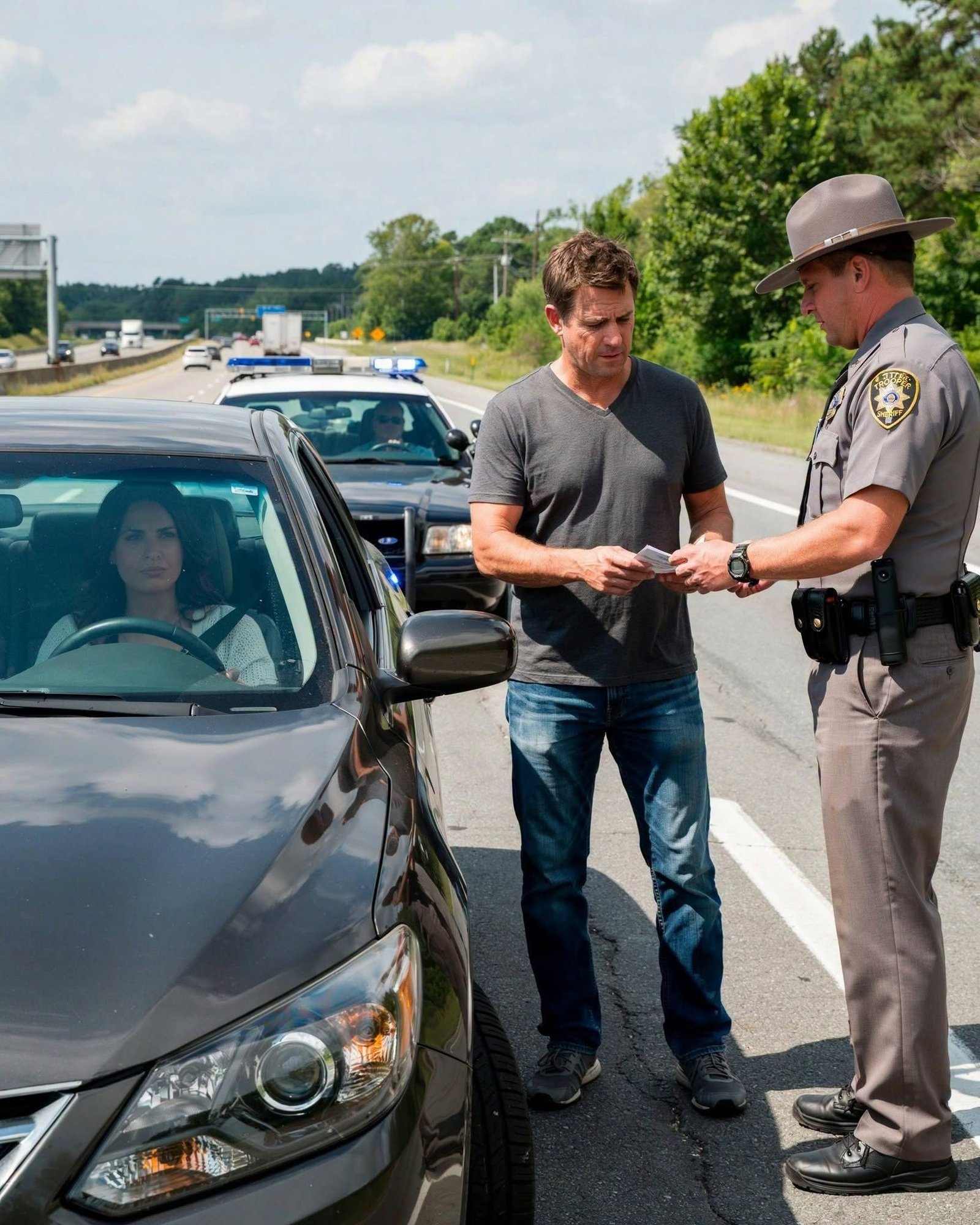
The patrol car’s lights washed red and blue across the inside of our Honda, turning the windshield into something like a slow strobe. This was the kind of stop that happens a thousand times a day on American highways and almost always ends the same way, with a ticket or a warning and a slightly irritated story told later over dinner. My wife, Sarah, had been doing seventy eight in a sixty five zone on Route 35, not recklessly fast, just fast enough to catch a trooper’s radar from behind an overpass as we drove out to see her mother in Millbrook on a flat gray Saturday afternoon.
She handed over her license and registration with the easy calm of someone who had been pulled over before and always walked away with nothing worse than a fine and a brief lecture. When the trooper asked if she knew why he’d stopped her, she gave him the same small, apologetic smile that had charmed me in a crowded coffee shop near Columbia more than ten years earlier, back when I still believed our life together was built entirely out of the truth, because that was the only kind of life I knew how to build. The officer, whose name tag read Martinez, took our documents back to his cruiser.
I watched him in the side mirror, expecting the usual minute or two of typing, the small bureaucratic pause between inconvenience and release. Instead something in the way he sat changed. He leaned closer to his screen.
He stayed there far longer than a routine stop should require. Traffic hissed past us on the highway. Sarah adjusted the rearview mirror, brushed a piece of lint from her sleeve, glanced at the clock.
When Martinez finally got out of his car, he didn’t walk back to her window. He came around to mine and tapped lightly on the glass. “Sir, could I speak with you for a moment?
Just step out here with me.”
There was nothing sharp in his voice. That, somehow, made it worse. I looked at Sarah.
She looked puzzled but not afraid. I opened my door and followed Martinez a few steps behind the car, far enough that our voices would dissolve into the hum of passing traffic. The shoulder smelled like hot asphalt and exhaust.
The afternoon sun pressed warm against the side of my face. Martinez turned to face me directly, and something in his expression made my stomach tighten before he said a single word. “Sir, I need you to listen to me carefully,” he said.
“Don’t go home tonight. Get somewhere safe. A hotel, a friend’s place, somewhere she doesn’t know about.”
For a full second I genuinely believed I’d misheard him.
“What are you talking about?” I said. “Is Sarah in trouble?”
His jaw tightened. Rather than answer, he reached into his shirt pocket and pulled out a small folded piece of paper, pressing it into my hand.
“Read this later. When you’re alone. And be careful who you trust right now.”
I looked down at the paper, then back up at him.
“We’ve been married ten years. We’re just driving to see her mother.”
He lowered his voice even further. “Her name triggered something serious in our system.
I can’t explain it here, but I’m telling you this because it matters for your safety.”
I turned and looked back at the car without meaning to. Sarah sat exactly where I’d left her, one hand resting on the wheel, the other tucking a strand of hair behind her ear. In the pulse of the cruiser’s lights her face looked subtly different to me, sharper somehow, like a photograph of someone I knew that had been slightly retouched.
Martinez walked back to her window, returned her license, gave her a standard verbal warning in the same easy professional tone he’d used from the start. Nothing in his manner would have told a passerby that he had just cracked the foundation of my entire life open on the shoulder of a state highway. We pulled back into traffic.
Sarah was quieter than the rest of the drive should have made her. Her hands stayed tighter on the wheel than usual. She checked the mirrors more than she needed to.
When I asked if she was upset about the warning, she smiled and said no, but the smile moved across her face without ever quite landing. The folded note sat in my pocket like a coin pulled straight from a fire, impossible to ignore and impossible yet to explain. By the time we reached her mother’s house, I had already begun looking at my wife as though the edges of her had shifted slightly, and I was only just starting to notice.
Dinner that evening passed with an almost cruel normalcy. Sarah laughed at the right moments. She helped clear the table.
She listened with bright, easy attention to family stories I’d heard a dozen variations of over the years. If there was any danger in that room, it wore lipstick and passed the salad with perfect manners. But once suspicion enters a marriage, it changes the texture of everything around it.
Her laughter sounded a touch too polished. Her warmth felt placed rather than spontaneous, like furniture arranged for a photograph. She wasn’t acting strangely, exactly.
She was acting with the precision of someone who understood exactly how to seem unremarkable. We slept that night in the guest room upstairs, the one with the floral curtains and the slightly lumpy mattress and a crooked watercolor of a harbor above the dresser. I waited until her breathing slowed and deepened before slipping into the bathroom and locking the door behind me.
I sat on the edge of the tub and unfolded the note under the glow of my phone. Seven words, written in tight block letters on a torn sheet of notepad paper. She isn’t who she says she is.
Below that, a phone number, and one more word. Detective. I read it again and again, as if rereading might somehow soften what it said.
It never did. I stayed awake the rest of that night beside my sleeping wife, watching the ceiling and letting memory rearrange itself under this strange new light. I thought about how little I actually knew of her work.
She told people she did marketing for a pharmaceutical company called Meridian. I had never once visited her office. Never met a coworker.
There had been no holiday party, no casual after work drinks, no names of colleagues that ever became familiar to me over the years. When I asked about clients or projects, she answered in vague, polished generalities that discouraged any real follow up question. At the time I had simply taken that as ordinary privacy, the kind even good marriages leave room for.
Lying awake in her mother’s guest room, it began to feel less like privacy and more like architecture, something built on purpose, with load bearing walls I had never been allowed to see. The next morning, once we’d driven home and Sarah had left for what she called a Saturday client meeting, I dialed the number. A man answered and introduced himself as Detective Adam Reynolds, organized crime division.
The phrase alone made my hands go cold around the phone. I explained who I was and how I’d gotten his number, and there was a pause on the line long enough that I could hear my own pulse in the quiet kitchen. Then he asked if I was alone, and when I said yes, he told me to listen carefully.
“Your wife has been under surveillance for eight months,” he said. “She’s a person of interest in an ongoing money laundering investigation. We’re talking about millions of dollars moved through shell businesses and personal accounts tied to organized criminal operations.”
The kitchen seemed to tilt slightly around me.
“That’s not possible,” I said, though even as the words left my mouth they sounded thin. “She works in marketing. She travels for clients, she has a laptop with the company logo, she—”
“There is no company called Meridian Pharmaceutical Marketing,” he said, not unkindly.
“We checked. The job is a cover. The laptop, the business cards, the travel schedule, all of it is staged.
Your marriage has been useful to her because it made her look stable and respectable, the kind of person banks and institutions don’t think twice about.”
I sat down hard at the kitchen table where Sarah and I had spent years sharing coffee and grocery lists and small ordinary intimacies that now felt, in retrospect, like a performance staged for an audience of one. Her mug still sat unwashed in the sink. Outside, a neighbor’s leaf blower whined to life, absurdly normal against the quiet collapse happening inside me.
“Are you telling me I’ve been used as cover?”
“I’m telling you your wife has been living two lives,” Reynolds said. “And the one she showed you appears to have been built specifically to protect the one she kept hidden.”
Once Reynolds started asking questions, the shape of my own blindness became almost unbearable to look at directly. Had I ever seen her office.
No. Had I met a supervisor, a coworker, anyone from this company she supposedly worked for. No.
Had I seen tax paperwork that clearly named her employer. Not really, now that I thought about it. Did she take calls in other rooms, door closed.
Yes. Did she travel more than seemed reasonable for a marketing job with no clear scope. Yes.
Had she grown irritated whenever I asked one question too many about her work. Also yes, though at the time I had filed all of it under stress, or fatigue, or simply the private corners every adult is allowed to keep for themselves. Reynolds explained it to me slowly, in plain terms.
Sarah had allegedly been working as a financial intermediary inside a laundering operation, moving illegal money through transfers and shell companies built to look ordinary. Money from drugs. From illegal gambling rings.
From extortion. Money that came in dirty and needed someone careful, patient, and unremarkable enough to wash it clean. According to the investigation, my wife had been exactly that person.
And our marriage, the house, the routine, the predictable suburban rhythm of our life together, had functioned as the perfect disguise. Then came the part that hollowed me out completely. Reynolds told me they had evidence Sarah was preparing to leave.
Funds quietly rerouted over recent months. A second financial identity. Documents suggesting an offshore account and a possible relocation plan already in motion.
She hadn’t only lied to me about who she was. She had been quietly preparing to take what she could and disappear, with or without warning. Reynolds didn’t ask for my help right away.
He laid out the risks first, plainly, the way I imagine he’d done with other frightened spouses before me. If I wanted nothing to do with it, the investigation would continue without me, and I could simply leave, find a hotel, start somewhere new and let the case unfold from a distance. But if I was willing to help, to quietly document what happened inside my own home, they could move faster and build a stronger case, not just against Sarah but against the wider network she was tied to.
There would be risk either way. If I did nothing, I would be living in a house with a woman who had used trust itself as a kind of currency for a decade. If I agreed to help, I would become a witness against the person I had loved more intimately than anyone else in my life.
Put that way, it wasn’t really a choice at all. Over the six weeks that followed, I became something close to a stranger inside my own home. Reynolds and his team taught me how to set up small cameras disguised as ordinary household objects, how to quietly copy files from Sarah’s laptop while she showered, how to leave my phone recording on the kitchen counter during her private calls, how to sit across the dinner table from her and keep my face arranged into something normal while I helped, piece by piece, take apart the life she had built underneath our marriage.
The technical part wasn’t what nearly broke me. It was the performance. It was kissing her goodnight knowing that hours earlier I had watched footage of her discussing cash movements in careful, coded language with men whose names had already surfaced in organized crime files.
It was nodding along while she complained about a difficult client when I was holding printed ledgers proving she had moved sums of money neither of us had ever honestly earned. It was finding, buried in encrypted folders, messages where she referred to me not as her husband but as cover, the way someone might describe a useful prop, something convenient to keep around as long as it served its purpose. I had loved Sarah with the uncomplicated faith of a man who believed intimacy meant being equally known by the person beside him.
I understood now that I had been entirely exposed while she remained, for ten years, professionally hidden, and that the imbalance had never once been accidental. It had been the entire design. The night everything finally came apart began like any other.
I came home from work to find Sarah already in the kitchen, a glass of wine beside her laptop, her reading glasses pushed up into her hair the way they always were when she was deep in something she didn’t want me to see. She closed the screen the moment I walked in, smooth and practiced, a gesture so familiar by now that I almost didn’t notice it anymore. We ate dinner.
We talked about nothing important. I asked about her week, and she gave me an answer built entirely out of soft, comfortable fiction, the kind she had clearly perfected over years of practice. What she didn’t know was that Reynolds had called me earlier that afternoon.
The investigation had reached its final stage. Federal agents, working alongside the organized crime unit, had enough now to move. There would be arrests within days, not just of Sarah but of several men further up the chain she had been quietly serving for years.
Reynolds told me to behave exactly as I always had. One more ordinary night. One more performance.
End Part Here: My Wife Got Pulled Over For Speeding But The Officer’s Warning Was About Something Much Worse