
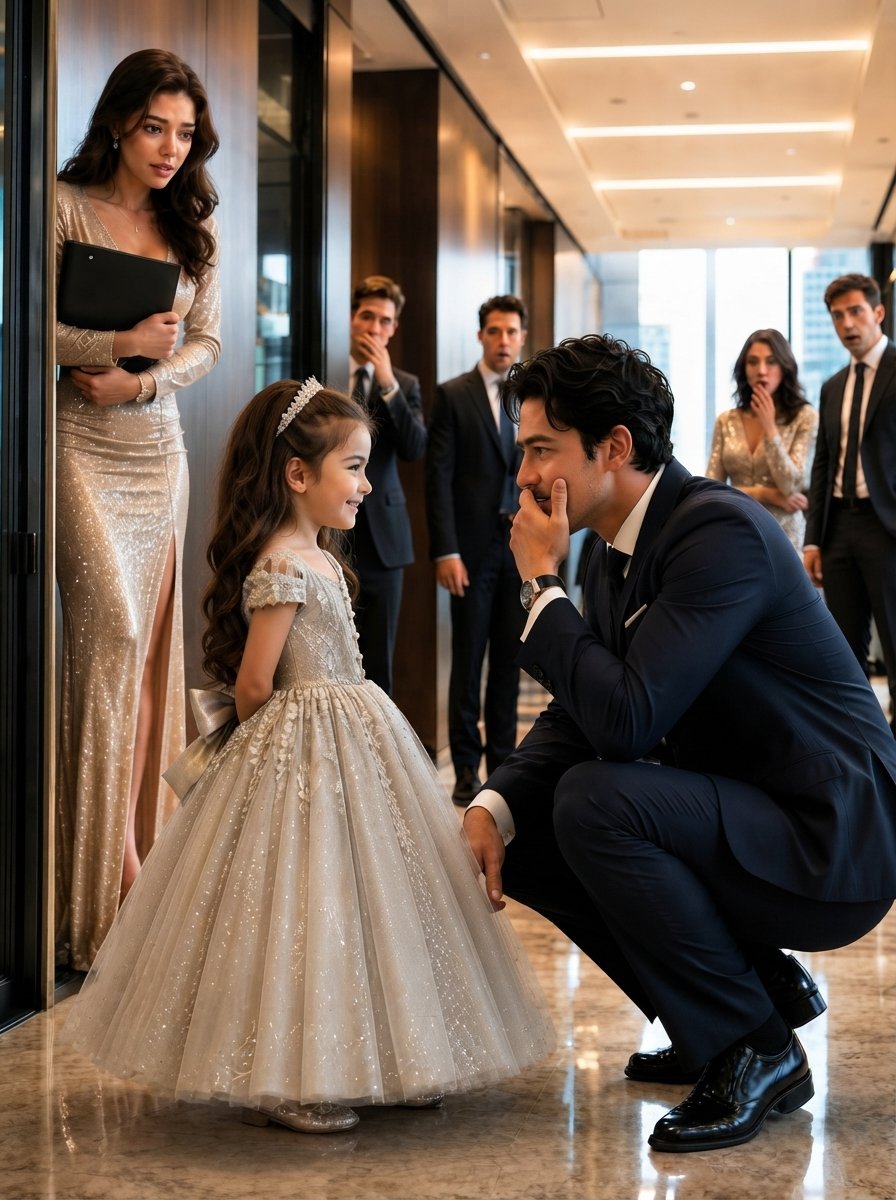
The first time my six-year-old daughter asked a billionaire to become her father, twenty-three executives were standing close enough to hear her.
Nobody laughed.
Nobody breathed.
Nobody even pretended not to listen.
And I was absolutely certain my career was over.
Adrian Kane stood in the middle of the executive hallway in a navy suit that probably cost more than my first car, staring down at my daughter with an expression I had never seen on his face before.
Not anger.
Not irritation.
Shock.
Mia looked up at him as if she had just asked whether he wanted chocolate or vanilla ice cream.
“You’re too handsome to be alone,” she announced. “I think you should be my daddy.”
Behind Adrian, our chief financial officer made a choking sound.
My assistant covered her mouth.
Someone farther down the corridor whispered, “Oh my God.”
I wanted the polished marble floor to split open and swallow me.
“Mia!”
She turned toward me happily.
“Hi, Mommy.”
“What are you doing?”
“I found your boss.”
“I can see that.”
“He’s nicer than you said.”
Adrian lifted one eyebrow.
I closed my eyes.
Excellent.
Now I was definitely unemployed.
My name is Sophie Bennett, and until that morning I had spent two years carefully maintaining a professional relationship with Adrian Kane.
Professional being the important word.
At thirty-six, Adrian was the billionaire chairman of Kane Global Holdings and majority owner of Blackwell & Reed, the Manhattan luxury branding agency where I worked as senior creative director.
He was brilliant.
Demanding.
Controlled.
And almost offensively handsome.
Dark hair, gray-blue eyes, sharp features, broad shoulders, and the sort of quiet confidence that made rooms rearrange themselves around him.
I had seen experienced executives forget their own presentations when Adrian asked a question.
I had watched a department director resign after Adrian silently stared at a falsified financial report for approximately twelve seconds.
The man did not yell.
He did not need to.
Which was why seeing him crouched in the hallway laughing with my six-year-old daughter had felt like discovering that Mount Everest occasionally told knock-knock jokes.
That morning had begun badly.
At 5:42 a.m., my nanny called.
“Sophie, I’m so sorry.”
I was standing barefoot in my kitchen making coffee.
“What happened?”
“A pipe burst upstairs. My apartment is flooded.”
I looked toward the living room.
Mia was asleep on the couch beneath a blanket, one tiny foot sticking out.
“What about today?”
“I can’t leave. The landlord says they need everyone here.”
My stomach dropped.
My mother was visiting my aunt in Atlanta.
My best friend Rachel had flown to Denver for a conference.
Mia’s school was closed for teacher training.
And that afternoon, I was presenting a campaign worth nearly eighteen million dollars to the board.
Calling out was impossible.
So I did something no ambitious employee working for Adrian Kane should ever do.
I brought my child to work.
“You are going to be invisible,” I told Mia over breakfast.
She spooned cereal into her mouth.
“Like a ghost?”
“Exactly.”
“Can ghosts eat crackers?”
“Yes.”
“Can ghosts watch cartoons?”
“With headphones.”
She considered this.
“Can ghosts use the bathroom?”
“Yes, Mia.”
“Can ghosts ask your mean boss why he always looks angry?”
I pointed my spoon at her.
“Absolutely not.”
She smiled.
That should have warned me.
By 8:35, we were inside our Park Avenue office tower.
I placed Mia in the corner of my office with coloring books, snacks, an iPad, two juice boxes, and Gerald, the stuffed elephant she had slept with since infancy.
For ninety minutes, she behaved perfectly.
Then my assistant, Jenna, appeared.
“Board preparation moved up. Kane wants department heads in Conference A in ten minutes.”
I crouched beside Mia.
“Mommy has to go downstairs.”
“Okay.”
“You stay right here.”
“Okay.”
“No wandering.”
“Okay.”
“No looking for me.”
“Okay.”
“No adventures.”
She frowned.
“What if adventure finds me?”
“It won’t.”
Eighteen minutes later, I returned.
Her chair was empty.
Gerald was gone.
My heart stopped.
I rushed into the hallway.
“Mia?”
Nothing.
Then I heard something even more alarming.
Adrian Kane laughing.
I followed the sound toward the executive wing.
And there she was.
Mia stood directly outside Adrian’s private office.
Adrian was crouched in front of her, one hand over his mouth, trying unsuccessfully to stop laughing.
“You’re very handsome,” Mia was explaining.
“So I’ve been told.”
“And tall.”
“I’ve also been told that.”
“I like tall.”
“Useful information.”
“So you should be my daddy.”
That was when I arrived.
Now Adrian slowly stood.
His amusement faded.
His eyes moved from Mia to me.
Then back to her.
“Mia,” he said softly, “why exactly do you think your mother needs me to be your daddy?”
My daughter’s smile disappeared.
For the first time that morning, she became serious.
She glanced at me.
I knew that expression.
It meant she was deciding whether to reveal something I had desperately hoped she had never noticed.
“Mia.”
But she answered him.
“Because Mommy cries when she thinks I’m asleep.”
The hallway became painfully silent.
My throat tightened.
“Mia, sweetheart…”
“She says she’s fine in the daytime,” my daughter continued. “But sometimes at night she sits on the kitchen floor.”
Adrian’s eyes found mine.
I could not look away.
“She thinks I don’t hear.”
“Mia.”
“And she said daddies always leave.”
Something inside me cracked.
That sentence had not been meant for her.
It had been whispered to Rachel six months earlier after too much wine, after Mia had fallen asleep, after another disastrous date with a man who had spent twenty minutes complaining that dating a single mother meant inheriting someone else’s responsibility.
I had not known Mia was awake.
Adrian’s expression changed.
The intimidating billionaire disappeared.
For just a second, he looked almost unbearably human.
He crouched again.
“Your mother sounds very brave to me.”
“She is.”
“And brave people sometimes cry.”
“I know.”
He nodded toward me.
“She also has excellent judgment most of the time.”
“Most?”
“Mia,” I warned.
Adrian almost smiled.
Then Mia leaned closer to him.
“You don’t have a wife.”
“No.”
“Or kids.”
“No.”
“You work too much.”
He glanced at me.
“Apparently my personnel file has been compromised.”
A few executives laughed nervously.
I finally reached Mia and took her hand.
“I am so sorry, Mr. Kane.”
“Adrian.”
I blinked.
In two years, he had never asked me to call him Adrian.
He looked at Mia.
“Your daughter and I have been formally introduced.”
“I still apologize.”
“For what?”
I glanced around.
“For all of this.”
He studied me for a moment.
Then he said something that stunned everyone.
“Bring her to the board presentation.”
I stared at him.
“What?”
“She appears to have better instincts than half the people attending.”
The CFO looked offended.
Adrian walked into his office.
Mia tugged my hand.
“See?”
“See what?”
“He likes me.”
Unfortunately, she was right.
The board presentation should have been impossible after that.
Instead, it became the best presentation of my career.
Our client was Maison Aurelia, a heritage jewelry company struggling to attract younger customers without destroying its old-world identity.
My campaign centered on inheritance.
Not wealth.
Memory.
The idea was simple.
The most valuable things passed between generations were not objects, but stories.
I had spent three months developing it.
Halfway through my presentation, I noticed Adrian watching me differently.
Not merely evaluating.
Studying.
When I finished, silence followed.
Then Adrian said, “Run it.”
The CEO of Maison Aurelia smiled.
“Exactly what I was hoping you would say.”
My knees nearly weakened.
Eighteen million dollars.
Approved.
Afterward, while executives congratulated me, I looked through the glass wall.
Mia sat outside with Gerald in her lap.
Adrian had somehow acquired a box of crayons and was drawing beside her.
The picture made absolutely no sense.
Adrian Kane did not color.
Adrian Kane acquired companies.
He restructured corporations.
He negotiated nine-figure deals before breakfast.
Yet there he was, arguing with a six-year-old about whether an elephant could realistically be purple.
I watched too long.
Jenna noticed.
“Careful.”
I turned.
“With what?”
She smiled.
“That.”
“There is no that.”
“There is definitely a that.”
“He is my boss.”
“And?”
“And billionaires don’t date employees with Goldfish crackers in their handbags.”
Jenna glanced through the glass.
“Apparently this one colors with their children.”
I ignored her.
That was easier.
Until Adrian appeared in my office doorway at six that evening.
Mia was sleeping on my sofa.
“You’re still here.”
I looked up from my laptop.
“Campaign revisions.”
“Go home.”
“I need to finish these.”
“Tomorrow.”
I hesitated.
“Is that an instruction?”
“Yes.”
He looked at Mia.
Then at me.
“Do you have a car coming?”
“We’ll take the subway.”
His expression hardened.
“With a sleeping six-year-old?”
“People do it every day.”
“I know.”
Something about the way he said it surprised me.
Then he took out his phone.
“My driver will take you.”
“That’s unnecessary.”
“So is arguing with me.”
There was the Adrian Kane I recognized.
Twenty minutes later, Mia and I were inside a black Mercedes heading toward Brooklyn.
I assumed that was the end of it.
I was wrong.
It was the beginning.
Three days later, a package arrived at my office.
Inside was a purple stuffed elephant wearing a tiny navy suit.
Mia screamed when she saw it.
There was no card.
But I knew.
I marched toward Adrian’s office carrying the ridiculous elephant.
His assistant waved me through.
Adrian looked up.
“Problem?”
I placed the toy on his desk.
“You bought my daughter a stuffed billionaire elephant.”
“It has no stated occupation.”
“It’s wearing cuff links.”
“Elephants can appreciate tailoring.”
I fought a smile.
“You shouldn’t buy her things.”
His expression softened.
“Why?”
“Because children get attached.”
The words came out more sharply than I intended.
He leaned back.
“To stuffed animals?”
“To people.”
Silence.
Something passed between us.
Then he nodded.
“That’s fair.”
I picked up the elephant.
“Sophie.”
I stopped.
“I’m not playing with her.”
I turned.
His voice had lost its teasing edge.
“I know what children remember when adults disappear.”
That sentence stayed with me.
I wanted to ask what he meant.
I didn’t.
Two weeks later, Adrian joined our creative team for dinner after a client event.
He never joined team dinners.
Yet somehow he ended up sitting across from me.
Somehow Mia came up.
“She named the elephant Adrian Junior,” I admitted.
He looked horrified.
“That’s terrible.”
“She rejected my suggestion.”
“What was yours?”
“Corporate Overlord.”
He laughed.
The waiter nearly dropped a wineglass.
I realized I liked making him laugh.
That frightened me more than anything else.
After dinner, we walked toward my cab.
Rain shimmered across Madison Avenue.
“Can I ask you something?” he said.
“Depends.”
“Where is Mia’s father?”
There it was.
The question everyone eventually asked.
I looked toward the traffic.
“There isn’t one.”
“That isn’t biologically possible.”
“Thank you, Harvard.”
“Yale.”
“Even worse.”
He smiled briefly.
Then waited.
I sighed.
“I used a donor.”
His expression changed.
“A donor?”
“I had a medical issue when I was twenty-six. Endometriosis. My doctor told me fertility might become difficult quickly.”
“So you decided to have a child alone.”
“Yes.”
“Because you wanted one.”
“More than anything.”
He looked thoughtful.
“Was the donor anonymous?”
“Yes.”
“Do you know anything about him?”
“Basic profile. Height. Education. Medical background.”
“What made you choose him?”
I laughed awkwardly.
“This sounds ridiculous.”
“Try me.”
“His answer to one question.”
“What question?”
“The clinic asked donors what they would save if their house were burning and everyone they loved was already safe.”
Adrian stopped walking.
I took another step before realizing.
“What?”
His face had gone pale.
“What was his answer?”
I thought back.
I had read that profile dozens of times while deciding.
“My grandfather’s watch.”
Adrian stared at me.
Cars moved behind us.
Rain tapped against the awning.
“What kind?”
“I don’t know.”
“Sophie.”
His voice sounded strange.
“What clinic?”
Something uneasy moved through me.
“Hudson Reproductive Center.”
He said nothing.
“Why?”
“When?”
“Seven years ago.”
His jaw tightened.
“Adrian?”
He looked almost frightened.
Then the expression vanished.
“Nothing.”
“That clearly wasn’t nothing.”
He stepped backward.
“I have to go.”
“What?”
“Good night, Sophie.”
He walked away in the rain.
I stood beneath the awning watching him disappear.
And for the first time, I wondered if my daughter’s absurd hallway proposal had touched something neither of us understood.
The next morning, Adrian did not come to work.
Neither did he the following day.
By Friday, rumors spread that he had flown unexpectedly to Switzerland.
I told myself it had nothing to do with me.
Then I received an email from Human Resources requesting every document associated with my employment background screening.
An hour later, Legal requested a private meeting.
I walked into Conference Room C and found three attorneys.
No Adrian.
The senior attorney, Margaret Hale, folded her hands.
“Ms. Bennett, we need to ask you several questions.”
My stomach tightened.
“About what?”
“Hudson Reproductive Center.”
Everything inside me went cold.
“How do you know about that?”
She ignored the question.
“Did you ever receive the donor’s identifying information?”
“No.”
“Did anyone from Kane Global contact you before your treatment?”
“No.”
“Have you ever met Adrian Kane before joining Blackwell & Reed?”
“No.”
Margaret studied me.
“Are you certain?”
I almost laughed.
“Yes.”
“Have you ever sought financial compensation from the Kane family?”
“What?”
“Please answer.”
“No.”
“Has anyone encouraged you to approach Mr. Kane personally?”
I stood.
“This conversation is over.”
“Ms. Bennett.”
“You’re asking whether I somehow engineered my daughter into your CEO’s hallway six years after she was born?”
“No one said that.”
“You didn’t have to.”
I walked out.
I was shaking when I reached my office.
An email waited.
Administrative leave.
Effective immediately.
I stared at it.
Two years of twelve-hour days.
Missed birthdays.
Weekend calls.
Campaigns that had generated millions.
And suddenly I was being escorted from the building like a criminal.
Jenna appeared.
“What happened?”
“I don’t know.”
Security stood behind her.
That hurt the most.
I gathered my purse.
Then I saw the photograph on my desk.
Mia at five, missing both front teeth.
I picked it up.
“Tell Adrian something for me.”
Jenna nodded.
“Tell him he should have had the courage to fire me himself.”
Three nights later, someone knocked on my apartment door.
Mia was asleep.
I looked through the peephole.
Adrian.
I almost ignored him.
He knocked again.
“Sophie.”
I opened the door but left the chain attached.
“What do you want?”
“To explain.”
“You suspended me.”
“I didn’t.”
“Your company did.”
“My father did.”
That stopped me.
I removed the chain.
Adrian entered.
He looked exhausted.
His tie was gone.
His hair was messy.
I had never seen him look less like a billionaire.
“What does your father have to do with this?”
“A great deal.”
He placed a folder on my kitchen table.
Then his eyes moved to the floor.
The same kitchen floor Mia had told him I sometimes cried on.
He looked away quickly.
“My mother died when I was twenty-three,” he said.
I waited.
“Cancer. Aggressive ovarian cancer. The doctors told us there might be a hereditary component.”
“I’m sorry.”
“Because of the family history, I underwent genetic testing.”
I frowned.
“What does that have to do with Mia?”
“A year later, I was diagnosed with lymphoma.”
My anger disappeared.
“You had cancer?”
“Stage two. I recovered.”
He looked toward the folder.
“Before chemotherapy, my doctors recommended preserving reproductive material in case treatment affected my fertility.”
I stopped breathing.
“No.”
“Sophie.”
“No.”
“I used Hudson Reproductive Center.”
The room tilted.
I gripped the back of a chair.
“That doesn’t mean anything.”
“No.”
He spoke carefully.
“It doesn’t.”
“But?”
“My samples were supposed to remain in private storage. They were never authorized for donation.”
I stared at him.
“You’re saying…”
“I don’t know what I’m saying yet.”
“You went to Switzerland.”
“The company that purchased Hudson’s records is headquartered there.”
My hands began trembling.
“Why did Legal suspend me?”
“My father discovered what I was investigating.”
“Why would he care?”
Adrian was silent.
“Why would your father care?”
“Because Kane Global quietly acquired Hudson Reproductive Center eight years ago.”
The air vanished from my lungs.
“What?”
“Through a healthcare subsidiary.”
I sat down.
Adrian opened the folder.
Inside were corporate records.
Payments.
Acquisition documents.
Storage numbers.
“My father buried the purchase after Hudson was investigated for improper donor-record practices.”
“Improper?”
His jaw tightened.
“Missing files. Samples assigned to incorrect numbers. Unauthorized transfers.”
I felt sick.
“Mia.”
“We don’t know.”
I stood immediately.
“I am not turning my daughter into some corporate DNA experiment.”
“I’m not asking you to.”
“Then why are you here?”
His eyes met mine.
“Because when you told me the donor’s answer about the watch, I remembered filling out the same questionnaire.”
My throat closed.
“My grandfather gave me his watch the year before he died.”
He lifted his sleeve.
A vintage silver watch sat against his wrist.
The same watch Mia had once pointed at in a photograph of Adrian online and said she liked because “it looked old and important.”
I backed away.
“No.”
“Sophie.”
“There must have been hundreds of men.”
“Yes.”
“Thousands.”
“Possibly.”
“So it could be coincidence.”
“Yes.”
But his face said something else.
“What aren’t you telling me?”
Adrian closed his eyes.
“My donor identification number was K-417.”
I froze.
I knew that number.
Every mother using anonymous donation knew the number attached to the file that had helped create her child.
Mine was written in Mia’s baby book.
Hudson donor K-417.
I whispered, “No.”
Adrian did not move.
“No.”
I pressed both hands against my mouth.
“That was the number.”
Neither of us spoke.
From the bedroom came the soft sound of Mia turning in her sleep.
Adrian looked toward the door.
For the first time since I had known him, Adrian Kane looked terrified.
I refused a DNA test.
For nine days.
Not because I didn’t want the truth.
Because I was afraid the truth would change everything.
Mia was mine.
She had always been mine.
I had chosen motherhood knowing there would be nobody beside me.
I had survived colic alone.
Fevers alone.
First steps.
First words.
Her first day of preschool, when she had clung to my coat and begged me not to leave.
Nobody had been missing.
Not until the world suddenly told me somebody might have been.
Adrian did not pressure me.
He did something stranger.
He stayed away.
Then one afternoon, Mia asked, “Did I make Mr. Kane mad?”
I looked up.
“Why would you think that?”
“He doesn’t come see you anymore.”
“He never came to see me.”
“Yes, he did.”
Children were infuriatingly perceptive.
She colored Gerald’s ears purple.
“I think he likes you.”
“Mia.”
“And me.”
I swallowed.
“Yes.”
“Do you like him?”
I looked at my daughter.
Her dark hair.
Her unusually pale gray-blue eyes.
Eyes I had always assumed came from the donor.
My chest tightened.
“Yes,” I whispered.
“I do.”
That evening, I called Adrian.
“I’ll do the test.”
He was silent.
“Are you sure?”
“No.”
A pause.
“Neither am I.”
The results arrived four days later.
I opened them in Adrian’s office after business hours.
He stood across the room.
Neither of us touched the envelope for almost a minute.
Finally, I laughed nervously.
“This is ridiculous.”
“Yes.”
“My six-year-old wandered out of my office and accidentally selected her biological father from several thousand people in Manhattan?”
“When you phrase it like that, yes.”
“She called you handsome.”
“One of her stronger observations.”
Despite everything, I laughed.
Then I opened the envelope.
I read the first page.
And stopped.
Adrian watched me.
“Sophie?”
I read it again.
Probability of paternity.
0.00%.
I looked up.
“You’re not her father.”
Something passed across Adrian’s face.
Relief.
Then something else.
Disappointment.
He took the paper.
“That’s impossible.”
“The test says zero.”
He stared at it.
“The clinic number matched.”
“Then Hudson mislabeled the profile.”
He looked unconvinced.
I should have felt relieved.
Instead, strangely, I didn’t.
For ten days I had been terrified Adrian might be Mia’s father.
Now discovering he wasn’t felt like losing something I had never allowed myself to want.
He folded the paper.
“Sophie.”
“It’s fine.”
“You don’t look fine.”
“I’ve been suspended from my career because your family thought I might have accidentally had your child. Forgive me for requiring a minute.”
“My father had no right.”
“No.”
“And you’re returning Monday.”
I looked at him.
“I don’t want special treatment.”
“You aren’t getting it. Maison Aurelia threatened to leave if you weren’t reinstated.”
That made me smile faintly.
Adrian stepped closer.
“What happens now?”
“With what?”
“Us.”
My heartbeat changed.
“There is no us.”
“Isn’t there?”
“We spent ten days discussing whether you accidentally fathered my child.”
“I’m aware.”
“That tends to complicate flirting.”
“I wasn’t flirting.”
I stared at him.
He almost smiled.
“Fine. I was extremely inefficiently flirting.”
I laughed.
Then he kissed me.
It was not dramatic.
No orchestra.
No falling paperwork.
Just Adrian touching my face as though giving me time to move away.
I didn’t.
His lips met mine.
Softly.
Carefully.
For the first time in years, I allowed myself to imagine that someone might stay.
Then the office door opened.
Adrian’s father stood there.
Richard Kane.
Seventy years old.
Silver-haired.
Immaculate.
Terrifying in a completely different way from his son.