
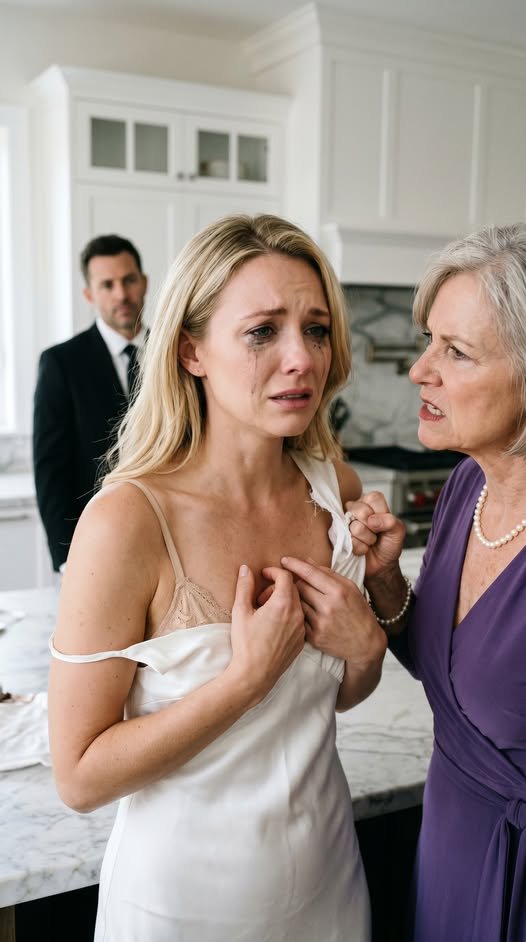
When my mother-in-law tore my white custom-made dress in the middle of my own kitchen, I did not scream.
That was what frightened my husband the most.
I simply stood beneath the warm amber light of the pendant lamps and watched strips of delicate silk drift toward the marble floor like dead flower petals.
The dress had been created especially for the biggest corporate gala of my career. It had cost $3,800 and taken nearly two months to finish.
Now, part of it hung from my shoulder while another piece remained clenched inside my mother-in-law’s fist.
Doña Patricia stood across from me, breathing heavily. Her face was red with anger, but her expression carried the satisfaction of someone who believed she had finally put me in my place.
“My son pays for everything in this house,” she declared. “You are nothing here, Valeria. You are only a guest who has forgotten her place.”
Behind her stood my husband, Diego.
He said nothing.
His silence hurt more than the destruction of the dress.
Fabric could be replaced. Even expensive, imported silk could be reordered.
Respect could not.
I looked directly at Diego, waiting for him to defend me.
I searched his face for the man I had married—the man who once sat across from me in a cheap diner and told me he admired my ambition. He had claimed to love my independence and the fact that I never waited for someone else to build my future.
He had also promised that his mother would never come between us.
But that man did not step forward.
Diego chose comfort over courage.
“Valeria,” he said quietly, “don’t make this bigger than it is. Just let it go.”
Something inside me became completely still.
I did not argue.
I did not cry.
I bent down and collected the largest piece of the ruined dress. The marble floor felt cold beneath my knees. I folded the silk neatly across my arm as though it were still whole.
Patricia smiled.
Diego released a relieved breath.
They both believed the confrontation was over.
They had no idea it had only just begun.
The Truth Inside My Office
That night, the house was painfully quiet.
Patricia slept in the large guest room at the end of the hallway—a room she had started calling “her room” three months earlier.
Diego slept beside me in our king-sized bed with his back turned. His breathing was deep and steady, as though nothing important had happened.
I stared at the ceiling and studied the shadows around the crown molding I had chosen myself.
Then I made a decision.
I was finished begging for respect inside a house that belonged entirely to me.
At 1:17 in the morning, I slipped from beneath the linen blanket.
Diego did not move.
I walked barefoot down the hallway and entered my home office. After closing the heavy wooden door, I sat at my desk and opened my laptop.
A hidden, encrypted folder sat on the desktop.
It was named simply:
Diego.
Inside were three years of evidence I had collected without ever truly wanting to use it.
There were bank statements showing his constant overspending, maxed-out credit cards, deleted text messages, hotel receipts from Miami and Las Vegas, recordings of his angry outbursts, and emails he had assumed I would never see.
Then I opened the most important document.
The deed to the house.
Only one name appeared under the section marked Owner of Record.
Mine.
Not Diego’s.
Not Patricia’s.
Mine.
I had purchased the five-bedroom estate two years before marrying Diego. My digital marketing company had recently signed a major contract with a national retailer, and I bought the house through my company’s holding account.
It represented years of sacrifice, sleepless nights, and relentless work.
It was my achievement.
My sanctuary.
Diego had moved in after our engagement with two old suitcases and a luxury watch he could barely afford.
Soon afterward, Patricia began telling her relatives and friends that her successful son had purchased a beautiful home for his new wife.
At first, I corrected people politely.
“Actually, I bought the property,” I would explain.
Then one evening, after a family dinner, Diego pulled me aside.
“Please let Mom believe it,” he begged. “She’s proud of me. She tells everyone I’m successful. We know the truth, so what does it matter?”
I loved him then.
I wanted peace with his family.
So I allowed the lie to remain.
That was my first mistake.
A lie does not stay small when it is repeatedly fed. Eventually, it grows large enough to replace the truth.
I attached the property deed to an email and sent it to my attorney, Mr. Harris.
Then I searched for a locksmith who provided twenty-four-hour emergency services.
If Patricia believed she owned my home, it was time to teach her the legal meaning of trespassing.
The Locks Changed
I slept for only two hours on the velvet sofa in my office.
At exactly 7:30 the following morning, a locksmith named Mike arrived at the front door carrying a heavy metal toolbox.
“Lost your keys?” he asked.
“Something like that,” I answered. “I need every exterior lock replaced immediately.”
He worked without asking questions.
By 8:10, every exterior door had been fitted with new high-security locks. I changed the garage code and removed all temporary access from the smart-home system.
Then I opened the biometric security settings.
Patricia’s fingerprint had been added while I was away on a business trip to London.
Diego had never asked my permission.
I pressed the screen.
Delete User.
Confirm.
Patricia’s access disappeared.
At 8:42, my phone vibrated on the kitchen counter.
Front Door Camera: Motion Detected.
I opened the live feed.
Patricia stood on the porch wearing a cream designer coat and oversized sunglasses. A large department-store bag hung from one arm.
She confidently pushed her silver key into the new lock.
It did not turn.
She frowned and tried again.
Then a third time.
Her expression shifted from confusion to outrage.
I stood inside the kitchen, calmly drinking coffee from a mug that read CEO Energy in large gold letters.
Patricia removed her sunglasses and looked directly at the security camera.
“Valeria!” she shouted. “Open this door! The lock is broken!”
I activated the camera microphone.
“Good morning, Patricia.”
Her head jerked upward.
“What did you do?”
“I changed the locks.”
“Are you insane? This is Diego’s house! Open the door immediately!”
I smiled.
“This house was never his.”
Patricia became completely still.
Then she laughed harshly, as though her mind refused to accept what she had heard.
“You are out of your mind,” she said. “I’m calling my son.”
“Please do.”
I ended the audio connection.
Five minutes later, Diego came rushing down the stairs in yesterday’s clothes. His hair was disorganized, and his phone was clutched tightly in his hand.
“What did you do?” he demanded.
The ruined white dress lay across the marble island between us.
“I changed the locks.”
“On my mother?”
“On my house.”
Fear briefly crossed his face.
It disappeared almost immediately, but I saw it.
“Valeria,” he said, lowering his voice. “Don’t start this.”
I laughed softly.
“Your mother tore a dress from my body, insulted me in my own kitchen, and claimed ownership of my home. But I’m the one starting something?”
“She was upset.”
“She was cruel.”
“She’s my mother.”
“And I was your wife.”
The past tense struck him immediately.
His face lost its color.
I turned my laptop toward him and slid it across the marble island.
The property deed filled the screen.
“Why are you showing me this?” he whispered.
“Because your mother needs to understand who actually owns and pays for everything here.”
Diego stepped closer.
“We can fix this. I’ll speak to her. I’ll make her apologize.”
“Fix what?” I asked. “The $3,800 dress? The years of lying? Or the fact that your mother has treated me like an intruder while you stood beside her in silence?”
His face became red.
“Don’t speak about me that way.”
“What should I call a man who allows his wife to be humiliated in her own home?”
Diego slammed his palm against the island.
My coffee shook inside the mug.
Neither of us moved.
Then Diego noticed the small red light on the kitchen security camera.
His anger disappeared.
“Are you recording this?”
I tilted my head.
“You tell me.”
Before he could answer, the doorbell began ringing repeatedly.
Patricia’s voice came through the front door.
“Diego! Open this door! Your wife has lost her mind!”
I gestured toward the entrance.
“Go ahead. Let her inside.”
Relief appeared on his face.
He believed I was surrendering.
Diego hurried toward the foyer and unlocked the door.
Patricia swept into the house like a storm.
“This is unacceptable!” she screamed as she entered the kitchen. “Do you know how humiliating it was to be left outside? The neighbors were watching!”
“You do not live here,” I said calmly. “You are not entitled to a key.”
She froze.
“Valeria,” Diego warned.
I ignored him.
Patricia pointed at me.
“I sacrificed everything to raise my son. If Diego says I belong in this house, then I belong here.”
“That explains a great deal,” I replied.
Her eyes narrowed.
“You believe giving birth to a man gives you permanent ownership over every woman he marries. You believe his invitation is more powerful than my name on the property deed.”
“Do not speak to my mother like that,” Diego said.
I looked at him.
“You never said those words when she spoke to me.”
Patricia threw her shopping bag onto my counter.
“I am moving in. I’ll stay for several weeks until you learn to respect your elders.”
“No.”
She blinked.
“What did you say?”
“No.”
The word felt clean and powerful.
“Diego,” Patricia ordered, “control your wife.”
I smiled.
“That sentence is exactly why you are leaving.”
The Deed
Diego stepped between us.
“Everyone needs to calm down. We can sit and discuss this.”
I picked up the ruined dress.
“Your mother destroyed a custom-made dress worth $3,800. She insulted me in my home and claimed ownership of property that does not belong to her.”
I looked at Diego.
“And you supported her by remaining silent.”
Patricia laughed.
“You’re throwing a tantrum over a dress? I’ll buy you another cheap one.”
I opened a black folder beside my laptop and placed the dress invoice in front of her.
Her smile disappeared when she saw the total.
Then I placed a certified copy of the property deed beside it.
“Read it.”
Patricia studied the document.
At first, she appeared confused. Then annoyed.
Finally, she found the section marked Owner of Record.
Fear entered her eyes.
“Where is Diego’s name?”
“Exactly.”
“This must be fake.”
“It is a certified county record.”
“My son told everyone he bought this house.”
I turned toward Diego.
He stared at the floor.
“Diego?” Patricia asked.
He swallowed.
“Mom, it was complicated.”
The truth was not complicated.
It was only embarrassing.
“You told your mother that you purchased my house,” I said.
Diego finally exploded.
“You always made more money than me! Do you think that was easy? You paid for the holidays, the cars, and the roof over our heads. Everyone probably wondered what you saw in me.”
He struck his own chest.
“You made me feel like less of a man!”
The kitchen became silent.
At last, the real problem stood before us.
It had never truly been about Patricia.
It had never been about the dress or the house.
It was Diego’s insecurity.
“You were ashamed that I supported us,” I said.
“I was ashamed of feeling useless.”
“So you made me smaller to make yourself feel larger.”
He had no answer.
Patricia quickly recovered.
“A wife is supposed to support her husband,” she said. “If you earn money, it belongs to him too.”
“That is not partnership,” I answered. “You and Diego created a performance. I paid for the entire production while he stood onstage and accepted the applause.”
“I contributed,” Diego protested.
“You paid for a streaming subscription and occasionally purchased groceries.”
“I paid some utility bills.”
“You told people you bought a three-million-dollar estate.”
His mouth closed.
Patricia grabbed her shopping bag.
“I will not be insulted by an arrogant woman who believes money makes her better than everyone.”
I stepped closer.
“Money did not make me better. Work made me stable. Discipline made me independent. Your son’s lies simply made me tired.”
“You will regret this,” she whispered.
“No,” I answered. “But Diego will.”
I left the kitchen.
I had five hours to prepare for the biggest professional event of my life.
And I needed new armor.
The Green Suit
That evening, I attended the annual Cruz & Vale corporate gala.
I did not wear the ruined white dress.
My executive assistant, Maya, had found an emerald-green tailored suit from an exclusive boutique. It had sharp shoulders, clean lines, and fit like armor.
When I entered the Ritz-Carlton ballroom, conversations paused.
People did not turn because I was Diego’s wife.
They turned because I was Valeria Cruz, the founder and chief executive officer of Cruz & Vale—the woman who had just secured a major seven-figure partnership.
Diego arrived twenty minutes later with Patricia holding his arm.
She wore a confident smile.
Diego looked nervous.
My business partner, Amanda Vale, handed me a glass of champagne.
“Is the woman wearing faux fur in warm weather your mother-in-law?”
“Yes.”
During the networking reception, Patricia approached a group of senior executives.
“My son and Valeria make such a wonderful team,” she announced. “This company would not exist without Diego’s support behind the scenes.”
I walked toward them.
Diego saw me and became pale.
One executive smiled politely.
“Does Diego work for Cruz & Vale?”
“No,” I replied pleasantly. “Diego has never held a position at the company. He attends these events as my husband and enjoys the open bar.”
Patricia’s smile froze.
Amanda covered a laugh with a cough.
Before Patricia could respond, the host’s voice filled the ballroom.
“Please welcome our visionary founder and CEO, Valeria Cruz!”
Applause rose across the room.
Patricia stared as I walked onto the stage.
She had always imagined I was merely decorating Diego’s life.
Now she was forced to watch hundreds of people rise for me.
I stood beneath the spotlight.
“Good evening,” I began. “Tonight, I was supposed to wear a white dress.”
The room became quiet.
“But last night, that dress was destroyed by someone who believed appearances mattered more than truth.”
I paused.
“Sometimes, what gets torn is not merely a piece of fabric. Sometimes, it is an illusion you have exhausted yourself trying to protect.”
I spoke about ownership, dignity, and the cost of shrinking yourself to make insecure people comfortable.
I never mentioned Diego or Patricia by name.
I did not need to.
When I finished, half the ballroom rose to its feet.
Amanda hugged me as I left the stage.
“That was a funeral,” she whispered.
She was right.
But the burial had only begun.
The End of the Marriage
A recording of my speech spread through our industry by the next morning.
Clients sent messages of support. Employees shared the video. Members of Diego’s extended family began asking uncomfortable questions.
By noon, he was pacing through my living room.
“You humiliated us in front of hundreds of people!”
“I told the truth,” I replied. “If you recognized yourself in a speech about fragile pride, that is your problem.”
He stopped pacing.
“We should go to marriage counseling.”
“You do not want to save our marriage. You want to save the comfortable life your lies created.”
I stood.
“You and your mother must leave by Friday.”
His face twisted in disbelief.
“You cannot throw me out. I am your husband.”
“I can legally ask you to leave property that I solely own. If you refuse, my attorney will begin formal removal proceedings.”
Diego immediately called his mother.
Within an hour, Patricia returned with Diego’s sister, Carmen, and two large suitcases.
“I am not leaving,” Patricia declared.
I pointed toward the legal notice on the console table.
“Your permission to remain as a guest has been revoked. If you refuse to leave, the police will remove you for trespassing.”
Carmen looked horrified.
She had known nothing about the torn dress or the true ownership of the house.
When she read the deed, she turned toward her brother.
“You told us you bought this place.”
Diego looked gray and defeated.
“Mom,” he said quietly, picking up one of the suitcases. “We need to go.”
Patricia screamed that I would die alone.
But she walked through the door.
When it closed behind them, the house finally felt as though it could breathe again.
It belonged to me.
Not only legally.
Emotionally.
Two weeks later, Diego asked to meet me at a coffee shop.
He looked exhausted. His clothes were wrinkled, and his hands trembled around the mug.
“I lied because I hated feeling smaller than you,” he admitted. “I was proud of you, but I was also ashamed. I thought everyone wondered why someone like you had married someone like me.”
“That insecurity belonged to you,” I said gently. “But you forced me to pay for it.”
He agreed to the divorce without a fight.
Six months later, the papers were finalized.
The settlement included the $3,800 cost of the destroyed dress.
It was not about recovering the money.
It was about recording what had happened.
The dress represented the moment they tried to tear away my dignity.
The invoice represented the moment I took it back.
One Year Later
A year after the divorce, I hosted a dinner party in my kitchen.
The marble island gleamed beneath the pendant lights. My friends laughed around the table, and music drifted softly through the rooms.
On one wall, I had framed a piece of the ruined white silk.
It no longer looked like evidence of humiliation.
It looked like art.
A reminder of the night an illusion was destroyed and my life finally became my own again.
After the guests left, I stood alone in the peaceful kitchen.
My phone vibrated.
The message came from an unfamiliar number.
I hope you’re happy.
I knew it was Patricia.
I looked around my home.
The space was quiet, warm, and entirely mine.
I thought about the woman I had become while they were busy underestimating me.
Then I typed two words.
I am.
I blocked the number and placed the phone on the counter.
As I reached for the light switch, a sharp knock echoed from the front door.
I stopped.
Another knock followed.
Harder this time.
Then a man’s voice came through the wood.
“Ms. Cruz? I need to speak with you about Diego.”
I slowly turned toward the security screen.
The man standing outside was not Diego.
He wore a dark suit and held a thick envelope stamped with the seal of the federal court.
Then he lifted his face toward the camera and said the words that changed everything.
“Your former husband has disappeared.”
Part 2: The Man at My Door
“Your former husband has disappeared.”
For several seconds, I remained completely still.
The man on the security screen stood beneath the porch light, holding a thick envelope against his chest. Behind him, a black sedan waited at the curb with its engine running.
I pressed the intercom button.
“Who are you?”
“My name is Special Agent Marcus Hale,” he replied. “Financial Crimes Division. I need to speak with you privately.”
My fingers tightened around the edge of the kitchen counter.
The words Financial Crimes Division changed everything.
I looked toward the framed piece of torn white silk hanging on the wall. One year earlier, that dress had marked the end of my marriage. I had believed the divorce papers were the final page of my life with Diego.
Apparently, they had only closed the first chapter.
“Show your identification to the camera,” I said.
The man did not appear offended. He removed a leather case from his coat and held it toward the lens.
The badge and identification appeared legitimate.
Still, I did not immediately unlock the door.
Instead, I opened the security application and sent the image to Mr. Harris, my attorney.
He called less than a minute later.
“The identification number is real,” he said. “But do not answer questions without me present.”
“Can you come here?”
“I’m already leaving.”
I ended the call and returned to the intercom.
“My attorney is on his way. You may wait inside the foyer until he arrives.”
I unlocked only the front entrance while leaving the security doors to the rest of the house active.
Agent Hale stepped inside.
He appeared to be in his early forties, with tired eyes and the careful posture of a man accustomed to entering homes where people did not want him.
He glanced around the foyer but made no comment about the expensive furniture or towering windows.
His gaze stopped briefly on the framed white silk visible through the kitchen entrance.
“You kept the dress,” he said.
I stared at him.
“How do you know about that?”
“Your speech was widely shared.”
“That was a year ago.”
“Yes,” he replied. “But Diego has spent the last year telling people a very different version of what happened.”
I crossed my arms.
“What version?”
Agent Hale did not answer immediately.
He looked toward the front windows, as though checking whether anyone had followed him.
“According to Diego, you manipulated the divorce, forged the property documents, and used your influence to remove him from a company he secretly helped build.”
I almost laughed.
The accusation was so ridiculous that for a moment I assumed he was joking.
But Agent Hale’s expression remained serious.
“Diego never worked for my company,” I said. “He had no ownership, no position, and no investment.”
“I know.”
“Then why are you here?”
“Because someone has been using documents bearing your signature to secure large private loans.”
The amusement vanished from my face.
“How large?”
“More than nine million dollars.”
The house suddenly felt colder.
“That is impossible.”
Agent Hale placed the envelope on the entry table.
“Six separate loans were issued over the last eleven months. Each was supported by documents claiming that Diego retained a silent ownership interest in Cruz & Vale.”
“He did not.”
“The applications included corporate income statements, partnership agreements, property guarantees, and letters allegedly signed by you.”
My heartbeat began to quicken.
“I signed nothing.”
“That is why we are speaking to you.”
Headlights swept across the front windows.
A moment later, Mr. Harris entered through the unlocked door. He carried his briefcase in one hand and wore a dark overcoat over his pajamas.
After examining Agent Hale’s credentials, he stood beside me.
“Valeria will cooperate,” Mr. Harris said. “But she will not speculate.”
Agent Hale nodded.
“I am not here to accuse her. At the moment, we believe she may also be a victim.”
“At the moment?” I repeated.
He looked directly at me.
“Diego disappeared three days ago. The lenders began contacting him when the first repayment deadlines were missed. His apartment was found empty yesterday morning.”
“Where was he living?”
“With his mother.”
A familiar heaviness settled inside my chest.
Of course he was.
“Where is Patricia?”
“We don’t know.”
That answer disturbed me more than Diego’s disappearance.
Patricia did not disappear quietly. She announced every entrance, every insult, and every imagined injustice.
If she was gone, there was a reason.
Agent Hale opened the envelope and removed several copies of financial records.
One page contained what appeared to be my signature.
It was almost perfect.
Almost.
The letters matched the way I signed formal contracts, but the final stroke curved too sharply upward.
“I didn’t sign this.”
Mr. Harris adjusted his glasses and studied the page.
“This was electronically notarized,” he said.
Agent Hale nodded.
“The identification used during verification belonged to Valeria.”
“My identification is in the safe upstairs.”
“Have you checked it recently?”
I opened my mouth to answer.
Then stopped.
The safe had not been opened in months.
I had no reason to use the old passport stored inside it. My current passport remained in my office because I traveled regularly for work.
But my previous passport, several expired identification cards, and original property records were kept in the home safe.
Diego knew where it was.
He had known the code during our marriage.
I changed it after he left.
At least, I believed I had.
Without speaking, I turned and walked toward my office.
Mr. Harris and Agent Hale followed.
The safe was hidden behind a painting beside the bookshelves.
I entered the code.
The door opened.
At first, everything appeared normal.
Folders stood neatly along the back. Jewelry boxes remained stacked on the lower shelf. My mother’s antique watch sat inside its original case.
Then I reached for the folder containing my expired identification.
It was empty.
My old passport was gone.
So was the original copy of the property deed.
Mr. Harris swore quietly.
Agent Hale remained calm.
“When was the last time Diego had access to this house?”
“The day he moved out.”
“Did he return afterward?”
“Not with my permission.”
Agent Hale turned toward the ceiling camera.
“Your security system stores historical recordings?”
“For eighteen months.”
“Then we need to see them.”
End Part Here: When my mother-in-law tore my white custom-made dress in the middle of my own kitchen, I did not scream