
Part 1: The First Person Who Clapped
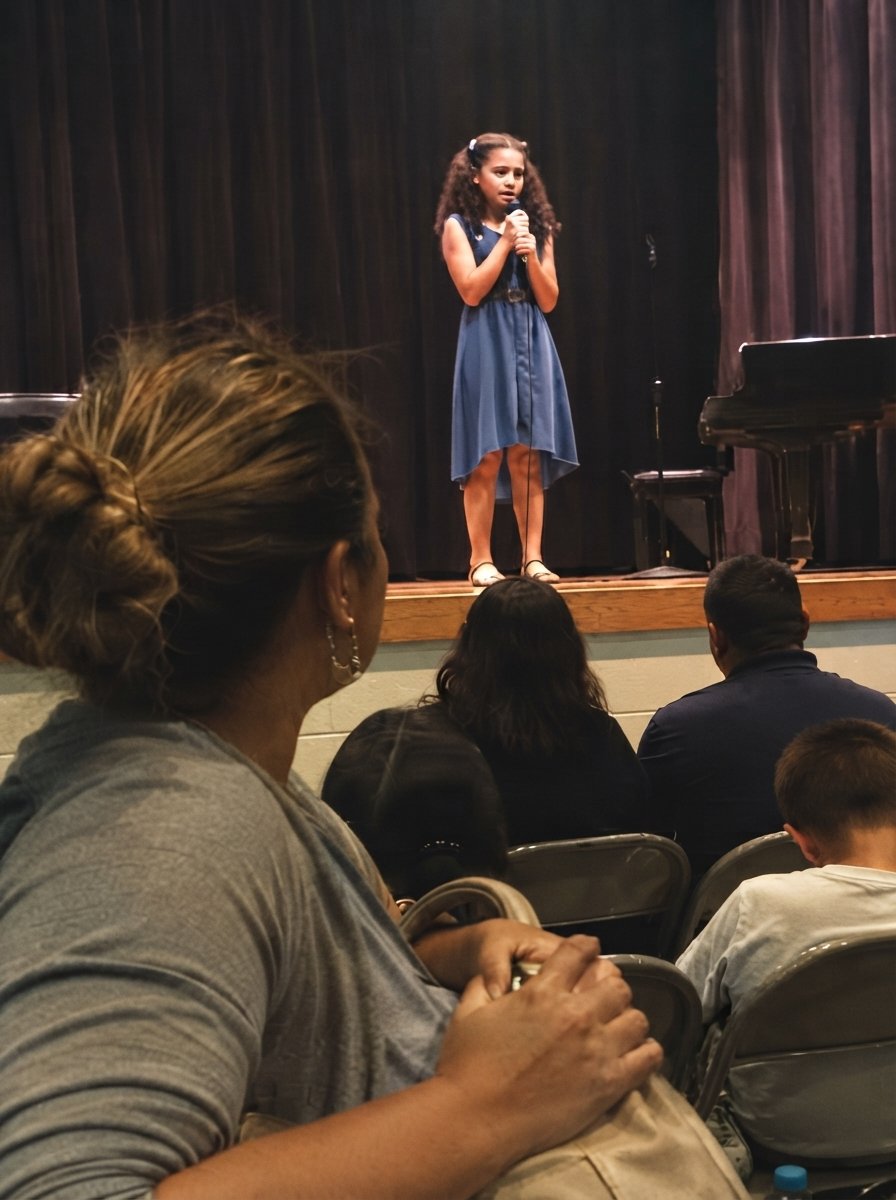
Maribel Knox sat in the third row of the middle school auditorium with both hands wrapped tightly around her purse.
Onstage, her twelve-year-old daughter, Wren, looked painfully small beneath the bright lights.
She wore a blue dress Maribel had stitched herself the night before. Her curls were pinned back with two inexpensive silver clips, and she held the microphone with both hands as though it weighed fifty pounds.
Maribel wanted to run onto the stage and tell her daughter she did not have to do this.
But Wren had begged to sing.
Not because she expected to win.
Not because she wanted a trophy.
She wanted to prove to herself that she could still be heard.
Six months earlier, a fire had destroyed the rental house where Maribel and Wren lived.
There had been no dramatic explosion.
Just smoke.
Sirens.
Neighbors standing outside in pajamas.
And Maribel barefoot in the yard, holding her coughing daughter against her chest.
Wren survived.
Everyone kept saying the same thing.
“She’s alive. That’s what matters.”
Maribel was grateful.
But surviving did not mean everything returned to normal.
Smoke had damaged Wren’s throat.
For weeks, she barely spoke above a whisper. Her voice cracked unexpectedly, and sometimes she stopped halfway through a sentence because she was embarrassed by the sound.
At school, she became quieter.
At home, she stopped singing.
That hurt Maribel more than almost anything.
Before the fire, Wren had sung everywhere.
In the shower.
While feeding the dog.
While folding laundry.
She even invented ridiculous songs about burnt toast and missing socks.
Their house had always been full of music.
After the fire, it became silent.
Then one afternoon, Wren came home carrying a crumpled talent-show form.
“Mom,” she said softly, “I think I want to try.”
Maribel nearly cried.
Instead, she smiled.
“Then we’ll practice.”
Every evening after work, Maribel sat beside her daughter.
Wren would sing one line.
Stop.
Take a breath.
Then try again.
Some nights she cried.
Some nights she became angry.
Sometimes she whispered, “My voice sounds ugly now.”
Maribel always gave the same answer.
“No, baby. It sounds brave.”
Now Wren stood beneath the auditorium lights.
The piano track began.
She missed the first word.
Maribel leaned forward.
“Come on, baby,” she whispered.
Wren closed her eyes.
She tried again.
Her voice came out thin and raspy.
A little off-key.
But it came out.
Then Maribel heard someone whisper behind her.
“This is painful to listen to.”
Another woman answered.
“Some parents need to be honest with their children.”
A quiet laugh followed.
“She should’ve done a poem instead.”
Maribel’s stomach tightened.
Those women knew nothing.
They did not know about the fire.
They did not know Wren sometimes woke in the middle of the night because she imagined she could smell smoke.
They did not know about speech therapy.
They did not know about the notebook where Wren had written:
I miss my old voice.
They did not understand what it had taken for that little girl to stand onstage.
Maribel wanted to turn around and defend her daughter.
But she knew if she opened her mouth, anger would not come out.
Tears would.
So she stayed silent.
Wren kept singing.
Then came the final note.
It cracked badly.
The music stopped.
For one terrible second, the auditorium was completely silent.
Wren lowered the microphone.
Maribel saw the change in her daughter’s face.
It was small.
But mothers notice small things.
The look said:
I knew I shouldn’t have tried.
Then a sound came from the very back of the auditorium.
Clap.
Clap.
Clap.
Slow.
Steady.
Certain.
Everyone turned.
The school janitor, Mr. Calloway, stood beside the double doors wearing his gray work shirt.
A broom rested in one hand.
He was clapping with the other.
He was not smiling with pity.
He was not clapping because he felt sorry for Wren.
He was applauding like he had just witnessed something worth honoring.
He leaned the broom against the wall.
Then he began clapping with both hands.
A teacher joined him.
Then a grandmother.
Then a student near the front.
Then half the room.
And finally, almost everyone.
People stood.
Wren slowly lifted her head.
Her eyes widened.
Maribel covered her mouth as tears filled her eyes.
Wren did not win the talent show.
A boy who juggled glow sticks won first place.
A dance group won second.
Wren received a tiny participation ribbon.
But when she walked offstage, she was smiling.
Small.
Shy.
But real.
Afterward, Maribel found Mr. Calloway stacking chairs in the hallway.
“You have no idea what you did for my daughter tonight,” she told him.
Mr. Calloway stopped.
“Yes, ma’am,” he said quietly. “I think maybe I do.”
He reached into his shirt pocket.
Inside was an old photograph of a little girl sitting on a porch holding a violin.
“My granddaughter,” he explained.
“She had a stutter when she was young. People laughed at her during a church performance.”
His eyes lowered.
“She never played in front of people again.”
Then he looked toward the auditorium.
“I made myself a promise after that. If I ever saw a child being brave in a quiet room, I wasn’t going to let that room stay quiet.”
Maribel cried beside the stack of folding chairs.
On the drive home, Wren stared at her ribbon.
Finally she whispered:
“Mom?”
“Yeah, baby?”
“Did they really clap for me?”
Maribel swallowed.
“They sure did.”
Wren touched the ribbon.
“I think maybe my voice is coming back.”
Maribel squeezed her hand.
“No, baby. Your voice was never gone.”
Later that night, Maribel heard something coming from Wren’s bedroom.
Soft.
Rough.
A little off-key.
Singing.
For the first time since the fire, music had returned to their home.
Maribel thought the hardest part was over.
She had no idea that by morning, someone would turn Wren’s bravest moment into a video for the entire town to watch.
Part 2: When Kindness Became Content
The next morning began beautifully.
While Maribel cooked breakfast, she heard Wren humming in the bathroom.
It was barely a tune.
But after six months of silence, it sounded like a miracle.
Wren came into the kitchen smiling.
“Do you think Mr. Calloway knew I was scared?”
Maribel placed a plate in front of her.
“I think he knew you were brave.”
Wren smiled.
“I want to thank him again.”
“We will.”
For the first time in months, Maribel drove to work feeling lighter.
She did not know that someone had recorded the talent show.
She did not know the video had been posted online before midnight.
And she did not know it was already spreading across town.
By lunchtime, one of Maribel’s coworkers approached her.
“Have you been online today?”
Maribel immediately knew something was wrong.
“What happened?”
“It’s Wren.”
Her coworker showed her the video.
There was Wren onstage.
The thin voice.
The shaking hands.
The cracked final note.
Then the camera turned toward Mr. Calloway.
He began clapping.
The room joined him.
The video ended there.
It did not show Wren smiling afterward.
It did not show Maribel hugging her daughter.
It did not explain the fire.
It did not tell Mr. Calloway’s story about his granddaughter.
It reduced everything to a simple internet moment:
A struggling girl.
A compassionate janitor.
A lesson about kindness.
Hundreds of comments appeared below it.
Many were supportive.
That child is so brave.
Bless that janitor.
Schools need more people like him.
But others were cruel.
Why would her mother let her embarrass herself?
Not every child needs a stage.
People clap for everything these days.
Maribel felt sick.
She called Principal Larkin.
“Who posted my daughter?”
The principal explained that many parents had recorded the public talent show and the school was trying to identify the original uploader.
“My daughter is twelve,” Maribel said. “She didn’t agree to become a story for strangers.”
Principal Larkin tried to reassure her.
Many comments were positive, he explained.
People were inspired.
Some parents had even suggested creating a school kindness campaign around Wren and Mr. Calloway.
“No.”
Maribel’s answer was immediate.
“My daughter is not a school campaign.”
The principal fell silent.
“You watched one man protect her in a room full of adults,” Maribel said. “Now those same adults want to use her.”
At school, Wren discovered the video from another student.
A boy named Eli approached her locker holding his phone.
“Wren, you’re famous.”
He meant it as a compliment.
That almost made it worse.
Wren saw herself on the screen.
Her frightened face.
Her cracked voice.
Her hands gripping the microphone.
Then two girls nearby began discussing the video.
“My aunt said the janitor was the best part.”
The janitor was the best part.
They did not mean to hurt her.
But the words landed anyway.
When Maribel picked Wren up after school, she found her sitting on the curb with her knees pulled against her chest.
“Baby.”
Wren looked up.
“Did you know?”
“I found out today.”
“People saw it.”
“I know.”
“People I don’t even know.”
“I know.”
Wren swallowed.
“They keep saying Mr. Calloway was the best part.”
Maribel crouched in front of her.
“He did something beautiful.”
“I know,” Wren whispered.
Then her voice broke.
“But it was my song.”
That evening, their home became quiet again.
At dinner, Maribel told Wren the school wanted to organize a kindness event.
“Do I have to go?”
“No.”
The answer came so quickly Wren looked surprised.
“You don’t owe anyone another brave moment,” Maribel told her.
Wren looked down.
“But what if people think I’m ungrateful?”
“Kindness is not a debt.”
Wren’s eyes filled.
“Then why does it feel like I have to pay everyone back?”
Maribel did not have an easy answer.
Finally she said:
“Because adults sometimes forget that being thankful and being used are not the same thing.”
Later that night, Maribel received a message.
It was from Lydia Barnes, one of the mothers who had sat behind her during the performance.
I owe you an apology.
Then another message arrived.
I posted the video.
Maribel stared at the screen.
Her reply was simple.
Why would you?
Lydia answered:
I thought the moment was beautiful. I wanted people to see what Mr. Calloway did. I didn’t think.
Maribel’s anger rose.
You posted my daughter’s pain. You let strangers judge her voice and my parenting. And you never asked.
Lydia apologized.
She removed the video from her page.
But it was already everywhere.
The next afternoon, Lydia met Maribel in person.
She admitted something even more painful.
She had also been one of the women whispering cruelly during Wren’s performance.
“I didn’t know her story,” Lydia said.
“That’s the problem,” Maribel replied. “You didn’t know, but you judged her anyway.”
Lydia lowered her head.
Then she admitted why she had posted the video.
After Mr. Calloway began clapping, she had felt ashamed.
She wanted other people to learn the same lesson.
“You turned my daughter into a symbol,” Maribel said. “And symbols don’t get to say no.”
Lydia cried.
“You’re right.”
The words did not undo the damage.
But she did not make excuses.
So Maribel asked her to do one thing.
“At the parent meeting, stand up and tell everyone what you did. Tell them that good intentions can still hurt someone.”
Lydia agreed.
At the meeting, the community argued.
Some parents said it was a public event.
Others said a child still deserved privacy.
Some called Maribel overly protective.
Others believed the school needed stronger rules.
Finally, Maribel stood.
“My daughter survived a fire,” she said. “She survived losing the voice she loved. She survived speech therapy. She survived children asking why she sounded different.”
Her voice shook.
“What she should not have to survive is strangers deciding whether her courage was entertaining enough to share.”
Then Lydia stood.
“I posted the video,” she admitted.
End Part Here: The Janitor Started Clapping When Everyone Else Sat Silent, And A Little Girl Found Her Voice Again