
Nine-year-old Lila Carter learned at an early age that absence could take on a shape.
It was the empty chair at school performances.
The permission slip folded twice inside her backpack because no parent was there to sign it.
The uncomfortable pause after teachers asked whether her mother or father would be attending an event.
Her grandmother did everything she could.
No one could say otherwise.
She packed Lila’s lunches even when her hands ached. On good mornings, she braided the little girl’s hair before school. She kept every certificate, drawing, and graded assignment inside a shoebox beneath her bed.
But during the week of Lila’s fourth-grade completion ceremony at Carver Primary School, her grandmother could barely walk across the apartment without holding on to the wall.
The doctor had warned her to rest.
The school auditorium was three bus stops away.
There was no way she could make the journey.
On the morning of the ceremony, at exactly 7:43, Lila wrote a question on the back of an old school lunch notice.
Could you pretend to be my dad, just for today?
She practiced saying it in front of the bathroom mirror until her voice stopped trembling.
The mirror was cracked in one corner. The sink smelled faintly of lemon soap and old pipes. Her yellow dress hung loosely from her small shoulders.
Lila did not know whom she would ask.
She only knew she could not bear the thought of another empty chair.
By 9:12 that morning, she stood outside Carver Primary School, twisting the frayed hem of her dress until the loose threads hurt her fingers.
The pavement was already warm beneath her shoes.
Balloons squeaked as they rubbed against car doors. Folding chairs scraped across the auditorium floor. Parents arrived carrying flowers, gifts, cameras, and brightly wrapped packages.
Every other child seemed to have someone.
Mothers adjusted collars.
Fathers balanced bouquets in their arms.
Grandparents waved enthusiastically from the sidewalk.
Lila watched everything with the careful stillness children use when they are trying not to cry in public.
Then a silver SUV pulled up across the street.
A man stepped out wearing a charcoal-gray suit.
He checked his phone before closing the door with a quiet click.
He did not look like the other parents.
He looked polished and successful, but also tired.
And somehow, painfully alone.
His name was Elliot Vance.
Lila did not know that he had come to Carver Primary because a folded graduation program had been left on the dashboard of his car.
She did not know that Mrs. Hanley, one of the teachers, had called his office two days earlier after discovering his name on an old emergency contact form.
All Lila knew was that her desperation had become stronger than her fear.
She crossed the street.
“Hello,” Elliot said when he noticed her approaching.
His voice was so gentle that Lila almost lost her courage.
“I need to ask you something really strange,” she blurted out. “Please don’t leave until I finish.”
Elliot put his phone into his pocket.
That small action mattered.
Most adults looked over Lila’s head, past her, or through her.
Elliot looked directly at her.
“All right,” he said. “I’m listening.”
“Today is my graduation. Well, my fourth-grade completion ceremony.”
She pointed toward the school.
“Everyone has their mothers, fathers, or grandparents coming. But my mother died, and my grandmother is too sick to leave our apartment.”
Her voice cracked on the final word.
She tried to swallow the sadness, but it had already escaped into the space between them.
“I’m going to be the only child sitting there alone,” she continued.
Elliot’s expression changed, but he did not interrupt.
“So, I was wondering…”
Lila stared at the pavement.
“Could you pretend to be my dad? Just for today?”
Traffic hummed at the corner.
A car door slammed nearby.
Behind them, a father laughed while pulling a bouquet of roses from the trunk of his car.
The sound seemed to belong to another kind of life.
For several seconds, Elliot said nothing.
Lila immediately believed she had made a terrible mistake.
Then Elliot crouched so that they were looking directly into each other’s eyes.
“What is your name?” he asked.
“Lila. Lila Carter.”
The surname affected him instantly.
His fingers tightened around the folded program in his hand.
He looked toward the school and then back at the little girl, as though the ground had shifted beneath him.
“My name is Elliot Vance,” he said.
Lila did not recognize it.
“That is a very big thing to ask a stranger,” he told her.
“I know.”
She twisted her fingers together.
“I won’t tell anyone it’s real. I just don’t want them looking at the empty chair.”
Elliot glanced toward the school windows, where paper stars had been taped in uneven rows.
A banner hung above the entrance.
CONGRATULATIONS, FOURTH GRADE!
Finally, he looked back at Lila.
“I can sit with you,” he said. “But I won’t lie to you. I can’t promise I’ll know how to be good at pretending.”
Lila’s mouth trembled.
“You only have to clap.”
That was all she believed fathers did.
Inside the school office, Mrs. Hanley was organizing certificates at 10:06 when she saw Elliot signing the visitor sheet.
The pen stopped in her hand.
Years earlier, Lila’s enrollment file had contained a crossed-out emergency contact.
Elliot Vance.
There had been no explanation.
No working phone number.
No additional note except for a faded copy of an intake form and a correction written in Lila’s mother’s handwriting.
Mrs. Hanley had taught long enough to understand that paperwork rarely told the entire story.
But paperwork often remembered what people tried to forget.
She did not confront Elliot.
Not yet.
And certainly not in front of Lila.
By 11:51, the auditorium was full.
The air was warm with perfume, paper programs, and the dusty smell of stage curtains.
Balloons brushed against the ceiling.
Children whispered to one another in small rows near the stage while parents held up their phones before the ceremony had even begun.
Lila sat near the end of the second row with her knees pressed tightly together.
Elliot sat beside her.
He was too tall for the small folding chair, and his expensive suit looked out of place among floral dresses, polo shirts, and school-spirit T-shirts.
He held the program carefully in both hands.
Whenever another child’s name was called, Lila clapped.
Elliot followed her example.
When one father whistled so loudly that the microphone squealed, Lila jumped and then quietly laughed.
Elliot heard that small laugh.
He looked down at her with an expression he could not hide quickly enough.
The ceremony continued with songs, certificates, and speeches from teachers.
Then Mrs. Hanley walked to the microphone holding a pale-blue folder.
“Every year,” she began, “we recognize one student for resilience, kindness, and outstanding effort.”
The auditorium became quiet.
“Some children complete their homework at peaceful kitchen tables. Others work in crowded apartments or difficult circumstances.”
Her voice softened.
“Some children carry more than any child should ever have to carry.”
She opened the folder.
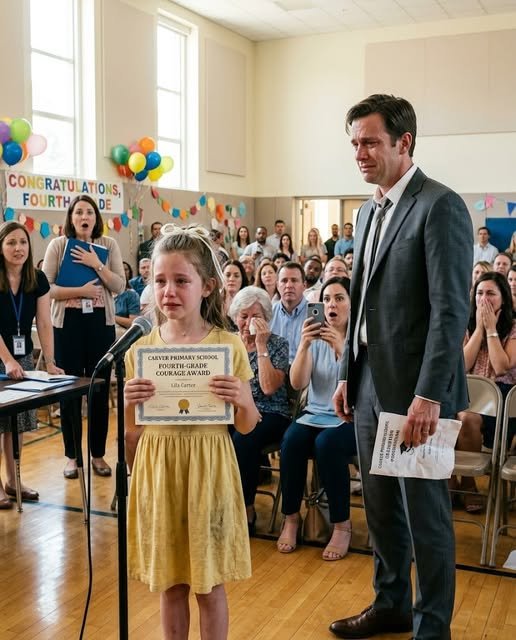
“This year’s Courage Award goes to Lila Carter.”
For half a second, Lila did not move.
Elliot leaned closer.
“That’s you,” he whispered.
She rose on shaking legs and walked toward the stage.
The applause began politely.
Then it grew louder when the audience saw how small she looked beneath the bright lights and how hard she was trying to remain composed.
Mrs. Hanley handed her the certificate.
“Is there anyone here today you would like to thank?” she asked gently.
She lowered the microphone.
Lila looked out at the crowd.
She saw mothers wiping their eyes.
Fathers recording videos.
Grandparents smiling proudly from their seats.
Then she saw Elliot in the second row.
“I want to thank…”
Her voice trembled.
“The man who came today so I wouldn’t have to be alone.”
Every head turned.
Elliot slowly stood.
At first, the only sound was the scraping of chair legs against the floor.
Then people noticed his face.
The tears in his eyes.
The program crushed inside his hand.
The way Mrs. Hanley had suddenly become completely still beside the microphone.
The entire auditorium froze.
Phones remained raised in the air.
Balloons stopped brushing against the ceiling.
A boy held a candy wrapper half-open in his hands.
One grandmother lowered her eyes because looking at Lila suddenly felt too personal.
Nobody moved.
“Lila,” Elliot said.
The microphone captured how badly his voice broke.
He stepped into the aisle.
“I didn’t come here only for the ceremony,” he said. “I came because I saw a name on the program.”
A quiet murmur moved through the auditorium.
Mrs. Hanley opened the blue folder and removed an old sheet of paper she had hidden behind the awards list.
It was a copy of Lila’s original school record.
Beneath her mother’s name was a crossed-out emergency contact.
Elliot Vance.
Lila looked from the document to the man standing in the aisle.
“Did you know my mother?” she asked.
Elliot pressed the program against his chest.
For several seconds, he could not speak.
“Yes,” he finally said. “I knew your mother.”
The auditorium became even quieter.
“I knew her before you were born,” Elliot continued. “I loved her.”
His voice trembled.
“And I spent years believing she wanted me gone because that was what I was told.”
End Part Here: The Girl Who Asked a Stranger to Pretend to Be Her Father