
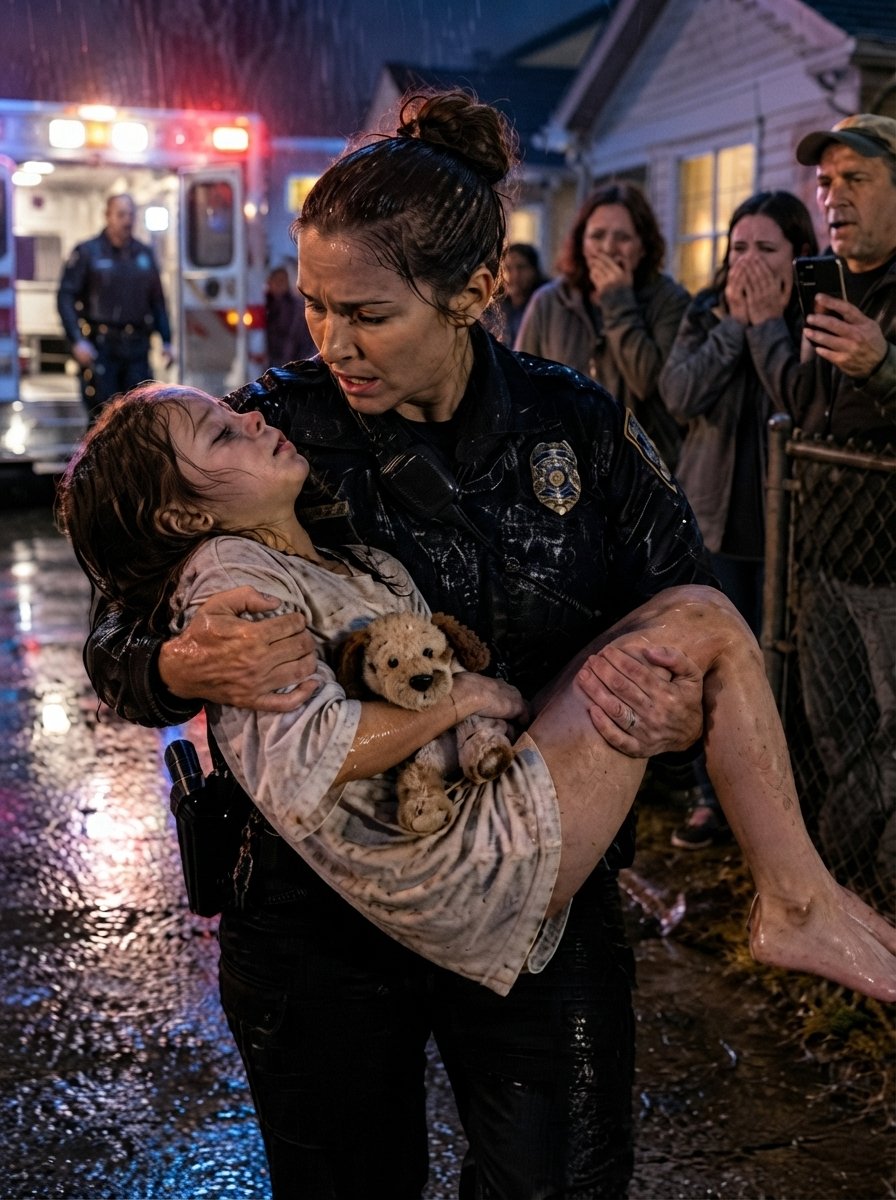
Everyone Thought Andrew Abandoned His Daughter. Four Days Later, Ashley’s Whisper Revealed Who Had Really Been Watching Their House.
The first thing seven-year-old Ashley Hale whispered to 911 made dispatcher Eric Malloy stop typing.
“My daddy says it’s love,” she breathed.
Rain hammered the metal awning outside the little rental house on Cedar Street, breaking her words into fragments.
Eric leaned closer to his headset.
“What did you say, sweetheart?”
Ashley sniffed.
“Daddy says sometimes people do scary things because they love somebody.”
Eric glanced toward the call information appearing on his monitor.
“Okay. What’s your name?”
“Ashley.”
“How old are you?”
“Seven.”
“And where is your daddy now?”
The little girl hesitated so long that Eric felt the familiar tightening in his chest that came whenever a call shifted from unusual to dangerous.
Then she whispered:
“My daddy said he’d only be gone for thirty minutes… but it’s been four whole days.”
Eric sat upright.
Four days.
“Are you alone?”
A tiny sob came through the line.
“Yes.”
The address belonged to a working-class neighborhood near the eastern edge of town, where narrow ranch houses stood behind chain-link fences and everyone noticed everyone else’s cars.
Eric silently alerted the nearest patrol unit.
“What’s your daddy’s name?”
“Andrew.”
“Where did Andrew say he was going?”
“To get my medicine. And chicken. And rice.”
Ashley’s breathing sounded weak.
“My tummy hurts.”
“When did you eat last?”
“I don’t remember.”
Eric swallowed.
“What food is there?”
“Soup.”
“Can you eat some?”
“It smells funny.”
“Anything else?”
“No.”
“What have you been drinking?”
“Sink water. I gave Buddy some too.”
“Who’s Buddy?”
“My puppy.”
A beat passed.
“My stuffed puppy.”
Eric closed his eyes for half a second.
“Okay, Ashley. A police officer named Natalie is coming to help you.”
“Am I in trouble?”
“No. You did exactly the right thing.”
“Daddy said not to call unless it got really bad.”
Eric looked at the silent blinking timer counting the length of the call.
“This is really bad.”
Officer Natalie Brooks reached Cedar Street six minutes later.
The storm had intensified.
Rain rolled from the roofs in silver sheets, and water filled the gutters.
Ashley’s house was nearly dark.
No porch light.
No television.
No visible movement except a curtain shifting behind the front window.
Natalie approached slowly.
“Ashley?”
The door opened one inch.
A frightened brown eye appeared.
“You’re not gonna yell?”
Natalie immediately crouched.
“No, sweetheart.”
The door opened wider.
Ashley stood barefoot on cold linoleum wearing an oversized gray T-shirt. Her light-brown hair hung in tangled strands around her face.
She clutched a worn stuffed dog.
Her cracked lips worried Natalie.
Her thin arms worried her more.
But when Natalie noticed the swelling beneath Ashley’s shirt, an instinctive alarm sounded in her mind.
“You said your tummy hurts?”
Ashley nodded.
“All the time now.”
Natalie entered the kitchen.
The refrigerator contained mustard, butter and a cloudy plastic container of soup.
Nothing else.
But the kitchen table told a different story.
A grocery list lay beside Andrew’s wallet-sized family photograph.
Rice.
Chicken.
Electrolyte drinks.
Ashley’s medicine.
Next to it was another note:
Urgent appointment. Call first thing Monday.
Natalie picked it up.
A father planning to disappear usually did not leave behind a grocery list and an urgent pediatric appointment.
“Did your daddy write this?”
Ashley nodded.
“He said the doctor wanted to see me again.”
“Was your dad worried?”
“He worries all the time.”
Ashley hugged Buddy.
“He keeps saying my belly shouldn’t hurt this much.”
Outside, neighbors began gathering beneath umbrellas.
A woman in a yellow raincoat stood closest to the fence.
Natalie recognized her from the address database.
Denise Carter.
Two houses down.
“I knew something like this would happen,” Denise said.
Another neighbor lifted a phone.
“What do you mean?” someone asked.
Denise shook her head dramatically.
“Andrew’s been under pressure since his wife died. Raising a child alone? Some people can’t handle it.”
Natalie stepped onto the porch.
“Please stop recording.”
The man lowered his phone only slightly.
“We’re documenting this.”
“You’re filming a sick seven-year-old.”
The phone disappeared.
Natalie returned to Ashley.
“I’m going to pick you up.”
Ashley nodded.
“Don’t forget Buddy.”
“I won’t.”
Natalie slipped an arm behind her shoulders.
The moment she lifted her, Ashley whispered:
“Daddy didn’t leave me.”
“I know.”
“He promised.”
Then, unexpectedly:
“He said people might think bad things.”
Natalie stopped walking.
“What people?”
Ashley stared past her.
“I don’t know.”
“What exactly did he say?”
Ashley’s brows pinched together.
“He said sometimes people do scary things because they love somebody.”
Natalie felt cold despite the humid room.
“Who was he talking about?”
Ashley’s mouth opened.
But before she could answer, her eyes rolled shut.
Her body went limp.
“Ashley!”
Buddy fell from her fingers.
Natalie caught both child and toy.
“Dispatch! Minor unconscious. Severe dehydration suspected. Medical now!”
The neighbors stopped talking.
For the first time that night, Cedar Street became silent except for the rain.
The ambulance rushed Ashley to St. Matthew’s Hospital.
Within an hour, social media had transformed uncertainty into certainty.
Andrew Hale had abandoned his daughter.
By midnight, strangers were calling him a monster.
By 1:00 a.m., someone had found an old photograph of him online and reposted it thousands of times.
By 2:00 a.m., a local livestreamer interviewed Denise Carter beneath an umbrella.
“He loved that girl,” Denise said tearfully. “But love isn’t always enough.”
That clip went viral.
Nobody mentioned that Andrew worked overtime at the Wilson Machine Works.
Nobody mentioned that he packed Ashley’s school lunch every morning.
Nobody mentioned that after his wife, Rachel, died two years earlier, Andrew had refused offers to send Ashley to live with relatives.
And nobody mentioned that he had spent the previous three months taking Ashley to doctors because of unexplained abdominal pain.
Natalie returned to the house after midnight.
Andrew’s work boots remained by the door.
His paycheck envelope was unopened.
His shaving supplies were in the bathroom.
His prescription glasses were beside his bed.
Everything about the house said the same thing:
He intended to come home.
Natalie examined the grocery list again.
Something beneath the final line caught her attention.
Pencil marks.
Erased.
She angled the paper toward the light.
Three words emerged.
DON’T TRUST DENISE.
Natalie stared toward the window.
Two houses away, Denise stood beneath her porch light.
Watching.
Then Natalie’s radio crackled.
A road crew had discovered a blue pickup below a washed-out guardrail four miles east of town.
Andrew owned a blue Ford pickup.
The truck was damaged.
The driver’s door was open.
Andrew was missing.
Natalie requested a rescue team.
Then, inside the silent house, a cell phone began ringing.
It wasn’t Ashley’s.
It wasn’t Andrew’s registered number either.
Natalie followed the sound to the living room.
A black prepaid phone lay beneath the couch.
The screen displayed:
DENISE.
Natalie answered without speaking.
Silence.
Then Denise whispered:
“Andrew?”
The line disconnected.
Natalie crossed the yards in the rain and reached Denise’s house within seconds.
The front door stood open.
“Police!”
No response.
A cup of coffee still steamed on the table.
Denise’s purse remained on the sofa.
Muddy prints led toward the basement.
Natalie followed them.
What she found downstairs changed the case.
Dozens of photographs covered a folding table.
Andrew entering Ashley’s school.
Ashley leaving a pediatric clinic.
Andrew filling his truck.
Ashley playing in the backyard.
Some photographs were months old.
Someone had been watching the Hale family.
At the center of the table sat copies of Ashley’s medical records.
Beside them lay an envelope addressed to Andrew.
Inside was a handwritten message:
YOU NEED TO KNOW WHAT REALLY HAPPENED TO RACHEL.
Natalie heard a floorboard creak.
Denise stood at the top of the stairs.
“I can explain.”
“Start with Andrew.”
Denise’s face went pale.
“I didn’t hurt him.”
“You called a phone hidden in his house.”
“I gave him that phone.”
“Why?”
“Because he stopped trusting his regular phone.”
“Why?”
Denise descended one step.
“Because somebody was watching him.”
Natalie looked at the photographs.
“You?”
“Yes.”
“Why?”
Denise’s eyes filled with tears.
“Because I was trying to keep Ashley alive.”
Before Natalie could respond, her radio erupted.
Search crews had found Andrew near Old Mill Road.
Alive.
Barely conscious.
His first coherent word had been a name.
Denise.
Andrew Hale arrived at the hospital with hypothermia, dehydration and a fractured wrist.
He had survived by crawling beneath an old concrete drainage structure after climbing from the ravine.
Natalie questioned him when doctors permitted it.
The first thing Andrew asked was:
“Ashley?”
“Alive.”
His entire body relaxed.
“Thank God.”
“She’s being treated.”
Andrew closed his eyes.
Then Natalie placed a clear evidence bag on the table.
Inside was the erased grocery list.
“You wrote this?”
His expression changed.
“Yes.”
“Why shouldn’t I trust Denise?”
Andrew looked toward the closed hospital door.
“You found the phone?”
“Yes.”
“Then you need to hear everything.”
Two months earlier, Andrew explained, Denise had approached him privately.
She claimed Rachel Hale’s death might not have been natural.
Rachel had officially died following a sudden cardiac event at thirty-four.
She had complained of nausea, weakness and abdominal pain beforehand.
The symptoms disappeared from importance after her death.
Until Ashley developed similar ones.
Denise worked as a billing clerk for the medical network that included Ashley’s pediatric practice.
She had noticed repeated test orders.
Then she noticed something else.
Both Rachel and Ashley had been seen regularly by the same family physician.
Dr. Gregory Mercer.
Mercer was also Denise’s older brother.
Natalie stared.
“Your neighbor’s brother was Ashley’s doctor?”
Andrew nodded.
“Denise recommended him when Rachel was sick.”
The situation had become more disturbing when Andrew requested Rachel’s old records.
Several pages were missing.
Then someone entered Andrew’s house while he was working.
Nothing valuable was stolen.
But Ashley’s medical folder had been moved.
Andrew became suspicious of Denise because she seemed to know things he had never told her.
She knew appointment dates.
She knew test results.
She knew which medication Ashley had been prescribed.
“I thought Denise was involved,” Andrew said.
“So why take a phone from her?”
“Because she told me her brother was monitoring my calls.”
Natalie folded her arms.
“And you believed her?”
“I didn’t know what to believe.”
Four days earlier, Denise had sent Andrew a message on the burner phone.
COME NOW. I FOUND RACHEL’S ORIGINAL LAB RESULTS.
Andrew had been preparing to buy Ashley’s medicine and groceries.
He drove toward Old Mill Road because Denise said she would meet him at an abandoned storage building there.
She never arrived.
Instead, another vehicle began following him.
Rain had just started.
The vehicle accelerated.
Andrew panicked.
He entered the curve too fast.
His truck went through the guardrail.
“I never saw the driver.”
“Why did you keep saying Denise’s name when rescuers found you?”
“Because she was the only person who knew where I was going.”
That made Denise either the person who had set him up—
or the only witness who could explain why.
Meanwhile, doctors treating Ashley discovered something frightening.
Her symptoms were not caused simply by starvation.
Her blood showed evidence of prolonged exposure to a toxic heavy metal.
Not enough to kill immediately.
Enough to cause progressive abdominal pain, weakness, dehydration and gastrointestinal problems.
Natalie received the call while still questioning Andrew.
The physician spoke carefully.
“This appears chronic.”
“Meaning?”
“She may have been exposed repeatedly.”
Andrew heard.
His face collapsed.
“No.”
“There’s something else,” the doctor said.
“Rachel Hale’s archived toxicology samples still exist.”
Andrew stopped breathing.
Natalie understood instantly.
“If Rachel was exposed to the same substance…”
“Then her death may need to be reexamined.”
The neighborhood woke the next morning to a very different story.
Police tape appeared around Dr. Mercer’s medical office.
Investigators seized files.
Reporters abandoned Andrew’s front lawn and moved downtown.
People who had condemned him began deleting their posts.
Denise voluntarily entered the police station.
She handed Natalie a flash drive.
“I copied Gregory’s files.”
“What files?”
“Private patient records.”
“Illegally?”
“Yes.”
“Why?”
Denise folded her hands.
“Because my sister-in-law died three years ago.”
Natalie stared.
“Gregory’s wife?”
Denise nodded.
“Same symptoms.”
That was why Denise had started investigating her own brother.
Three women connected to Mercer’s practice had suffered strange illnesses.
Two died.
The third moved away.
Denise had suspected him for years but had never found enough evidence.
Then Rachel died.
Denise became convinced.
“But why photograph Andrew and Ashley?”
“To see who approached them.”
“You could have gone to police.”
“With what? Stolen billing records and a theory accusing a respected doctor?”
“So you watched a seven-year-old instead?”
“I watched Gregory.”
Natalie placed one photograph on the interview table.
It showed Ashley outside school.
Someone stood in the distant background.
A man in a dark jacket.
Dr. Mercer.
Denise whispered:
“He wasn’t supposed to be there.”
The flash drive contained hundreds of files.
But the most important discovery appeared in a folder labeled L.
Inside were scanned laboratory results.
Rachel Hale had tested positive for heavy-metal exposure weeks before her death.
The result had never been added to her official chart.
Someone had removed it.
Ashley had undergone a similar test two weeks earlier.
That result was missing too.
The laboratory’s original server showed who accessed both files.
Dr. Gregory Mercer.
Police obtained a warrant.
Mercer was arrested at his office.
The neighborhood assumed the mystery had been solved.
It had not.
Because Mercer denied poisoning anyone.
And then he said something investigators had not expected.
“Ask Andrew what was in the soup.”
Natalie returned immediately to Cedar Street.
The cloudy soup container from Andrew’s refrigerator had already been collected.
Lab technicians tested it.
It contained elevated levels of the same toxic substance found in Ashley’s blood.
Andrew was devastated.
“I made that soup.”
Natalie watched his face carefully.
“When?”
“The night before I disappeared.”
“What ingredients?”
“Vegetables. Chicken broth. Rice.”
“Anything unusual?”
“No.”
“Did anyone else enter the house?”
Andrew thought.
Then froze.
“Denise.”
Natalie’s pulse quickened.
“She came over that night?”
“She said she wanted to check on Ashley.”
This complicated everything.
Denise had access to the house.
Denise had photographed the family.
Denise had medical records.
Denise had sent Andrew to Old Mill Road.
And Denise had been inside the house hours before the contaminated soup was prepared.
Natalie rushed back to the station.
Denise was gone.
Her attorney had secured her release because investigators lacked grounds to detain her.
A patrol unit was sent to her house.
Empty.
Her car was missing.
Natalie felt the investigation collapsing into a darker shape.
Had Denise framed her own brother?
Had she poisoned Rachel?
Was Andrew next?
Then the hospital called.
Ashley was awake.
And asking for Natalie.
Ashley looked tiny beneath the white hospital blankets.
Buddy rested beside her.
Natalie sat down.
“How are you feeling?”
“Better.”
“That’s good.”
Ashley touched Buddy’s ear.
“Did you find Daddy?”
“Yes.”
“Is he okay?”
“He’s hurt, but he’s alive.”
Tears rolled down Ashley’s cheeks.
Natalie waited before asking:
“Ashley, do you remember the soup?”
She nodded.
“Daddy made it.”
“Did anyone help him?”
“No.”
“Did anyone come over?”
“Miss Denise.”
“What did she do?”
Ashley looked confused.
“She cried.”
“Why?”
“She hugged Daddy.”
That surprised Natalie.
“Anything else?”
Ashley nodded.
“She gave him something.”
“What?”
“A little bottle.”
Natalie leaned forward.
“What kind of bottle?”
Ashley pointed at the bedside table.
“Like medicine.”
“Did your dad put it in the soup?”
“No.”
Ashley frowned.
“Miss Denise said, ‘Don’t let Gregory find this.’”
Natalie sat back.
That changed the meaning entirely.
“What happened to the bottle?”
“Daddy put it in the cabinet.”
Investigators searched the house again.
Behind a stack of canned goods they found a small sealed vial.
Inside was a sample of contaminated medication prescribed to Rachel before her death.
Denise had not brought poison.
She had brought evidence.
Which meant someone else contaminated the soup.
Then Ashley said one more thing.
“The man came later.”
Natalie turned.
“What man?”
“The doctor.”
“Dr. Mercer came to your house?”
Ashley nodded.
“Daddy was outside fixing his truck.”
“What did Dr. Mercer do?”
“He said he wanted to make my tummy better.”
“Did he touch the soup?”
Ashley slowly nodded.
“He put drops in it.”
There it was.
The direct witness.
Mercer had poisoned the food.
But the question remained:
Why?
Under renewed interrogation, Mercer finally broke.
But not in the way anyone expected.
He admitted altering records.
He admitted visiting Ashley’s house.
He admitted adding the toxic substance to the soup.
He admitted knowing Rachel had been exposed before she died.
Yet he insisted:
“I didn’t start this.”
Natalie stared through the interview-room glass.
Mercer leaned toward the detective questioning him.
“You think I’m protecting myself. I’m protecting someone else.”
“Who?”
Mercer shook his head.
The detective placed photographs of Rachel and Ashley on the table.
“You poisoned a child.”
Mercer began crying.
“I was trying to make her sick enough that Andrew would finally take her out of that house.”
Natalie frowned.
That made no sense.
Then Mercer said:
“The exposure source is inside their home.”
Investigators tested everything.
Pipes.
Paint.
Soil.
Cleaning products.
Old appliances.
End Part Here: The first thing seven-year-old Ashley whispered to 911 was so strange that dispatcher Eric Malloy thought he had misheard her