
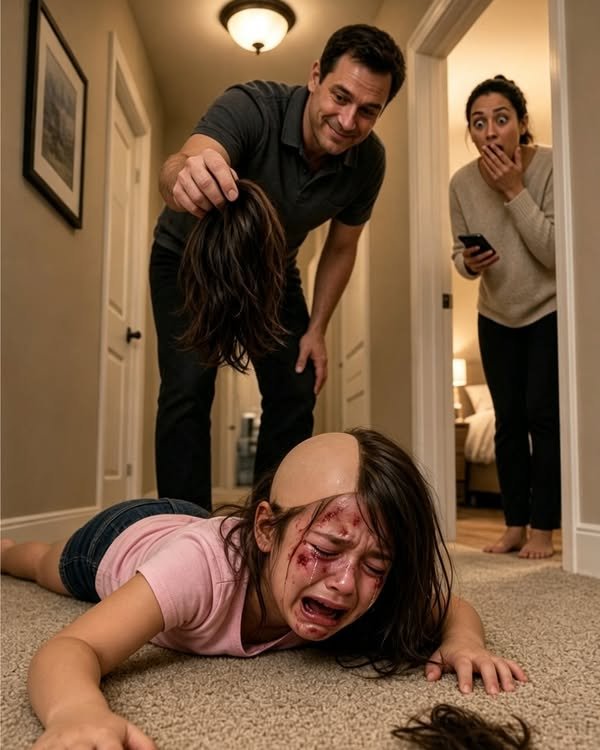
Six family members watched without blinking as my husband pinned our daughter down, struck her, and pulled out a handful of her hair over a spilled glass of water.
When I pulled out my phone to record what was happening, they didn’t rush forward to protect her. Instead, they stared at me and told me to put it away.
That was the exact moment I realized something terrifying: the danger inside that house wasn’t limited to my husband. Everyone surrounding us had chosen his side.
My husband looked at the phone in my hand and finally released our daughter. Not because he regretted what he’d done. Not because he suddenly understood her fear.
He stopped because he realized there could now be evidence.
For several seconds, nobody moved. My daughter remained curled against the floor, one trembling hand pressed against her head, while I stood there recording everything.
My husband’s mother was the first person to speak. She didn’t ask whether her granddaughter was hurt. She didn’t condemn her son. She looked directly at me.
“Put that phone away.”
Her voice was calm, almost irritated, as though I were the person creating the problem. Behind her, my father-in-law slowly nodded in agreement.
My husband’s brother stood near the kitchen doorway with his arms folded. His wife sat at the dining table. Two other relatives remained frozen beside the living room.
Six adults.
Six witnesses.
Not one had stepped forward when my daughter cried for help.
I looked around the room and suddenly understood why my husband had become so comfortable behaving this way. He believed nobody there would ever challenge him.
He was right.
Until that night.
It had started with something so ordinary that remembering it still feels impossible. We were having a family dinner at my in-laws’ house on a Saturday evening.
My daughter, Emily, was twelve years old. She had been helping clear plates because her grandmother had complained that children her age needed to “learn responsibility.”
Có thể là hình ảnh về trẻ em
Emily carried three glasses toward the kitchen.
One slipped.
Water spilled across the hardwood floor.
That was all.
No broken glass. No ruined furniture. No insult. No deliberate disobedience. Just water spreading across polished wood while a frightened child immediately apologized.
“I’m sorry. I’ll clean it.”
My husband stood up so quickly that his chair scraped backward.
Everyone became silent.
I recognized the expression on his face immediately. I had seen versions of it before, usually behind closed doors.
But never like this.
Never in front of everyone.
He demanded to know why Emily couldn’t follow simple instructions. She apologized again and reached for a towel, hoping that would end it.
It didn’t.
He grabbed her arm.
I immediately told him to stop.
He ignored me.
Emily tried pulling away, frightened by how tightly he was holding her. That resistance only made him angrier.
Within seconds, everything escalated.
He forced her down while shouting about respect, discipline, and how she needed to learn that actions had consequences.
Emily screamed for me.
I rushed toward them, but my father-in-law stepped between us.
“Let him handle his daughter.”
I couldn’t believe what I was hearing.
“Move.”
He didn’t.
Behind him, Emily was crying and begging her father to stop. My husband continued raging while everyone else watched.
Nobody seemed shocked.
That frightened me almost as much as what he was doing.
His mother actually sighed.
“She needs discipline.”
I stared at her.
“She’s twelve.”
“And she’s spoiled because you constantly interfere.”
Something inside me changed at that moment.
Until then, part of me had believed these people simply didn’t understand how serious my husband’s temper had become.
I had made excuses for years.
His father came from a strict generation.
His mother believed children should obey adults.
His brother avoided confrontation.
His relatives didn’t know what happened inside our house.
Those excuses disappeared that night.
They knew.
They had always known.
And worse, they approved.
I pushed past my father-in-law and reached for my daughter. My husband turned toward me and warned me not to interfere.
That was when I grabbed my phone.
I opened the camera.
The tiny recording symbol appeared on the screen.
Everything changed instantly.
My husband froze.
The same man who had ignored my daughter’s crying suddenly became incredibly aware of his surroundings.
He released her.
“What are you doing?”
“Recording.”
His face changed.
His anger didn’t disappear. It transformed into something colder.
Fear.
Not fear of hurting his daughter.
Fear of consequences.
My mother-in-law stepped toward me.
“Turn that off.”
I kept recording.
My husband’s brother finally unfolded his arms, but instead of checking on Emily, he told me I was “making everything worse.”
Worse.
That word nearly made me laugh.
My daughter was shaking on the floor, and somehow the camera in my hand was what they considered dangerous.
I pointed the phone around the room.
“Everyone here saw what happened.”
Nobody answered.
“Didn’t you?”
Silence.
My husband ordered me to give him the phone.
I backed away.
He stepped forward.
I raised my voice.
“Don’t come any closer.”
For perhaps the first time in our marriage, he stopped when I told him to stop.
Because the camera was still recording.
I moved toward Emily.
She reached for me immediately.
When I knelt beside her, she whispered something I will remember for the rest of my life.
“Mom, please don’t leave me here.”
Five words.
That was enough.
I helped her stand.
My mother-in-law moved toward the front door.
For one horrible second, I thought she might physically prevent us from leaving.
Instead, she began bargaining.
“Everybody is emotional. Sit down. We can talk about this.”
There was nothing to discuss.
I told Emily to get her shoes.
My husband laughed bitterly.
“You’re seriously leaving because I disciplined my own child?”
I looked at him.
“No. I’m leaving because you hurt her.”
The room went completely silent.
He immediately began rewriting what had happened.
He said Emily had been disrespectful.
He claimed she had fallen.
He insisted everyone was exaggerating.
Then he apparently remembered that I was still recording.
His voice softened.
That sudden transformation was chilling.
Minutes earlier, he had been furious.
Now he sounded calm and reasonable.
“You’re upset. Let’s talk tomorrow.”
I finally understood something I should have understood years earlier.
His temper wasn’t uncontrollable.
He could control it whenever consequences appeared.
That realization hurt.
For years, he had apologized after frightening arguments and claimed he “lost control.”
He hadn’t lost control.
He had made choices.
Emily returned wearing her shoes and carrying her backpack.
We headed toward the door.
My father-in-law spoke from behind us.
“If you walk out now, you’re destroying this family.”
I stopped.
Then I turned around.
“No. I’m protecting my daughter.”
Nobody followed us.
Nobody apologized.
Nobody even asked whether Emily needed medical attention.
They simply watched us leave.
We reached my car, locked the doors, and drove away.
I didn’t know exactly where we were going.
I only knew where we weren’t going.
Home.
My husband had access to our house. I couldn’t risk taking Emily somewhere he could easily find us before I understood what happened next.
So I drove toward a brightly lit public place and called someone I trusted.
Then I contacted authorities.
My hands shook throughout the call.
Emily sat beside me wrapped in my jacket.
Every few minutes she asked the same question.
“Is Dad coming?”
“No.”
“Are you sure?”
“Yes.”
I wanted my voice to sound stronger than I felt.
That night, we documented everything we safely could.
The recording mattered.
So did photographs, messages, timestamps, and the names of every person who had witnessed what happened.
My husband’s relatives began calling almost immediately.
At first, I didn’t answer.
Then the messages started.
His mother said family problems should remain private.
His brother accused me of trying to ruin my husband’s reputation.
Another relative said Emily would eventually forgive her father and that involving outsiders would permanently damage their relationship.
Nobody asked how Emily was feeling.
That told me everything.
Their concern wasn’t centered on the child who had been terrified.
Their concern was protecting the adult who had caused that terror.
My husband eventually texted.
His first message wasn’t an apology.
It was a demand.
DELETE THAT VIDEO.
I stared at those words for a long time.
Then another message appeared.
We need to handle this privately.
Then:
You’re destroying everything.
Not “Is Emily okay?”
Not “Tell her I’m sorry.”
Not even “I made a terrible mistake.”
Only consequences.
Only reputation.
Only himself.
I saved every message.
Over the next several days, the story changed repeatedly.
First, nothing serious had happened.
Then Emily had supposedly provoked him.
Then he claimed I had manipulated the video.
Then the family insisted they hadn’t clearly seen anything.
That last claim was particularly remarkable.
Six adults had been within several feet of us.
Some had spoken during the incident.
One had physically blocked me from immediately reaching my daughter.
Yet suddenly everyone had poor memories.
Fortunately, my phone didn’t.
The recording captured enough.
But the most painful evidence came from Emily herself.
When we finally sat somewhere safe and quiet, she told me this wasn’t the first time she had been afraid of him.
I felt sick.
There had been shouting when I wasn’t home.
Threats.
Punishments she had been afraid to tell me about.
Moments when he warned her that telling me would only make things worse.
She had carried that fear alone.
I asked why she hadn’t told me.
Her answer shattered me.
“Because you always forgave him.”
I couldn’t respond.
She wasn’t accusing me.
She was explaining.
Every time my husband shouted and apologized, I accepted the apology.
Every time he frightened us and promised improvement, I wanted desperately to believe him.
Emily had been watching.
Without realizing it, I had taught her that his apologies mattered more than her fear.
That truth was painful.
But I needed to hear it.
I couldn’t change what I had failed to recognize before.
I could change what happened next.
So I made her a promise.
“We are not going back.”
She started crying.
Then she hugged me.
Not because she was sad about leaving.
Because she was relieved.
That told me more about our marriage than anything my husband could ever say.
The following weeks were difficult.
There were appointments, statements, paperwork, legal consultations, and countless nights when neither Emily nor I slept properly.
My husband alternated between anger and charm.
One day, I was evil.
The next, he loved me.
Then he blamed stress.
Then childhood trauma.
Then alcohol.
Then me.
Then Emily.
Everyone was responsible except him.
His family continued defending him.
Eventually, I stopped expecting anything different.
They had shown me who they were before we even left that house.
Their silence had been a decision.
Their demands that I stop recording had been another.
Their messages afterward confirmed everything.
They didn’t want accountability.
They wanted secrecy.
And secrecy was the environment in which my husband had learned that frightening people smaller than him carried no meaningful consequences.
I refused to participate anymore.
Emily began counseling.
Slowly, pieces of the girl I remembered started returning.
She laughed more.
She stopped flinching whenever someone raised their voice nearby.
She began sleeping through the night.
One afternoon, several months later, she accidentally knocked a glass from our kitchen counter.
It hit the floor.
Water splashed everywhere.
Emily froze.
Her face went pale.
She immediately began apologizing.
“I’m sorry, Mom. I’m sorry. I didn’t mean to. Please don’t—”
I walked toward her.
She instinctively stepped backward.
That broke something inside me.
I picked up a towel.
“It’s water.”
She stared at me.
“We clean it up.”
“You’re not mad?”
“No.”
Her shoulders dropped.
Then she started crying.
I hugged her while water remained scattered across the kitchen floor.
That moment made me understand how deeply fear can reshape a child’s understanding of ordinary mistakes.
A spilled drink should mean grabbing a towel.
A broken plate should mean sweeping carefully.
A bad grade should mean a conversation.
Childhood mistakes should never become reasons for terror.
I wish I could say everything became easy after we left.
It didn’t.
Leaving wasn’t the ending.
It was the beginning.
We had to rebuild routines.
Rebuild trust.
Rebuild our understanding of what home was supposed to feel like.
I had to forgive myself without excusing myself.
There were warning signs I had minimized because acknowledging them would have forced me to make decisions I wasn’t ready to make.
I can’t undo that.
But I can tell the truth about it.
Today, Emily understands something I wish I had taught her much earlier.
Love does not require silence.
Family does not mean protecting someone’s reputation while another person suffers.
And forgiveness cannot substitute for accountability.
Sometimes I think about those six adults sitting around that room.
For a long time, their behavior filled me with rage.
Now I mostly understand what their presence revealed.
They showed me the system surrounding my husband.
They showed me why he believed he could behave however he wanted behind closed doors.
Most importantly, they forced me to finally choose.
I could protect the appearance of a family.
Or I could protect my child.
I couldn’t do both.
So I chose her.
The phone in my hand that night wasn’t what destroyed our family.
The recording didn’t create what happened.
It simply prevented everyone from pretending it hadn’t happened.
And sometimes, the most dangerous thing to people who depend on silence isn’t confrontation.
It’s evidence.
My daughter is older now.
She’s stronger.
So am I.
We still talk about that night occasionally, although less often than we once did.
Recently, she asked whether I regretted recording.
I thought about the question.
Then I told her the truth.
“I regret that I ever needed to.”
But I don’t regret pressing record.
And I will never regret walking out that door with her.
Because the moment six adults told me to put my phone away while my frightened daughter needed protection, I finally understood something clearly.
Silence wasn’t keeping our family together.
Silence was protecting the wrong people.
So I stopped being silent.