
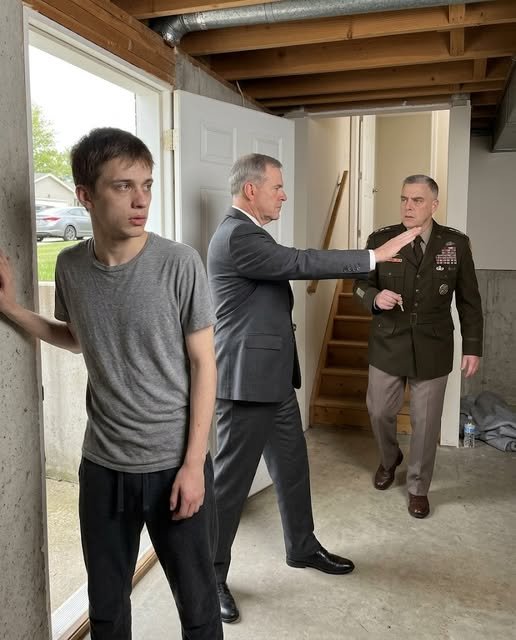
MY STEPFATHER LOCKED ME IN THE BASEMENT TO FORCE ME TO ENLIST
PART 1 — THE BASEMENT DOOR
My stepfather stopped with the basement key still pinched between his fingers.
Behind me stood the Secretary of Defense.
He had entered through the exterior cellar door while my stepfather was upstairs preparing the speech he planned to give me when I finally surrendered.
Now he stood in the basement wearing a dark suit, an official folder tucked beneath one arm.
“Step away from the door, General,” he said.
My stepfather, General Daniel Mercer, recovered quickly.
He straightened his shoulders and gave the same commanding stare that had controlled our house for years.
“This is a family matter,” Daniel said. “The boy needed discipline.”
The Secretary looked around the basement.
Bare concrete.
A thin blanket I had folded into a pillow.
An empty water bottle near my foot.
My mouth was so dry that I could taste blood where my lip had cracked.
“Three days without food is not discipline,” the Secretary said. “And confinement is not recruitment.”
Daniel tightened his fingers around the key.
“He refused every opportunity I gave him. He has no direction, no respect, and no understanding of duty.”
I had heard those words since the day he married my mother.
Whenever I talked about college, Daniel called it weakness.
Whenever I mentioned a civilian career, he said I was wasting my potential.
To him, there had only ever been one acceptable future for me.
The military.
His military.
His plan.
Two weeks earlier, Daniel had placed enlistment papers on the kitchen table.
“Sign them before breakfast,” he had ordered.
I refused.
First he took my phone.
Then my wallet.
Then my car keys.
And finally, he marched me downstairs and locked the basement door.
He believed hunger and isolation would eventually make me surrender.
On the fourth morning, he opened that door expecting obedience.
Instead, he found the Secretary of Defense waiting behind me.
The Secretary opened his folder.
“General Mercer.”
Daniel did not move.
The first page listed Daniel’s name, the confinement, and the immediate suspension of his authority pending formal proceedings.
Daniel stared at the document.
For the first time in my life, his rank did not protect him.
“You cannot do this based on the word of an ungrateful kid,” he said.
“This investigation did not begin with his statement,” the Secretary replied.
Then he turned toward me.
“Do you want to leave this basement?”
It should have been the easiest question anyone had ever asked me.
But Daniel was still standing near the interior stairs.
The key in his hand had controlled almost every decision in our home.
Part of me still expected him to slam the door shut the moment nobody was watching.
So instead of walking toward him, I forced myself upright and moved toward the exterior exit.
Daniel stepped after me.
The Secretary immediately moved between us.
“You will not touch him.”
Daniel’s voice became quiet.
That was always worse than shouting.
“He lives under my roof,” he said. “I was preparing him for the life his mother and I chose for him.”
The Secretary removed another document.
An enlistment packet.
My name appeared across the top.
My stomach tightened.
There was a signature at the bottom.
It looked like mine.
Almost.
The Secretary pointed toward the date.
The application had been submitted three weeks earlier.
Before Daniel ever placed enlistment papers in front of me.
Before I had agreed to anything.
That meant the basement had never been about changing my mind.
Daniel had already made the decision in my name.
He only needed me to cooperate afterward.
Daniel stared at the document.
“His mother witnessed the signature.”
The Secretary turned the page toward me.
Beside the forged version of my name was my mother’s signature.
Before I could speak, footsteps came from the doorway.
My mother appeared.
She looked exhausted.
“It isn’t mine,” she said.
Daniel turned toward her.
Mom ignored him.
Instead, she reached into her coat pocket and placed a second basement key in my hand.
Two days before Daniel locked me downstairs, she had discovered copies of the enlistment paperwork.
When she confronted him, Daniel told her the application was only a draft.
He claimed I had already agreed.
For a while, she believed him.
Or perhaps she wanted to.
Challenging Daniel had always carried a price.
Then she heard me pounding on the basement door.
That was when everything changed.
She left the house pretending she was going to buy groceries.
Instead, she contacted an attorney.
The information eventually reached federal officials.
Then she returned with the one person Daniel never imagined would walk into our basement.
Daniel looked at her.
“You are destroying everything we built.”
Mom shook her head.
“No. You built it around fear.”
The Secretary placed a blank statement over the forged packet and offered me a pen.
He explained that my written account would determine whether the confinement and falsified paperwork became part of the formal investigation.
Daniel stared at the pen.
“If you sign that,” he said, “you are no longer my son.”
I looked at the key in my palm.
A small piece of metal.
But for three days, it had represented food.
Freedom.
The door.
My future.
Then I placed it beside the statement.
I took the pen.
And I signed my name slowly enough that nobody could ever confuse it with Daniel’s forged version again.
My mother took the pen from me.
“I’m signing too,” she said.
PART 2 — THE HOUSE THAT FEAR BUILT
Daniel stared at my mother.
For the first time since I had known him, General Daniel Mercer seemed to have no prepared response.
He usually had one for everything.
If I disagreed, I was disrespectful.
If Mom questioned him, she was emotional.
If neighbors complained about shouting, they were interfering in private family matters.
Every disagreement ended the same way.
Daniel was right because Daniel had rank.
He had medals.
He had photographs with generals, senators, commanders, and foreign officials lining our hallway.
For thirty-two years, he had built a reputation that made people stand straighter when he entered a room.
But none of that mattered in the basement.
Mom signed beneath my statement.
Her hand shook during the first few letters.
Then it steadied.
“Eleanor,” Daniel said quietly.
Mom stopped writing for one second.
Not because she had changed her mind.
Because she knew that tone.
So did I.
Daniel rarely shouted when he was truly angry.
He became calm.
Controlled.
Almost gentle.
That was when everyone became afraid.
“You need to think very carefully about what you’re doing,” he said.
Mom looked up.
“I have.”
“You’re making permanent accusations because you’re upset.”
“No.”
“You don’t understand the consequences.”
Her expression hardened.
“I understand them better than I ever have.”
The Secretary placed our signed statements inside his folder.
Daniel stepped forward.
Two military security officers appeared at the exterior doorway.
“General Mercer,” one of them said. “You need to come upstairs.”
Daniel stared at him.
“You don’t give me orders.”
The Secretary answered.
“Today, he does.”
Daniel’s face changed.
Then he looked directly at me.
There was no disappointment anymore.
No performance of parental concern.
Only anger.
“You wanted this.”
My legs were weak.
My stomach hurt.
But I stood as straight as I could.
“No.”
His eyes narrowed.
“I wanted you to open the door.”
That silenced him.
One of the officers approached.
Daniel finally surrendered the basement key.
Then they escorted him upstairs.
I listened to his boots disappear one step at a time.
For years, the sound of those boots in our hallway had meant only one thing.
Be quiet.
Stand straight.
Hide anything he might interpret as disrespect.
Now the sound faded.
Then disappeared completely.
Mom reached toward me.
I flinched.
I couldn’t stop myself.
Her hand froze.
Pain crossed her face.
“I’m sorry,” she whispered.
I hated my reaction.
But I understood it.
Mom had lived inside the same house.
She had seen Daniel control where I went.
Who I talked to.
Which college applications I completed.
Which friends were acceptable.
He opened my mail and called it responsibility.
He checked my phone and called it parenting.
Mom had argued with him sometimes.
But Daniel always reminded her what she supposedly owed him.
The house.
The insurance.
The stability.
The connections that helped her after my biological father died.
Everything came with a price.
“Why didn’t you stop him sooner?” I asked.
My voice sounded harsher than I intended.
Mom lowered her hand.
“I kept believing there was a line he wouldn’t cross.”
I looked around the basement.
The bare walls.
The blanket.
The empty bottle.
The locked door.
“He crossed it.”
“I know.”
“When did you know?”
She sat on the bottom stair.
“The first night you were down here.”
I stared at her.
“He told me you had agreed to stay downstairs until you calmed down.”
“I was pounding on the door.”
“I know.”
“Then why—”
My voice broke.
Mom closed her eyes.
“Because I was afraid of him.”
The answer hurt.
But it was honest.
And after three days surrounded by lies, honesty mattered.
The second morning, she had tried bringing me water.
Daniel stopped her.
That was when she understood this was not discipline.
It was punishment.
That afternoon, she searched Daniel’s office.
She found emails.
Copies of my enlistment paperwork.
And evidence that the forged packet was not an impulsive decision.
Daniel had been planning it for months.
One message said I was immature but would eventually “understand what was best.”
Another said my resistance should be treated as temporary.
And another contained the words:
Once he is committed, he will adapt.
Mom photographed everything.
Then she contacted an attorney she trusted.
She did not call local authorities first because she feared Daniel’s name and rank might change how people approached the situation.
The attorney contacted federal officials.
The information moved upward.
Much faster than Daniel expected.
Then the Secretary said something that changed the entire case.
“The enlistment packet was not the first questionable document connected to General Mercer.”
Mom went pale.
“What does that mean?”
The Secretary opened the folder again.
There were more documents.
Travel authorizations.
Recommendations.
Personnel communications.
Several contained signatures belonging to people who now said they had never signed them.
Daniel had allegedly spent years manipulating administrative processes.
Protecting people loyal to him.
Punishing people who questioned him.
Creating paperwork that made his choices appear properly authorized.
My situation had not started the investigation.
It had accelerated it.
“So this wasn’t only about me?” I asked.
“No.”
I thought the answer would make me feel better.
It didn’t.
Instead, the basement suddenly felt larger.
As though I had been trapped in one small room belonging to a much bigger system of control.
Then shouting came from upstairs.
“You cannot remove that!”
Daniel.
Another voice answered.
“Sir, step back.”
The Secretary stood.
Mom and I followed him upstairs.
When I entered the kitchen, I barely recognized our home.
Security officers photographed documents.
Investigators stood outside Daniel’s office.
Another officer sealed his laptop inside an evidence bag.
Daniel stood in the middle of everything wearing his uniform.
His jacket was covered with ribbons.
For years, those ribbons had seemed larger than life.
Now they looked like pieces of cloth pinned to a man who believed achievement could erase accountability.
Daniel saw me.
“This is because of you.”
I stopped.
“No.”
The room went silent.
“This is because of you.”
His expression twisted.
“I gave you everything.”
“You gave me your plan.”
“I gave you discipline.”
“You gave me fear.”
“I was trying to make you into something.”
I looked directly at him.
“That was the problem.”
He stared at me.
“I was already someone.”
Nobody spoke.
Then an investigator came out of Daniel’s office carrying a small black notebook.
He handed it to the Secretary.
The Secretary opened it.
His expression changed.
Page after page contained names.
Beside each one were short notes.
Loyal.
Useful.
Weak.
Problem.
Transfer.
Pressure.
Family vulnerability.
My stomach tightened.
Then he reached the final pages.
My name was there.
Evan Hale — resistant. Civilian ambitions. Must be corrected before age nineteen.
Underneath it was another note.
If necessary: financial dependency, isolation, enlistment commitment.
My mother covered her mouth.
Daniel looked down.
And suddenly I understood something worse than being locked in a basement.
This had not been anger.
It had not been a parent losing control during an argument.
He had planned it.
I had been something to manage.
A problem to solve.
The Secretary closed the notebook.
“General,” he said quietly, “you are finished.”
Daniel looked at me one final time.
But I did not lower my eyes.
And for once, neither did my mother.
PART 3 — FINAL: I CHOSE MY OWN FUTURE
The investigation continued for eight months.
Daniel was immediately removed from command.
His access to military systems was suspended.
His office was searched.
His devices were examined.
Then people who had stayed silent for years began speaking.
Officers.
Enlisted personnel.
Military families.
One former aide said Daniel had threatened to destroy his career after he refused to alter a report.
Another officer claimed Daniel blocked his promotion because he questioned a decision.
A captain produced emails showing that Daniel pressured him to sign something he did not agree with.
End Part Here: My stepfather, a decorated Army General, locked me in the basement without food for three days to force me to enlist