
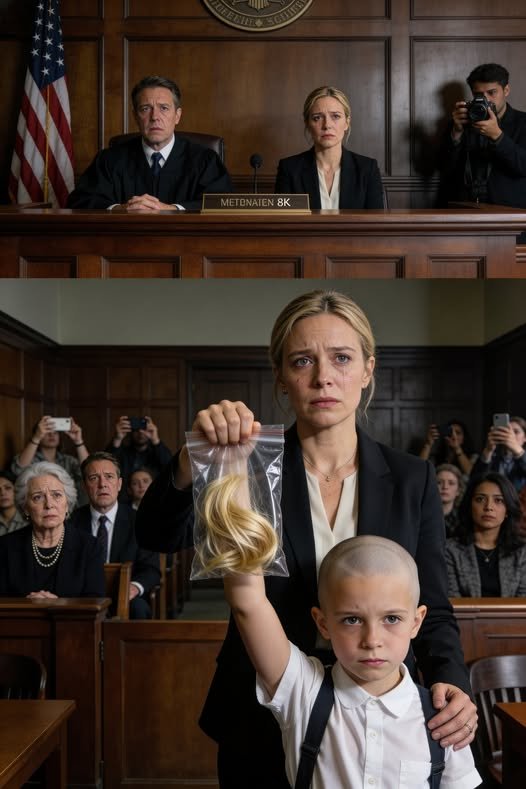
When I pushed open my mother-in-law’s guest bedroom door, my eight-year-old daughter was sitting in the corner with both hands over her head, sobbing.
For three full seconds, my mind refused to understand what I was seeing.
Meadow’s waist-length golden curls were scattered across Judith Cromwell’s spotless beige carpet.
Some pieces were still tied with the tiny purple ribbons I had carefully knotted into her braids that morning.
Other strands clung to Meadow’s tear-streaked cheeks and the knees of her leggings.
Her hair was everywhere.
And my little girl’s head was almost completely bald.
Not neatly cut.
Not professionally shaved.
Uneven patches of stubble covered her scalp. Angry red marks showed where the clippers had scraped too close, and above her left ear was a tiny line of dried blood.
“Meadow?” I whispered.
She slowly lifted her face.
Something inside me broke.
Not loudly.
Not with screaming or rage.
It broke cold and clean in the quiet place inside a mother where mercy used to live.
Meadow tried to speak, but nothing came out.
Behind me, Judith stood in the hallway holding electric clippers in one hand and a garbage bag in the other.
“She needed a lesson,” she said.
I turned slowly.
“A lesson?”
Judith’s gray hair was pinned perfectly into place. Pearl earrings glinted beneath the hallway light.
She looked completely calm.
“She was becoming vain,” Judith said. “Always touching her hair. Always admiring herself. A child who worships her appearance grows into a woman with no character.”
I stared at the clippers.
“You shaved my daughter’s head.”
“I corrected her,” Judith snapped. “Something you and Dustin were too weak to do.”
At the sound of my husband’s name, my stomach dropped.
“What does Dustin have to do with this?”
For the first time, Judith smiled slightly.
“I called him this morning. I told him Meadow needed discipline.”
She paused.
“He said I should do what I thought was best.”
The air seemed to disappear from the room.
Then Meadow made a small sound.
Not a word.
Something shattered.
I dropped to my knees and moved through the piles of her hair until I reached her.
When I touched her shoulder, she flinched.
That nearly destroyed me.
“Baby,” I whispered, wrapping my arms around her carefully. “Mommy’s here. I’m here.”
Her entire body shook so violently that her teeth clicked.
Judith sighed impatiently.
“You’re being hysterical, Bethany. It’s hair. It grows back.”
I pressed my cheek against Meadow’s bare scalp.
It felt too warm.
Too exposed.
Too vulnerable.
Then Meadow finally found her voice.
Three words.
“Daddy said yes.”
I closed my eyes.
She whispered it again.
“Daddy said yes.”
And suddenly, everything changed.
For twelve years, I had protected my marriage by swallowing insults and calling them misunderstandings.
I had excused Judith’s cruelty.
I had excused Dustin’s silence.
I had told myself family relationships were complicated.
But there was nothing complicated about my child trembling in my arms while the woman who hurt her stood nearby holding the clippers.
I looked at Judith.
“Move away from the door.”
Her eyebrows lifted.
“You cannot take her from my house in this state.”
“If you stand between me and my daughter for one more second,” I said quietly, “you will regret it.”
Something in my voice finally reached her.
Judith stepped aside.
I picked Meadow up and carried her into the hallway.
Behind us, Judith called,
“Someday you’ll thank me! Beauty is temporary. Humility lasts.”
I didn’t answer.
I only looked down at my daughter.
Because Judith was wrong.
What lasts is what a child remembers when the adults who are supposed to protect her become the people she fears.
BEFORE THAT DAY
Before that Tuesday, I believed my family was strained.
I didn’t understand that it was already broken.
My name is Bethany Cromwell.
I was thirty-eight years old and worked as an elementary school librarian in suburban Indianapolis.
My husband, Dustin, worked as an insurance adjuster.
We lived in a two-story white house on Maple Street.
We had a mortgage we complained about, a refrigerator covered in drawings, and one little girl who believed every living thing deserved a name.
That was Meadow.
She named worms after rainstorms before carefully moving them off sidewalks.
She cried when weeds were pulled because, according to her, “they were trying their best.”
Once, she made Dustin stop the car in a grocery store parking lot because a moth had gotten stuck under a windshield wiper.
Meadow loved everything deeply.
And she loved her hair.
It wasn’t vanity.
It was joy.
Every morning, she sat on the bathroom counter while I worked detangling spray through her golden curls.
While I braided, she told me about school, friends, dreams, and whatever new adventure existed inside her imagination.
She wanted her hair to grow down to her ankles like Rapunzel.
Not because she believed it made her better than anyone else.
Because children attach magic to ordinary things.
Some children love superhero capes.
Some collect baseball cards.
Meadow had her hair.
Judith hated it.
My mother-in-law believed softness was a weakness.
She had raised Dustin alone after his father left, and she wore that history both as a medal and as a weapon.
She rarely shouted.
She preferred comments that cut slowly.
She called my parenting “permissive.”
She called Meadow “dramatic.”
She said girls needed discipline before the world spoiled them.
Whenever I objected, Dustin said the same thing.
“She means well.”
When Judith complained that Meadow sang too loudly, she meant well.
When Judith threw away cookies I had packed and replaced them with rice cakes, she meant well.
When Judith told my daughter that girls who cared about being pretty would be punished by God, somehow, she still meant well.
And I kept allowing it.
Partly because childcare was expensive.
Judith watched Meadow twice a week while Dustin and I worked.
Partly because she was family.
And family was supposed to be safe.
Meadow often came home quieter after spending time with Judith.
But by bedtime, she usually bounced back.
Until the day she didn’t.
THE WARNING I IGNORED
The morning I dropped Meadow off, she hugged me more tightly than usual.
Her hair smelled like strawberry shampoo.
Purple ribbons rested at the ends of both braids.
Judith opened the door wearing a navy cardigan.
“You’re two minutes late.”
“It’s 7:32,” I replied.
“That is late.”
Meadow buried her face against my coat.
I crouched.
“Be good for Grandma.”
Judith’s eyes moved toward Meadow’s braids.
“We need to talk about this hair obsession.”
I sighed.
“She’s eight.”
“She spends too much time looking at herself.”
Something cold moved through me.
I should have listened to it.
I should have turned around.
I should have put Meadow back into the car.
But I had a staff meeting.
Overdue reports.
Responsibilities.
And a life built around convincing myself that things were never quite as bad as they felt.
So I kissed Meadow’s forehead.
Then I left.
Twenty-seven hours later, the basement of our school library flooded during a thunderstorm.
I got to leave early.
I thought I would surprise Meadow.
Maybe we could bake banana bread.
Paint her nails lavender.
Watch an old movie.
Instead, Judith blocked the doorway when I arrived.
“You’re early.”
“Where’s Meadow?”
Her expression barely changed.
“Learning.”
That single word made my skin crawl.
I pushed past her.
The house was silent.
Too silent for a house with an eight-year-old inside.
No cartoons.
No singing.
No footsteps.
Then I heard crying from the guest bedroom.
And everything I believed about my family ended when I opened that door.
HER FATHER KNEW
I drove Meadow home with one hand on the steering wheel and the other reaching backward so she could hold my fingers.
She had pulled the hood of my raincoat over her head.
She sat curled into the booster seat as though she wanted to disappear.
When we arrived home, Dustin was waiting in the kitchen.
His first words were not,
“Is Meadow okay?”
Instead, he said,
“Mom called. You screamed at her.”
I stared at him.
Rainwater dripped from my clothes onto the floor.
Meadow had already gone upstairs without speaking.
“Did you tell your mother she could shave our daughter’s head?”
Dustin rubbed his face.
“I told her to handle the situation.”
“What situation?”
“Meadow’s attitude.”
“Our eight-year-old had an attitude because she liked her hair?”
“Bethany, don’t twist this.”
I laughed once.
There was nothing humorous about it.
It sounded more like something breaking.
“She held our child down and shaved her bald.”
“She probably didn’t hold her down.”
“Meadow has cuts on her scalp.”
For one brief second, Dustin’s expression changed.
Then it disappeared.
“Mom can be intense,” he said. “But she loves Meadow.”
“Love does not leave a child shaking on the floor.”
He lowered his voice.
“You’re making this bigger than it is.”
That was the moment I finally understood.
Dustin wasn’t trapped between his mother and his wife.
He had already chosen.
He had chosen every time Judith insulted me and he told me to ignore her.
He had chosen every time Judith criticized Meadow and he told our daughter Grandma meant well.
He had chosen every time he translated cruelty into tradition.
Every time he translated control into love.
This was simply the first time his choice had left visible marks.
MEADOW STOPPED SPEAKING
For two days, Meadow barely spoke.
She refused school.
She barely ate.
Even though it was May, she slept wearing a winter hat.
When I reached toward it once, she jerked backward.
“Don’t.”
That one word nearly broke me again.
I took her to the pediatrician.
Dr. Renfield removed the hat and examined Meadow’s scalp.
The moment she saw the cuts and uneven patches, her face changed.
“Who did this?”
“Her grandmother,” I answered.
Then I forced myself to say the rest.
“With her father’s permission.”
Dr. Renfield looked at me.
“I have to report this.”
“Do it.”
That afternoon, I called my sister, Francine.
Francine was a paralegal.
For years, she had told me Judith wasn’t merely difficult.
She was dangerous.
When I finished explaining everything, Francine was silent.
Then she said,
“Bethany, listen carefully. You need photographs. Medical records. Therapy notes. Everything.”
“My husband will say I’m destroying the family.”
“No,” Francine replied. “He helped destroy your daughter’s sense of safety. You’re trying to save what’s left.”
So I documented everything.
The scraped scalp.
The uneven stubble.
The bald patches.
Even the piles of golden hair I had gathered from Judith’s carpet because something inside me had known evidence would matter.
Then I packed.
Not everything.
Just clothes.
School drawings.
Meadow’s purple stuffed elephant, Professor Plum.
The tiny lock of hair from her first haircut that I had saved in her baby book.
And the bag containing the hair Judith had cut away.
Dustin stood in our bedroom doorway.
“You’re seriously leaving?”
I zipped the suitcase.
“Meadow is afraid in this house.”
“Because you’re making her afraid.”
I stared at him.
“No. Because her grandmother hurt her, and her father defended it.”
His jaw tightened.
“Mom was trying to help.”
“Then go live with your help.”
At that moment, Meadow appeared at the top of the stairs.
She wore a pink hat and held Professor Plum against her chest.
“Are we leaving because I was bad?” she whispered.
I crossed the room so quickly I nearly fell.
I knelt in front of her.
“No, baby. We’re leaving because adults were bad to you.”
Meadow looked past me toward Dustin.
“Daddy, why did you say yes?”
Dustin swallowed.
“Sweetheart, Grandma just wanted—”
Meadow stepped behind me.
That tiny movement said everything his excuses refused to admit.
THE COURTROOM
Meadow and I moved into Francine’s apartment near downtown.
For the first three nights, she slept beside me.
Sometimes she woke in terror without making a sound.
Her mouth would open.
Tears would run across her cheeks.
But no scream came.
Two weeks later, we had an emergency hearing.
By then, Meadow had begun speaking again, but only softly.
She wore hats everywhere.
Her teacher submitted a statement explaining that Meadow no longer played at recess and hid in the bathroom whenever another child mentioned her hair.
Dr. Norton, a child psychologist, wrote that Meadow showed signs of trauma and fear linked to a forced bodily violation by someone she trusted.
I read that description again and again.
Clinical language could not capture what I had seen.
End Part Here: MY MOTHER-IN-LAW SHAVED MY 8-YEAR-OLD DAUGHTER’S HEAD — AND MY HUSBAND SAID YES