PART 2
For several seconds, nobody moved.
The restaurant continued existing around us—the low piano near the bar, the Atlantic darkening beyond the windows, the soft clink of silverware—but our table had become its own still little world.
Dad was on one knee beside his chair, one hand gripping the edge of the table.
Mom was crouched beside him.
Nathan stood with his palms flat against the linen.
And Colonel Quinn Parker was watching the two men approaching from the entrance.
They weren’t soldiers.
Both wore ordinary suits. One was a compact woman in her fifties with silver threaded through dark hair. The other was a tall man carrying a leather folder.
Quinn looked at me.
“General, those are Special Agent Elena Vasquez from the Defense Criminal Investigative Service and Detective Mark Halloran from the state financial crimes unit.”
I stared at her.
“You told me tonight was about a family dinner.”
“It was supposed to be.”
Dad found his voice.
“What is this?”
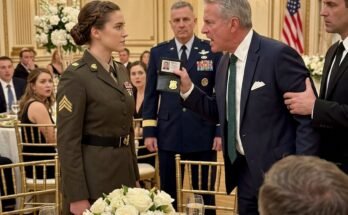
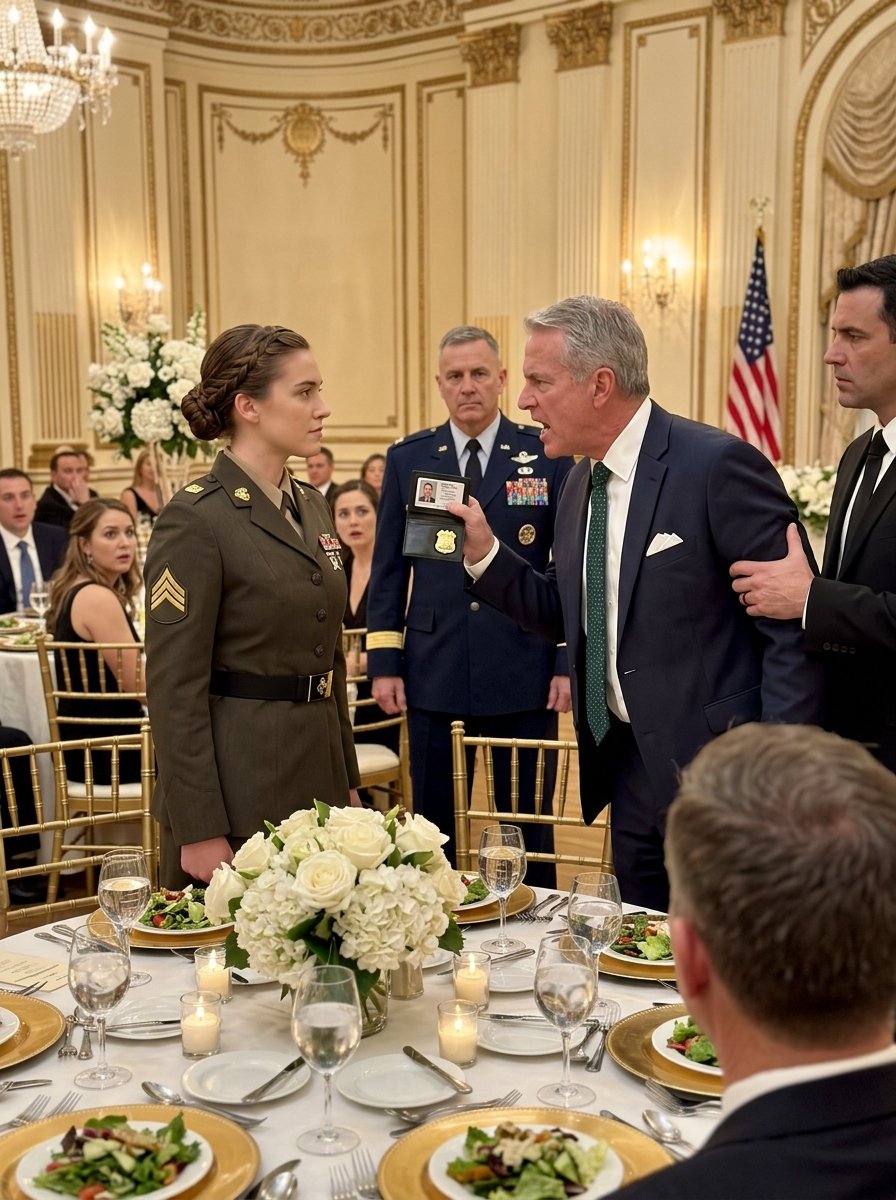
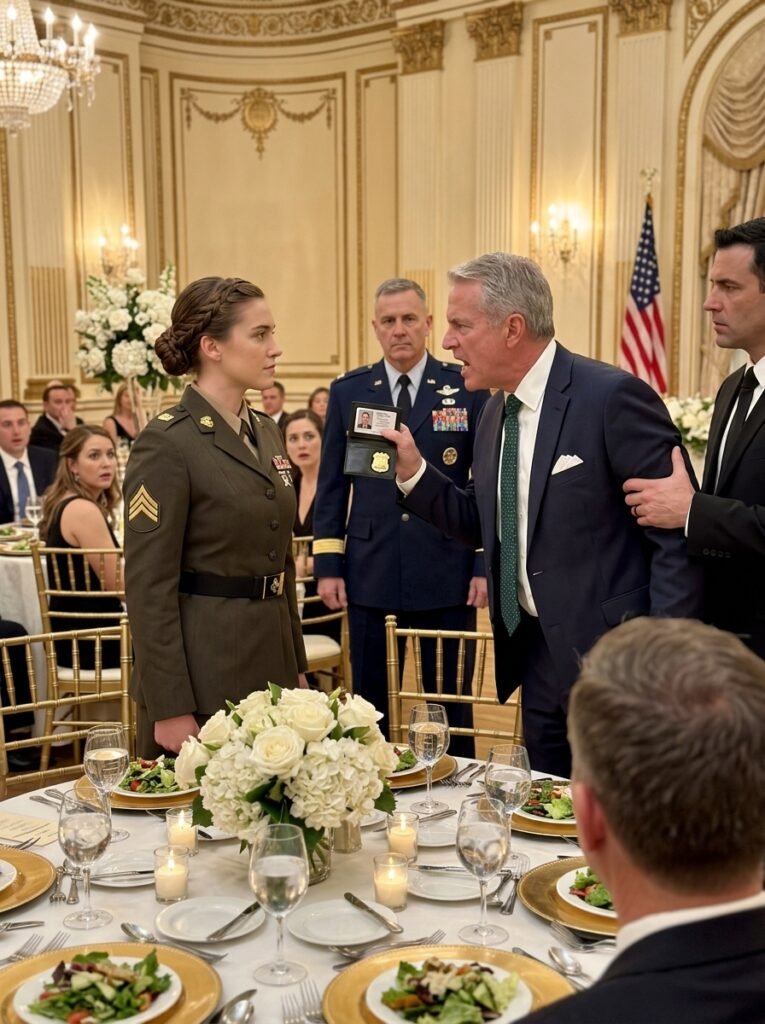
Agent Vasquez stopped a few feet from the table.
“Richard Mercer?”
He straightened slowly.
“Yes.”
She produced identification, held it where he could see it, then put it away.
“We need to speak with you regarding an active investigation.”
Dad looked immediately at me.
Not at Quinn.
Not at the investigators.
At me.
And in that instant, before anyone explained anything, I knew.
Not what he had done.
But that whatever it was, he had expected my name to be somewhere inside it.
“What did you do?” I asked.
His expression hardened.
“Nothing.”
Nathan gave a short, disbelieving laugh.
It was the first truly spontaneous sound I had heard from my brother all evening.
Dad turned toward him.
“Nathan.”
“No,” Nathan said quietly. “Don’t do that.”
Dad blinked.
“Do what?”
“Say my name like it’s an order.”
The words seemed to surprise Nathan as much as they surprised the rest of us.
Mom rose from the floor and pressed one hand to the table.
“Could somebody please explain?”
Agent Vasquez glanced around the restaurant.
“This isn’t the appropriate place for details.”
Dad latched onto that immediately.
“Exactly. So you can leave.”
“Richard,” Quinn said.
He looked at her.
She spoke without raising her voice.
“They have a warrant.”
The color left his face.
Not dramatically. It simply drained away until he looked older than seventy-three.
I had spent my adult life reading rooms where one wrong assumption could cost people dearly. I knew the difference between surprise and recognition.
My father recognized those words.
“How long?” I asked.
He didn’t answer.
Agent Vasquez did.
“The investigation has been active for eleven months.”
I turned to Quinn.
“You knew?”
“For three weeks.”
“And you said nothing?”
“I was instructed not to compromise an investigation. I came tonight because investigators believed your father might attempt to contact you once he realized they were closing in.”
Dad gave a bitter shake of his head.
“Closing in. Listen to yourselves.”
Halloran opened his folder.
“Mr. Mercer, we’re going to step outside with you.”
“For what?”
“Questions first. Processing after that.”
Mom’s voice trembled.
“Processing?”
Dad looked around then, finally noticing the restaurant again.
People were pretending not to watch.
Some were failing.
For all his life, Richard Mercer had cared about appearances with almost religious intensity.
That night, something unexpected happened.
I found that I no longer cared about his.
I cared about Mom standing beside him with trembling hands.
I cared about Nathan looking like the floor had shifted.
I cared about understanding why investigators had arrived at my father’s birthday with my colleague already aware of their case.
“Can we have five minutes?” I asked Vasquez.
She considered me.
“Two.”
Dad said immediately, “Lila, fix this.”
There it was.
The old assumption.
That family meant protection.
That loyalty meant concealment.
That love meant preventing consequences.
I touched the swelling beginning along my cheek and looked at him.
“I don’t know what this is.”
“You know people.”
“That isn’t the same thing.”
“Make a call.”
“No.”
The word came easily.
That surprised me most.
Dad stared at me.
Mom closed her eyes.
Nathan sat down as though his legs had become unreliable.
I turned to Quinn.
“What involves me?”
She hesitated.
“Lila—”
“Tell me what you can.”
Agent Vasquez answered instead.
“Your name appears on several documents connected to Mercer Civic Development.”
I frowned.
Dad had founded Mercer Civic Development nearly thirty years ago. It renovated municipal buildings, community centers, small government offices, and, later, housing projects.
I had never worked there.
“I’ve never signed anything for his company.”
Vasquez nodded once.
“We were hoping you’d say that.”
The room seemed to narrow.
“What documents?”
“Letters of endorsement. Introductions. Statements suggesting you had reviewed certain projects related to military-family housing.”
I looked at Dad.
He looked away.
That hurt more than I expected.
Not because I believed he had suddenly become someone different.
Because a dozen small memories began rearranging themselves.
Dad asking for my current duty title.
Dad requesting a sample of my signature because he claimed he was “updating the family trust.”
Dad asking whether my office used official letterhead for personal recommendations.
Questions I had treated as harmless because they had come from my father.
“You used my name?”
He rubbed his forehead.
“You make it sound worse than it was.”
Nathan whispered, “Oh, Dad.”
“I opened doors,” Dad snapped. “That’s what business is.”
“With my rank?”
“With your reputation.”
The distinction meant nothing.
I felt Quinn watching me carefully.
“You said arrest,” I told Agent Vasquez.
“Yes.”
“For forged letters?”
“That’s part of the case.”
Dad pushed his chair back.
“Enough.”
Halloran moved slightly, not threateningly, simply making clear that leaving was no longer Dad’s decision.
Mom looked at me.
“Lila, did you know any of this?”
“No.”
The relief on her face was immediate.
Then came shame for feeling relieved.
I recognized that too.
In our family, emotions had always arrived in pairs.
Love and fear.
Pride and resentment.
Relief and guilt.
Dad was escorted away quietly.
There were no raised voices.
No handcuffs held dramatically above the table.
Agent Vasquez permitted him to put on his jacket first.
He paused beside Mom.
“Marlene, call Gordon.”
Gordon Pike was his attorney.
Mom nodded automatically.
Then Dad looked at me.
He seemed to expect something.
A promise.
An apology.
A rescue.
I gave him none of those.
But neither did I give him anger.
“I’ll make sure Mom gets home,” I said.
For some reason, that was the sentence that changed his face.
He looked wounded by its ordinariness.
Perhaps because it meant I was not following him.
The investigators led him toward the lobby.
Conversation slowly returned to the restaurant behind them.
Quinn sat.
Nathan did too.
Mom remained standing.
“I need my purse,” she said.
It was hanging from the back of her chair.
She had been looking directly at it.
I lifted it and handed it to her.
“Thank you.”
Then she walked toward the ladies’ room.
Nathan watched her go.
“Should one of us—”
“Give her a minute.”
He nodded.
The waiter approached cautiously.
“I’m very sorry, ma’am.”
Quinn looked at him.
“Could we have the check, please?”
He shook his head.
“The manager has taken care of it.”
“No,” I said.
Everyone looked at me.
I took my wallet from my bag.
“We pay for dinner.”
The waiter hesitated.
“Ma’am, really—”
“My father’s birthday dinner happened here. You served us. We’ll pay.”
He gave a small nod.
“I’ll bring it.”
Quinn’s mouth almost curved.
“What?”
“Nothing.”
“You’re smiling.”
“You just had the most chaotic dinner I’ve attended in twenty-six years, and your first administrative decision is to settle the restaurant bill.”
“Procedure matters.”
“Sometimes paperwork matters,” she reminded me.
Despite myself, I laughed.
It hurt my cheek.
That made me laugh again.
Nathan stared at me for a moment, then began laughing too.
Not because anything was funny.
Because sometimes a body needed somewhere else to put the pressure.
When Mom returned, she sat between us.
For the first time that evening, nobody occupied the head of the table.
We paid the bill.
Then we went home.
Mom still lived in the house where Nathan and I had grown up.
The rolls were not burning.
Mrs. Lane had already turned off the oven.
Of course she had.
Mom found this deeply upsetting.
“I ruined his birthday over an oven that wasn’t even on.”
“You didn’t ruin anything,” Nathan said.
She looked at him.
He seemed startled by his own certainty.
Mom sat at the kitchen table.
I made tea.
It was strange how quickly crisis turned people domestic.
Quinn had gone with Agent Vasquez to coordinate whatever came next. Before leaving, she squeezed my shoulder and told me she’d call in the morning.
Nathan opened cupboards as though he had forgotten where glasses were kept.
Mom stared at Dad’s empty chair.
“He always sits there,” she said.
Neither of us answered.
After a while, she looked at me.
“When did you become a general?”
“Eight months ago.”
Her eyes filled.
“Eight months?”
“I told you I was promoted.”
“You said you got another star.”
“I thought you understood.”
She gave a helpless little laugh.
“Your father said it wasn’t the kind people see on television.”
Nathan leaned against the counter.
“Dad knew?”
“Yes.”
I thought about that.
Of course he had known.
He had known exactly what my rank meant.
He simply hadn’t allowed the information to change our family hierarchy.
Mom folded her hands.
“Why didn’t we come to the ceremony?”
I was quiet.
“You were invited.”
She looked up.
“No.”
“Yes.”
“I never saw an invitation.”
Nathan stopped moving.
I watched his expression.
“What?”
“Nothing.”
“Nathan.”
He hesitated.
“A few years ago Dad asked me whether you were still trying to make everybody fly out for your Army events.”
My chest tightened.
“What did you say?”
“That I hadn’t heard anything about one.”
Mom looked between us.
“He told me those ceremonies were mostly internal.”
“My promotion was at Fort McNair.”
She covered her mouth.
“I would have come.”
“I know.”
And I realized I did know.
For years I had told myself Mom chose Dad’s version of the world every time.
Maybe sometimes she hadn’t been offered another one.
That didn’t erase anything.
But it changed something.
Near midnight, Gordon Pike called.
Dad would remain in custody until an initial appearance the following morning.
The allegations involved financial fraud, falsified records, and misrepresentation connected to federally backed housing contracts.
Gordon spoke in careful legal language.
Mom heard only one thing.
“Will he come home?”
“I don’t know yet,” Gordon said.
After the call, she went upstairs.
Nathan and I remained in the kitchen.
He poured two glasses of water.
Then he said, “There’s something I should tell you.”
I looked at him.
His eyes were fixed on the table.
“I’ve been helping Dad with the company books.”
I felt my stomach drop.
“How much helping?”
“Not what you’re thinking.”
“I don’t know what I’m thinking.”
“I’m an accountant, Lila. He asked me to review cash flow after their controller left.”
“When?”
“January.”
Eleven months.
The exact length of the investigation.
Nathan saw the connection on my face.
“I didn’t know.”
“I believe you.”
He looked relieved, then immediately worried again.
“But there were things I didn’t understand.”
“What things?”
“Payments that moved through consulting companies. Nothing huge individually. Just… strange.”
“Did you ask?”
“Of course.”
“And?”
“He said they were subcontractor referral fees.”
Nathan rubbed both hands over his face.
“I wanted to believe him.”
That sentence sat between us.
I understood it too well.
“When did you stop?”
“Three weeks ago.”
The same time Quinn learned investigators were getting close.
“Why?”
Nathan went upstairs without answering.
He returned carrying a battered blue accordion folder.
I recognized it.
Dad had kept household tax papers in folders like that for years.
Nathan placed it on the table.
“Because I found this behind a filing cabinet at the office.”
Inside were copies of contracts, payment records, correspondence, and several letters on official-looking stationery.
Then I saw my name.
MAJOR GENERAL LILA MERCER.
Below it was a signature.
Mine.
Almost.
Whoever had copied it had made one tiny mistake.
For more than twenty years, I had crossed the final stroke of the M in Mercer backward, an odd habit from rushing through forms.
This signature crossed forward.
Nathan watched me.
“You didn’t sign it.”
“No.”
“I didn’t think so.”
I read the letter.
It praised Mercer Civic Development’s commitment to military families.
It implied I had personally reviewed a housing initiative.
I had never heard of the project.
There were six similar letters.
Then, beneath them, I found something else.
An envelope.
It was addressed to me in Mom’s handwriting.
The postmark was eight months old.
The week of my promotion.
It had never been mailed.
I opened it carefully.
Inside was a card.
On the front, my mother had written:
For our daughter, who has always gone farther than we knew how to follow.
Inside was a handwritten note.
Lila, your father says you don’t want a fuss and the ceremony is restricted, but I need you to know I am proud of you. I wish I could see it. Maybe someday you’ll tell me what it felt like.
I read it twice.
Nathan sat across from me in silence.
Then he pushed one more item toward me.
A printed email.
Dad had sent it to someone named Stephen Vale.
The subject line was:
MERCER LETTERS — FINAL APPROVAL
The message contained only two sentences.
Use the updated rank. It carries more weight.
And don’t let Lila see anything until the Harbor Point deal closes.
I stared at those words.
Harbor Point.
I knew that name.
Not from my father.
From work.
It was a proposed redevelopment of surplus federal property into mixed housing for military families, veterans, and civilian residents.
A project currently under review.
A project important enough that the Department of Defense had recently requested additional scrutiny of every contractor associated with it.
I looked at Nathan.
“When did you find this email?”
“Three weeks ago.”
“And who else knows?”
His face tightened.
“One person.”
“Who?”
He swallowed.
“Mom.”
Upstairs, a floorboard creaked.
We both looked toward the ceiling.
Then Nathan said the words that changed the mystery entirely.
“She didn’t just know about the folder, Lila.”
He lowered his voice.
“She was the one who told me where to look.”
-END OF PART 2, –PRESS NEX PART IN BOTTOM OF PAGE TO READ NEXT PART
PART 3: The Name He Borrowed: A Daughter’s Long Road From Silence to Truth, and the Family Choice That Followed.
PART 3
Mom came downstairs before either of us called her.
She wore her old blue robe and slippers, and without Dad in the house she somehow looked both smaller and more present.
Her eyes went directly to the blue folder.
“So you told her.”
Nathan nodded.
Mom sat beside me.
For a while, she said nothing.
Then she took the unopened cup of tea I had made earlier and wrapped both hands around it.
“I found that folder in June.”
“June?”
“Yes.”
“Why didn’t you tell me?”
Her gaze dropped.
“Because I wasn’t sure what I had found.”
“You saw my name.”
“I saw a lot of names.”
“But mine was on forged letters.”
“I didn’t know they were forged.”
“Mom.”
“I didn’t.”
Her voice was quiet, not defensive.
That made me stop.
She looked tired in a way I had never seen before.
Not tired from one bad evening.
Tired from maintaining explanations.
“Your father always handled business matters,” she continued. “He would bring papers home. Contracts. Tax forms. Loan documents. I stopped asking what most of them meant years ago.”
Nathan pulled out the chair on her other side.
“What changed?”
Mom traced the rim of her cup.
“I heard him talking to Stephen Vale.”
The name from the email.
“Who is he?” I asked.
“Richard’s former operations director.”
“Former?”
“He left in July.”
“Right after you found the folder.”
She nodded.
“What did you hear?”
Mom looked toward the doorway, as though some part of her still expected Dad to enter.
“He said, ‘Lila won’t challenge it. She never gets involved with family business.’”
My throat tightened.
“What was he talking about?”
“I didn’t know.”
Mom gave me a sad smile.
“But I knew he was wrong about one thing.”
“What?”
“You challenge everything.”
Nathan almost smiled.
“So I started paying attention.”
The words were simple.
The meaning wasn’t.
For forty-seven years, Mom had lived beside a man who filled every room with certainty. Paying attention had once meant anticipating his mood, his preferences, his expectations.
Now she had begun paying attention in another direction.
To facts.
To inconsistencies.
To herself.
She found the folder behind a filing cabinet while helping the office manager look for insurance records.
She took photographs of several pages before putting it back.
Then she called Nathan.
“Why Nathan?” I asked.
“Because he knows numbers.”
Nathan groaned softly.
“Thanks, Mom.”
“You do.”
“I meant why didn’t you call me?”
Mom looked at me.
“Because I was afraid your father had used your position somehow. And if he had, I didn’t want to put you in the middle until I knew.”
“You were trying to protect me.”
“Yes.”
The irony almost hurt.
All these years I had thought she needed protecting.
And she had been quietly trying to protect me.
Poorly, perhaps.
Too late, perhaps.
But sincerely.
“Did Dad know you found it?”
“No.”
“Does he know Nathan saw it?”
Nathan answered.
“I don’t think so.”
“What happened three weeks ago?”
He exhaled.
“I contacted an attorney.”
“Gordon?”
“No. Someone independent.”
Good.
“What did they tell you?”
“To stop touching the company books and preserve anything I legally had access to.”
“Then?”
“I made a report.”
I stared at him.
“You contacted investigators?”
Nathan nodded.
“So this began with you?”
“No. They were already looking.”
He glanced toward the papers.
“I think my report filled in some gaps.”
Suddenly Quinn’s silence made more sense.
Three weeks.
That was when investigators had confirmed enough to begin tracing the forged endorsements back to my father.
Mom reached into the pocket of her robe.
“There is something else.”
She placed a small brass key on the table.
Nathan frowned.
“What is that?”
“A safe-deposit box.”
“Dad’s?”
“Ours.”
I looked at her.
“What’s inside?”
“I don’t know.”
Nathan leaned back.
“Mom.”
“I really don’t.”
She almost sounded offended.
“Your grandmother left me the box when she died. I used it for jewelry and old documents. Richard started storing things there a few years ago.”
“Business things?”
“He said estate papers.”
“And you believed him?”
“Yes.”
She looked at me.
“Until June.”
“Have you gone back?”
“No.”
“Why not?”
“Because his name is on the box too.”
Nathan asked, “Then why show us the key?”
Mom looked at me.
“Because last week, Richard asked me for it.”
Something inside me went cold.
“What did you tell him?”
“That I couldn’t find it.”
“And?”
“He searched the bedroom.”
There was no drama in the way she said it.
No accusation.
Just information.
“Did he find it?”
She shook her head.
“I had moved it.”
“Where?”
Mom gave the smallest smile.
“My sewing basket.”
Nathan stared.
“You hid a bank key in your sewing basket?”
“Your father hasn’t looked inside that basket since 1989.”
I laughed.
Mom did too.
It was the first time I could remember the three of us laughing together without checking whether Dad approved of the joke.
The next morning began at a courthouse.
Dad appeared before a judge shortly after ten.
He had an attorney beside him.
He looked composed.
Smaller somehow, but composed.
The prosecutor described allegations, not convictions: false statements connected to federal contracting, wire fraud, and falsified endorsement documents.
Dad pleaded not guilty.
The judge ordered him released pending trial under conditions that included surrendering his passport and avoiding contact with certain witnesses.
Then came the condition that changed everything.
He was not permitted to discuss the case with Mom, Nathan, or me except through counsel where necessary.
Mom sat beside me when the judge said it.
Her fingers tightened around her purse.
Dad looked over his shoulder.
Not at me.
At her.
Nearly half a century of marriage, reduced temporarily to a rule spoken from a bench.
Afterward, outside the courthouse, Gordon Pike approached us.
“Richard will be staying elsewhere.”
Mom nodded.
“Where?”
“A furnished apartment his firm maintains.”
“Is he all right?”
Gordon softened.
“He’s upset.”
Mom looked toward the courthouse doors.
“So am I.”
I had never heard her answer him that way.
Gordon seemed surprised too.
He nodded politely and left.
Quinn arrived five minutes later carrying two coffees.
She handed one to me.
“Black.”
“Thank you.”
She handed the other to Mom.
“Two sugars.”
Mom stared.
“How did you know?”
“Lila told me.”
“When?”
“Years ago.”
Mom looked at me.
Something tender passed across her face.
A tiny realization that I had talked about her during the years she imagined I had simply gone away.
We sat on a stone bench.
Quinn explained what she could.
My rank was not why investigators pursued Dad.
His company had already attracted attention because of irregular subcontractor billing connected to several federally supported developments.
The letters bearing my name had made the matter more serious because they appeared designed to influence decision-makers.
“Did they influence anyone?” I asked.
“Investigators are still determining that.”
“Did Harbor Point get approved?”
“No.”
Relief moved through me.
“Was I under investigation?”
Quinn did not pretend otherwise.
“Briefly.”
Mom inhaled sharply.
“But evidence strongly indicates you had no involvement.”
“Evidence including?”
“Travel records. Email records. Document metadata. The wording of the letters. And the fact that whoever drafted them misunderstood how your office describes certain programs.”
I almost smiled.
“So bad bureaucracy saved me?”
“Precise bureaucracy.”
I looked out toward the courthouse square.
“Why come to dinner?”
“Because Agent Vasquez believed your father might be notified of a warrant through his attorney or an employee. They wanted to reach him before documents disappeared.”
“And you?”
“I came because if he tried to involve you, I wanted you to have someone there who knew the investigation existed.”
Mom asked quietly, “Did you expect what happened at dinner?”
Quinn’s expression changed.
“No.”
I appreciated that she didn’t elaborate.
Neither did we.
There was enough to address without allowing one ugly moment to become the definition of an entire family.
That afternoon, Mom called the bank.
She learned she could access the safe-deposit box alone.
Dad had listed her as primary holder years ago and himself as authorized co-owner.
Agent Vasquez asked her not to remove anything that might relate to the investigation without documenting it.
So two days later, Mom entered the bank vault with her attorney and an investigator present.
I waited outside.
I wanted no question later about my involvement.
Nathan waited with me.
“You ever notice,” he said, “how banks always smell like old carpet?”
“No.”
“They do.”
“You’re nervous.”
“Extremely.”
“So you’re talking about carpet.”
“Yes.”
Twenty minutes later, Mom emerged carrying a photograph in one hand.
Not contracts.
Not ledgers.
A photograph.
She sat beside us.
It showed Nathan and me as children on a beach.
I was twelve.
He was six.
Dad was behind us building something ambitious out of sand. Mom was laughing at whoever held the camera.
“Why was that in the box?” Nathan asked.
“There are family papers in there too.”
She turned the photo over.
Dad had written a date.
And below it:
THE BEST SUMMER WE EVER HAD.
Mom rubbed her thumb over the handwriting.
“I had forgotten he wrote things like this.”
Her eyes filled.
I understood then that accountability would be harder than anger.
Anger simplified people.
Love complicated them.
Dad could have done real harm and still have been the man who spent four hours building a sand fort because six-year-old Nathan demanded a drawbridge.
Both things could be true.
Neither canceled the other.
“What else was there?” I asked.
Mom’s expression shifted.
“Records.”
“What kind?”
“Company records. And letters.”
“To whom?”
“You.”
My heart stopped for half a beat.
“Me?”
“Unsent.”
She handed me a sealed envelope.
My name was written on the front in Dad’s handwriting.
The paper was yellowed.
The date in the corner was seventeen years earlier.
The year I had taken command of my first battalion.
I opened it.
Lila,
Your mother says I should call. I don’t know what I would say.
I know you think I don’t respect what you do. That isn’t true. The truth is worse and smaller: I don’t know how to speak to you when you know more than I do.
When you were young, I understood my job. I was your father. You were supposed to need me.
Now I hear your mother tell people what you’re doing, and I am proud, but I also feel myself becoming unnecessary.
I know that is not a good reason to stay silent.
I simply don’t know how to become someone else.
There was no signature.
The letter ended there.
I read it again.
Nathan leaned over.
“What does it say?”
I handed it to him.
Mom looked away while he read.
Afterward, nobody spoke for a while.
Then Mom said, “There are twelve more.”
“Twelve?”
“One from almost every year.”
“Why didn’t he send them?”
“I don’t know.”
The investigator had photographed them before allowing Mom to remove the personal correspondence.
That evening we spread the envelopes across the kitchen table.
Apologies never mailed.
Congratulations never spoken.
Questions never asked.
Pride translated into private handwriting and then locked underground.
The letters did not excuse Dad.
They did something more difficult.
They made him understandable.
And understanding someone did not automatically tell you what to do with them.
Three months passed.
Winter came to the coast.
Mercer Civic Development appointed interim leadership and began cooperating with investigators.
Stephen Vale, Dad’s former operations director, entered into an agreement to testify.
The emerging story was less dramatic than rumor and more painful than I wanted.
Dad had not invented the scheme alone.
He had allowed a company culture to grow around shortcuts.
A favorable introduction here.
An exaggerated endorsement there.
Consulting fees designed to reward people who opened doors.
Then the shortcuts became practices.
The practices became expectations.
And eventually someone decided my name was another useful door.
Dad had approved it.
That fact never changed.
But another fact emerged.
He had later ordered the forged letters withdrawn.
Not because he had confessed.
Not because he had suddenly become principled.
Because Harbor Point’s project manager had asked to verify them directly with my office.
Dad panicked.
He told Stephen Vale to pull everything.
By then, copies had already circulated.
The case continued.
Nathan left the company permanently.
He accepted a job at a regional accounting firm and, for the first time in years, sounded excited when he talked about work.
Mom joined a watercolor class.
This was somehow the most astonishing development of all.
“Watercolors?” I asked.
“I like them.”
“You used to say painting was messy.”
“Richard said painting was messy.”
She looked at me over her glasses.
“I have discovered he was correct.”
I laughed.
“So why continue?”
“Because I also discovered I don’t care.”
That sentence stayed with me.
In March, Dad changed his plea.
On advice of counsel, he accepted responsibility for a limited set of charges related to false records and misuse of endorsement materials. Several broader allegations remained contested, but the agreement avoided a long trial.
I expected to feel victorious.
I felt sad.
Nathan felt relieved.
Mom cried for an hour, then went to painting class anyway.
People rarely react to life in the clean ways stories teach us to expect.
Two weeks before sentencing, Gordon Pike called me.
“Your father would like to speak with you.”
“About the case?”
“No.”
“Then why?”
“He wouldn’t say.”
I nearly refused.
Instead I asked, “Is he allowed?”
“With counsel’s approval. The restriction involving immediate family has been modified now that the plea is entered.”
I looked at the stack of Dad’s letters on my desk.
I had read every one.
Not one asked me to forgive him.
Perhaps because he had never intended me to read them.
That made them harder to dismiss.
“I’ll meet him,” I said.
We chose a quiet park overlooking the water.
Neutral ground.
Dad was already there when I arrived.
He had lost weight.
His hair had gone almost completely white.
For the first time in my memory, he stood when I approached but did not tell me where to sit.
“Lila.”
“Dad.”
I sat at the opposite end of the bench.
The Atlantic moved beyond the dunes.
He looked at my uniform.
I had come directly from work.
“Two stars,” he said.
“Yes.”
“I know what they mean.”
“I know you do.”
His jaw tightened.
Then relaxed.
“I owe you an apology.”
I waited.
He stared out at the water.
“Several, actually.”
Still I waited.
“I should never have put my hands on you at dinner.”
“No.”
“I should never have used your name.”
“No.”
“I should have gone to your ceremony.”
“Yes.”
Each answer landed between us without cruelty.
He nodded after every one.
Then he said, “I was jealous of you.”
That I had not expected.
“Of me?”
“You became the kind of leader I kept telling everyone I was.”
I looked at him.
He gave a quiet, humorless laugh.
“That’s an unpleasant sentence to discover at seventy-three.”
I didn’t know what to say.
So I said nothing.
He continued.
“I thought respect meant being deferred to. You learned that respect meant being responsible for people.”
“Sometimes.”
“I saw people listen to you because they trusted you. People listened to me because I made disagreement exhausting.”
It was such an accurate description that I almost smiled.
“You did.”
He nodded.
“I know.”
Then he turned toward me.
“You don’t have to forgive me.”
I studied his face.
“Good.”
That startled him.
“I mean it,” I said. “Because if you came here to receive forgiveness like a certificate, we’re wasting our time.”
“I didn’t.”
“What do you want?”
He reached into his coat.
For one strange second I thought he might produce another letter.
Instead, he handed me a photograph.
My promotion ceremony.
I was standing beneath flags, receiving my second star.
Mom wasn’t there.
Nathan wasn’t there.
Dad wasn’t there.
But someone had printed the official photograph.
On the back, Dad had written:
I SHOULD HAVE BEEN THERE.
“I kept that on my desk,” he said.
“Why?”
“I don’t know.”
“That answer isn’t good enough anymore.”
He looked at me.
“No. It isn’t.”
He took a breath.
“I kept it because I was proud of you. And ashamed that being proud of you made me feel smaller.”
That, at least, sounded true.
We sat silently.
Then Dad said something even stranger.
“I have something that belongs to your mother.”
I frowned.
“What?”
“A letter.”
“Another one?”
“No. This one isn’t mine.”
He looked toward the ocean.
“Your grandmother wrote it to Marlene before we got married.”
“Why do you have it?”
His face changed.
Because suddenly we were approaching a truth he found harder to admit than fraud.
“I took it.”
“When?”
“Forty-seven years ago.”
I stared at him.
“Why?”
“Because her mother told her not to marry me.”
The wind moved through the dune grass.
Dad swallowed.
“I read it before Marlene did.”
“You opened her mail?”
“Yes.”
“And kept it?”
“Yes.”
“Why tell me now?”
“Because your mother deserves the truth about more than the company.”
I stood.
He remained sitting.
“Where is it?”
“In the safe-deposit records. Inside a red envelope.”
Mom had mentioned a red envelope.
She had not opened it because Dad’s handwriting on the front said PERSONAL.
“What does the letter say?”
He looked up at me.
“I remember only one line exactly.”
“What line?”
Dad’s eyes filled, though his voice remained steady.
“Her mother wrote, ‘Don’t marry a man if loving him requires you to become quieter every year.’”
I could not speak.
Dad looked back toward the ocean.
“I spent forty-seven years proving her right.”
And for the first time, I understood that the most important decision awaiting our family might not be mine at all.
It might be my mother’s.
-END OF PART 3–PRESS NEX PART IN BOTTOM OF PAGE TO READ NEXT PART
PART 4 (THE END): The Name He Borrowed: A Daughter’s Long Road From Silence to Truth, and the Family Choice That Followed.
PART 4 (THE END)
Mom read her mother’s letter at the kitchen table.
The same table where Nathan had shown me the forged documents.
The same table where Dad used to sit at the head even though a round table technically had no head.
Spring sunlight came through the window.
Her watercolor supplies were drying near the sink.
I had offered to leave.
She asked me to stay.
Nathan sat beside her.
The red envelope had softened with age.
Mom unfolded the letter carefully.
Her mother had written four pages.
There were no dramatic accusations.
No prophecy.
Just the worried observations of a woman watching her daughter prepare to marry a man who filled every silence.
You laugh differently around Richard, one line said.
You look toward him before answering questions.
Another:
I know he loves you. I am not questioning whether he loves you. I am asking whether he knows how to love someone without arranging the room around himself.
Mom stopped reading there.
She removed her glasses.
Nathan looked down.
I reached for her hand but stopped before touching it.
Mom noticed.
She took mine instead.
For several minutes, we sat together.
Finally she said, “She tried to tell me.”
“You were young,” Nathan said.
“I was twenty-four, not four.”
“You were in love.”
“Yes.”
She smiled sadly.
“I still am.”
Neither of us expected that.
Mom looked from Nathan to me.
“That’s the problem with everyone wanting feelings to be tidy. I am angry with your father. I am disappointed in him. I may never trust him the same way again.”
She looked toward Dad’s empty chair.
“And I love him.”
I squeezed her hand.
“You don’t have to decide what that means today.”
“I know.”
This time she smiled fully.
“That’s another thing I’ve learned.”
“What?”
“I don’t have to decide everything on Richard’s schedule.”
Dad was sentenced in May.
The judge considered his age, his plea, the company’s cooperation, the money already returned, and the absence of prior convictions.
He received a period of confinement followed by supervised release and restitution obligations.
The sentence was serious.
It was also not the end of his life.
Dad stood before the court and made a statement.
He did not mention me by rank.
He did not describe himself as a provider or founder or businessman.
He said:
“I spent many years confusing being in charge with being accountable. I understand now that they are not the same.”
Mom cried quietly.
Nathan looked straight ahead.
I listened.
That was all.
When court ended, Dad was led through a side door.
Mom did not follow.
Outside, reporters waited behind a barrier.
Quinn met us near the steps.
“You don’t have to say anything,” she reminded me.
“I know.”
Nathan loosened his tie.
“I would like to say one thing.”
Mom gave him a warning look.
He raised both hands.
“Nothing dramatic. I just want to tell that man from Channel Eight that his tie is terrible.”
Mom stared at him.
Then she laughed so suddenly she had to cover her mouth.
Quinn laughed.
I did too.
Nathan smiled.
“Thank you. My work here is done.”
We walked away together.
Life afterward was not a montage.
There was no single conversation that repaired us.
No perfect holiday where everyone cried, apologized, and became new people before dessert.
There were forms.
Appointments.
Legal bills.
Awkward phone calls.
Quiet drives.
Days when Mom was furious at Dad.
Days when she missed him.
Days when I missed him too and resented myself for it.
Then I decided resentment over missing my own father was another burden I didn’t need.
Love was not acquittal.
Missing someone was not endorsement.
Forgiveness, I began to understand, was not a door you either opened or locked.
Sometimes it was simply deciding how much of the past you were willing to carry into tomorrow.
Nathan changed fastest.
Without Dad’s company, he became strangely adventurous.
For Nathan, adventure meant joining a weekend cycling group and ordering Thai food above medium spice.
We celebrated both developments.
He started seeing a woman named Priya who taught high school chemistry.
The first time she met Mom, she brought flowers.
The first time she met me, Nathan whispered beforehand, “Please don’t interrogate her.”
“I don’t interrogate people.”
“You interrogated my realtor.”
“He lied about the roof.”
“He said it was ‘newer.’”
“It was eleven years old.”
Priya overheard.
“I already like her,” she told Nathan.
Mom’s watercolor paintings improved.
At first she painted bowls, windows, flowers.
Then beaches.
Then people.
One afternoon she mailed me a painting of a woman standing beside the ocean.
The woman was seen from behind.
Her shoulders were straight.
Above her was an enormous sky.
On the back Mom wrote:
Lila — taking up space is not the same as demanding it.
I put it in my office.
Quinn noticed it immediately.
“Your mother?”
“Yes.”
“She’s good.”
“Don’t tell her that unless you’re prepared to receive six paintings.”
“I have walls.”
That was Quinn.
Practical even about affection.
Dad wrote letters from confinement.
Actual letters this time.
Mailed ones.
The first went to Mom.
She did not show it to us.
The second went to Nathan.
He read it three times before answering.
The third came to me.
Lila,
I have rewritten this four times because every version began with an explanation, and explanations are what I have used most of my life when an apology would have been shorter.
So I am sorry.
Not for one dinner.
For teaching you that keeping peace meant becoming quiet.
For making your achievements feel like challenges to me.
For using your name as though being your father gave me ownership over what you had earned.
I am attending a class here about decision-making and accountability. I dislike it intensely, which probably means I need it.
That sounded so much like him that I laughed aloud.
The letter continued.
I don’t know what our relationship will be.
I have finally realized that I don’t get to decide by myself.
Richard
Not Dad.
Richard.
I understood why.
He was leaving the title to me.
I waited three weeks before answering.
Not to punish him.
Because I wanted to know what I actually meant.
Finally, I wrote:
Dad,
I received your letter.
I don’t know what our relationship will be either.
But I am willing to find out slowly.
Lila
I mailed it before I could turn it into something more complicated.
Nine months later, I visited him.
We met in a plain visitors’ room filled with bolted chairs and vending machines.
Dad walked in wearing ordinary clothes provided for visits.
He looked older.
But something about him seemed less rigid.
He sat across from me.
“General.”
I raised an eyebrow.
He smiled.
“Sorry. Habit.”
“You never called me General before.”
“New habit.”
I smiled despite myself.
“How are you?”
“Learning patience.”
“That must be unbearable.”
“It is.”
We talked for forty minutes.
Nothing monumental.
Nathan.
Mom’s painting.
The Red Sox.
A book he was reading about Dwight Eisenhower.
Then he asked, “Is your mother happy?”
I thought carefully.
“I think she’s learning what she likes.”
He nodded.
“Good.”
“You could ask her.”
“She hasn’t said she’s ready for visits.”
There was no complaint in his voice.
That mattered.
“You’re respecting that?”
“Yes.”
“Good.”
He looked at me.
“I suppose you expected me to argue.”
“A little.”
“So did I.”
We both laughed.
Before I left, he said, “Lila?”
I turned.
“I told people here about you.”
I waited.
“Not that you’re a general.”
“What did you tell them?”
“That you’re my daughter.”
For once, it was enough.
Dad returned home the following year under supervised release.
But “home” was no longer automatically Mom’s house.
She had made that decision months earlier.
He rented a small apartment fifteen minutes away.
He had one couch, three frying pans, a television too large for the room, and absolutely no idea how much laundry detergent to use.
Mom visited eventually.
Then again.
Sometimes they had dinner.
Sometimes they argued.
Once she returned home after twenty minutes because Dad interrupted her four times.
He called the next morning and apologized.
The following week they tried again.
People around us kept asking the same question.
“Are they getting back together?”
As though forty-seven years of marriage had become a light switch.
Mom refused to answer.
“So what are you?” I asked once.
She was trimming flowers at the kitchen counter.
“We are Richard and Marlene.”
“That clears everything up.”
“It clears it up for me.”
Fair enough.
Over time, they developed something new.
Not the old marriage restored.
Not quite separation either.
A relationship with boundaries neither had understood when they were young.
Dad came for Sunday dinner twice a month.
He no longer sat automatically at the head of the table.
Mostly because Mom had replaced the old table.
The new one was round.
“Strategic purchase?” I asked.
“Watercolor class recommended it.”
“Your watercolor class recommended furniture?”
“No.”
Mom winked.
Two years after the birthday dinner, we gathered again for Dad’s birthday.
Not at the Ocean House.
At Mom’s home.
Nathan brought Priya, now his fiancée.
Quinn came too.
Dad had been nervous about that.
“Does she still dislike me?”
“She never disliked you.”
“She had me arrested.”
“She did not.”
“She announced it.”
“She announced that investigators were approaching.”
“Very efficiently.”
“She’s a colonel.”
“That explains everything.”
By six o’clock, the kitchen was chaotic.
Priya was making curry.
Nathan had somehow burned rice despite owning a rice cooker.
Mom was setting out one of her paintings as a gift for Dad.
Quinn arrived carrying a bakery box.
Dad opened the door.
They regarded each other.
“Colonel Parker.”
“Mr. Mercer.”
Dad cleared his throat.
“I owe you an apology too.”
Quinn removed her coat.
“Yes.”
Dad blinked.
Then she smiled.
“But not before cake.”
He laughed.
It was awkward.
It was also real.
At dinner, Dad sat wherever there was an empty chair.
Nobody said grace until Mom asked whether anyone wanted to.
Dad looked around the table.
“Would you?”
Mom nodded.
Her prayer was short.
She thanked God for food, for second chances, and for “the wisdom to know that second chances are not the same thing as first chances.”
Dad lowered his head.
“Amen,” he said.
After dinner, Mom brought out the painting.
It showed a sandcastle beside the ocean.
Two small children stood nearby.
Behind them, a younger man crouched in the sand constructing an absurdly elaborate drawbridge.
Dad stared.
“Where did you get this?”
“I painted it from the photograph.”
His eyes filled.
“That was Rhode Island.”
“I remember.”
Nathan leaned over.
“I demanded the drawbridge.”
“You demanded engineering standards no six-year-old had any right to understand.”
“I was gifted.”
“You were unbearable.”
Priya nodded.
“He remains gifted.”
We laughed.
Dad turned the painting over.
Mom had written something on the back.
He read it privately.
Later, while helping her carry dishes, I asked what she’d written.
She shrugged.
“Something between us.”
I didn’t ask again.
That was another lesson.
Not every family secret was dangerous.
Some were simply private.
Near the end of the evening, Dad tapped his glass.
Every person at the table went still.
He noticed.
For a moment, embarrassment crossed his face.
Then he set the glass down.
“Sorry. Old instincts.”
Nathan smiled.
“What were you going to say?”
Dad looked around.
“Just thank you.”
“For what?” Mom asked.
“For coming.”
He looked at me.
“And for letting this birthday be different.”
There were many things I could have said.
Instead I lifted my glass.
“To different.”
Quinn lifted hers.
Nathan did too.
Then Priya.
Then Mom.
Finally Dad.
“To different,” he repeated.
No speech followed.
No grand reconciliation.
We ate cake.
It was better that way.
Several months later, I received orders for a new assignment.
Washington.
A position carrying more responsibility than any I had held before.
Years earlier, I would have told my family after everything was final.
This time I called Mom first.
She screamed.
Then Nathan.
He shouted so loudly that Priya took the phone away from him.
Then Dad.
He was quiet.
For half a second, an old instinct in me prepared for disappointment.
Instead he said, “Tell me when the ceremony is.”
I leaned against my desk.
“Why?”
“So I can put it on my calendar.”
“You don’t know whether there will be a ceremony.”
“Then when you know, tell me.”
“All right.”
“And Lila?”
“Yes?”
“I’ll be there.”
The words reached somewhere old inside me.
Somewhere I had stopped checking.
“I know,” I said.
And this time, I did.
There was a ceremony.
Mom wore blue.
Nathan brought Priya.
Quinn stood with colleagues near the front.
Dad sat beside Mom.
When my name was announced, I crossed the stage.
For years I had believed strength meant never looking toward the audience.
Never needing anyone to be there.
But that day I looked.
Mom was crying openly.
Nathan was grinning.
Priya was taking a photograph despite being told not to block the aisle.
Quinn gave me one small nod.
And Dad—
Dad was standing.
Not because anyone else stood.
Not because the room expected it.
He stood alone for a moment with his hands at his sides.
Then he began to applaud.
There was no possessiveness in his face.
No need to claim credit.
Only pride.
He had finally learned that another person’s light did not diminish his own.
And I had learned something too.
For most of my life, I thought healing would arrive when my father became the man I had needed as a child.
He never could.
That time was gone.
Healing arrived when I stopped asking the past to change and began deciding what the future would be allowed to become.
Dad did not earn his way back into our lives through one apology.
He earned small pieces through consistency.
By listening.
By accepting no.
By showing up when invited.
By leaving when asked.
By telling the truth even when the truth made him smaller.
Mom never became the woman she had been before marrying him.
She became someone new.
She painted.
She traveled with friends from her art class.
She stayed married on her own terms.
She sometimes spent weekends with Dad and sometimes told him she preferred being alone.
Nathan built a life outside the company and discovered that loyalty did not require silence.
Quinn remained my friend and, much to Dad’s surprise, eventually became his favorite person to argue with about baseball.
And me?
I stopped counting exits at family dinners.
Not all at once.
At first I still noticed every door.
Every hallway.
Every shift in tone.
Then one Sunday I realized dessert had arrived and I had no idea where the nearest exit was.
I looked around the table.
Mom was laughing.
Nathan was stealing food from Priya’s plate.
Quinn was telling Dad his baseball statistics were twenty years out of date.
Dad was listening.
Actually listening.
Outside, the Atlantic moved beneath a pale evening sky.
Nothing had been erased.
That mattered.
Because forgetting would have made our peace fragile.
We remembered.
We changed anyway.
My father once believed a family stayed together because one person held it tightly enough.
In the end, he learned the opposite.
A family stays together, when it can, because each person is free to leave the table—
and still chooses, for reasons of their own, to come back.