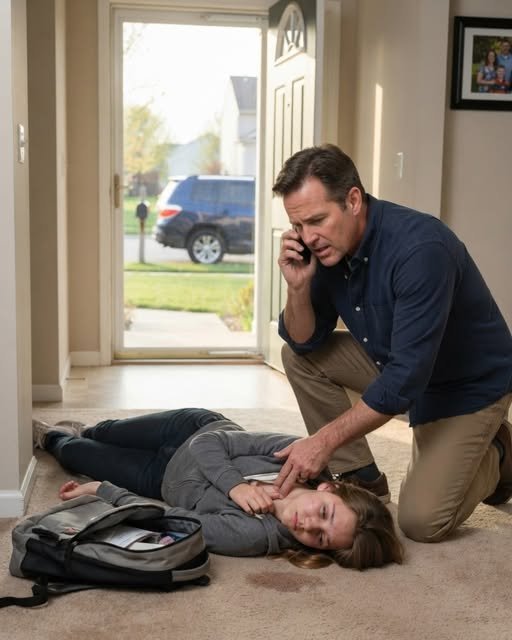
MY DAUGHTER WAS ON THE HALLWAY FLOOR in a pool of BLOOD, her school backpack open, her face a mask of bruises. The police called it a ROBBERY, but the alarm had been DISARMED from inside. Who opened the door?
I spent fifteen years learning how to stay calm.
People often misunderstand calm because they think it means fear never reached you, your pulse never raced, and your mind never pictured the worst thing that could happen.
That was not the kind of calm I knew.
My calm had been built in smoke-filled rooms where every breath hurt, where the air became so thick that the walls seemed to move, and where one panicked decision could leave someone behind.
I had watched men fall and kept moving because stopping would not help them, because fear was something you carried while your hands continued doing what needed to be done.
Calm was never the absence of fear.
It was control.
It was knowing which sound mattered, which doorway might collapse, and which instinct had to be ignored long enough to make the right choice.
For fifteen years, that control had protected me and the people beside me.
Then I came home to Maple Drive and discovered that none of that training could prepare a father for the sight of his own front door standing open.
Violet’s sixteenth birthday was two days away, and I had told no one I was coming home early.
Not my wife, Harper.
Not my daughter.
I wanted one clean moment of surprise before ordinary life found another way to interrupt us.
I had imagined Violet opening the door, staring at me for half a second, and then throwing her arms around my neck before pretending she had not missed me as much as she clearly had.
I had imagined Harper laughing from somewhere behind her, probably telling me that I had ruined whatever birthday plan they had been trying to keep secret.
Those were simple pictures, the kind a man allows himself when he has been gone long enough to miss the sound of a refrigerator humming in his own kitchen.
The Uber dropped me off at exactly 4:00 P.M.
The driver pulled away while I stood near the curb with my bag at my feet, taking in the block as though I had never seen it before.
Everything looked normal.
May sunlight stretched across the lawns, bright enough to make the wet grass shine where sprinklers clicked back and forth.
A dog barked behind a wooden fence, then stopped when its owner called from somewhere in the backyard.
A family SUV rolled slowly toward the corner while a paper grocery bag sat on a neighbor’s porch beside a case of bottled water.
The neighborhood looked ordinary in the most comforting way possible.
Then I saw our front door.
It was cracked open.
Not forced.
Not kicked in.
Not hanging from damaged hinges or surrounded by splintered wood.
It was simply resting against the frame, as though someone had pulled it almost closed without waiting for the latch to catch.
The father in me wanted to leave my bag on the sidewalk, run across the lawn, and shout Violet’s name before I reached the porch.
The soldier in me went silent.
That silence was not hesitation.
It was attention.
I looked at the windows first, then the driveway, then the narrow strip of yard beside the house where someone might have passed without being seen from the street.
There was no broken glass on the porch, no dropped tool near the lock, and no obvious sign that anyone had fought their way inside.
I crossed the lawn without calling out.
The wooden porch felt solid beneath my shoes, and the welcome mat sat straight in front of the threshold.
Nothing had been knocked aside.
I pushed the door with two fingers.
It moved easily and opened into the familiar living room.
“Harper?”
Nothing answered.
The room looked untouched.
The couch cushions were straight, and the throw blanket Harper always folded too neatly was still resting over one arm.
The remote sat beside a sweating glass of lemonade on the coffee table, with a damp ring spreading slowly beneath it.
Violet’s math notebook was open beside the glass, and one pencil lay across a page of unfinished equations.
The scene did not look abandoned.
It looked interrupted.
I stepped inside and listened for movement from the kitchen, the stairs, or the hallway leading toward the bedrooms.
The house gave me only ordinary sounds: the low hum of the refrigerator, the soft rush of air through the vents, and the faint tick of water dripping from the lemonade glass onto the coaster.
Then the smell reached me.
Metallic.
Sharp.
Wet.
Blood.
I had smelled it before in places where it belonged to strangers, coworkers, and men who needed someone else to stay focused while they could not.
Recognition came immediately, but accepting where I was took another second.
This was not a distant building filled with smoke.
This was my home.
Robbers do not leave a house that neat.
They do not move through a living room without disturbing the electronics, opening drawers, knocking over a chair, or grabbing something visible on the way out.
They do not ignore a wallet-sized stack of mail on the side table or leave a phone charger plugged into the wall while searching for valuables.
At least, not if valuables are what they came for.
I followed the smell toward the hallway.
Every step made the silence feel heavier.
Violet’s backpack came into view first.
It was lying open on the floor, one strap twisted underneath it and several school papers bent near the zipper.
A birthday-card envelope had been crushed beneath the edge of the bag.
Then I saw my daughter.
She was curled on the hallway floor beside the backpack, folded inward so tightly that for one terrible instant she looked smaller than she had when I left.
Her face was swollen, and bruises darkened the skin around her cheek and eye.
The hair near her temple was damp and darker than the rest, and blood had spread across the floor beneath her.
She had pulled her arms close to her body as though becoming smaller might have made the person hurting her stop.
“No. No, baby.”
The words came out before I realized I was speaking.
I dropped beside her, letting my bag slide from my shoulder and hit the wall behind me.
My knees landed hard on the floor, but I barely felt the impact.
I pressed two fingers against her neck and searched for a pulse.
For one impossible second, I felt nothing.
The hallway narrowed around me until there was no house, no sunlight, and no sound beyond the pounding in my own ears.
Then a faint rhythm touched my fingertips.
A pulse.
Weak, but there.
I called 911 with one hand and kept the other against her throat.
My fingers remained steady because they had been trained to remain steady, but everything inside me was shaking.
I gave the address, described what I could see, and forced myself to answer each question clearly.
I did not move Violet more than necessary.
I did not search the rest of the house.
I did not chase the possibility that whoever had done this might still be nearby.
For the first time in fifteen years, every instinct I had about securing a scene had to come second to one fact.
My daughter was alive.
I kept my hand against her neck because I was afraid that if I stopped feeling that faint pulse, it might disappear.
The minutes before help arrived felt longer than entire nights I had spent waiting for extraction.
I watched Violet’s chest for movement, listened for each shallow breath, and tried not to focus on the blood drying against my palm and sleeve.
When the responders took over, I moved only when they told me to move.
My calm followed instructions while the father in me wanted to lift her from the floor and carry her somewhere no one could ever reach her again.
At the hospital, time stopped behaving normally.
Minutes stretched beneath fluorescent lights, then disappeared whenever a door opened and someone in scrubs crossed the corridor without looking toward us.
Violet was somewhere beyond a set of closed doors while Harper and I sat on opposite sides of a waiting area that felt too bright and too cold.
Blood had dried across the front of my shirt.
I could feel the fabric pulling against my skin each time I breathed, but I would not change clothes because it was hers, and taking the shirt off felt too much like leaving her alone.
Detective Grant arrived with a small notebook and the kind of careful expression people wear when they have decided what happened before asking enough questions.
He stood near me while another set of footsteps passed behind the doors.
“Looks like a break-in,” he said. “Wrong place, wrong time.”
I looked down at Violet’s blood on my shirt.
Then I looked at the polished hospital floor because I could not look at him without saying something I might regret.
Grant was calling it a robbery because robbery was a shape he recognized.
It gave him a stranger entering a house, a frightened teenager surprising that stranger, and violence happening in the panic that followed.
It was simple.
It was also wrong.
Nothing valuable had been taken.
The living room television was still mounted on the wall.
The remote had not moved.
The drawers I could see had remained closed, and there was no trail of dumped belongings leading from one room to another.
The front door showed no damaged lock, no cracked frame, and no mark where a tool had been forced between the door and the jamb.
Whoever entered had not needed to break in.
They had either been allowed inside or already knew how to make the house accept them.
The alarm keypad made that possibility harder to ignore.
When I entered, the panel had been glowing green.
Ready.
Not smashed.
Not ripped from the wall.
Not silenced by cutting a wire or destroying the system.
The house had been armed until somebody deliberately entered a valid code and turned it off.
A robber might force a door and hope the alarm failed.
A robber might run after hearing the siren.
A robber would not normally stand at the keypad and enter a code known only to the people trusted with access to our home.
I told Grant about the panel.
His expression shifted slightly, but he did not abandon the robbery explanation.
He asked whether the system could have malfunctioned, whether Violet might have disarmed it herself, and whether anyone outside the immediate family knew our code.
They were reasonable questions, but each one pressed against something I had already seen.
Violet had been found only a few feet from her open backpack.
Her math notebook was still on the coffee table.
The lemonade had been cold enough to sweat against the glass.
Whatever happened had interrupted an ordinary afternoon before the house had time to feel empty.
Across the corridor, Harper sat beneath a flickering ceiling light with both hands covering her mouth.
She had not spoken since arriving.
Every few seconds, her eyes moved toward the doors behind which doctors were treating our daughter.
Her shoulders were drawn inward, and one foot kept shifting against the polished floor as though her body wanted to move while the rest of her had forgotten how.
I wanted to cross the corridor and sit beside her.
I wanted to ask when she had last spoken to Violet, where she had been at 3:41, and why the front door had been left resting against the frame.
I wanted to ask every question at once.
But Violet was still behind those doors, and Harper was still my wife, and the facts had not yet told me what they meant.
Control required me to separate suspicion from certainty.
It required me to look at what could be proven before fear chose a target for me.
I pulled out my phone and opened the security app.
The screen reflected the hospital lights while the event history loaded.
My hands did not shake.
Fifteen years of controlled calm kept them steady as the system arranged the afternoon into a list of times and actions.
The first entry showed the front door opening.
The next showed motion detected in the hallway.
Those lines confirmed movement, but they did not explain who had entered or what happened after the door opened.
I scrolled farther.
The screen refreshed once, and a new line appeared below the motion alert.
It was the entry that destroyed the robbery story.
ALARM DISARMED—3:41 P.M.—USER CODE 02.
I stared at the words until the letters seemed sharper than everything around them.
The system had not failed.
The alarm had not been defeated by force.
Someone had entered a valid code.
Someone with access had stood inside my home at 3:41 P.M., deliberately disarmed the system, and moved into the same hallway where I later found Violet bleeding beside her backpack.
Grant stepped closer when he saw my expression, but I did not hand him the phone yet.
I read the entry again because part of me still wanted it to become something else.
The time remained 3:41 P.M.
The code remained 02.
Our security system assigned each approved user a separate number so the event history could show exactly which code had been used.
My code was not 02.
Violet’s was not 02.
I knew every person who had been trusted with access to that house, and I knew which name the system had attached to each number.
The robbery explanation was gone.
In its place was a question far worse than anything Detective Grant had offered me.
The person who opened our door had not been a stranger searching for a way inside.
The house had recognized them.
I lifted my eyes from the phone and looked across the corridor at Harper, still sitting beneath the flickering light with both hands near her face.
Then I looked back at the event history.
Final Part: The House Recognized Her
Code 02 belonged to Harper.
My wife.
For several seconds, I stared at the security log, hoping exhaustion had caused me to misremember. But the numbers did not change.
My code was 01.
Harper’s was 02.
Violet’s was 03.
No neighbor, relative, repairman, or housekeeper had been assigned a permanent code. The system recorded temporary access separately.
At 3:41 that afternoon, someone had entered Harper’s personal code.
I lifted my eyes and looked across the hospital corridor.
She was still sitting beneath the flickering ceiling light, her hands pressed together near her mouth. She looked frightened, but it was no longer the fear of a mother waiting for news about her child.
It was the fear of someone waiting for a secret to be discovered.
Detective Grant followed my gaze.
“Whose code is that?”
I turned the phone toward him.
“My wife’s.”
Harper heard me.
Her hands dropped into her lap.
“That doesn’t mean anything,” she said quickly.
Grant crossed the corridor.
“Mrs. Cole, did you disarm your home alarm at 3:41 this afternoon?”
“No.”
“Does anyone else know your code?”
Harper looked at me before answering.
“I might have given it to someone.”
“Who?”
She swallowed.
“My brother.”
I felt my jaw tighten.
“Mason?”
Harper nodded.
Mason had been drifting in and out of our lives for years. He was charming when he wanted money and offended when anyone asked how he planned to repay it.
Two years earlier, I had loaned him eight thousand dollars after he claimed he was about to lose his apartment. Three weeks later, Harper discovered that he had used part of the money to buy a motorcycle.
I had refused to help him again.
Since then, Mason had called me controlling, arrogant, and ungrateful for everything he had supposedly done for our family.
I had never understood that last accusation.
Now I wondered what Harper had promised him.
“Why did Mason have your alarm code?” I asked.
“He fed the dog once while we were away.”
“We haven’t owned a dog in four years.”
Her face changed.
It was small, almost unnoticeable, but I saw it.
The pause.
The calculation.
She was searching for another answer.
Grant noticed it too.
“When did you last speak to your brother?” he asked.
“This morning.”
“What time?”
“I don’t remember.”
“May I see your phone?”
Harper reached into her purse but did not take the phone out.
“I left it in the car.”
“You were holding it when I came into the waiting room,” I said.
Her eyes snapped toward me.
Grant extended his hand.
“Mrs. Cole.”
Slowly, Harper removed the phone from her purse.
Before she could unlock it, a doctor stepped through the double doors.
“Mr. and Mrs. Cole?”
Everything else disappeared.
I stood so quickly that the chair behind me scraped across the floor.
“How is Violet?”
“She is stable.”
My knees nearly gave way.
The doctor continued carefully.
“She has a concussion, a fractured wrist, several broken ribs, and a deep cut near her hairline. We have controlled the bleeding. Her scans show no immediate need for surgery, but she will remain under close observation.”
“Can we see her?”
“One person at a time. She is awake, but she is frightened and disoriented.”
Harper stepped forward.
“I’m her mother.”
The doctor looked at Grant, who gave a subtle shake of his head.
“I think her father should go first.”
Harper’s expression hardened.
Only for a second.
Then she forced it back into grief.
I followed the doctor into Violet’s room.
My daughter looked impossibly small beneath the white blankets. A bandage covered part of her forehead, and purple bruises spread across one side of her face.
Her left arm rested in a temporary splint.
When she saw me, tears filled her eyes.
“Dad?”
I sat beside her and took her uninjured hand.
“I’m here.”
“You came home.”
“I came early for your birthday.”
Her fingers tightened weakly around mine.
“I thought he was going to kill me.”
My chest constricted.
“Who?”
Violet glanced toward the door.
“Is Mom outside?”
“Yes.”
Fear moved across her face.
“Don’t let her come in.”
Those six words hurt more than anything I had seen that day.
“Violet, tell me what happened.”
She closed her eyes.
For a few seconds, I thought she had fallen asleep.
Then she whispered, “Uncle Mason came to the door.”
“At 3:41?”
“I didn’t open it. He used the code.”
That confirmed what the security system had already told us.
“What did he want?”
“He said Mom had sent him to pick something up.”
“What?”
Violet began trembling.
I pressed the nurse-call button, but she shook her head.
“I need to tell you before she makes it disappear.”
“Before who makes what disappear?”
“Mom.”
The room seemed to tilt beneath me.
Violet took a careful breath.
“Uncle Mason went straight to your office. He knew the combination to the small safe.”
Only Harper and I knew that combination.
The safe held emergency cash, legal documents, my service records, and several sealed envelopes containing evidence from an investigation I had been assisting with overseas.
The documents were not classified, but they proved that a private contractor had been stealing supplies from military shipments.