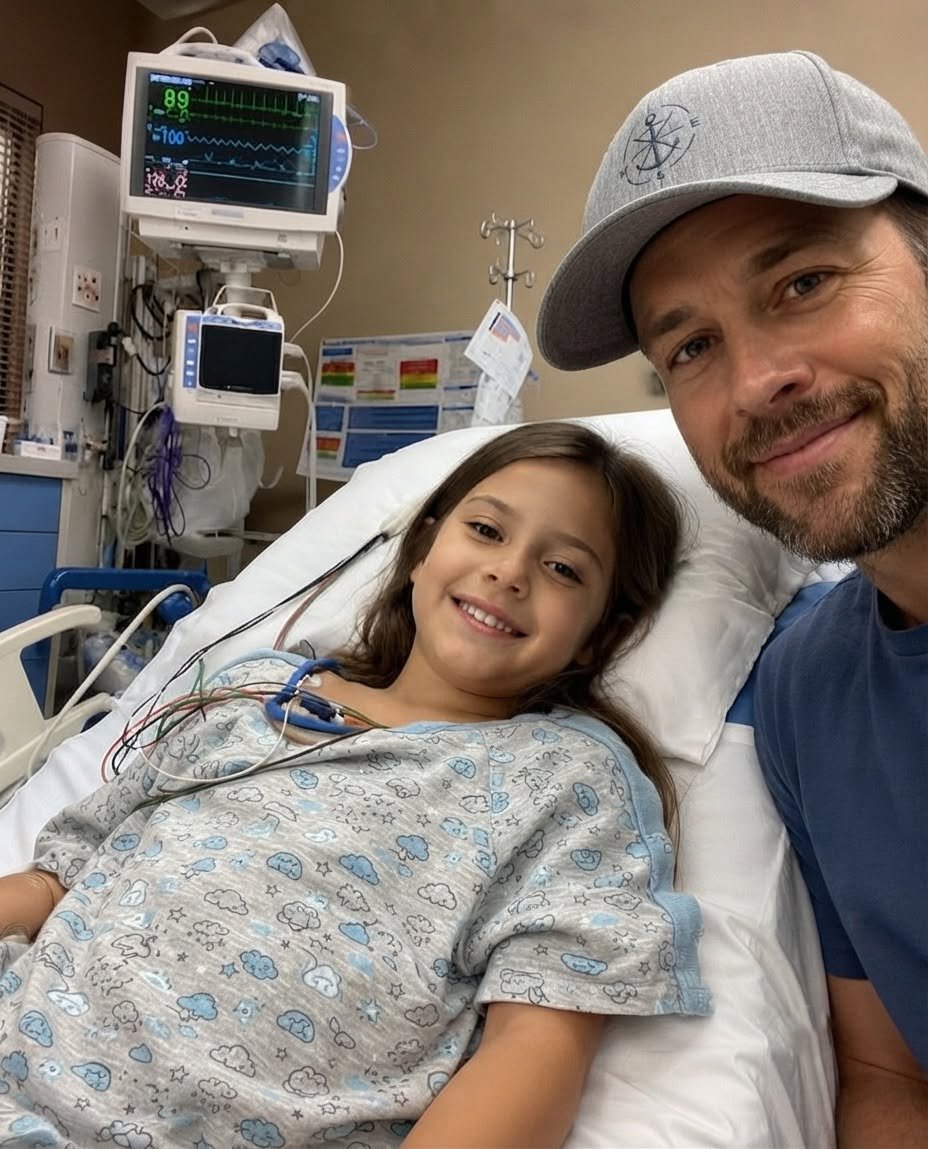
My daughter was in the hospital.
No one from my family came.
But two days later, my mom texted me.
“Can you help with your brother’s honeymoon fund? $5,000 should do.”
I turned off my phone.
The next morning, my dad called sixteen times.
I will never forget the sound of those machines.
Slow.
Steady.
Cold.
Each little beep felt like a reminder that my four-year-old daughter was still fighting.
Layla was lying in that hospital bed, too small for all the wires attached to her body.
An oxygen mask covered half her face.
Her tiny hand rested in mine, warm but weak, and every time her chest rose, I silently begged God to let it rise again.
Pneumonia.
That was the word the doctors used.
But to me, it sounded like fear.
It sounded like losing sleep for two nights straight.
It sounded like sitting on a plastic hospital couch at 3:00 a.m., drinking cold coffee from a paper cup, wondering how the world could keep moving while my baby was struggling to breathe.
The first night, I texted my family.
My mom.
My dad.
My brother Jason.
I told them Layla was in the ICU.
I told them it was serious.
I told them I was scared.
And then I waited.
One hour.
Three hours.
All night.
Nothing.
Not one call.
Not one message.
Not even a simple, “Is she okay?”
At first, I made excuses for them.
Maybe they were asleep.
Maybe their phones were off.
Maybe they had not seen it yet.
But morning came.
Then afternoon.
Then another night.
And still, no one came.
No one.
The nurse brought me coffee and asked if there was anyone she could call for me.
I almost laughed.
Because there was.
There should have been.
There was a grandmother who should have been rushing through those hospital doors.
A grandfather who should have been asking doctors questions.
An uncle who should have cared that his niece was lying there with tubes in her arm.
But instead, there was only me.
Me, holding Layla’s hand.
Me, signing forms.
Me, trying not to fall apart every time her breathing sounded too shallow.
I stared out the hospital window at the parking lot below and had one thought that broke something inside me.
No one is coming.
And the worst part was that we were not strangers.
We were not some broken family that had not spoken in years.
I called my mother every other week.
I helped my father with paperwork when his back pain got worse.
I had even given Jason and his fiancée money just last month because their wedding venue had some “emergency.”
Twelve hundred dollars.
I did not ask for it back.
Because that was what family did.
At least, that was what I thought.
On the second day, Layla finally fell into a deeper sleep.
Her little fingers curled around mine, and for the first time in hours, I let myself breathe.
Then my phone buzzed.
My heart jumped.
I thought it was my mom.
I thought maybe she was finally asking about Layla.
Maybe she was outside.
Maybe she was sorry.
I opened the message.
And I read it once.
Then again.
Then a third time.
“Can you help with your brother’s honeymoon fund? $5,000 should do.”
That was it.
No “How is Layla?”
No “Are you okay?”
No “We are coming.”
Just money.
Five thousand dollars.
For my brother’s honeymoon.
While my daughter was lying in the ICU.
I stared at that message until the screen went dark in my hand.
Something inside me went completely still.
Not angry.
Not yet.
Just empty.
As if my body already knew what my heart was refusing to understand.
They had seen my message.
They knew.
They knew Layla was in the hospital.
They knew I was alone.
And they still chose Jason’s honeymoon over my daughter’s life.
I did not reply.
I did not explain.
I did not beg.
I just turned off my phone.
That night, I sat beside Layla’s bed and looked at her tiny face under the hospital lights.
She was only four.
She still believed monsters were under the bed.
She still asked me to check the closet before she slept.
But the real monsters were not hiding in the dark.
They were in my phone.
They were people with my blood.
People who called themselves family when they needed something.
I made a decision right there in that ICU room.
I was done.
Done being the reliable one.
Done being the emergency wallet.
Done being the daughter who always understood.
Done being the sister who gave and gave until there was nothing left.
If they could not show up for Layla during the scariest moment of her little life, then they did not deserve to know her.
Not now.
Not ever.
The next morning, I turned my phone back on.
Sixteen missed calls.
All from my dad.
For one second, my heart softened.
Maybe he finally realized.
Maybe he was worried.
Maybe someone had told him how serious it was.
The phone rang again.
I looked at Layla.
Then I answered.
“Hello?”
My father did not ask how she was.
He did not ask if I had slept.
He did not ask what room we were in.
He started yelling.
Telling me I was being dramatic.
Telling me I had embarrassed my mother.
Telling me Jason was stressed because of me.
Because of me.
I sat there in that hard hospital chair, staring at my daughter’s IV drip, listening to my own father defend a honeymoon while my child fought to breathe.
Then he said something that made the room feel colder.
He said they needed my Social Security number.
For a loan.
I did not speak.
I could not.
The machines kept beeping beside me.
Layla shifted in her sleep.
And my father continued, like this was normal.
Like this was nothing.
Like my identity, my credit, my life were just another tool the family could use whenever Jason needed saving.
I gripped the phone so tightly my fingers hurt.
And then he said the words that told me this was only the beginning.
“Your mother already gave Jason the information from that old tax folder. We just need you to confirm it with the bank.”
For a moment, I forgot how to breathe.
“What did you say?” I whispered.
My father huffed like I was annoying him.
“Do not start, Emma. Your mother found copies of your old documents in the storage box at the house. Jason needs to qualify for the honeymoon package before Friday. The bank may call you. Just say yes.”
The room tilted.
The IV bag.
The gray wall.
The little stuffed rabbit beside Layla’s pillow.
Everything blurred.
“My daughter is in the ICU,” I said slowly.
“I know,” Dad snapped. “And we are sorry about that. But life does not stop just because your child has a cold.”
A cold.
He called pneumonia a cold.
Something hot and sharp rose inside my chest.
I stood so fast the chair scraped the floor.
A nurse looked through the glass window, concerned.
I forced myself to lower my voice.
“You used my Social Security number?”
“Do not twist it,” he said. “Nobody used anything yet. We are just trying to help your brother start his marriage properly.”
“By stealing my identity?”
“Do not use that word.”
“What word should I use?”
“Family.”
I laughed then.
Not because it was funny.
Because if I did not laugh, I might scream.
“Family?” I repeated. “You ignored me for two days while Layla was fighting to breathe. Mom texted me for honeymoon money while I was sitting beside my sick child. And now you are telling me you gave Jason my private information for a loan?”
Dad lowered his voice.
That was when I knew Mom was probably near him.
“You need to calm down,” he said.
“No.”
“Emma.”
“No,” I repeated, louder. “You do not get to tell me to calm down.”
There was silence.
Then he said, “If you refuse to help your brother, do not expect to be part of this family anymore.”
I looked at Layla.
Her lashes rested against her pale cheeks.
Her little chest rose and fell beneath the blanket.
For two days, strangers had cared more about her than my own parents had.
The nurses had brought me coffee.
The doctor had sat beside me and explained every number.
The cleaning lady had quietly left a box of tissues near my chair when she saw me crying.
And my family?
They wanted five thousand dollars.
They wanted my Social Security number.
They wanted my silence.
I pressed the phone closer to my ear.
“I already have not been part of this family for years,” I said.
Then I hung up.
My hands were shaking.
I wanted to cry, but there was no time.
Because ten minutes later, my phone buzzed again.
This time, it was not my father.
It was a notification from my bank.
A new credit inquiry had been made under my name.
My blood ran cold.
I opened the banking app with trembling fingers.
There it was.
An application.
A personal loan.
Fifteen thousand dollars.
Submitted at 8:42 that morning.
My name.
My information.
My Social Security number.
But not my signature.
Not my permission.
Not my consent.
I stared at the screen until the words stopped making sense.
Then I walked out of Layla’s room and found the nearest nurse.
“My daughter,” I said, trying to keep my voice steady. “Can someone sit with her for ten minutes?”
The nurse, Carla, looked at my face and did not ask too many questions.
“Of course,” she said softly. “Go. I will stay right here.”
I stepped into the hallway and called the bank.
My voice did not sound like mine.
It sounded calm.
Too calm.
The woman on the phone asked security questions.
I answered them.
Then she asked if I had applied for a personal loan that morning.
“No,” I said.
My voice cracked on the word.
“No, I did not.”
She transferred me to the fraud department.
I repeated everything.
My daughter in the ICU.
My father’s call.
My mother finding my documents.
My brother’s honeymoon.
The silence from the other end became heavy.
Finally, the fraud officer said, “Ms. Walker, I need you to listen carefully. The application was not only submitted. Someone also attempted to upload identification documents.”
My stomach dropped.
“What documents?”
“A copy of your Social Security card and an old driver’s license.”
I closed my eyes.
The old tax folder.
The box my mother kept in her hallway closet.
I had forgotten it existed.
Years ago, when I was twenty-two and still trusting, I had left copies of old documents at my parents’ house because my mother said she was “keeping them safe.”
Safe.
What a joke.
“Can you stop it?” I asked.
“We are flagging it now,” the officer said. “But I strongly recommend you freeze your credit immediately and file a police report.”
A police report.
Against my own family.
The words hit hard.
Not because I doubted they deserved it.
But because some small, broken part of me still remembered being a child.
Remembered sitting on my father’s shoulders at Fourth of July fireworks.
Remembered Mom brushing my hair before school.
Remembered Jason as a little boy holding my hand when he was scared of thunder.
That was the cruelest part about betrayal.
It did not erase the good memories.
It poisoned them.
It made you wonder if you had imagined them.
I thanked the fraud officer and ended the call.
Then I stood in the hospital hallway, surrounded by the smell of disinfectant and coffee, and I finally cried.
Not loudly.
Not dramatically.
Just one silent tear after another.
A doctor passed by and gave me a gentle nod.
Carla saw me from Layla’s room and stepped into the hall.
“Is everything okay?” she asked.
I wiped my face quickly.
“No,” I said. “But it will be.”
And I meant it.
For the first time in two days, I did not feel helpless.
I felt clear.
I sat in the family waiting room and froze my credit with all three major bureaus.
I changed my banking passwords.
I locked my debit card.
I called the bank again and requested written confirmation of the fraud report.
Then I called the police.
My hands shook while I did it, but I did it.
The officer on the line was calm and professional.
He asked questions.
Names.
Dates.
Messages.
The loan notification.
My father’s statement.
My mother’s text.
He told me an officer would come to the hospital to take my report.
When I walked back into Layla’s room, Carla was sitting beside the bed, humming softly while adjusting the blanket.
Layla’s oxygen numbers were better.
Not perfect.
But better.
For the first time, I felt a small piece of hope.
I leaned down and kissed Layla’s forehead.
“Mommy is here,” I whispered. “And Mommy is going to fix everything.”
By noon, my mother started texting.
At first, it was sweet.
Fake sweet.
“Emma, honey, your father said you were upset. Let’s not make this worse.”
Then guilt.
“Jason has always looked up to you. You know that.”
Then anger.
“You are being cruel during the happiest time of your brother’s life.”
Then the truth.
“If you report this, you will destroy this family.”
I stared at that message for a long time.
Then I typed back one sentence.
“You did that yourselves.”
I sent it.
Then I took screenshots of everything.
By three o’clock, a police officer arrived.
His name was Officer Daniel Reeves.
He looked tired, kind, and serious.
He took my statement in a quiet consultation room down the hall.
I showed him the text from my mother.
The bank notification.
The missed calls.
The call log.
I repeated what my father had said.
When I got to the part where Dad called Layla’s pneumonia “a cold,” my voice broke.
Officer Reeves paused his writing.
“Take your time,” he said.
I shook my head.
“No. I am done taking time for them.”
He looked up at me then.
Maybe he understood.
Maybe he had seen this before.
Families who smiled in photos and stole from each other behind closed doors.
When he left, he gave me a case number.
A case number.
That was what my family had become.
Not birthdays.
Not Christmas dinners.
Not old photo albums.
A case number written on a yellow slip of paper.
That evening, Layla woke up fully for the first time in almost twenty hours.
Her eyes fluttered open.
She looked confused.
Then scared.
“Mommy?” she whispered behind the oxygen mask.
I leaned close, tears filling my eyes.
“I am here, baby.”
“Can we go home?”
“Soon,” I promised. “Not today. But soon.”
She looked around the room.
“Where’s Grandma?”
The question cut straight through me.
I brushed her hair back from her forehead.
“Grandma cannot come today.”
Layla blinked slowly.
“What about Grandpa?”
I swallowed.
“He cannot come either.”
She thought about that.
Then she asked the question that broke my heart.
“Was I bad?”
“No,” I said instantly.
I took her little face gently in my hands.
“No, sweetheart. You were never bad. Never.”
“Then why they no come?”
I had no answer that would make sense to a four-year-old.
Honestly, I barely had one that made sense to me.
So I said the only thing I could.
“Sometimes people do not know how to love the right way.”
Layla stared at me.
Then she whispered, “You know.”
I kissed her hand.
“Yes, baby. I know.”
That night, I slept for almost forty minutes in the chair beside her bed.
It was the first sleep I had gotten since we arrived.
When I woke, my phone was buzzing nonstop.
Jason.
Of course.
I let it ring.
Then he texted.
“What the hell is wrong with you?”
Then another.
“You called the police over a misunderstanding?”
Then another.
“You are jealous because I am getting married and you are alone.”
I almost laughed.
Alone.
He thought I was alone because I did not have a husband.
Because my marriage had ended two years ago.
Because Layla’s father had decided parenthood was “too much pressure” and disappeared before her second birthday.
Jason thought alone meant not having a man standing beside me.
But I had learned something in that ICU room.
Alone was not sitting beside your sick child by yourself.
Alone was having a family who knew you were drowning and still asked you to carry them.
I did not answer Jason.
Instead, I added his messages to the folder I had created on my phone.
Evidence.
That word felt strange.
Cold.
Necessary.
The next morning, the doctor came in with good news.
Layla was responding to treatment.
Her fever was down.
Her oxygen levels were improving.
If things continued, she could leave the ICU within twenty-four hours.
I cried so hard the doctor handed me tissues.
“Thank you,” I kept saying.
He smiled gently.
“She is a fighter.”
I looked at my daughter, asleep with her stuffed rabbit under one arm.
“Yes,” I whispered. “She is.”
For the first time in days, I stepped outside the hospital for air.
The sunlight felt unreal.
Too bright.
Too normal.
People were walking to their cars.
A man was laughing into his phone.
A woman carried balloons through the entrance.
The world had continued without asking my permission.
I stood near the hospital doors and breathed in the cold morning air.
Then I saw my parents’ car pull into the parking lot.
My stomach tightened.
My mother got out first.
Perfect hair.
Perfect coat.
Perfect wounded expression.
My father followed, jaw clenched.
And Jason stepped out of the back seat.
Of course he came.
Not when Layla was barely breathing.
Not when I needed help.
But when police became involved.
They walked toward me like a storm.
Mom opened her arms as if she planned to hug me.
I stepped back.
Her face hardened for half a second before she covered it with sadness.
“Emma,” she said. “Look what you are doing to us.”
I stared at her.
“Layla is upstairs.”
Mom blinked.
“What?”
“Your granddaughter,” I said. “The one in the ICU. She is upstairs.”
Dad sighed.
“Do not start with that again.”
Something in me turned to steel.
Jason pointed at me.
“You need to drop the police report.”
I looked at him carefully.
He was wearing expensive sunglasses pushed up on his head.
New shoes.
A gold watch I had never seen before.
He looked more irritated than afraid.
That made me angrier.
“You applied for a loan in my name,” I said.
Jason scoffed.
“It was not going to hurt you. We were going to pay it back.”
“You have not paid back the twelve hundred from last month.”
“That was different.”
“How?”
He looked away.
Mom stepped forward.
“Your brother is under a lot of pressure. Weddings are expensive.”
“My daughter’s hospital bills are expensive.”
Mom’s mouth tightened.
“This is not the same.”
“You are right,” I said. “It is not. One is a party. One is a child’s life.”
Dad’s face reddened.
“You always do this. You always make yourself the victim.”
I laughed once.
A sharp, bitter sound.
“The victim? You stole my identity.”
“We are your parents,” Dad said.
As if that explained everything.
As if giving me life gave them the right to ruin mine.
“No,” I said. “You are people who had access to my documents.”
Mom’s eyes filled with tears.
I had seen those tears before.
They appeared whenever she needed a room to turn against me.
At birthdays.
At holidays.
At Jason’s graduation.
When I said no.
When I had boundaries.
When I did not smile fast enough.
“You would really send your brother to jail?” she whispered.
I looked at Jason.
Then at my father.
Then at her.
“No,” I said. “Jason made his choices. You helped him. Dad helped him. I am only telling the truth.”
Jason stepped closer.
“You think anyone will believe you over us?”
For one second, fear flickered.
Then I remembered the screenshots.
The bank report.
The police case number.
My father’s voicemail.
Mom’s texts.
Jason’s threats.
For once, they had underestimated the wrong daughter.
“They already do,” I said.
Jason’s face changed.
Just slightly.
But I saw it.
Fear.
Before anyone could speak, Officer Reeves walked out of the hospital entrance.
I had not called him.
But he was there for a follow-up statement.
His eyes moved from me to my family.
“Ms. Walker,” he said. “Is everything all right?”
My mother immediately changed.
Her shoulders softened.
Her voice became sweet.
“Officer, thank goodness. This is all a family misunderstanding.”
Officer Reeves looked at me.
I said nothing.
Mom kept talking.
“Our daughter is emotional. Her child is sick. She misunderstood a small financial matter.”
“A small financial matter?” I repeated.
Dad hissed, “Emma.”
Officer Reeves turned to my parents.
“Did you submit a loan application using Ms. Walker’s information?”
Mom’s mouth opened.
Closed.
Jason said, “No.”
At the exact same time, Dad said, “We were only helping.”
Silence.
It was almost beautiful.
Officer Reeves wrote something down.
Jason looked at Dad like he wanted to disappear.
Mom’s tears vanished.
“Officer,” she said quickly, “you have to understand—”
“No,” I interrupted.
Everyone looked at me.
For once, my voice did not shake.
“No one has to understand. Not anymore.”
I turned to my mother.
“You did not come when Layla was sick.”
Then to my father.
“You called her pneumonia a cold.”
Then to Jason.
“You tried to use my name to pay for a honeymoon.”
I looked at all three of them.
“And somehow, you still think I am the problem.”
Mom whispered, “We are family.”
“No,” I said. “Layla is my family.”
Then I walked back into the hospital.
I did not look back.
The next twenty-four hours changed everything.
Layla was moved out of the ICU.
She still needed oxygen, but less.
She smiled when the nurse brought her grape juice.
She asked for cartoons.
She complained that hospital socks were “too slippery.”
Each tiny normal thing felt like a miracle.
I sat beside her bed and watched her color a picture of a house with purple windows.
“Who lives there?” I asked.
“Me and you,” she said.
“Anyone else?”
She shook her head.
“No. But Nurse Carla can visit.”
I smiled.
“She would like that.”
Layla looked up at me.
“Grandma cannot visit?”
My throat tightened.
“Not for a while, baby.”
“Because she loves wrong?”
I closed my eyes for a second.
“Yes,” I said softly. “Because she loves wrong.”
Layla went back to coloring.
Children accept truths adults spend years denying.
By the time Layla was discharged three days later, I had received seventy-two messages from relatives.
Aunts.
Cousins.
People who had not called once when Layla was in the ICU.
Suddenly, they all had opinions.
“Your poor mother is devastated.”
“Jason made a mistake.”
“You know how your father gets when stressed.”
“Family should not involve police.”
Not one asked how Layla was.
Not one.
So I posted one message in the family group chat.
“Layla was in the ICU for pneumonia. I informed Mom, Dad, and Jason. None of them came or called. Two days later, Mom asked me for $5,000 for Jason’s honeymoon. The next morning, Dad admitted they used documents from their house to attempt a loan in my name. I have filed a police report and frozen my credit. Do not contact me unless your first question is about my daughter.”
Then I attached screenshots.
Mom’s text.
Dad’s call log.