For several seconds, nobody moved.
My daughter stared at the floor.
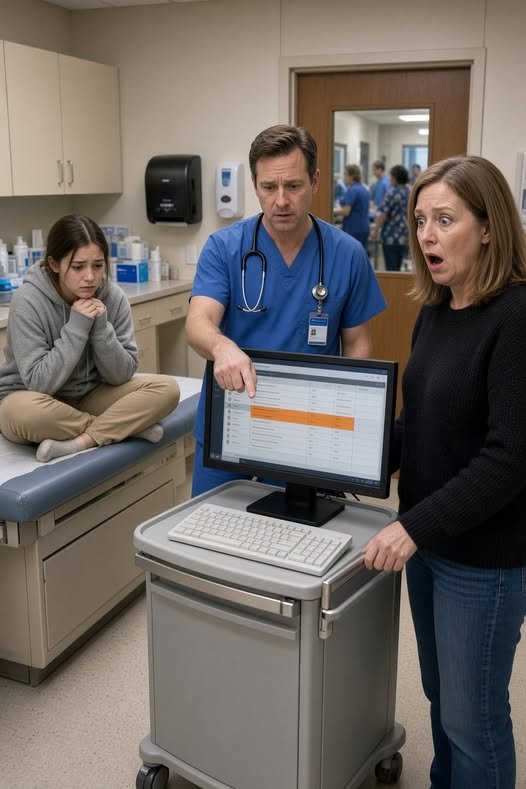
The doctor remained beside the computer, one hand resting against the edge of the desk.
And I could hear my own heartbeat.
“He said I agreed with him?” I asked.
My daughter nodded.
“He said you were tired of me complaining.”
I closed my eyes.
I wanted to tell her that none of it was true.
I wanted to tell her I had never believed she was pretending.
But before I could speak, the doctor quietly said, “There’s something else you need to see.”
He turned the monitor toward me.
The scan showed an area that made my stomach twist.
I didn’t understand the medical details, but I understood enough to see that something was wrong.
“What is that?”
“We need additional imaging and a specialist,” he said. “I don’t want to speculate before we have the complete picture.”
My daughter looked frightened.
“Am I going to be okay?”
The doctor pulled up a chair.
“We’re going to find out exactly what’s happening.”
She looked at me.
“Mom?”
I took her hand.
“You’re not going through this alone.”
The doctor stepped outside briefly.
I sat beside my daughter.
For the first time in months, I looked closely at her face.
She looked exhausted.
Not like a teenager who had stayed up too late studying.
Not like a teenager dealing with ordinary stress.
Exhausted.
“How long have you been hurting this badly?”
She stared at her hands.
“Almost four months.”
Four months.
I felt as though someone had knocked the air from my lungs.
“Why didn’t you tell me?”
“Because Dad said you had enough problems.”
I swallowed hard.
“What else did he say?”
She hesitated.
“He said if I kept complaining, you’d think I was weak.”
I closed my eyes.
My husband had always been obsessed with toughness.
He believed problems should be handled quietly.
He believed children needed discipline more than sympathy.
But I had never imagined he would teach our daughter to hide pain from me.
“Did he ever stop you from seeing a doctor?”
She nodded.
“Twice.”
“When?”
“The first time was when I couldn’t get out of bed.”
My hands began shaking.
“What happened?”
“He said we couldn’t afford another hospital bill.”
I almost laughed.
Not because it was funny.
Because it was unbelievable.
We had insurance.
We had savings.
We had never struggled to pay for a medical appointment.
“Then what happened?”
“He gave me pain medicine.”
“What kind?”
She shrugged.
“I don’t know.”
“Did you take it?”
“Yes.”
“How much?”
“I don’t know.”
I stood.
“Doctor.”
He returned immediately.
I told him everything.
His expression became serious.
“We’ll document that.”
Then he asked my daughter another question.
“Has your father ever given you medication without your mother knowing?”
She nodded.
My stomach dropped.
“What medication?”
“He said it was just something to help me sleep.”
The doctor exchanged a glance with the nurse.
“Do you know the name?”
She shook her head.
“Where did he keep it?”
“In his office.”
The nurse immediately wrote it down.
The doctor looked at me.
“I want toxicology testing.”
My daughter looked frightened.
“Am I in trouble?”
“No,” I said.
“You are not in trouble.”
The doctor nodded.
“This is about making sure we understand everything that’s been happening to your body.”
The tests began.
Bloodwork.
Urinalysis.
Additional imaging.
More consultations.
Hours passed.
I didn’t leave her side.
At around six in the morning, my husband called.
His name appeared on my phone.
I stared at it.
My daughter saw the screen.
“Don’t answer.”
I looked at her.
“Why?”
“Because he’ll know I’m here.”
I answered anyway.
“Where are you?” he demanded.
“At the hospital.”
Silence.
Then his voice changed.
“What happened?”
“Why didn’t you tell me about the previous appointment?”
Another silence.
“I didn’t think it was important.”
“The doctor recommended follow-up.”
“He always recommends more tests.”
“You told me they found nothing.”
“I said it wasn’t serious.”
My hands tightened around the phone.
“You lied to me.”
“I didn’t lie.”
“You told our daughter I agreed with you.”
His breathing became heavier.
“She exaggerates.”
My daughter looked away.
I stood and walked toward the hallway.
“You told her not to tell me.”
“I was trying to protect you.”
“From what?”
“From unnecessary stress.”
I stared through the hospital window.
Rain streaked the glass.
“You don’t get to decide what I deserve to know about my daughter.”
He lowered his voice.
“Come home.”
“No.”
“She’s probably fine.”
That sentence changed something inside me.
I turned toward my daughter’s room.
“No,” I said.
“She isn’t.”
I ended the call.
Ten minutes later, the doctor returned.
His face told me something had changed.
“We found something in the bloodwork.”
My heart stopped.
“What?”
“There are abnormalities that require further evaluation.”
“Cancer?”
He shook his head.
“I am not saying that.”
“Then what are you saying?”
“I am saying we need to take this seriously.”
He showed me the latest imaging.
There was an abnormal area that had changed since the earlier scan.
The doctor explained that the difference mattered.
The previous physician had documented it.
Follow-up had been recommended.
But nobody had completed it.
Nobody except my husband had known.
I felt sick.
“Could this have been caught earlier?”
He paused.
“Potentially.”
That single word destroyed me.
Not because it meant my daughter was necessarily in danger.
But because someone had known there was a problem.
And instead of helping her, he had hidden it.
My daughter was taken for another procedure.
I waited outside.
At 8:17 a.m., a nurse came running down the hall.
“Her mother?”
I stood immediately.
“Yes.”
“There’s been a change.”
I followed her.
My daughter was awake.
But she was crying.
Not from pain.
From fear.
“Mom.”
I grabbed her hand.
“What happened?”
She looked at the doctor.
Then at me.
“I remembered something.”
“What?”
“Dad knew.”
The room became still.
“Knew what?”
“He saw the scan.”
I stared at her.
“He saw it?”
She nodded.
“When?”
“Five weeks ago.”
The doctor looked at me.
My daughter continued.
“He asked the doctor if it was serious.”
My heart pounded.
“What did the doctor say?”
“He said I needed another test.”
“Then what?”
“Dad asked how much it would cost.”
The doctor stepped closer.
“Did you hear what happened after that?”
She nodded.
“He told the doctor we couldn’t afford it.”
My stomach turned.
“That wasn’t true.”
“I know.”
“Then why?”
She looked toward the door.
“Because Dad said he didn’t want anyone finding out.”
“Finding out what?”
She hesitated.
Then she whispered:
“That he had been giving me something.”
The doctor immediately asked, “What?”
She began crying.
“I don’t know the name.”
“What did it look like?”
“A little white pill.”
“How often?”
“Almost every night.”
I felt my knees weaken.
The toxicology report suddenly mattered more than anything else.
The doctor left the room.
Minutes later, he returned with a laboratory specialist.
They had found a medication in her system that should not have been there.
It wasn’t a routine painkiller.
It was a prescription drug.
And my daughter had never been prescribed it.
The specialist explained that repeated exposure could interfere with certain symptoms and make it harder to recognize how serious her condition had become.
I stared at the report.
“Could this have hidden her symptoms?”
“It could have reduced them.”
My daughter looked at me.
“That’s why Dad kept saying I was fine.”
I couldn’t breathe.
He hadn’t simply ignored her pain.
He had helped suppress it.
I called the police.
My husband arrived at the hospital before they did.
He came through the emergency department doors wearing the same jacket he had worn that morning.