
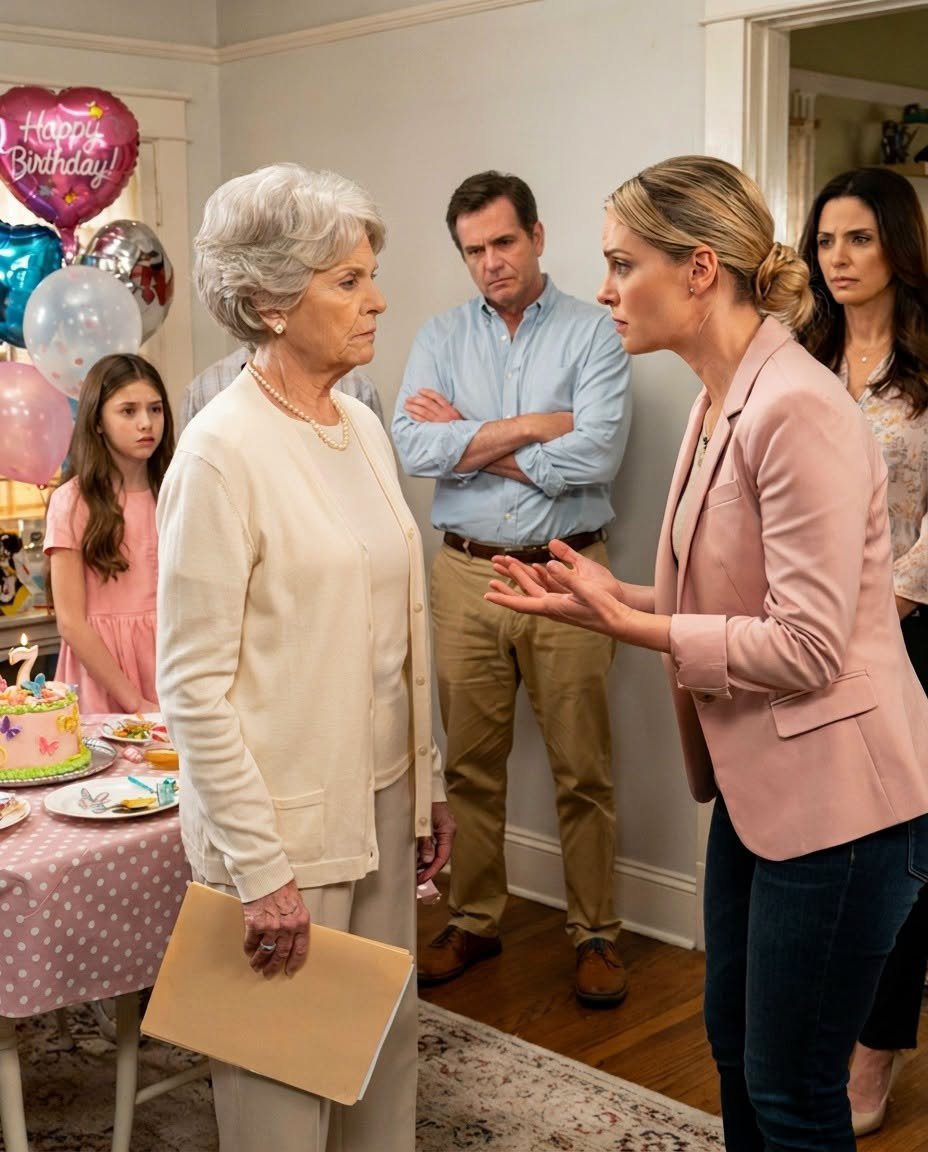
My name is Sylvia Morrison. I am sixty-five years old, a widow, a retired CFO, and a grandmother who learned the hard way that money has a way of revealing who people actually are when they believe no one is watching them closely enough.
For most of my adult life, I was the person watching closely. Thirty years in corporate finance will do that to you. You learn to read rooms, to hear what is underneath the language people choose, to recognize the difference between someone who wants your partnership and someone who wants your resources while making you feel like the distinction is offensive.
I thought I had left that kind of vigilance at the office when I retired.
I was wrong.
To understand what happened at Lucas’s sixth birthday party, and what happened after, you need to understand the family I had spent my life building and what it cost to protect it.
Martin and I married in our early twenties, when we were both still figuring out what we were capable of. He was a software engineer with a quiet, precise mind and a gift for seeing three moves ahead of any problem. I was working my way up through the finance departments of companies that were not always sure they wanted a woman with opinions in a position of authority, which meant I became someone who did not waste words or time. We were, in many ways, the same person translated into different professional languages, and for forty-three years we made decisions together with the kind of trust that comes not from never disagreeing but from always being honest about the disagreement.
We worked hard. We invested carefully. We lived modestly relative to what we earned, not from deprivation but from the shared conviction that wealth accumulated quietly was more stable than wealth displayed loudly. By the time I retired at sixty, we had built something real. Not extravagant, but solid, the kind of financial foundation that takes decades of discipline to construct and can be dismantled with surprising speed if the wrong hands find access to it.
Martin died four years ago from pancreatic cancer. He was there, and then he was diminished, and then he was gone, and the speed of it left a specific kind of grief, the grief of a person who had always planned alongside someone and suddenly found themselves holding all the plans alone. He left everything to me. Not because he did not trust our children, but because he trusted me absolutely, and he knew I would do what needed doing for the people we both loved.
Our son Derek is forty-two. For most of his life he was a man with a backbone, thoughtful and considerate, someone who had inherited his father’s patience and my tendency to think before speaking. He works as a civil engineer, which suits him, the kind of work that requires both precision and the ability to see how individual components bear weight collectively.
Seven years ago, Derek married Amber.
She is thirty-eight, and she had worked in marketing before leaving to stay home with the children. I want to be fair when I describe Amber, because fairness is what I have always tried to offer even people who have not offered it back. She is intelligent and organized and capable of great warmth when warmth serves her purposes. What she is also, and what took me longer than I would like to admit to name clearly, is someone who had learned to use other people’s love as a lever.
My daughter Rachel, who is forty-five and works as a pediatric surgeon, saw it before I did. Rachel has the diagnostic habit of her profession, a trained eye for what is actually happening underneath the presenting symptoms. She told me, over coffee during the second year of Derek and Amber’s marriage, that something was shifting in Derek. Shorter calls. Canceled dinners. A particular exhausted quality in his eyes when I saw him that reminded me of men I had worked with who were managing more than they were acknowledging.
“She’s isolating him,” Rachel said.
I wanted to believe she was reading too much into ordinary newlywed adjustment.
I was wrong, as she often is right.
My grandchildren are Lucas, who is six and bright and sweet in the specific way of children who have not yet learned that the world will sometimes be unkind to brightness, and Sophie, who is three and still too young to understand the complexity of what the adults around her are constructing. Rachel’s son Owen is nine, and he is the kind of child who makes you believe the next generation might be all right.
When Lucas and Sophie were born, I did something deliberate.
I had seen, over decades in finance, what happened to families when money was introduced without structure. Wealthy parents who gave freely and without accountability, children who arrived at adulthood having never developed the capacity to manage resources or recover from difficulty, relationships that became transactional in ways nobody acknowledged until the damage was thorough. I had watched it happen to other families and I had discussed it with Martin, and we had agreed that love expressed only as financial provision was incomplete at best and harmful at its worst.
So I established trust funds. Lucas, Sophie, and Owen each received $250,000 in protected accounts structured to grow until they turned twenty-five, at which point they could access the funds for education, a home, a business, whatever represented the beginning of a genuinely independent adult life. The conditions were deliberate. The timeline was deliberate. The structure was designed not to withhold from my grandchildren but to give them something more durable than a check, which was a foundation rather than a shortcut.
And I made myself the trustee, with full control over the accounts until the conditions were met.
This was not an accident or an oversight. It was the most considered financial decision I made following Martin’s death, and I made it with my eyes open, understanding exactly what it would mean and why it was necessary.
Amber never liked it.
At first this expressed itself in small ways, the kind of thing you can always explain away if you are motivated to. A tight smile when I brought gifts for the children. An eye roll, barely perceptible, when I offered advice. New protocols around visits that accumulated gradually, restrictions on when I could see Lucas and Sophie that went from reasonable to something that began to feel less like parenting preferences and more like territory management.
Then came the direct conversations about the trusts.
They were framed, initially, as curiosity. Amber asking how the accounts worked, what the conditions were, who held authority over distributions. I answered clearly and without suspicion because I had nothing to hide and because I believe in transparency within families. The questions became more pointed over time. She mentioned, more than once, that it seemed unusual for a grandparent to retain trustee control rather than the parents. She mentioned that the children’s parents understood their needs best. She mentioned that the money was, after all, for the children, and the children’s parents were perhaps better positioned to make decisions about it.
I held the line without making it a confrontation, because I had not yet fully understood what I was holding the line against.
The morning of Lucas’s sixth birthday party was a clear Saturday in September, the particular clarity of early fall that makes everything look slightly more significant than it might otherwise.
Amber had specified my invitation. I was welcome for the cake portion. Three o’clock exactly. No earlier.
I arrived at three with Rachel and Owen, carrying the Lego robotics kit Lucas had been mentioning for months with the specific enthusiasm children reserve for things they do not believe they will actually receive. Amber opened the door with a smile that had the quality of a performance rather than a greeting, the warm-but-calibrated expression of someone who is aware of their audience.
“Right on time, Sylvia,” she said.
Inside, the house was full of children and noise and the organized chaos of a well-planned party. Amber’s family was everywhere, her parents, her sister, several friends I recognized from years of occasions. From Derek’s side of the family there was almost no one. Not his brother. Not my sister. Just me and Rachel and Owen, and Derek himself, standing in the kitchen with a glass of lemonade and the look of a man who had arrived somewhere he no longer quite recognized as home.
Lucas found me before I had taken my coat off.
“Grandma Sylvia, you came!”
He said it with a relief that was slightly too large for a birthday party, the relief of a child who has been uncertain about something and has just been reassured. I held him and told him happy birthday and felt, for that moment, that the complications of the adults around him were suspended.
He opened my gift and his face did what children’s faces do when they receive exactly what they wanted, completely open and completely genuine.
“Mom, look! It’s the robot building set!”
Amber’s smile did not disappear. It tightened, which is a different thing. “That’s very generous, Sylvia. Though we did talk about keeping gifts more practical this year.”
There it was. The public calibration. The small reminder, delivered in front of witnesses, that even my expressions of love for my grandchildren required her editorial approval.
I stayed quiet. I had become practiced at the particular restraint of staying quiet in rooms where speaking would only give someone ammunition.
After the cake was served and photographed and distributed and the children had begun the work of metabolizing sugar in various corners of the house, Amber touched my arm and inclined her head toward the hallway with the gesture of someone who has been planning this conversation for longer than the day.
Her smile was gone before we had taken three steps.
“We need to talk about boundaries,” she said. “You’ve been overstepping for a long time, and today isn’t the first time I’ve wanted to address it.”
I looked at her steadily. “I arrived at exactly the time you specified. I have not seen the children in six weeks.”
“That’s not the point,” she said. “You’re always offering money. Always giving opinions. Always inserting yourself into decisions that aren’t yours to make.”
She stepped closer. The hallway was narrow and she was using the narrowness deliberately.
“And another thing. Those trust funds you set up for Lucas and Sophie. We’ve decided we want control of them. They are our children. You had no right to make yourself the trustee without our full agreement, and we want that changed.”
The hallway went quiet in the way spaces go quiet when something consequential has just been said.
I had spent thirty years in rooms where people made moves on resources that were not theirs and dressed those moves in the language of fairness and partnership and family. I recognized every element of what was in front of me. The framing of control as a parental right. The implicit suggestion that holding the line was a form of aggression. The timing, chosen in a semi-public space where she expected I would be too careful of the occasion to respond fully.
I looked at Amber for a long moment.
End Part Here: My Daughter In Law Told Me To Stop Interfering So I Protected My Grandsons Trust Fund…