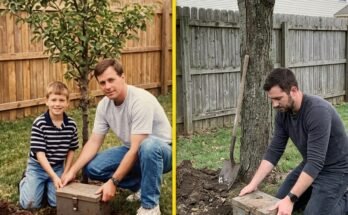
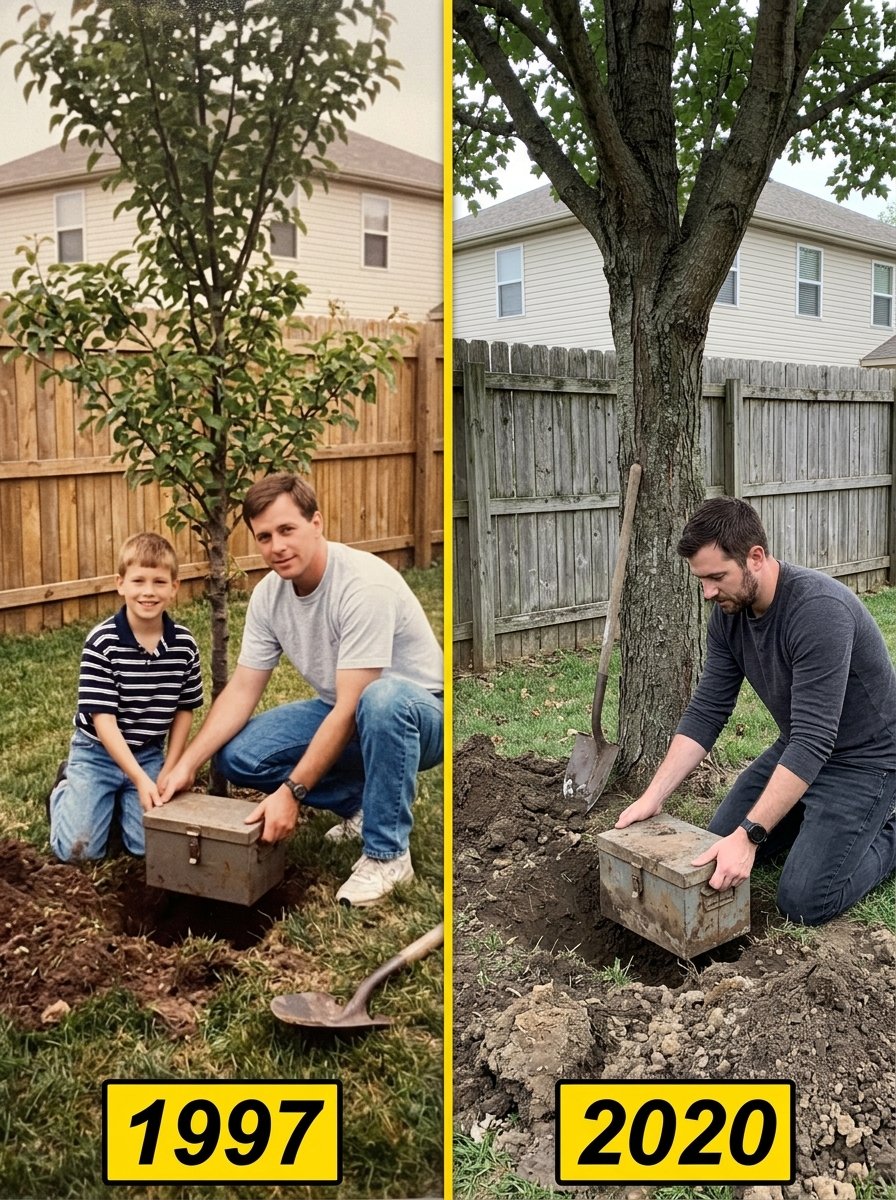
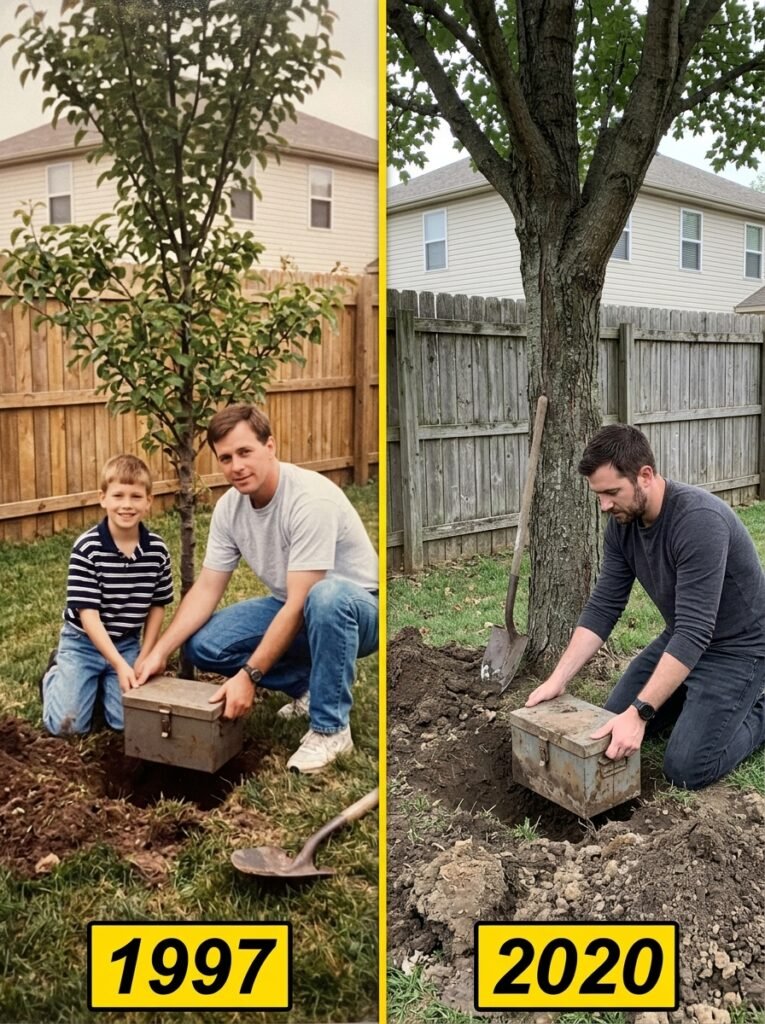
For 23 years, I kept my father’s final promise and never opened the box he buried before his death. But when I finally dug it up after my wedding, Mom turned pale at the first photograph. What she told me next changed everything I believed about my childhood.
The first thing I pulled from the box was a photograph of my father holding a baby.
I recognized him immediately.
But the woman standing beside him wasn’t my mother.
She had dark hair and a tired smile.
She was looking down at the baby in Dad’s arms, who couldn’t have been more than a year old.
I turned the photograph over.
In Dad’s handwriting were five words.
“Before everything changed for us.”
“Mom?” I asked. “Who is this woman?”
My mother, Martha, had been standing behind me under the apple tree.
When she saw the photograph, her face went pale.
“Oh, Nathan,” she whispered. “I was afraid you’d find out this way.”
I stared at her.
“Find out what? Did Dad have another family?”
She looked away and slowly sat down on the grass.
“Mom, answer me.”
“There’s something I should have told you a long time ago.”
My wife, Sarah, reached for my hand.
I looked back inside the box.
There were two envelopes and a folded sheet of paper.
I could just make out three little stick figures drawn in crayon.
One envelope had my name on it.
The other was addressed to my mother.
Both were written in Dad’s handwriting.
For 23 years, I’d imagined what my father might have left me.
I never imagined it would make my mother afraid to look at me.
I was eight when Dad buried that box.
He had surgery scheduled the following morning.
Everyone kept saying he’d be fine.
He had smiled, but his eyes were wet.
Then he had pulled me into his arms.
Held me tighter than he ever had before.
“Whatever happens tomorrow, remember how much I love you,” he whispered.
I told him to stop worrying.
The doctors were going to fix him.
And we’d come back to the apple tree together.
He kissed the top of my head but didn’t answer.
The next morning, he went into surgery.
By afternoon, he was gone.
I never got to say goodbye.
For years, the box was the only thing I had left that felt like a secret between us.
Mom wanted to dig it up after his funeral.
I refused.
“Dad said after my wedding.”
She looked like she wanted to argue.
But she only nodded.
Growing up, I couldn’t understand why Mom found it so difficult to talk about him.
She kept his wedding ring in a drawer.
She took down several photographs.
Whenever I asked about his final days, she changed the subject.
I thought remembering him hurt her too much.
Sometimes, I wondered whether she wanted to forget him altogether.
But don’t get me wrong.
His death never made her love me any less.
She never missed a school event or a birthday.
When I was sick, she slept in the chair beside my bed.
But her parents were different.
At Christmas, my cousins climbed onto Grandpa’s lap while I sat beside Mom.
I never understood why they treated me differently.
Mom always said they were just old-fashioned.
Still, I had plenty of happy childhood memories.
I remembered a drawing I’d made of three people holding hands.
Dad had kept it on the refrigerator.
But there was always something about our family we couldn’t discuss.
When I was 12, we had a terrible argument because I wanted to spend the night at a friend’s house.
She said no.
I shouted, “You’re not Dad! Stop acting like you are!”
She went completely silent.
Later, I heard her crying outside my bedroom door.
Something rustled in her hands, like papers being folded.
Then she walked away.
I never apologized properly.
At 18, shortly before I left home, she brought up the capsule again.
“Maybe we should open it before you go.”
I couldn’t believe she’d suggested it.
“Why can’t you respect the one promise I made to Dad?”
She looked down.
“There’s something you need to understand, Nathan.”
“Then tell me without touching his box.”
She opened her mouth, but nothing came out.
We never discussed it again.
Until the morning after my wedding.
I was still holding the photograph when Mom finally spoke.
“That woman is your biological mother.”
I stared at her.
“What?”
“Her name was Vanessa.”
I looked at the baby again.
“That’s me?”
Mom nodded.
“But you’re my mother.”
“I am.”
“Then what are you saying?”
She wiped her cheeks.
“I didn’t give birth to you, sweetheart.”
The words made no sense.
“Did she die?” I asked.
Mom shook her head.
“Then where is she?”
“She left, Nathan.”
I looked at Sarah, hoping she’d understood something I hadn’t.
She looked just as shocked.
Mom explained that Vanessa had struggled with addiction.
She left when I was still a toddler and never returned.
Dad raised me alone until he met Martha.
“Your father and I fell in love,” Mom said. “And I fell in love with you too.”
She told me she had adopted me when I was little.
I shook my head.
“No. You would have told me.”
“I know.”
“You would have told me, Mom.”
Her eyes filled again.
“I should have.”
I pulled my hand away when she reached for me.
“Did Dad know you were going to keep this from me?”
“He wanted you to know someday. He put everything in that box so you’d have something from him when you learned the truth.”
“Then why wait until my wedding?”
“Read his letter.”
I unfolded the envelope with my name on it.
The paper had yellowed, but I recognized Dad’s handwriting.
“My dear Nathan,”
“If you’re reading this, I hope you’ve had a wonderful wedding.”
“I wish more than anything that I could have been there.”
“There is something about our family that you deserve to know.”
“Your mother didn’t give birth to you.”
“But she was your mother long before we married.”
I stopped reading.
Mom was crying silently.
I looked at her.
“Why didn’t you ever tell me, Mom?”
She lowered her head.
“All those years? Every birthday? Every time you told me stories about when I was little?”
“Nathan—”
“You let me grow up believing you were my birth mother?”
“Yes,” she whispered.
I stood up.
Sarah rose beside me.
I wanted to walk away.
I wanted to ask a hundred questions.
Instead, I said the one thing I couldn’t stop thinking.
“Why didn’t she want me?”
Mom looked up.
“Your birth mother?”
I nodded.
Her expression changed.
“Oh, Nathan.”
“Was there something wrong with me?”
She stood and took a step toward me.
“Nothing. There was never anything wrong with you.”
“Then why did she leave?”
“I don’t know everything she was going through. But her leaving was never your fault.”
Sarah squeezed my hand.
“You don’t have to understand everything right now,” she whispered.
I looked at the photograph again.
The woman who had carried me had disappeared.
The man holding me had died.
And the only parent I had left had kept the truth from me.
I suddenly felt like that little boy beside the apple tree again.
Then I remembered something.
All those Christmas dinners when Grandpa let my cousins sit on his lap but barely spoke to me.
The way Mom always held my hand when we visited.
“Mom, is that why Grandma and Grandpa always treated me differently?”
She looked down.
“After your father died, they wanted me to give you away.”
I stared at her.
“What?”
“They thought your father’s parents should raise you.”
She swallowed.
“They said I was still young. That I could start over.”
Mom looked toward the house.
“Your grandfather told me I didn’t have to spend my life raising another woman’s child.”
I felt Sarah tighten her grip on my hand.
“What did you say?”
“I told him you weren’t another woman’s child. You were mine.”
Mom’s voice shook.
“He said I was making a terrible mistake. He told me not to expect their help if I kept you.”
“Did they really say that?”
She nodded.
“Your grandmother begged me to think about my future.”
“What happened?”
“I refused. They wouldn’t help us anymore.”
“Is that why things got so hard after Dad died?”
“Yes. Without your father or my parents helping, I had to manage everything alone.”
I remembered.
I remembered buckets on the floor when it rained.
Mom coming home exhausted.
Her sewing clothes late into the night.
Once, I’d asked why we couldn’t move somewhere nicer.
She’d told me, “Because this is our home, and we’re staying together.”
Back then, I thought she was just trying to make me feel better.
Now I remembered those Christmas dinners.
The way she’d squeeze my hand whenever Grandpa forgot to include me.
She had been protecting me from something I hadn’t even known was happening.
“You lost your family because of me?”
“I didn’t lose my family, Nathan. I kept it.”
I sat down again.
“Why didn’t you ever tell me?”
“Because I didn’t want you growing up thinking you were a burden.”
She knelt in front of me.
“Nathan, when your father died, everyone talked about what I’d lost. My husband. My future. The life I’d planned.”
She touched my cheek.
“But nobody asked what would happen to you.”
I couldn’t speak.
“So I made sure you knew you still had a home.”
Sarah picked up the folded paper from the box.
“What’s this?”
Mom looked at it and gave a small, broken smile.
“Your drawing.”
Sarah carefully unfolded it.
Three stick figures stood beneath a yellow sun.
The smallest figure stood between the other two.
Above them, Dad had written “Daddy,” “Me,” and “Mommy.”
I frowned.
“I remember this. I thought I drew it after you got married.”
Mom shook her head.
“You drew it before.”
She told me that when I was three, Dad had brought home crayons and paper.
I drew three people and asked him to write their names.
He pointed to the woman.
“Who’s this?”
And I’d answered, “Mommy.”
Martha hadn’t married Dad or officially adopted me yet.
“When your father told me,” she said, “I cried.”
“Why?”
“Because I’d been afraid you might never see me that way.”
I looked down at the picture.
Three crooked people holding hands.
A little boy who didn’t know what adoption meant had already decided who his mother was.
Mom brushed a finger over the paper.
“Your father made a copy for me. He kept this one.”
I opened his letter again.
“I remember the first time you called Martha your mother.”
“She came home crying because she was so happy.”
“She told me she couldn’t imagine a future without you in it.”
“If something happens to me, never mistake her staying for an obligation.”
“She chose you, Nathan.”
“And you chose her.”
“I asked you to wait until your wedding because I hoped that when someone promised to share a life with you, you would understand what that choice means.”
“I love you, son.”
“I hope I taught you that before I had to leave.”
“Dad.”
I held the letter against my chest.
Mom was looking at the ground.
“Why did you keep it from me for so long?” I asked quietly.
She took a breath.
“At first, you were grieving. You kept asking why your father hadn’t come home. I couldn’t bear to tell you that another parent had left you too.”
“And later?”
She closed her eyes.
“When you were 12, I was going to tell you.”
I remembered the argument.
Her crying outside my bedroom.
“I’d brought the adoption papers upstairs,” she said. “Then you shouted that I wasn’t your father.”
I swallowed.
“I didn’t mean—”
“I know. You were a child. But I was frightened that if you knew the truth, you’d tell me I wasn’t your real mother either.”
She wiped her face.
“When you were 18, I tried again. I thought opening the box would help me explain.”
“And I wouldn’t let you.”
She nodded.
“After that, every year made it harder. Then I started telling myself I was respecting your father’s wishes.”
She looked directly at me.
“But that wasn’t the whole truth. I was afraid of losing you.”
I stared at her.
“You should have told me.”
“I know.”
“You had so many chances.”
“I know, sweetheart. I’m sorry.”
For the first time that morning, she didn’t try to explain anything else.
She just let me be hurt.
There was still another envelope inside the box.
It was addressed to Martha.
She stared at her name for a long moment before opening it.
Inside was a short note from Dad.
And a second, smaller sheet in her own handwriting.
“Oh,” she whispered.
“What is it?”
She handed me the sheet.
It was a list.
“Teach Nathan to ride a bike.”
“Watch him finish school.”
“Help him through his first heartbreak.”
“See him find someone who makes him happy.”
At the bottom, something was written in shaky handwriting.
“Please let me have enough years to do all of this.”
I looked up.
Mom pressed her lips together.
“I wrote that a week before your father’s surgery. I was terrified he’d die. I didn’t know if I could raise you alone.”
She glanced at Dad’s note.
“I gave him the list. I didn’t know he’d put it in here.”
She gave a sad smile.
“But I wanted to try. More than anything.”
I read the list again.
She’d taught me to ride my bike.
She’d cheered at my graduation.
She’d held me when my first girlfriend broke my heart.
And yesterday, she’d watched me marry Sarah.
Every wish on that paper had come true.
Then I noticed one final line.
“I hope he’ll always know how much I wanted him.”
I broke down.
Mom reached for me, then hesitated.
This time, I moved toward her.
I held her as tightly as I could.
For a long while, neither of us spoke.
Then I asked, “Did you ever regret staying?”
She pulled back.
“Never.”
“Not even when things were hard?”
“Especially not then.”
I wiped my eyes.
“I’m angry you didn’t tell me.”
“I know.”
“But you were always my mom.”
She covered her face and started crying again.
Sarah knelt beside us, and the three of us held each other under the apple tree.
After a while, Mom said there was something she wanted to show me.
We went inside.
In her bedroom, she opened the drawer beside her bed.
Beneath a stack of old birthday cards was the faded copy of my drawing.
The same three stick figures.
The same crooked sun.
She had kept it all these years.
“I used to look at this whenever I was afraid I wasn’t doing enough,” she said.
I took her hand.
“You were enough, Mom.”
Then I noticed something I’d never paid attention to before.
In the drawing, I stood in the middle.
Dad held one of my hands.
Mom held the other.
For 23 years, I’d believed that when Dad died, he’d left me alone.
But looking at that picture, I finally understood.
One hand had let go.
The other had never left mine.