
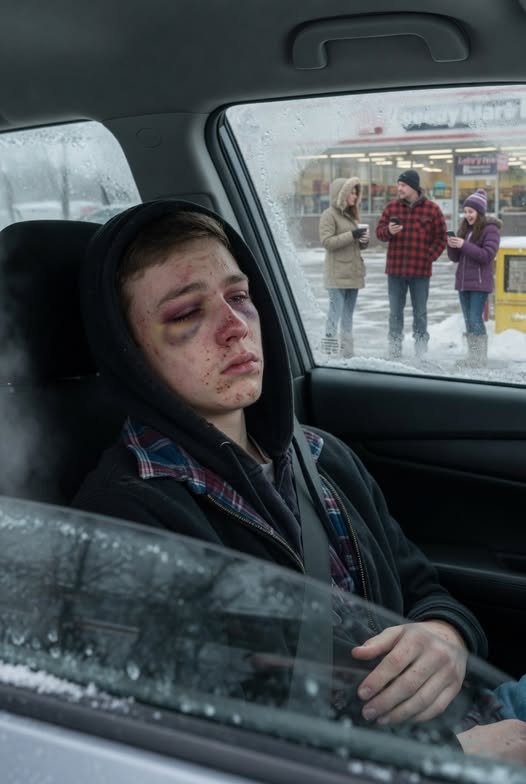
THE CUSTODY FILE SHE HID FOR EIGHTEEN YEARS
Part 1: The Message on My Hospital Phone
The phone screen glowed against the thin hospital blanket like a small emergency light.
A message appeared from the contact I had secretly saved as Mr. Bell Auto.
I’m downstairs. I brought the custody file she hid for eighteen years.
For three seconds, no one in the hospital room moved.
The heart monitor beside my bed continued beeping. The IV pump clicked quietly, and somewhere outside the glass wall, a cart rattled through the hallway.
My mother looked down at the message.
Then she looked at me.
She was not frightened for me.
She was frightened of me.
Tyler, the nurse, stepped closer to my bed. He did not touch my phone, but he positioned himself slightly between my mother and me.
The hospital social worker, Ms. Reed, read the message carefully.
“Who is downstairs?” she asked.
My mother answered before I could.
Her voice became smooth and controlled—the pleasant voice she used at church, school meetings, and anywhere strangers might judge her.
But my throat was raw from the breathing tube. Speaking felt like swallowing broken glass.
Still, I forced the words out.
“My father.”
Greg, my stepfather, gave a dismissive laugh.
“Your father abandoned you,” he said. “Don’t start rewriting history because you got sick.”
Ms. Reed looked at me.
“What is his full name?”
My mother’s fingers tightened around the strap of her purse.
“Daniel Carter,” I whispered.
The name felt unfamiliar on my tongue.
At home, he had never been Daniel.
He was always simply your father, followed by something cruel.
Your father did not want responsibility.
Your father signed away his rights.
Your father started another life.
Your father forgot you existed.
For most of my childhood, I imagined him as a shadow walking away with a suitcase.
Then, when I was sixteen, I found an old birthday card hidden inside a shoebox in the garage.
It said:
Happy seventh birthday, Ethan. I’m still trying. I’ll never stop. Love, Dad.
The envelope had already been opened.
The card had never been given to me.
That was the first crack in my mother’s story.
After that, I began searching.
Behind boxes of Christmas decorations, I found three more birthday cards. I found a photograph of a man holding a toddler in a red hoodie.
The toddler was me.
I also found a receipt from a lawyer’s office and a child-support payment record for seven hundred and fifty dollars.
It was dated during a year when my mother repeatedly told me there was no money for school shoes.
I did not confront her.
In our house, questions did not lead to answers.
They led to punishment.
Instead, I searched for Daniel’s name on a public library computer.
I found Daniel Carter Auto Repair, located outside Naperville, Illinois.
The first time I called, I hung up as soon as a man answered.
The second time, I remained silent.
“Hello?” he said.
I could hear machinery in the background.
I still said nothing.
Then the man spoke my name.
“Ethan?”
He did not sound as though he were guessing.
He sounded like someone who had waited years to hear me breathe.
That was six months before the day my appendix ruptured.
Daniel and I did not meet immediately.
I was afraid.
My mother sometimes checked my phone, so I saved his number under Mr. Bell Auto and deleted every call from my history.
We communicated only when I was at school or work.
He never pressured me.
He sent photographs of the birthday cards he had kept copies of. He sent court dates, payment receipts, and a blurry scan of a visitation schedule containing my name.
I wanted to believe him.
At the same time, I hated needing to believe him.
Then my appendix ruptured while I was locked inside my mother’s Tahoe in a Best Buy parking lot.
My mother, Greg, and my stepsister Samantha had gone inside to buy a phone charger.
I had begged them to take me to urgent care before we arrived.
They told me I was being dramatic.
When Ms. Reed left my hospital room, she returned less than a minute later with a security officer.
My mother’s smile became sharper.
“Is that really necessary?”
“Until we understand what happened, yes,” Ms. Reed replied.
Greg stepped forward.
Tyler stepped forward too.
It was a small movement, almost polite, but the entire room changed.
My mother leaned over my bed.
Her expensive perfume mixed with the sharp smell of hospital disinfectant.
“You are confused because of the medication,” she whispered. “You don’t want to say something you’ll regret.”
I closed my hand around my phone.
The IV pulled painfully against my skin.
“I remember the click,” I said.
The click of the car doors locking.
For one second, the pleasant expression disappeared from my mother’s face.
At exactly 9:27 that morning, the hospital room door opened.
The man who entered looked nothing like the villain I had imagined throughout my childhood.
Daniel Carter had gray hair at his temples and dark oil marks beneath his fingernails. He wore a navy work jacket over a plain white shirt.
His eyes were red from exhaustion and restrained emotion.
In one hand, he carried a thick folder.
In the other, he held a battered envelope with my name written across it.
My mother stood so quickly that her purse fell from her shoulder.
“You cannot be here.”
Daniel did not look at her.
He looked at me.
For half a second, his face nearly broke.
Then he steadied himself, as though he understood that I needed someone strong more than I needed someone emotional.
“Hey, kiddo,” he said softly.
No long speech.
No dramatic attempt to hug me.
Just two words.
My chest tightened around the surgical stitches.
My mother turned toward Ms. Reed.
“He has no legal right to be near my son.”
Daniel opened the folder.
“Actually,” he said calmly, “that is exactly what I came here to clarify.”
Part 2: Eighteen Years of Evidence
Daniel placed the first document on the rolling table beside my bed.
Ms. Reed picked it up.
“This is the original custody order from DuPage County,” Daniel explained. “We had joint legal custody. I was granted alternating weekends and divided holidays. I never signed away my parental rights.”
My mother’s lips parted.
Daniel placed another document on the table.
“These are certified contempt filings for missed custody exchanges, returned letters, and address changes I was never informed about.”
Then he added another record.
“These are the child-support payments. I paid every month until the court froze the account after Ethan was reported missing from my household records.”
Missing.
I had never been missing.
I had been living in the same house, eating cereal for dinner while my mother told me my father could not be bothered to send twenty dollars.
Ms. Reed examined one of the documents.
“Mrs. Miller, is this your signature?”
My mother looked down.
For once, she did not answer immediately.
Greg turned toward her.
That was the first moment I saw real fear enter his face.
Not guilt.
Fear.
Greg could insult a sick teenager.
He could roll his eyes while I vomited into a grocery bag.
He could call me dramatic while my appendix was tearing open.
But official documents frightened him.
Documents could be copied.
Documents could be filed.
Documents could survive charm, denial, and carefully constructed stories.
My mother finally lifted her chin.
“These papers are old,” she said. “Daniel was unstable. I protected my child.”
Daniel’s hand tightened around the envelope he was holding.
But his voice remained controlled.
“You told Ethan I abandoned him.”
“I told him the truth he was capable of understanding.”
“No,” I rasped.
Everyone turned toward me.
My throat burned, and the stitches pulled beneath my hospital gown.
I turned my phone toward Ms. Reed.
The family group messages were still there.
At 1:31 that afternoon, I had written:
My stomach really hurts. Can someone take me to urgent care?
My mother replied fifteen minutes later:
We are busy. Stop spiraling.
At 2:03, I wrote:
I threw up. Please.
Greg responded:
Convenient timing.
Then Samantha sent a message at 2:21:
Can we stop at Best Buy? My charger is dead.
My mother replied with a thumbs-up.
Ms. Reed read the messages without touching the phone.
My mother stared at me.
“You saved those?”
I did not answer.
I did not need to.
Daniel moved closer to my bed.
Greg pointed at him.
“Don’t turn this into a custody performance. Ethan is already eighteen.”
Daniel finally looked directly at Greg.
“You locked my son inside a car while his appendix was rupturing.”
“It was only five minutes,” my mother said quickly.
Tyler looked up from my medical chart.
“The receipt indicates twenty-eight minutes.”
The sentence struck the room harder than a shout.
My mother turned toward him.
“What receipt?”
“The Best Buy receipt your daughter showed security downstairs,” Tyler replied professionally. “She was asking for help finding the charger she purchased because she believed she had left it inside the vehicle.”
Samantha had accidentally created the evidence.
Her charger purchase had produced a timestamp.
Purchase: 2:24 p.m.
Exit: 2:51 p.m.
Twenty-eight minutes inside Best Buy while I lost consciousness in the parking lot.
My mother touched the necklace at her throat.
Greg stared at the floor.
Ms. Reed closed the folder she was holding.
“I am asking both of you to leave the room.”
My mother’s head snapped upward.
“No. I am his mother.”
Daniel stood beside my bed.
“And I am his father.”
He did not raise his voice.
He did not need to.
For eighteen years, my mother had controlled the story because she was the only person allowed to tell it.
Now the room had another narrator.
My mother finally looked directly at me.
She did not look at the tubes, the stitches, or the pale color of my face.
She looked at the phone in my hand.
The custody documents.
Daniel.
The nurse who had stopped treating her words as unquestionable truth.
Her eyes narrowed.
“You think he is going to save you?” she asked.
Daniel did not answer on my behalf.
That mattered.
Instead, he looked down at me.
“You don’t have to go anywhere you don’t want to go.”
The words did not feel like a command.
They felt like permission.
Ms. Reed approached my bed.
“Ethan, do you feel safe being discharged into your mother and stepfather’s care?”
The machines continued beeping.
My mother stood near the door with her purse strap twisted tightly around her hand.
I looked at the woman who had called infection an attitude problem.
Pain, drama.
Abandonment, protection.
Then I looked at the man holding eighteen years of evidence in trembling hands.
“No,” I said.
My mother closed her eyes.
Greg whispered a curse.
Tyler wrote something on my chart.
After that, events moved quickly.
Security escorted my mother and Greg from the intensive care floor after Greg began calling Daniel a deadbeat loudly enough for families in the waiting room to hear.
My mother did not shout.
She smiled at the nurses as though they were confused people making an unfortunate mistake.
“You’ll understand eventually,” she told them. “Ethan has always been impressionable.”
Tyler stepped into the doorway.
“Ma’am, the exit is to your left.”
That was the first time I almost smiled.
Nothing had been repaired.
My body still felt as though it had been carved open.
My childhood had not suddenly become clean because a folder of documents arrived.
But the room no longer belonged to my mother.
End Part Here: “IT’S JUST GAS,” my mother said at 2:18 p.m., then left me locked in a $43,000 Tahoe outside Best Buy; 46 hours later