
Chapter 1: Leaving Pine Hollow
I was sixty-five years old when I retired from teaching and moved to the city to live with my son.
Every night at exactly three in the morning, he turned on the shower.
At first, I believed it was an unusual habit caused by stress. But one night, curiosity and fear drove me out of bed.
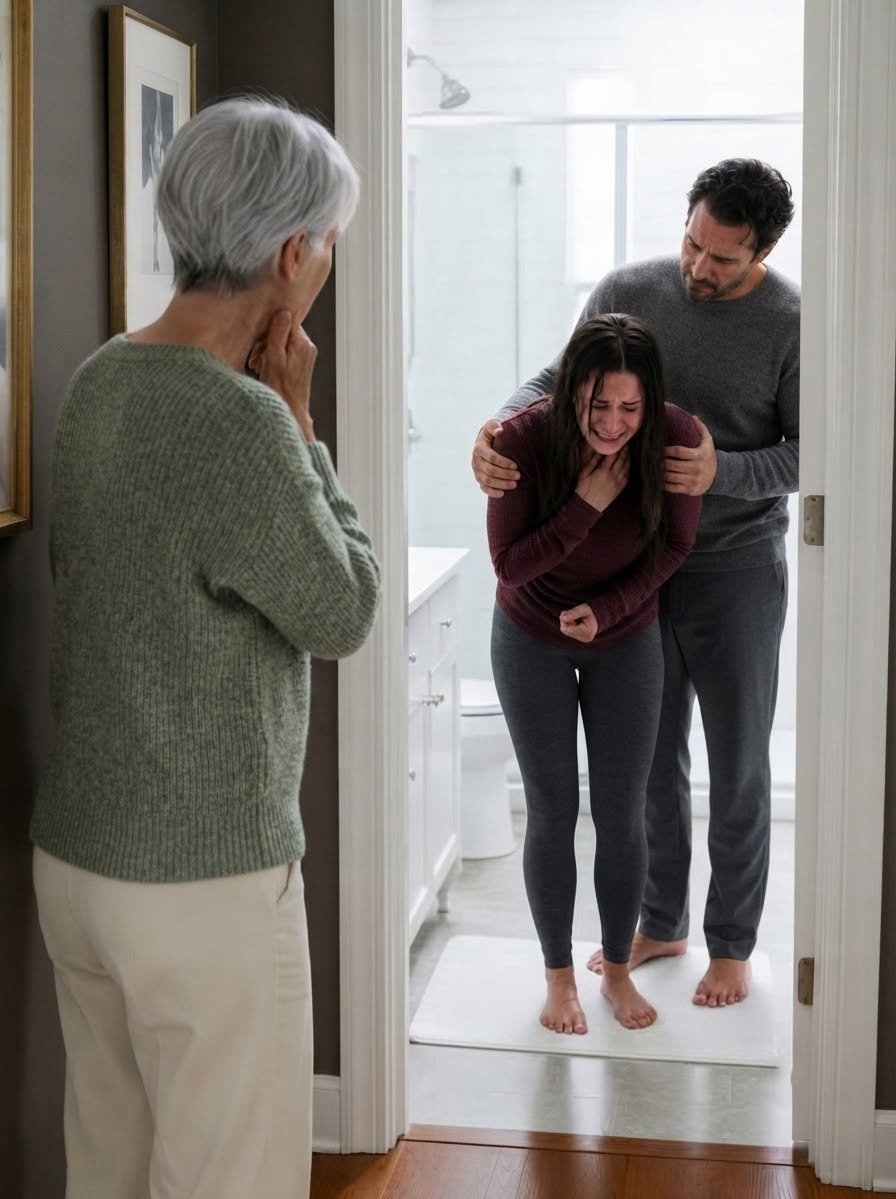
I looked through the bathroom door.
What I saw frightened me so deeply that the next morning, I packed my belongings and moved into a retirement community.
My name is Neala.
Before moving to the city, I had spent my entire life in the small town of Pine Hollow. Late autumn had arrived, bringing sharp winds and the dry cold of early winter.
I lived alone in an old Victorian house that had witnessed nearly every chapter of my life. I had entered it as a young teacher, raised my only son beneath its roof, and eventually become a widow there.
A photograph of my late husband, Samuel, still stood on the mantelpiece.
Whenever I looked at it, I felt both sadness and relief.
People often say that we should not speak badly of the dead. But death does not erase the wounds a person leaves behind.
Samuel had been controlling, cruel, and violent.
He treated our son, Nicholas, and me as possessions. He demanded obedience and used anger to rule our home.
The day Samuel learned he had terminal cancer was also the day Nicholas received his acceptance letter from a respected state university.
I buried my resentment and cared for Samuel until his final breath. I did not do it because I still loved him. I did it because I wanted Nicholas to focus on his studies without carrying the burden of his father’s illness.
When Samuel died, I did not cry.
For the first time in decades, the weight on my shoulders lifted.
From that day forward, Nicholas and I had only each other.
I gave him everything I had.
In addition to teaching during the day, I tutored students in the evenings to pay for his education. Nicholas had always been intelligent, confident, and determined.
But he also had a short temper.
Whenever he frowned or raised his voice, fear moved silently through my chest. His expression sometimes reminded me of his father.
Still, I believed patience and love could soften him.
Nicholas graduated with honors, found an excellent job in the city, and eventually became a regional manager for a large corporation.
He married a gentle young woman named Hazel.
I believed my responsibilities were finally over. I imagined spending retirement caring for my roses, reading in the afternoons, and walking with friends in the evenings.
Then Nicholas called.
I was working in my garden when the phone rang.
“Mom, what are you doing?” he asked.
“Checking the roses. They will need pruning soon. Is something wrong?”
“Hazel and I have discussed it. I’m coming this weekend to bring you to the city.”
I stopped moving.
“To live with you?”
“Yes. You’re alone out there. If something happened, no one would know until it was too late.”
“I appreciate your concern, but I am comfortable here. I have friends, my garden, and everything I need. I would only become a burden.”
“What burden?” His voice hardened slightly. “It is a son’s responsibility to care for his mother. We have already prepared a room for you.”
The tone made a chill pass through me.
It sounded exactly like Samuel.
I tried again.
“I am too old to begin a completely different life. I do not know anyone in the city.”
“You will have us,” Nicholas replied. “Here, talk to Hazel.”
After a moment, Hazel’s soft voice came through the phone.
“Mom, please come. Our condo is spacious, and it will feel warmer with you here. Nicholas worries constantly about you. I would love to have someone to talk to and go shopping with.”
Hazel’s kindness made it difficult to refuse.
Still, I heard something beneath her warmth—a careful obedience, as though Nicholas had already made the decision for all of us.
My mind became a battlefield.
On one side was the peaceful freedom I had spent years waiting for.
On the other was my love for my son and my fear of making him angry.
I had lived inside an angry man’s house once before. Even after all those years, I still feared confrontation.
“All right,” I finally said. “I will begin packing.”
Over the next few days, I placed my life into several suitcases.
I did not own much: a few clothes, several favorite books, and a faded family album.
As I looked through photographs of Nicholas smiling as a child, my doubts softened.
Perhaps I was worrying unnecessarily.
He was my son.
Maybe he truly wanted to protect me.
My neighbors congratulated me. They said I was fortunate to have a successful son willing to care for me in old age.
I smiled, but the smile never felt complete.
That weekend, Nicholas arrived in a shining black sedan. He wore a tailored suit and looked every bit like a successful businessman.
Hazel came with him.
Nicholas carried my bags and showed me several boxes of expensive vitamins he had purchased.
“You should not have spent so much,” I said.
“I have money, Mom. What I lack is time. I will work more peacefully knowing you are living with us.”
For a moment, his words seemed completely sincere.
As we drove away, I watched my old house and garden disappear behind us.
Ahead, the city rose from the horizon, filled with towering buildings, traffic, and unfamiliar noise.
I told myself that a new life was beginning.
I did not yet understand what kind of life I was entering.
Chapter 2: The First Shower
Nicholas and Hazel lived on the eighteenth floor of an expensive residential building.
Their condo was far larger than I expected. Polished wooden floors, elegant furniture, and modern appliances filled every room.
Nicholas showed me to a small but comfortable bedroom overlooking a green park.
“I installed a television and air conditioner,” he said. “Anything you need, tell Hazel.”
“It is beautiful. Thank you both.”
Hazel helped unpack my clothes. She worked constantly, always smiling and trying to make everyone comfortable.
But whenever Nicholas entered the room, her smile became stiff.
A flash of caution would appear in her eyes.
I noticed it, but said nothing.
Our first dinner seemed warm and welcoming. Hazel had prepared all my favorite dishes.
Nicholas placed a large piece of fish into my bowl.
“Eat more, Mom. You are too thin.”
“I can serve myself.”
He turned toward Hazel.
“Why are you sitting there? Give Mom more soup.”
His voice was not loud, but it carried authority.
Hazel flinched.
Her hand trembled slightly as she lifted the soup bowl.
“Thank you, dear,” I told her. “Everything is delicious.”
Nicholas spoke throughout the meal. He talked about important projects, difficult clients, and his successes at work.
Hazel and I listened quietly.
As I watched him, I realized my son was no longer the little boy who once needed my protection.
He had become a powerful man.
And he had brought that power into his home.
That night, I struggled to sleep in the unfamiliar bed.
Distant horns and the low murmur of the city drifted through the window.
I told myself that I simply needed time to adjust.
During my first days in the condo, everything seemed surprisingly pleasant.
After Nicholas left for work, Hazel took me to the farmers market. She refused to let me carry heavy bags and patiently listened to my stories about teaching.
Sometimes she took me shopping and purchased clothes for me despite my protests.
“That looks elegant on you,” she would say. “Nicholas will be happy to see you wearing it.”
Nicholas also behaved like a devoted son.
Every evening, he checked on me before doing anything else.
“How are you feeling today? Do you need more supplements?”
He bought an electronic blood pressure monitor and carefully explained how to use it.
“Measure it twice a day,” he instructed. “Hazel will record the numbers so I can review them.”
On the surface, I was surrounded by care.
But that peace was thin.
Two weeks after I arrived, I woke suddenly in the middle of the night.
The clock struck three.
Then I heard rushing water.
Someone had turned on the shower in the main bathroom beside my bedroom.
The sound was loud and sudden, cutting through the silence of the condo.
Who would take a shower at three in the morning?
I listened carefully.
There were no voices or footsteps. Only the steady sound of water.
Perhaps Nicholas was ill.
Perhaps Hazel had spilled something.
I considered opening my door, but I did not want to disturb them.
After about fifteen minutes, the water stopped.
The condo became silent again.
I did not fall back asleep.
At breakfast, I tried to sound casual.
“Nicholas, were you feeling unwell last night? I heard someone showering around three.”
He continued reading the newspaper.
“It was nothing. This project at work has made me restless. I took a quick shower to cool down.”
The explanation sounded reasonable.
But Hazel entered the room carrying oatmeal and froze when she heard the question.
Her hand shook so badly that the spoon almost fell.
She quickly recovered.
“Yes, Mom. Nicholas has been under a great deal of pressure. He has not been sleeping well.”
I looked at her.
The brief panic in her face did not escape me.
For decades, I had taught teenagers. I knew when someone was hiding something.
Two nights later, the shower came on again.
Exactly at three.
This time, cold fear spread through my body.
Taking one late-night shower because of stress was understandable.
Doing it repeatedly at the same hour was not.
Over the following nights, I began waiting for the sound.
Sometimes the water came on.
Sometimes it did not.
The unpredictability became its own form of torture. My sleep broke into pieces as I lay listening in the darkness.
During the day, Nicholas continued working as usual. But I noticed that he looked increasingly tired and irritated.
Small inconveniences made him angry.
Hazel looked exhausted as well.
One afternoon, I asked her quietly, “Is something troubling you? Has Nicholas done anything to you?”
She immediately shook her head.
“No, Mom. Nothing is wrong. He is very good to me.”
Her eyes moved away from mine.
Her words said one thing.
Her face said another.
Eventually, I tried speaking to Nicholas again.
We were alone in the living room after Hazel had finished her evening chores.
“Sit down, son. I need to talk to you.”
He looked surprised but sat beside me.
“I am worried about your health. Showering at three in the morning cannot be good for you. Your body is tired, the temperature is cold, and you are already under too much pressure.”
His expression darkened.
“Mom, enjoy your retirement and stop interfering in my affairs.”
He stood, entered his bedroom, and slammed the door.
The sound echoed through the condo.
From that moment, the atmosphere changed.
Nicholas barely spoke to me. He avoided my eyes and treated me as though I were invisible.
But as my attention moved away from him, I began noticing the person silently suffering beside him.
Hazel.
Chapter 3: The Bruises
One afternoon, Hazel and I were preparing vegetables in the kitchen.
She reached toward an upper cabinet, and the sleeve of her blouse slid down.
Dark purple and yellow marks covered her wrist.
They were shaped like fingers.
My heart stopped.
I knew those marks.
I had carried them on my own body many times.
I gently caught her hand.
“Hazel, what happened to your wrist?”
She pulled away as if she had been burned and hurriedly covered the bruises.
“It is nothing. I bumped against the corner of a desk. My skin bruises easily.”
She kept her eyes lowered.
It was a clumsy lie.
A bruise from an accident does not usually form the clear shape of a powerful hand.
I had once given similar excuses.
I had told neighbors I fell down the stairs. I told coworkers I struck a cabinet. I covered marks with makeup before entering my classroom.
I understood why Hazel was lying.
When a frightened victim chooses silence, aggressive questioning can force her further into isolation.
“You should be careful,” I said softly. “A woman must know how to protect herself.”
Hazel murmured a response and left the kitchen.
I watched her walk away, her shoulders thin and slightly bent.
History was repeating itself.
But this time, the violent man was my son.
Several mornings later, Hazel appeared with red, swollen eyes.
“Did you sleep badly?” I asked.
“A bug bit my eyelid while I was standing on the balcony.”
We lived on the eighteenth floor behind screened windows.
The excuses were becoming impossible.
Then I remembered Samuel’s behavior.
After hurting me, he often took long cold showers.
He acted as though water could wash away his rage and allow him to wake the following morning as an ordinary husband.
The three-in-the-morning showers suddenly had a terrifying meaning.
That night, the water began again.
I got out of bed.
My heart pounded as I moved silently down the dark hallway.
A narrow line of light shone beneath the bathroom door.
As I approached, I heard something beneath the rushing water.
A faint whimper.
A suppressed gasp.
Then Nicholas’s low voice.
“Do you dare speak back to me again?”
The bathroom door was not completely closed.
A small gap remained.
I placed one trembling hand against the wall and looked inside.
The sight destroyed the last excuse I had made for my son.
Nicholas stood beneath the harsh bathroom light, fully dressed in soaked pajamas.
Hazel was in front of him beneath the freezing shower.
She was also fully dressed.
Her wet hair covered her pale face. Nicholas had one hand twisted tightly into it, forcing her head backward beneath the water.
His expression was cold and cruel.
It was Samuel’s expression.
The face I had feared for most of my adult life now existed on my son.
Nicholas struck Hazel across the cheek.
The sharp sound rose above the rushing water.
Her body weakened, but his grip on her hair kept her standing.
She did not scream loudly.
Only a desperate whimper escaped her.
“Will you talk back to me again?” he demanded.
My first instinct was to rush inside.
I wanted to pull him away and protect Hazel.
But then the scene before me merged with a memory I had buried for decades.
I saw Samuel grabbing my hair and forcing my face into the rain barrel behind our house.
I felt water entering my nose and mouth.
I remembered struggling while he held me down.
A command screamed inside my mind.
Run.
Do not provoke him.
Do not make yourself his next victim.
My body obeyed before reason could stop it.
I backed away from the bathroom.
Then I ran to my bedroom, climbed beneath the blankets, and trembled like a frightened animal.
The water continued to run.
Its steady rhythm became the sound of my family’s tragedy—and of my own cowardice.
Memories returned one after another.
The beatings because dinner was not prepared correctly.
The nights I held my bruised body and cried silently.
The mornings I covered my face before entering the classroom.
I had believed Samuel’s death ended the nightmare.
I was wrong.
The violence had survived inside our son.
I had spent years trying to guide Nicholas away from his father’s example.
But I had failed.
Tears streamed down my face.
I cried for Hazel.
I cried for myself.
Most of all, I cried because another woman was now trapped in the same kind of marriage I had once survived.
Eventually, the shower stopped.
The condo became silent again.
That silence was even more frightening.
I knew I could not remain there.
I was not strong enough to confront Nicholas directly. The terror Samuel had planted inside me was still alive.
If I stayed, I would slowly disappear beneath guilt and fear.
By morning, I had made my decision.
I would leave.
Chapter 4: The Retirement Community
Sunlight entered my room the following morning.
I had not slept, but my mind was clear.
When I looked into the bathroom mirror, I saw a sixty-five-year-old woman with white hair, tired eyes, and a face marked by years of sorrow.
But I no longer saw submission.
I saw someone searching for the only path she knew toward survival.
At breakfast, Nicholas and Hazel sat across from me.
“I have something to tell you,” I began.
Nicholas looked impatient.
“What is it?”
“I have decided to move into a retirement community.”
Both of them stared at me.
Nicholas reacted first.
“A retirement community? Why? You have everything here. Do you want people to believe I abandoned my own mother?”
His objection was not about losing me.
It was about losing his reputation as a successful, devoted son.
Hazel looked frightened.
“Mom, did we do something wrong? Please do not leave.”
“It is not your fault,” I told her. “This condo is beautiful. But city life is not suitable for me. You two need privacy, and I want to be around people my own age.”
Nicholas continued arguing.
He spoke about embarrassment, public opinion, and what his coworkers might think.
I allowed him to finish.
Then I looked directly into his eyes.
“I have made my decision. This is my life, and I will spend my remaining years in the way I choose.”
He was not accustomed to hearing resistance from me.
Eventually, he fell silent.
Hazel began to cry.
I reached across the table and held her hand.
“You can visit me. That will be enough.”
That morning, I packed the same clothes and books I had brought with me.
Nicholas arranged a room in an expensive retirement community outside the city. Perhaps doing so eased his guilt. Perhaps he believed it protected his image.
As I stood at the condo door, I looked at him one final time.
He was the child into whom I had poured every hope.
Now he seemed like a stranger wearing my son’s face.
Then I looked at Hazel.
She stood behind him, pale and silent, her eyes filled with despair.
I left anyway.
Life in the retirement community was peaceful.
There were no angry voices.
No doors slammed.
No showers came on at three in the morning.
My days followed a gentle routine: morning exercise, breakfast with new friends, reading in the library, and afternoon walks through the garden.
My body felt safe.
But my conscience did not.
Whenever I closed my eyes, I saw Hazel beneath the cold water.
I heard Nicholas’s hand striking her face.
The peace I enjoyed had been purchased with another woman’s suffering.
I had saved myself.
But I had abandoned her.
One afternoon, I sat alone on a stone bench when someone called my name.
“Are you Neala, the English teacher?”
I looked up and recognized Sigrid, a former colleague who had retired several years earlier.
She still had the same warm smile and bright eyes.
As we spoke, a young woman approached carrying fruit.
“This is my daughter, Leah,” Sigrid said.
Leah greeted me politely.
Her smile was gentle but forced. Her eyes carried the deep exhaustion of someone who had suffered in silence.
She reminded me of Hazel.
After Leah left, Sigrid studied my face.
“You have something heavy on your heart,” she said. “Even here, you have not found peace.”
Her words opened everything I had tried to keep closed.
I told her the entire story.
I described Nicholas, the bruises, the three-in-the-morning showers, and what I had seen through the bathroom door.
I confessed that I had run away.
When I finished, Sigrid did not condemn me.
She held my hand.
“You have survived more than most people could bear,” she said. “But your story reminds me of Leah.”
Sigrid explained that Leah had also been trapped in an abusive marriage.
Her husband appeared educated and gentle in public. Inside their home, he was a monster.
“At first, I told her to be patient,” Sigrid admitted. “I told her that a good wife keeps her family together.”
She lowered her head.
“I thought patience would change him. Instead, it gave him permission to become worse.”
The abuse progressed from insults to pushing, then to severe beatings.
“One day, Leah came home with a black eye,” Sigrid said. “But the bruise was not what frightened me. It was her eyes. They were empty, as though her spirit had already died.”
That day, Sigrid apologized to her daughter and helped her leave.
The divorce was difficult. Leah’s husband threatened to destroy her reputation and harm her family.
But with her mother beside her, Leah collected evidence, hired an attorney, and fought.
Eventually, she became free.
Sigrid looked directly at me.
“Hazel is someone’s daughter too. Imagine what her parents would feel if they knew how your son treated her.”
Every word cut into my heart.
“I know,” I whispered. “But because of what I survived, I am still terrified. When I saw Nicholas hurting her, I became the frightened woman I used to be.”
“I understand,” Sigrid said. “But because you understand Hazel’s pain better than anyone, you cannot allow it to continue.”
She squeezed my hand.
“If you cannot change your son, help your daughter-in-law escape him.”
That sentence changed everything.
True peace was not hiding somewhere safe while another woman suffered.
My soul would never rest unless I tried to help Hazel.
I might not have the strength to confront Nicholas directly.
But I could become Hazel’s ally.
I could help place the weapons of truth and law into her hands.
“Thank you,” I told Sigrid. “I know what I must do.”
End Part Here: I was sixty-five years old when I retired from teaching and moved to the city to live with my son