PART 1 — The Phone Call I Will Never Forget
I needed $3,500 to save my eyesight.
That was the exact amount written at the bottom of the estimate from Dr. Melissa Grant’s office in Cleveland, Ohio.
Three thousand five hundred dollars.
Not a penny more.
Not a penny less.
My insurance company had refused to cover the procedure because, according to them, it was “urgent but not immediately life-threatening.”
I actually laughed when I read those words.
Not because they were funny.
Because if I didn’t laugh, I was afraid I would start crying right there in the clinic hallway.
My left eye had already become cloudy.
My right eye was beginning to follow.
Dr. Grant sat across from me and spoke gently.
“Mrs. Whitaker, if we perform the procedure within the next two weeks, we have a strong chance of preserving your vision. If we wait much longer, I can’t promise the outcome.”
I was sixty-eight years old.
Widowed.
Living alone in the small yellow ranch house my late husband, Paul, had painted twenty years earlier.
I had $412 in my checking account.
My next Social Security payment was nine days away.
And I had a forty-one-year-old son named Brandon who worked in commercial real estate, drove an expensive SUV, posted photographs of steak dinners online, and had recently purchased a vacation home near Lake Michigan.
So I called him.
“Mom,” Brandon said after I explained what the doctor had told me, “I’m sorry, but the timing is really bad.”
I gripped the kitchen counter.
“Bad timing?”
My voice shook.
“Brandon, I may lose my eyesight.”
There was a pause.
Then he sighed.
It was the same sigh he used to make when he was a teenager and I asked him to take out the trash.
“We just bought the vacation house,” he said. “Lake Michigan property isn’t cheap. We really can’t spare anything right now.”
I could hardly believe what I was hearing.
“Brandon, I’m asking for help with a medical procedure.”
Before he could answer, his wife, Courtney, spoke loudly enough for me to hear.
“Elaine, stop asking my husband for money. You need to learn how to plan better.”
I froze.
Plan better.
As if I had planned the disease affecting my eyes.
As if I had planned Paul’s fatal heart attack.
As if I had planned to spend a large portion of our retirement savings helping Brandon finish college because he promised us that someday, when things were stable, he would pay us back.
“Brandon,” I whispered. “Please.”
His answer was cold.
“I can’t do this right now.”
Then he hung up.
I remained standing in my kitchen with the phone in my hand long after the call ended.
That evening, rain began tapping against the windows.
Around seven, someone knocked on my front door.
When I opened it, Sophie stood on the porch.
She was wearing navy nurse’s scrubs, and her dark hair was damp from the rain.
Paul and I had adopted Sophie when she was eight years old after her mother—my closest friend—died unexpectedly.
From the moment she entered our home, she became our daughter.
Not almost.
Not partly.
Our daughter.
Sophie stepped inside and placed a sealed envelope on my kitchen table.
“What is this?” I asked.
“Open it after I leave.”
“Sophie…”
She shook her head.
“No, Mom. Just promise me one thing.”
“What?”
“Call Dr. Grant tomorrow.”
Then she wrapped her arms around me.
She hugged me so tightly that I could feel her trembling.
Three days later, I had the procedure.
When I returned home, one eye was covered with a protective patch and the other was still blurry.
But for the first time in weeks, I had hope.
That hope lasted until someone began pounding on my front door.
It was Brandon.
And he was furious.
PART 2 — He Wasn’t Worried About My Eyes
Brandon rarely visited without calling.
Actually, he rarely visited at all.
Maybe on holidays.
Sometimes on my birthday, if his schedule allowed.
Occasionally, flowers arrived from him, usually ordered by his assistant with a card that sounded more appropriate for a business client than a mother.
But that evening, he stood outside my house pounding on the door hard enough to shake the frame.
“Mom! Open up!”
My vision was still blurry from surgery.
I moved slowly through the hallway with one hand touching the wall for balance.
When I opened the door, Brandon pushed past me.
Courtney followed him inside.
Brandon was wearing an expensive gray coat.
Courtney stood behind him with her arms crossed.
Neither of them asked about my surgery.
Neither asked whether I could see.
Neither asked whether I was in pain.
Brandon turned toward me.
“Did Sophie give you money?”
I stared at him.
“That’s why you came here?”
“Answer me.”
“Yes,” I said. “She helped me.”
Courtney scoffed.
“Unbelievable.”
Brandon ran a hand through his hair.
“How much did she give you?”
“That is none of your business.”
“It became my business when my name got dragged into this.”
“What are you talking about?”
Courtney stepped forward.
“Sophie posted something online.”
I hadn’t even checked my phone since the surgery.
“She didn’t mention your name, did she?”
“She didn’t have to,” Courtney snapped. “Everyone knows who she meant. People are asking why Brandon’s mother needed help from his adopted sister while he’s buying property at Lake Michigan.”
Brandon pointed toward me.
“Do you understand how humiliating that is?”
I stared at him.
Something inside me became very still.
Humiliating.
Not the possibility that his mother might lose her eyesight.
Not the fact that I had sat alone in a clinic trying not to cry while someone asked me how I planned to pay for treatment.
Not my fear.
His humiliation.
“Did you come here because you were worried about me,” I asked, “or because people are talking about you?”
Brandon looked away.
That was answer enough.
Courtney pulled a checkbook from her purse and dropped it onto my coffee table.
“Fine. We’ll pay whatever Sophie gave you. Then you tell her to delete the post.”
I almost laughed.
“The surgery has already been paid for.”
“Then give Sophie her money back,” Brandon said.
“No.”
He stared at me.
“No?”
“No. Sophie didn’t help me because she wanted to protect anyone’s reputation. She helped me because she loves me.”
Courtney’s expression hardened.
“You’re enjoying this, aren’t you? Playing the abandoned mother so everyone feels sorry for you.”
I turned toward her slowly.
“For thirty-three years, I have swallowed things I should have said out loud. Tonight, I’m finished swallowing them.”
Brandon shifted uncomfortably.
“Mom, don’t turn this into some big drama.”
“It became drama when my son decided his vacation home mattered more than his mother’s eyesight.”
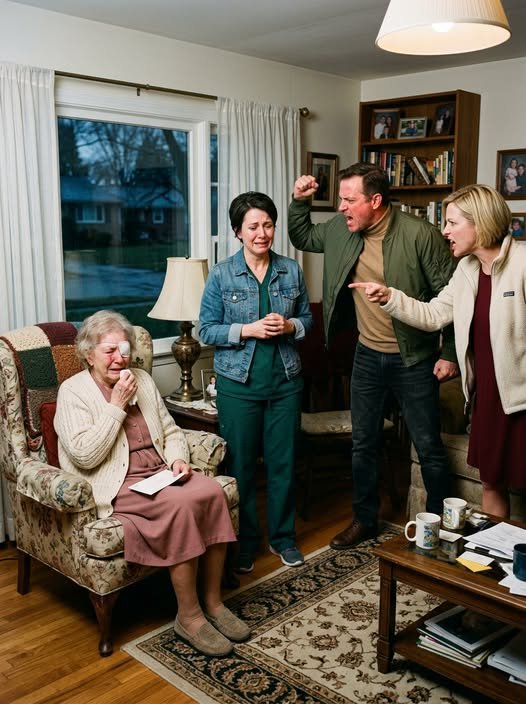
The room went silent.
Then I walked to the mantel and picked up the envelope Sophie had given me.
I had kept it there because of the note inside.
I handed the note to Brandon.
He read it.
Before he reached the final sentence, his face changed.
Courtney leaned closer.
“What does it say?”
Brandon didn’t answer.
So I did.
“It says, ‘Mom, you saved my life when I had no one. Let me save your sight now.’”
Brandon lowered the paper.
For the first time that evening, he couldn’t look at me.
But the argument over $3,500 was only the beginning.
Because the following morning, Sophie returned.
This time she wasn’t carrying an envelope.
She was carrying a thick folder filled with documents.
FINAL PART — The Documents Changed Everything
Sophie arrived shortly after nine.
I was sitting at the kitchen table with a cup of tea when I heard her key turn in the front door.
“Mom?”
“In here.”
She entered carrying a thick brown folder against her chest.
No envelope.
No smile.
Just documents.
She sat across from me.
“How’s your eye?”
“Still blurry, but Dr. Grant said that’s normal.”
Sophie nodded.
Then she placed her hand on the folder.
“I need to show you something.”
My stomach tightened.
“What?”
“When you told me you only had a little over four hundred dollars in checking, I started thinking about all the money you and Dad earned and saved over the years.”
I sighed.
“Retirement isn’t cheap. Neither are medical bills and house repairs.”
Sophie held my gaze.
“And helping children.”
She opened the folder.
The first page was a bank statement from sixteen years earlier.
A transfer.
$18,000.
Recipient: Brandon Whitaker.
I remembered immediately.
His final year of college.
His tuition payment had been due, and a student loan had been delayed.
Brandon called us in tears.
Paul and I sent the money that afternoon.
Sophie placed another document beside it.
$12,500.
That was for Brandon’s first apartment.
Deposit.
Furniture.
Credit-card debt.
Then came another.
$9,000.
Then:
$15,000.
Then:
$7,500.
Page after page.
I stopped counting.
“Sophie…”
“There’s more.”
She placed a notarized agreement in front of me.
I recognized Paul’s signature.
Eleven years earlier, we had lent Brandon $42,000 toward the down payment on his first investment property.
The agreement said he would repay us within five years.
He never did.
I stopped asking after Paul became ill.
There was always an excuse.
The market was bad.
A deal had fallen apart.
Taxes were higher than expected.
He had family expenses.
He needed more time.
Eventually, I told myself that helping your children was simply something parents did.
Sophie pushed a final sheet toward me.
“I added everything I could verify.”
At the bottom was a number.
$103,740.
I stared at it.
“That can’t be right.”
“It doesn’t include birthdays, vacations, the car Dad helped him buy, or the months you paid his health insurance,” Sophie said. “Only the major payments I could document.”
More than one hundred thousand dollars.
Three days earlier, the son I had helped with more than $100,000 told me he couldn’t spare $3,500 to protect my eyesight.
Not because he was struggling.
Because he had just bought a vacation home.
Sophie reached across the table.
“Mom, I didn’t find these because I want you to sue Brandon.”
“Then why?”
Her voice softened.
“Because Courtney told you to plan better.”
I looked away.
“And I need you to stop believing her.”
That sentence broke something open inside me.
For years, I had felt ashamed whenever money became tight.
When I postponed fixing the roof.
When I checked grocery prices twice.
When I waited for Social Security before paying certain bills.
I blamed myself.
I should have saved more.
I should have planned better.
I should have been smarter.
But part of the money I no longer had was sitting inside the life Brandon had built.
His education.
His first apartment.
His first investment property.
His career.
Maybe even that Lake Michigan vacation home.
I wasn’t angry because I suddenly wanted every dollar returned.
I was angry because I had forgotten how much I had given.
Then someone knocked on the door.
Hard.
“Mom!”
Brandon.
Sophie started to stand.
“No,” I said.
“I’ll answer it.”
I opened the door.
Brandon stood there alone.
No Courtney.
He looked exhausted.
“Can I come in?”
I stepped aside.
When he reached the kitchen and saw Sophie sitting beside the documents, his face changed.
Then he noticed the old loan agreement.
“Where did you get that?”
“Your father kept records.”
“Mom, that was years ago.”
“Yes.”
“I thought Dad told me not to worry about it.”
“Your father stopped asking because he was dying.”
“That isn’t fair.”
I almost laughed.
Fair.
When Brandon couldn’t pay college tuition, life wasn’t fair.
When rent increased, life wasn’t fair.
When his first deal failed, life wasn’t fair.
Whenever life became unfair to Brandon, Paul and I opened our wallets.
But when my eyesight was disappearing, fairness suddenly had limits.
Sophie pushed the summary toward him.
Brandon looked at the number.
$103,740.
“This is ridiculous.”
“What part?”
“You’re acting like I stole from you.”
“I never said you stole.”
“You’re keeping score.”
“No,” I replied. “I stopped keeping score years ago. Sophie found the score.”
He turned toward her.
“You had no right looking through our family finances.”
“She had my permission.”
That silenced him.
I pulled out a chair.
“Sit down, Brandon.”
He hesitated.
“Sit.”
He did.
“When your father died, do you know what frightened him most?”
Brandon said nothing.
“He worried that I would feel alone.”
My throat tightened.
“He asked me to promise that I would never become afraid of asking you or Sophie for help.”
I looked at my son.
“I broke that promise.”
Brandon frowned.
“What do you mean?”
“I became afraid to ask for anything.”
The kitchen went quiet.
“I didn’t tell you when the furnace broke. I didn’t tell you when I fell in the driveway last winter. I didn’t tell you when reading started becoming difficult because I didn’t want you worrying about an old woman.”
“Mom…”
“But when Dr. Grant said I could lose my sight, I finally became scared enough to call you.”
He looked down.
“I asked for $3,500.”
“I told you the timing was bad.”
“You hung up.”
He said nothing.
“And after surgery, you came here. You didn’t ask whether I could see. You asked whether Sophie had given me money.”
“I was angry.”
“No.”
I looked directly at him.
“You were embarrassed.”
He didn’t deny it.
“You cared more about strangers questioning you than whether your mother could see their faces.”
His eyes became wet.
For one brief moment, I saw the little boy I had raised.
The child who climbed into my bed during thunderstorms.
The boy Paul taught to ride a bicycle.
The college student who called because he was homesick but too proud to admit it.
I still loved him.
But loving him did not mean pretending the man sitting across from me had done nothing wrong.
“I’m sorry,” he whispered.
“What are you sorry for?”
“For saying no.”
“That isn’t enough.”
He took a long breath.
“I’m sorry I made you feel like asking me for help was wrong.”
I waited.
“I’m sorry Courtney spoke to you the way she did.”
“You allowed her to.”
He nodded.
“I know.”
“And?”
He looked at the documents.
“I’m sorry I forgot everything you and Dad did for me.”
That was the apology I needed to hear.
It didn’t erase anything.
But at least it was true.
“I don’t want your check,” I said.
His head lifted.
“I can pay Sophie back.”
“No.”
“I have the money.”
“I know. That was never the point.”
“Then what do you want?”
Sophie reached inside the folder and handed me one final document.
I placed it in front of him.
It was an appointment confirmation with an elder-law attorney.
Brandon frowned.
“What is this?”
“I’m changing some things.”
“What things?”
“My will. My medical directives. My power of attorney. My accounts.”
“Why?”
“Because this experience taught me something.”
I touched the protective patch over my eye.
“I’m sixty-eight years old. I live alone. Someday I might need someone to make important decisions when I can’t.”
Brandon glanced toward Sophie.
“You’re making her your power of attorney?”
“Yes.”
His expression changed.
“I’m your son.”
“And Sophie is my daughter.”
“Your adopted daughter.”
The words hit the room like a slap.
Sophie flinched.
I stood.
“No.”
Brandon looked surprised.
“You will never use the word ‘adopted’ to make her smaller in this family.”
“I didn’t mean—”
“Yes, you did.”
I pointed toward Sophie.
End Part Here: I Needed $3,500 to Save My Eyesight—My Son Said He Couldn’t Spare a Dime