
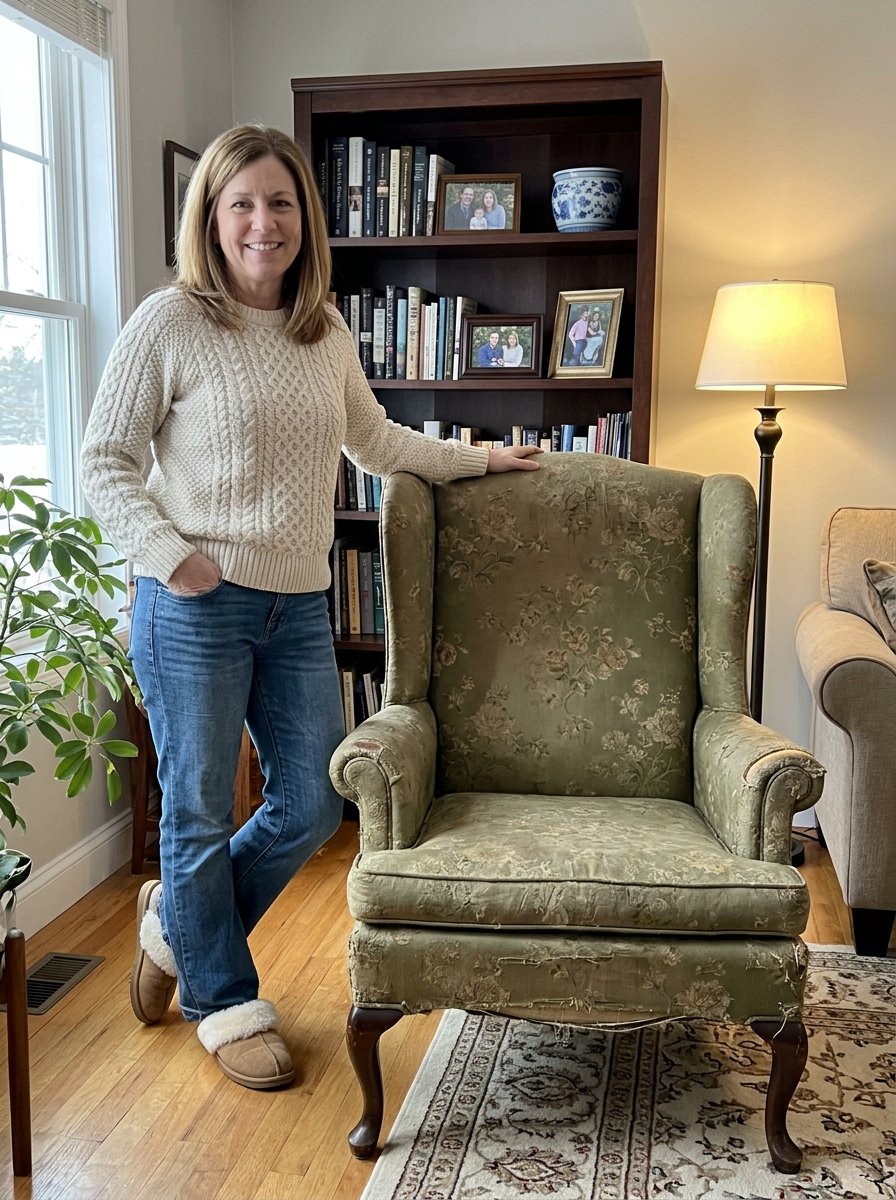
The five-dollar chair from a yard sale needed cleaning, nothing more. Then I lifted its cushion and found blue stitches sealing a pocket that wasn’t supposed to exist. What I pulled from it made me call Paige over. But the three filled holes beneath the arm told us the real secret was still missing.
“Mom, you don’t need another chair.”
My daughter, Paige, sounded as though I’d announced I was buying a horse.
“It’s five dollars,” I told her. “I can hardly say no.”
“Mom, you don’t need another chair.”
“That’s what you said about the lamp with no shade.”
“Which now has a shade.”
“And the table with three legs?”
“Four legs. I fixed it.”
Paige sighed.
At thirty-six, she had a husband, a seven-year-old son, and a habit of worrying about me.
“That’s what you said about the lamp with no shade.”
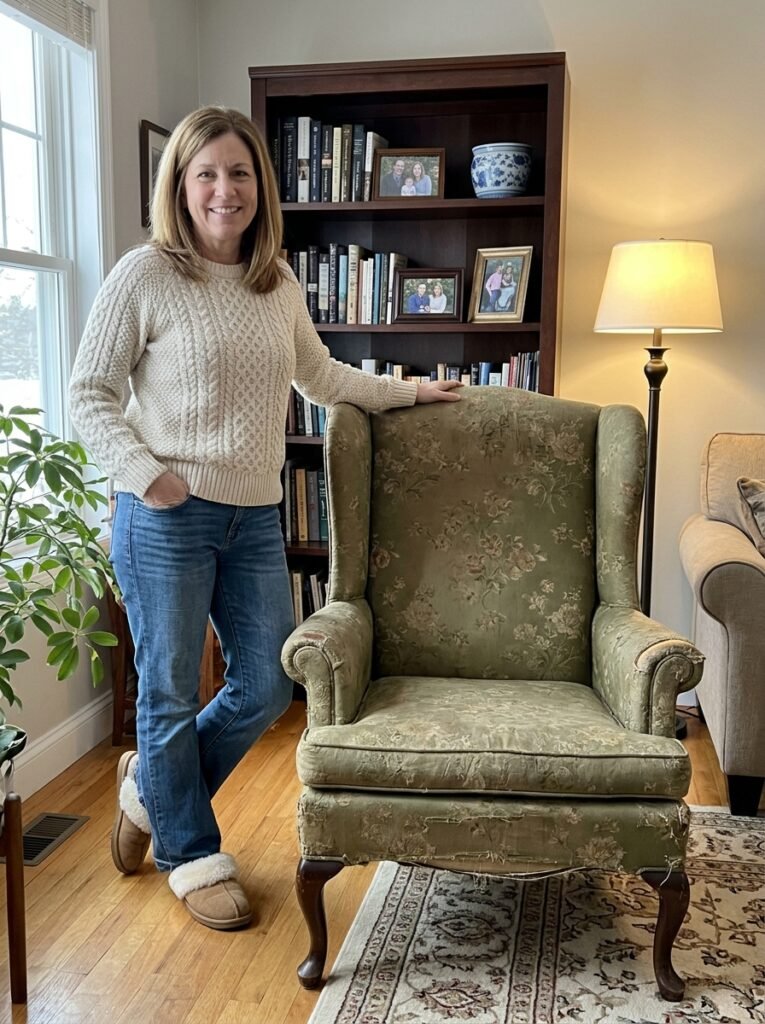
I’d retired from my office job the previous spring. After forty years of schedules and deadlines, I was enjoying mornings that belonged to me.
I’d also started fixing up a reading corner in my living room.
The faded green armchair seemed perfect.
I was enjoying mornings that belonged to me.
Its wooden legs were sturdy, the upholstery needed cleaning, and the cushion sat a little crooked.
The woman running the yard sale said it had belonged to her late aunt.
“Five dollars if you can take it today.”
I paid before she changed her mind.
It had belonged to her late aunt.
My neighbor helped me carry the chair inside.
I spent the afternoon wiping down its wooden frame.
Then I lifted the cushion.
Along the back seam, someone had stitched a narrow opening closed with blue thread.
The upholstery was green.
I lifted the cushion.
“Well, that’s odd,” I muttered.
I tugged gently at a loose stitch.
Behind the fabric was a small pocket.
Inside sat something wrapped in cloudy plastic.
I eased it out.
I tugged gently at a loose stitch.
The package was surprisingly light.
When I removed the wrapping, a miniature wooden chair fell into my palm.
I stared.
It was an exact copy of the armchair I’d bought.
Same curved arms.
Same narrow spindles.
The package was surprisingly light.
Even the little nick near the left front leg.
But the miniature had something my chair didn’t.
A second seat.
I touched a tiny wooden tab beneath the right arm.
But the miniature had something my chair didn’t.
A narrow second seat swung outward on a hinge.
A little support leg folded down beneath it, allowing the extra seat to rest beside the main one.
I tried folding it back.
It clicked neatly into place.
A narrow second seat swung outward on a hinge.
“Now why would anyone make that?”
I examined the full-sized chair.
Under the right arm, the wood felt rough.
I fetched my flashlight.
There were three filled screw holes and a shallow groove running toward the front leg.
“Now why would anyone make that?”
I took photographs before touching anything else.
I set the miniature beside the armchair and looked at the matching marks again.
Whoever had hidden it hadn’t just tucked away a keepsake. They’d preserved a model of something that had been removed from the real chair.
I took photographs before touching anything else.
And I couldn’t stop wondering why.
Then I called Paige.
“Did you finish cleaning your bargain chair?” she asked.
“Paige, are you home?”
“Yes. Why?”
“Get over here right now!”
I couldn’t stop wondering why.
“Mom, what’s wrong?”
I looked at the miniature again.
“You need to see this.”
Paige arrived twenty minutes later, breathless and annoyed.
“Do you know how frightening that phone call was?”
“Mom, what’s wrong?”
“I’m sorry. Look.”
I placed the miniature on the kitchen table.
She blinked.
“You made a doll’s chair?”
“I found it inside the cushion.”
She picked it up.
“That’s actually beautiful, Mom.”
“I found it inside the cushion.”
“Open the little tab.”
She did.
The second seat swung outward.
“That’s clever.”
“Now look at the real chair.”
I showed her the filled holes.
“Open the little tab.”
Paige crouched beside the armrest.
“Maybe somebody repaired it.”
“With three holes in a straight line?”
“Possibly.”
I brought out my tape measure.
The groove beneath the arm lined up with the miniature’s folding support when I compared their proportions.
“Maybe somebody repaired it.”
Paige looked between the two chairs.
“Wait. You think the big one had that extra seat?”
“I think somebody removed it.”
“Why would a chair need two seats, Mom?”
“Wait. You think the big one had that extra seat?”
“That’s what I intend to find out.”
She smiled.
“Of course you do.”
I still had the yard-sale receipt.
The seller had written her phone number at the bottom because she’d offered to help if I had trouble loading the chair.
“That’s what I intend to find out.”
I called her.
“Hello, this is Christine. I bought your green armchair on Saturday.”
“Oh, yes! Is something wrong with it?”
“No. But I found something inside.”
I described the miniature.
“I bought your green armchair on Saturday.”
The woman didn’t answer immediately.
“My aunt Evelyn made furniture,” she said finally.
“Did she make this chair?”
“I believe so.”
“My aunt Evelyn made furniture.”
“Do you know why it had a folding seat?”
“No. I’ve never heard of that.”
She introduced herself as Nora.
Evelyn had died the previous winter, and Nora was clearing out her house.
“Do you know why it had a folding seat?”
“She had a workshop out back,” Nora said. “There are still folders of drawings. I haven’t gone through them.”
“Would you mind if I looked? With you there, of course.”
Nora hesitated.
Then she agreed.
“Come Thursday afternoon.”
“She had a workshop out back.”
Paige offered to drive.
“I can drive myself,” I told her.
“I know, Mom. I want to come.”
“Because you’re curious?”
“Because I want to see what else you’ve bought for five dollars.”
I laughed.
“I know, Mom. I want to come.”
On Thursday, we met Nora outside a small brick house.
She was in her fifties, with short gray hair and paint on one sleeve.
“Sorry about the mess,” she said. “I’m still sorting everything.”
The workshop stood behind the garage.
We met Nora outside a small brick house.
Inside were shelves of timber, jars of screws, and a workbench worn smooth along one edge.
Nora switched on the lights.
“Aunt Evelyn spent most of her weekends out here.”
“Was she a carpenter?”
Inside were shelves of timber and a workbench worn smooth along one edge.
“She trained as a cabinetmaker. Did commissions for years.”
I showed Nora the miniature.
She held it carefully.
“I remember seeing this on her workbench when I was younger.”
“She trained as a cabinetmaker.”
“Do you remember the folding seat?” I asked.
“No.”
I looked around the workshop.
“May I see the drawings?”
Nora pointed to a cabinet.
“Those folders are hers.”
“Do you remember the folding seat?”
Most contained ordinary furniture plans.
Bookcases.
Kitchen stools.
A narrow writing desk.
Then I found a folder labeled GREEN CHAIR.
Most contained ordinary furniture plans.
Inside was a pencil drawing of the armchair.
I laid the miniature beside the drawing.
There was the curved back.
The spindle legs.
And beside the right arm, a folding wooden seat.
Inside was a pencil drawing of the armchair.
The shapes matched.
In the margin, Evelyn had written:
SEAT HEIGHT: 14 INCHES
Below that, in darker pencil, were four words.
FOR TOM AND ELLIE.
“Nora, who were Tom and Ellie?”
The shapes matched.
She came closer.
“Tom was my aunt’s husband.”
“And Ellie?”
“Their granddaughter.”
Paige looked at the drawing.
“Was this supposed to be a child’s seat?”
“Tom was my aunt’s husband.”
Nora studied it.
“Ellie was little when Tom got sick.”
“What kind of illness?” I asked.
“Something that affected his balance and strength. Toward the end, he couldn’t safely pick her up.”
“Ellie was little when Tom got sick.”
Nora touched the drawing.
“He used to read to her every afternoon.”
I looked at the tiny second seat.
Suddenly, I understood what Evelyn had been trying to make.
“She wanted Ellie to sit beside him,” I said.
“He used to read to her every afternoon.”
Nora nodded slowly.
“That makes sense.”
“Without Tom having to lift her.”
Paige ran a finger along the edge of the paper.
“Did Evelyn finish it?”
“Without Tom having to lift her.”
“I don’t think so.” Nora sat on a stool. “Tom died that year. Afterward, Aunt Evelyn stopped taking commissions for a while.”
I examined the drawing again.
There were several versions of the folding support.
“Tom died that year.”
One had been crossed out.
Another included a handwritten question about stability.
She’d crossed out one support and drawn another beside it.
I turned to Nora.
“Do you know why she removed the seat?”
“No.”
One had been crossed out.
“Or why she hid the model?”
Nora shook her head.
“I didn’t even know it was inside the cushion.”
We spent another hour looking through the folders.
“Or why she hid the model?”
I photographed the drawings with Nora’s permission.
In a smaller envelope, we found a picture of Tom sitting in the green chair.
A little girl stood beside him holding a book.
Tom was smiling at her.
I photographed the drawings with Nora’s permission.
Nora stared at the photograph.
“That’s Ellie.”
“How old was she?”
“About four.” She pointed to the chair. “That was always his favorite spot.”
Nora stared at the photograph.
I studied the space beside Tom’s right arm.
The folding seat wasn’t attached.
Perhaps Evelyn had removed it for adjustments.
Maybe she’d never been satisfied with it.
We couldn’t know.
The folding seat wasn’t attached.
Nora rubbed her thumb across the photograph.
“I thought I was just selling an old chair.”
“You couldn’t have known,” I said.
She looked at the miniature.
“I wonder why Aunt Evelyn kept that little thing all these years.”
“I thought I was just selling an old chair.”
I thought of the pocket beneath the cushion.
Maybe Evelyn couldn’t bear to finish the project.
But she hadn’t thrown it away, either.
I thought of the pocket beneath the cushion.
That evening, Paige stayed for dinner.
She watched me arrange the photographs on my laptop.
“You’re not going to start rebuilding the attachment yourself, are you?”
“No.”
She watched me arrange the photographs on my laptop.
She looked surprised.
“I thought you’d be halfway to the hardware store, Mom.”
“Those drawings have unanswered questions about stability,” I said. “I wouldn’t put a child on something I hadn’t checked.”
“I thought you’d be halfway to the hardware store, Mom.”
Paige pulled out a chair.
“So what are you going to do?”
“Ask someone who understands furniture construction.”
“And then?”
“I don’t know yet.”
“Ask someone who understands furniture construction.”
She smiled.
“That’s new.”
I gave her a look.
“I’ve been retired for less than a year. I’m allowed to develop new habits.”
“That’s new.”
Over the following week, I contacted a furniture conservator and a local woodworking group.
Both warned me that Evelyn’s original design would need careful assessment before anyone could use it.
Nora had given me permission to photograph the drawings, but not to share them.
I contacted a furniture conservator and a local woodworking group.
I realized that only after I’d emailed them to the woodworking group.
I called her before anyone proceeded.
“I sold you a chair, Christine,” she snapped. “Not my aunt’s life’s work.”
“You’re right. I should’ve asked first. I’m sorry.”
I called her before anyone proceeded.
“I need to think about this.”
“I understand. I’ll ask the group to pause everything.”
There was a silence.
“Would you be willing to meet me again?” I asked. “Just to talk about Evelyn?”
Nora hesitated.
“Come Saturday.”
“I need to think about this.”
Nora invited me into Evelyn’s old kitchen.
She’d found another photograph.
Tom was seated in the green chair, holding a book open while Ellie stood beside him.
Nora placed it between us.
She’d found another photograph.
“He couldn’t lift her anymore,” she said. “But she still brought him a book every afternoon.”
I looked at the picture.
“Did Evelyn ever say what she wanted done with her designs?”
“Not that I remember.”
“He couldn’t lift her anymore.”
“Then we shouldn’t pretend we know.”
Nora glanced at me.
“I think the idea might help someone,” I said. “But I don’t know yet. And I don’t want anyone using her work without your permission.”
“Then we shouldn’t pretend we know.”
She studied the miniature I’d brought.
“Would you really stop if I asked?”
“Yes,” I replied.
For a while, she said nothing.
Then she picked up the photograph.
“Ellie still lives nearby. She’s grown now.”
“Would you really stop if I asked?”
“Does she know about the chair?”
“I don’t think so.” Nora looked toward the workshop window. “Maybe I should ask her.”
I nodded.
“That sounds like a good place to start.”
“Does she know about the chair?”
Nora called the following week.
“I spoke to Ellie,” she said. “She remembers Grandpa reading to her, but she never knew about the extra seat.”
“How did she feel?”
“She cried when I showed her the drawings.”
“She never knew about the extra seat.”
I waited.
“She thinks we should explore the design,” Nora added. “So do I.”
We met with the woodworking group together.
Nora brought Evelyn’s drawings, and we agreed that nothing would proceed without her permission.
“She thinks we should explore the design.”
The group documented Evelyn’s contribution and explained how the design would need to change.
I volunteered to coordinate the project.
Paige raised an eyebrow when I told her.
“Mom, that’s a lot of work.”
“I know.”
I volunteered to coordinate the project.
“Are you sure?”
“Paige, I spent forty years organizing other people’s schedules. I think I can manage a few meetings.”
She laughed.
“Fair point.”
Over the following months, the workshop built a prototype.
“Are you sure?”
The folding mechanism was redesigned, the frame reinforced, and the seat tested before anyone tried it.
At a supervised feedback session, a father with limited mobility sat in the prototype chair.
His daughter climbed onto the adjacent seat with assistance.
The folding mechanism was redesigned.
“Too far from the armrest,” he told the team.
I wrote that down.
His daughter swung her feet.
“Can it have a cup holder?”
Everyone laughed.
“Too far from the armrest.”
I wrote that down too.
The project wasn’t finished.
But we had somewhere to begin.
One Sunday, Paige visited with my grandson.
The green armchair stood in my reading corner, cleaned and repaired.
We had somewhere to begin.
The miniature rested safely on the shelf above it.
Paige noticed my notebook.
“Another meeting?”
“Thursday. We’re reviewing the next design.”
“Need a ride?”
The miniature rested safely on the shelf above it.
“No, sweetheart. I’ve arranged one.”
She smiled.
“I should’ve known.”
My grandson climbed onto the sofa with a book.
“Grandma, will you read to me?”
“Of course, sweetheart.”
“I should’ve known.”
I sat beside him.
He opened it to a page covered in dinosaurs.
Paige settled into the green armchair.
“Mom?”
“Hmm?”
“I’m glad you bought that old thing.”
He opened it to a page covered in dinosaurs.
I looked at the faded green upholstery.
“Five dollars,” I reminded her.
She laughed.
My grandson tapped the page impatiently.
I looked at the faded green upholstery.
“Grandma, you’re missing the dinosaur!”
I put on my glasses and began reading.
Above the green chair, the miniature sat on its shelf with the little second seat folded open.
“Grandma, you’re missing the dinosaur!”