
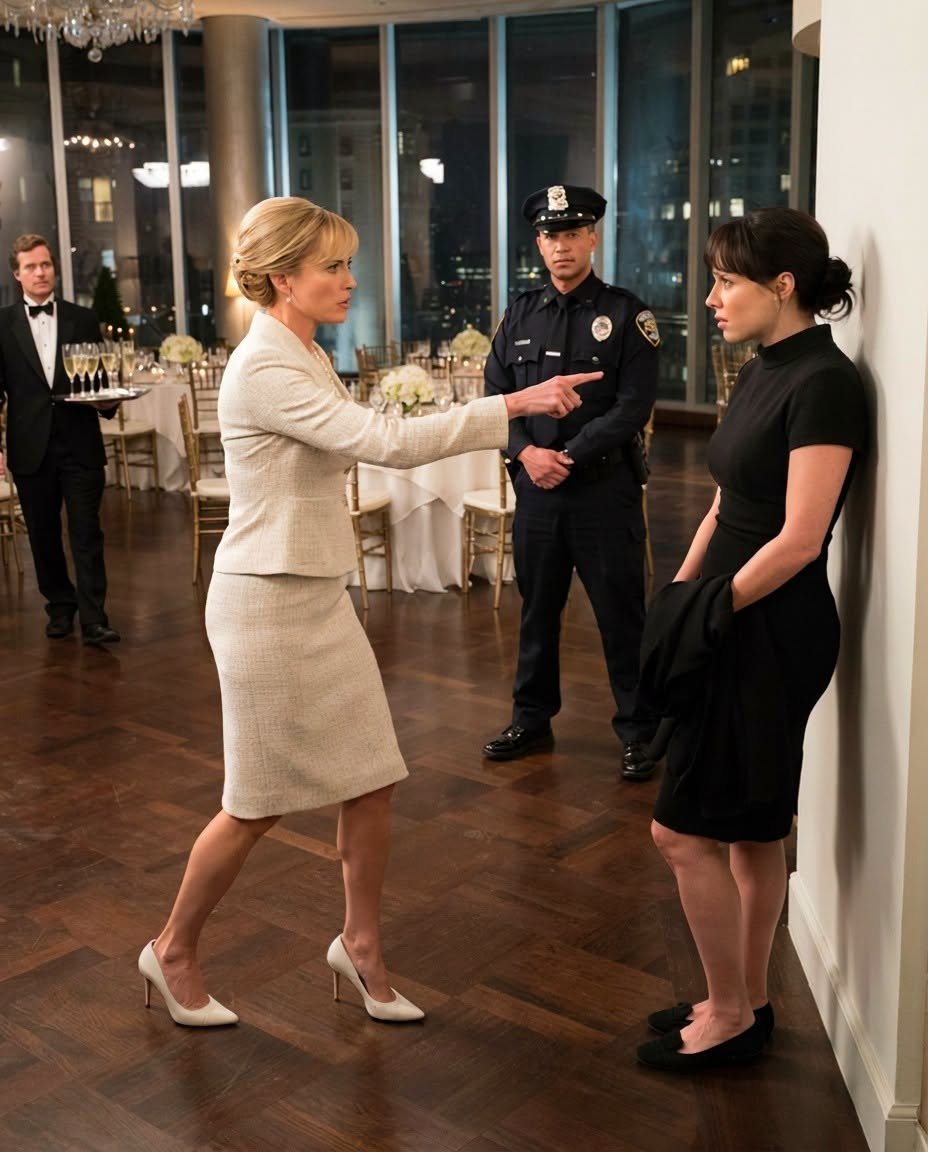
The ballroom smelled like polished wood, wet wool coats, and the kind of perfume people wear when they want money to notice them before they introduce themselves. Rain tapped steadily against the tall windows while every champagne flute on every white tablecloth caught and fractured the chandelier light, and for one foolish second, standing just inside the entrance with her coat folded over one arm and rain still clinging to the hem of her plain black dress, Gabrielle Townsend let herself believe her father had meant it.
Come tonight, Gabby. It matters that you’re there.
She had read the text three times before responding. Not because the words were ambiguous but because sixteen years of experience had taught her to look for the catch, the qualifier, the small print hidden inside what sounded like an invitation. She had not found one. So she had put on the black dress and driven across the city in the rain and walked into her mother’s hotel wearing her mother’s old pearl earrings, and she had allowed herself, just briefly, just for the length of three steps across a polished floor, to believe that this time might be different.
Then Vivian saw her.
She crossed the ballroom with that neat little smile she had perfected over years of social combat, the one that made a knife look like a dinner fork. Her beige gown was impeccable. Her hair was smooth in a way that seemed to comment negatively on the weather outside. Even the way she carried her fundraiser program looked rehearsed, held at precisely the angle that communicated effortless authority. She did not hurry. Women like Vivian never hurried when they were certain the room would wait for them.
“What are you doing here?” she asked.
Her voice carried just far enough. Not across the entire ballroom, but far enough for the nearest table to turn, far enough for a waiter to pause with his tray of glasses arrested in mid-air, far enough for the woman in pearls two seats away to develop a sudden interest in the contents of her water glass.
Gabrielle kept her coat folded over one arm. She kept her voice level.
“Dad invited me.”
Vivian’s eyes moved over her in the way they always did, with the particular assessment of someone who had decided long ago that Gabrielle was a problem requiring management rather than a person requiring acknowledgment. The plain dress. The damp hem. The absence of the kind of jewelry that announced itself. Each detail registered and was filed away as evidence.
“There has been a mistake,” Vivian said. “This is a private event. Family only.”
The small circle of attention around them widened. A man near the bar lifted a paper cocktail napkin to his mouth and pretended to cough. Two women at the nearest table exchanged a glance with the rapid, wordless fluency of people who have witnessed scenes like this before and know better than to intervene.
“I am family,” Gabrielle said.
She said it simply, without heat, because it was simply true. Elaine Townsend had built this hotel. Gabrielle had grown up in its corridors, had done her homework at the desk in her mother’s office, had learned to read by the light of the lobby lamp while her mother took calls from lenders who needed persuading. If any person in this ballroom had a claim to the word family in connection with these floors and these walls and these windows, it was Gabrielle.
Vivian raised one manicured finger toward the security staff positioned near the ballroom doors.
“Security,” she said, and each word came out smooth and cold and precisely weighted. “Remove her. She is not family.”
The silence that followed was worse than anything that had been said.
Forks paused over salad plates. The band at the far end of the room continued playing, some gentle piano arrangement of a familiar song, and somehow the softness of the music made everything worse rather than better, made the moment feel more exposed, more cruel, more observed. Nobody moved toward Gabrielle. Nobody said her name.
She found her father.
He stood between two guests in dark suits, his face flushed and his mouth slightly open, his eyes performing the entire conversation his spine refused to have. The look was one she had memorized over sixteen years. Gabby, please. Not here. Not in front of everyone. Don’t make this harder than it needs to be.
He did not move toward her.
He did not say her name.
He stood between his guests and let his wife’s instruction stand.
Sixteen years, Gabrielle thought. Sixteen years since her mother died and left a gap in this family that nobody had filled because nobody had tried. Sixteen years since Elaine’s name had begun its slow disappearance from the hotel’s public identity: from brochures first, then from plaques, then from the framed acknowledgment that used to hang in the lobby near the front desk. The hotel’s origin story had been gently, professionally rewritten over time, the way inconvenient truths always are, not removed all at once but softened into vagueness, compressed into the phrase family legacy, attributed to the smooth generality of the Townsend name rather than to the specific, exhausting, brilliant work of one specific woman who had saved the place from bankruptcy with cold coffee and red-circled invoices and a refusal to give up on something she believed in.
That woman had been Gabrielle’s mother.
In this ballroom, on this night, Vivian had just made Gabrielle the trespasser.
People love to invoke family history when it raises the value of a building. They become very quiet when the daughter of that history walks in wearing last season’s coat.
So Gabrielle did what she had always done when the room would not hold her.
She left.
No tears for anyone to feel good about later. No raised voice. No speech about what her mother had built or what her father had chosen to allow. She walked back across the polished floor with her coat still folded over her arm while people studied their salad plates, and the security guard followed two steps behind her as though she had stolen something rather than been publicly dispossessed of her own inheritance.
Outside, the rain had turned the pavement silver and the street lamps wore soft halos in the mist. Her breath shook once, one single involuntary tremor, and then she pressed it down and stood in the cold and let the evening air settle around her.
Something inside her went still.
Not calm exactly. Not forgiven. Still in the way that things go still when a decision has already been made even if the mind has not yet fully registered it.
She stood with the ballroom light glowing warm and gold behind the wet glass, and she thought about the cedar chest.
Her mother’s cedar chest.
The one she had been avoiding for years because grief can make even a key feel too heavy to lift. The one she had moved from the house to storage after the second year, when she understood that keeping it nearby meant being ambushed by it at irregular intervals, finding herself on her knees in front of it at midnight unable to remember opening it.
She had not opened it in seven years.
She walked to her car, sat in the driver’s seat with rain drumming on the roof, and drove to the storage unit off the highway.
The facility smelled of dust and cardboard and old varnish, and the fluorescent lights hummed steadily over rows of identical metal doors. Her fingers were stiff from the cold as she worked the combination lock, pulled the unit door up on its track, and maneuvered the cedar chest forward into the light.
She had expected letters. Scarves. Photographs. The kind of accumulated personal wreckage that can undo you even on an ordinary evening, and this was not an ordinary evening.
Instead, tucked beneath the folded edge of her mother’s favorite blue cardigan, sitting as deliberately as a bookmark in an important chapter, was a business card in a small white envelope.
Marian Webb. Independent Corporate Trustee.
She turned it over.
On the back, in her mother’s handwriting, three words.
Call her first.
Gabrielle sat down on the concrete floor. The cold came straight through the fabric of her dress but she did not move. She looked at her mother’s handwriting until the letters blurred and reformed and blurred again.
She was a property attorney. Had been for nine years. She understood trusts, she understood independent trustees, she understood the very specific and deliberate difference between a standard testamentary arrangement that a surviving spouse could influence or redirect over time and a properly structured independent trust with a third-party trustee who answered to the trust instrument and not to the family.
Her mother had not left her a sentiment.
Her mother had left her a mechanism.
Call her first meant: not the solicitors your father chose. Not the family accountants who sent Daniel their Christmas cards. Not anyone in that smooth and comfortable network of professionals who had been managing the Townsend estate in the direction of Daniel and Vivian’s preferences for sixteen years.
Call her first meant: there is another structure. There is something they do not know about, or something they hoped you would never find.
Gabrielle dialed the number at 9:41 p.m. with one cold thumb.
The line rang twice.
“This is Marian Webb.”
The voice was calm and precise and carried the quality of someone who had been expecting a call and had simply been waiting to find out when it would arrive.
Gabrielle swallowed. “My name is Gabrielle Townsend. I believe you knew my mother.”
The line went quiet. Not the confused silence of someone searching their memory. The purposeful quiet of someone allowing a moment its proper weight.
Then Marian Webb exhaled, very softly, and said, “Miss Townsend. I have been waiting sixteen years for this phone call.”
By 10:27 p.m., Gabrielle was sitting at a table in Marian’s office with a paper coffee cup going cold beside a document stack that represented sixteen years of her mother’s foresight operating quietly in the background while everyone else assumed they understood how the Townsend estate worked.
Marian Webb was in her mid-sixties, silver-haired, dressed in a dark jacket, and moved through her own office with the unhurried efficiency of someone who had stopped needing to perform competence decades ago. She brought the documents to the table in the order they would need to be understood, not the order that would be most impressive, and she explained each section with the directness of a person who respected her audience’s intelligence.
The Elaine Townsend Discretionary Trust had been established twenty-two years ago, two years before Elaine’s death, structured with Marian as independent trustee and Gabrielle as sole beneficiary. The trust held a property schedule covering the hotel. A land transfer rider. A private asset register documenting seventeen million pounds in holdings that had been characterized to Gabrielle, in the years since her mother’s death, as belonging to the family business, which in practice had come to mean belonging to Daniel.
The trust had been sitting in perfect legal order for sixteen years, fully funded, properly administered, waiting for its beneficiary to make contact.
“Your mother was very clear in her instructions,” Marian said, setting one particular document in front of Gabrielle, a handwritten letter of wishes signed and dated and witnessed with the thoroughness of someone who had understood that the details would matter. “She wanted you to have time. She felt that the grief of losing her would be complicated, and she did not want you to make significant decisions in that first period. She asked me to wait for you to call rather than to approach you.”
Gabrielle looked at the letter. Her mother’s handwriting. The same handwriting as the business card.
“She knew,” Gabrielle said.
“She knew your father,” Marian said carefully. “She loved him. But she understood how certain pressures work over time. She wanted to make sure that what she built would reach you intact, without being gradually redirected.”
Gabrielle thought about the brochures. The plaques. The framed acknowledgment removed from the lobby wall. The slow, professional erasure of Elaine Townsend from the history of the thing Elaine Townsend had saved.
She looked at the trust deed. At the property schedule. At the asset register with its column of figures.
“What do I need to sign?” she asked.
Marian placed the instruction letter in front of her and set a pen beside it.
“This activates the transfer of legal and beneficial ownership from the current holding structure to the trust, which you as sole beneficiary now control. The hotel, the land it sits on, and all associated assets transfer under your mother’s original documentation. The legal basis is already established. Marian’s firm handles the registration.”
Gabrielle picked up the pen.
“How long have those assets been technically held in this trust structure?”
“Since the day your mother established it,” Marian said. “What your father has been managing is the operational control he was granted under a limited letter of authority that expired, under the trust’s terms, upon your first contact with me as trustee.”
Gabrielle set the pen down for a moment. “He didn’t know the authority had an expiration?”
Marian’s expression was precise and neutral. “The trust documents were prepared by independent solicitors and registered correctly. Your father was informed of the trust’s existence at the time of your mother’s death. Whether he chose to read the documents carefully is not something I can speak to.”
“But his operational authority.”
“Ended tonight,” Marian said. “The moment you identified yourself to me as Gabrielle Townsend and I confirmed your identity against the trust records.”
Gabrielle picked up the pen again and signed the instruction letter at 10:52 p.m.
She signed the additional documentation with the steady hand of someone who had spent nine years in property law and understood exactly what each page represented, which was not an act of revenge, she told herself, though she was honest enough to acknowledge that the distinction felt academic in the present moment. It was an act of law. It was her mother’s intention, properly documented and patiently maintained, finally reaching its destination.
At 11:06 p.m., Marian sent the notices.
Gabrielle’s phone lit up at 11:14 p.m.
Her father.
Then Vivian.
Then her father again, three times in quick succession, as though repetition might accomplish what the first call had not.
She watched the screen and did not answer.
By 11:39 p.m., the missed call counter had reached sixty-eight.
She drove home through rain-slicked streets, parked in front of her building, and sat in the car for a moment. The city moved around her with its ordinary Friday night indifference, taxis and pedestrians and restaurant windows bright with warmth, none of it aware that anything had changed.
She went inside and made tea she did not drink and stood at her kitchen window and thought about her mother at the kitchen table with cold coffee and red-circled invoices, and she thought about the way Vivian’s voice had sounded in that ballroom, smooth and absolute, removing her as cleanly as a word being struck from a document.
At midnight, headlights swept across the front windows.
Her father’s SUV pulled against the curb below. Vivian stepped out first, still in the beige gown, one hand tight around her phone, the composed social smile that had served her so well all evening now entirely absent from her face. She looked up at Gabrielle’s window before moving toward the building entrance.
Then Daniel stepped out of the passenger side.
He moved more slowly. His jacket was open despite the rain. He looked up at the building with the expression of a man who has been told something he cannot quite make fit inside the version of reality he has been maintaining.
He climbed the steps to the front door and raised his fist and knocked.
Gabrielle stood in her hallway with her coat still over her arm, the pearl earrings still in her ears, the tea going cold on the kitchen counter.
She waited.
He knocked again.
“Gabby.” His voice came through the door. Not commanding. Not the voice he used in rooms full of people who already agreed with him. Something rawer underneath it. “Gabby, please open the door.”
She set her coat over the chair by the hallway table. She thought about what she wanted to say and in what order, and then she thought that perhaps the order mattered less than she imagined, because the facts were the facts and no particular arrangement of them would make them easier for him to absorb.
She opened the door.
Her father stood in the frame looking smaller than he had in the ballroom, which was not a physical change but the particular diminishment that happens to people when the room stops protecting them. Vivian stood one step behind him on the landing, and Gabrielle could see that she had been crying, which was not an expression of grief but of fury, the kind of crying that comes from having lost control of a situation rather than from being genuinely sorry about anything.
“Gabrielle,” her father said. He almost never used her full name. “We need to talk.”
“Yes,” she said. “Come in.”
She stepped back and let them enter. She did not offer tea or ask them to sit. She stood in her own hallway and looked at her father, and she let the silence sit for a moment before she spoke.
“You got the notice from Marian Webb’s firm,” she said.
“What did you do?” Vivian said. She did not wait for pleasantries. “What have you done? You cannot simply transfer assets in the middle of the night without any consultation. There are legal processes. There are considerations. Your father has been managing those holdings for sixteen years and you cannot just—”
“Vivian,” Gabrielle said.
End Part Here: Her Stepmother Had Her Removed From the Gala, but the Family Trust Revealed the Truth