
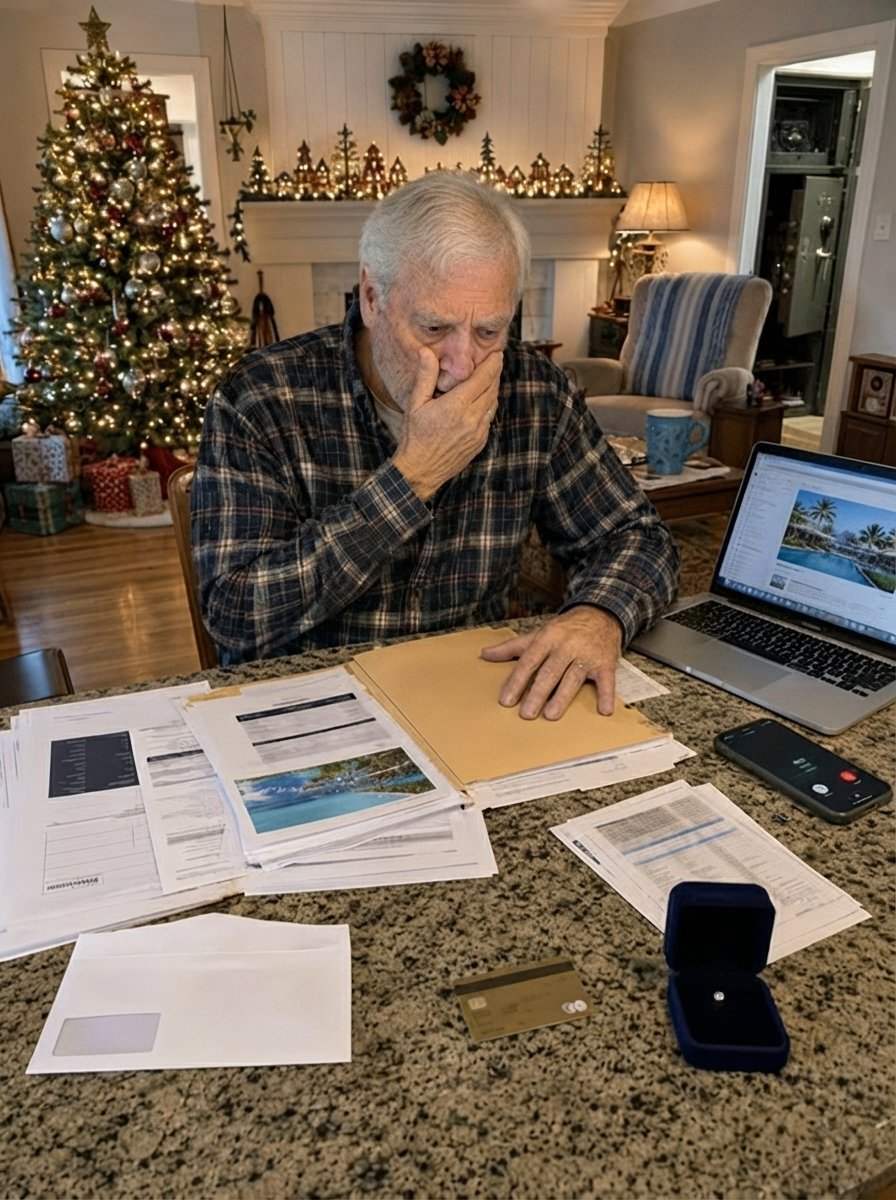
Every year, my family accused me of “ruining” Christmas.
Apparently, I was too quiet. Too serious. Too unwilling to pretend everything was perfect when it wasn’t.
So this year, I decided to make things easier for everyone.
I stayed home.
And I refused to pay for a single dollar of their Christmas.
Nine days before the holiday, I discovered a $30,000 charge on one of my credit cards for a luxury ski lodge in Telluride, Colorado.
The reservation had been made by my son.
The lodge had six bedrooms, a fireplace, private hot tubs, mountain views, and enough space for eleven members of the family.
Everyone, apparently, except me.
My accommodations were listed separately.
A roadside motel three miles away.
When I asked why, my daughter-in-law, Marissa, said my “gloomy look” would ruin the family photographs.
That was the moment something inside me finally changed.
I canceled the cards.
I updated my will.
Then I sent my son two sentences.
Not attending. Not paying.
I thought that would be the end of it.
Instead, at exactly four o’clock on Christmas Eve, my phone started ringing.
And it wasn’t my son calling to apologize.
It was the police.
My name is Raymond Whitfield.
I’m sixty-nine years old, retired after thirty years at an auto plant outside Cleveland, and I live alone in the house where my late wife, Eleanor, and I raised our only son, Preston.
Eleanor had been gone for several years, but some mornings I still expected to hear her humming in the kitchen.
Christmas had always been her favorite holiday.
After she died, I tried to keep every tradition alive for Preston and his family.
I paid for dinners.
I bought expensive gifts.
I covered vacations.
I hosted gatherings.
And whenever something went wrong, somehow I was blamed for “making things uncomfortable.”
For years, I told myself that keeping the peace was more important than being respected.
Then the bank statement arrived on a Tuesday morning.
I was drinking coffee at the kitchen table when I noticed a charge for $30,000 from a luxury lodge in Telluride.
At first, I thought it was fraud.
Then I recognized the card number.
It belonged to an additional card I had given Preston years earlier.
For emergencies.
Not vacations.
Not luxury lodges.
Emergencies.
I called him immediately.
“Preston, did you charge thirty thousand dollars to my card?”
There was a pause.
Then he sighed.
“Dad, please don’t start.”
“Don’t start what?”
“Making everything about money.”
I stared at the statement.
“You spent thirty thousand dollars of my money without asking me.”
“It’s Christmas,” he said. “The whole family is going. Mom would have wanted everyone together.”
Using Eleanor’s memory against me was an old trick.
Usually, it worked.
That time, it didn’t.
“Send me the reservation,” I said.
Another pause.
Then my phone buzzed.
Preston had forwarded the itinerary.
And that was his mistake.
Because he didn’t just forward the reservation.
He forwarded the entire email chain.
I opened it.
Then I began reading.
There were eleven people staying in the lodge.
Preston.
Marissa.
Their children.
Marissa’s parents.
Her sister.
Her brother-in-law.
Several other relatives.
My name was nowhere on the lodge reservation.
Instead, farther down the page, I found a separate booking.
A cheap roadside motel three miles away.
One room.
My room.
Then I saw an email from Marissa.
Raymond can stay there. He barely participates anyway, and that gloomy expression of his ruins every family picture.
Another message explained that my credit card would be used to cover dinners, groceries, transportation, and “unexpected expenses.”
I kept scrolling.
That was when I found something much worse.
An older conversation between Preston and Marissa.
It had nothing to do with Christmas.
Marissa had written:
We need him out of that house before spring.
Preston replied:
January will be easier. After the trip, he’ll be tired. We can convince him the house is too much for him.
I read those lines three times.
The house.
My house.
The home Eleanor and I had spent decades paying for.
Apparently, while I was expected to finance their Christmas vacation, they were also planning how to persuade me to give up my own home.
Suddenly, thirty thousand dollars didn’t feel like the biggest problem anymore.
I logged into my bank accounts.
That was when I discovered another surprise.
Five thousand dollars was missing from an old joint savings account.
Preston still had limited access because years earlier I had added him in case of an emergency.
I called the bank immediately.
By the end of the conversation, his access was restricted.
Then I went upstairs.
There was a small wall safe hidden behind a framed photograph in the bedroom.
Inside were the deed to the house, insurance documents, Eleanor’s jewelry, and a few sentimental items.
The deed was still there.
So were the insurance papers.
But the jewelry was gone.
Eleanor’s anniversary necklace.
Her bracelet.
Her earrings.
The pieces I had promised myself would someday belong to our granddaughter, Emma.
Gone.
Only two people had ever known where the spare safe key was hidden.
Eleanor.
And Preston.
That was when I stopped calling the situation “family tension.”
I called my attorney.
Julian Vance had been my lawyer for almost twenty years.
He had handled our estate planning, Eleanor’s affairs after her death, and several financial matters over the years.
He had never once seen me raise my voice.
He didn’t see it that day either.
I walked into his office and placed everything on his desk.
The bank statements.
The lodge reservation.
The emails.
The missing savings.
The list of stolen jewelry.
Then I sat quietly while he read.
For several minutes, Julian said nothing.
Finally, he removed his glasses.
“Raymond,” he asked, “what do you want?”
The question caught me off guard.
Nobody had asked me that in longer than I could remember.
Not Preston.
Not Marissa.
Not the family.
Everyone always told me what I should do.
What I should pay.
Where I should go.
What would make everyone else comfortable.
I looked at Julian.
“I want my choices to belong to me again.”
He nodded.
“Then that’s what we’ll do.”
By noon, Preston’s financial authority over my accounts was gone.
My estate documents were revised.
The house was placed into a trust that required my direct authorization for any major decision.
Beneficiary arrangements were updated.
Emergency permissions were changed.
Everything was legal.
Everything was documented.
There was no shouting.
No dramatic confrontation.
Just signatures.
Calm.
Final.
That evening, I sat alone at my kitchen table and looked at the Telluride itinerary one last time.
Eleven people in a six-bedroom luxury lodge.
My card expected to pay for the entire operation.
And me, tucked away in a motel three miles down the road so I wouldn’t ruin the family photographs.
I took a pen and wrote across the top of the itinerary:
Not attending. Not paying.
Then I mailed a copy to Preston.
On December twenty-third, Preston continued sending messages as though nothing had happened.
Flight reminders.
Shuttle schedules.
Packing instructions.
He even told me what time to call when I landed in Colorado.
I answered only once.
Have a wonderful Christmas.
His response came almost instantly.
He accused me of abandoning the family.
Of embarrassing him.
Of destroying Christmas over money.
I didn’t answer.
For the first time in years, I didn’t defend myself.
Christmas Eve arrived quietly.
I spent the afternoon in my kitchen making Eleanor’s old sugar-cookie recipe.
The first batch came out slightly crooked.
The second was better.
I played old Christmas music, drank coffee, and watched snow fall through the kitchen window.
There were no arguments.
No demands.
No expensive dinner reservations.
No one asking for my credit card.
It was the most peaceful Christmas Eve I had experienced in years.
I assumed the family was already in Colorado.
I assumed that was the end of the story.
Then, at exactly four o’clock, my phone rang.
Unknown number.
Local area code.
I almost let it go to voicemail.
Something made me answer.
“Hello?”
“Mr. Whitfield?”
“Yes?”
“This is Officer Daniels with the Cleveland Police Department. Is your residence 214 Larchmont Drive?”
My stomach tightened.
“Yes. What happened?”
“We received a call from your neighbor, Mr. Hendricks, reporting a possible break-in around three-thirty this afternoon. Responding officers found a man attempting to enter through a rear window.”
I gripped the phone tighter.
“Who?”
The officer hesitated.
“Sir, he’s identifying himself as your son.”
I slowly sat down at the kitchen table.
The same table where Eleanor and I had eaten Christmas breakfast for thirty years.
“Preston,” I whispered.
“Yes, sir. He claims he was retrieving personal belongings that belong to him. Because of the family relationship, we need you to clarify the situation.”
Twenty minutes later, I stepped outside.
Red and blue lights flashed across the snow in my driveway.
My neighbor Walter Hendricks stood on his porch looking both apologetic and relieved.
“I didn’t know it was Preston,” he told me. “I just saw someone climbing through your back window.”
“You did the right thing.”
Then I saw my son.
Preston was sitting in the back of a police cruiser.
No coat.
Shivering.
His shoulders were hunched forward.
For the first time in decades, he looked less like a successful grown man and more like the frightened boy I remembered from childhood.
I asked the officer if I could speak with him.
Officer Daniels agreed, remaining close enough to intervene if necessary.
Preston stepped out.
I looked at him.
“What were you doing?”
His breath came out in a trembling cloud.
“The lodge canceled the reservation this afternoon.”
I said nothing.
He continued.
“Marissa’s card got flagged. She was trying to cover the rest of the payment using a business account.”
“What business account?”