He put both hands on the back of the empty chair in front of him.
“You want policy? Fine. Make policy. But don’t sit there and pretend your fear is purely objective. Some of you were decided before he ever moved.”
A woman near the back said sharply, “That’s unfair.”
Arthur turned toward the voice.
“So was the world.”
Silence again.
Then the association head said, “With respect, sir, nobody is judging your appearance. This is about a powerful breed with unknown triggers.”
Arthur almost smiled.
It was the saddest smile I had ever seen.
“People always say they aren’t judging the appearance,” he said. “Right before they describe it in detail.”
I had never loved him more.
And still I felt my hand inch toward the phone.
Because truth alone was not going to carry the night.
Then Sam stood up.
I grabbed his arm automatically.
He gently pulled free.
“I want to talk.”
The principal hesitated.
Then nodded.
Sam walked to the front slower than everyone wanted.
That was the thing about a brace.
It teaches a room impatience.
Every metal click on the cafeteria floor made people wait.
Good.
Let them.
When he reached the front, he turned around and faced the crowd.
He looked small under those lights.
Then he opened his mouth and sounded bigger than half the adults in the room.
“Everyone keeps talking like Buster is the question,” he said.
His voice shook only a little.
“But he’s not.”
People leaned in.
Sam looked at Clara first.
Then at the association head.
Then at the principal.
“The question is how much someone has to do before you stop being scared of how they look.”
No one interrupted.
So he kept going.
“When I was younger, grown-ups used to tell me not to let my leg define me. But they were usually saying that while looking right at my brace. So I knew what they meant was, ‘Please make me comfortable fast.’”
Something changed in the room then.
Not agreement.
Not yet.
Attention.
Real attention.
Sam swallowed.
“Buster didn’t care about my brace. He didn’t care that I walk weird or fall weird or need extra time. And he didn’t help me because people were watching. He helped me because I was on the ground.”
His eyes flicked to me.
I knew he could feel the phone in my bag the way I could.
Then he said the thing that cut me open.
“I know some of you are scared. I know that can be real. But I need you to know something too. I am tired of having my worst moments turned into lessons for other people.”
My hand went still.
He knew.
Maybe he had always known.
He took a breath.
“There’s proof of how I met Buster. There’s proof of things that were done to me. And maybe showing it would change some minds tonight. But I don’t want strangers passing my bad day around like it belongs to them. So if you were waiting for me to do that, I’m not going to.”
The room went dead.
I could not breathe.
Arthur looked down at the floor.
I think because if he had looked at Sam, he might have broken.
Sam wasn’t done.
“If you want the truth,” he said, “then ask the people who made it happen to tell it.”
And then he stepped back.
He didn’t look at Tyler.
He didn’t need to.
Every head in that cafeteria turned.
Tyler did not move at first.
Then, slowly, like someone pulling himself through mud, he stepped away from the wall.
His face was bright red.
He stood where he was.
Couldn’t make it to the front.
That was all right.
The truth reached anyway.
“We bullied him,” Tyler said.
He was speaking to the floor at first.
Then he forced himself up.
“We threw his backpack into Arthur’s yard because we thought the dog would scare him. We filmed it. We called him names. He didn’t do anything to us.”
A noise moved through the room.
Not one sound.
Many.
Shock.
Disgust.
Recognition.
Tyler’s voice got steadier as it got worse.
“I sent the video to his mom because people online were saying Buster almost attacked him at the field, and that’s not true. Buster didn’t hurt him. We did.”
Clara went completely still.
The principal looked sick.
I realized, in that moment, how many adults had been willing to argue about a dog without first wondering why my son had ever been alone on the ground in the dirt.
Tyler took one shuddering breath.
“I’m sorry.”
Then he sat down on the floor against the wall because his legs had given out.
Nobody clapped.
Thank God.
Some things should never be rewarded with neat sounds.
The principal called for a five-minute recess.
The cafeteria exploded into whispers.
People turned to each other in clusters.
Some looked at me with pity.
Some with shame.
Some with the uncomfortable expression people wear when a tidy narrative gets ripped in half in public.
I should have felt victorious.
I did not.
I looked at Sam.
He looked drained.
Not triumphant.
Just tired.
Arthur crouched beside him.
“You did good,” he said.
Sam nodded once.
“I know.”
He had started answering that way when he wanted to keep from crying.
Then it happened.
At first it was so small I almost missed it.
Clara looked down beside her chair.
Lily was gone.
One second she was a pink cardigan and rabbit ears on lined cafeteria paper.
The next second her seat was empty.
Clara’s voice sliced through the room.
“Lily?”
Conversations stopped.
Chairs scraped.
She looked under the table.
Around the back.
By the coffee station.
Nothing.
“Lily!”
Now the room moved.
Adults flooded aisles.
Teachers checked the hallway.
Someone said maybe she went to the restroom.
Someone else ran there.
I stood up.
Sam did too.
Arthur’s head snapped toward the parking lot.
“Buster,” he said.
Clara heard him.
Their eyes met.
For one sharp second, all the arguments from the last hour stood between them like a wall.
Arthur did not move.
He asked the question with his face, not his mouth.
Do you want help?
Clara was trembling now.
Not composed.
Not eloquent.
Just terrified.
The principal hurried over.
“We’ve got staff checking exits—”
Arthur cut in.
“How long ago did anyone last see her?”
Nobody knew.
That was the worst answer.
Lily was six.
The cafeteria sat beside the back athletic field, the bus lane, and a low drainage area behind the storage sheds.
Too many places for a frightened child to wander.
Clara’s voice cracked.
“She hates loud rooms.”
That made awful sense.
All of it.
The shouting.
The tension.
The word monster flying around like a ball no adult wanted to admit they had thrown.
Arthur looked at her once more.
“Your call.”
That was all he said.
Your call.
Not a speech.
Not a lesson.
Clara’s whole face crumpled.
“Get the dog.”
Arthur moved before the last word fully left her mouth.
The parking lot light caught on his scars as he ran.
I had never seen him run.
Sam gripped my hand.
Within seconds Arthur was back with Buster, leash in one hand, blue bandana crooked from the rush.
The dog took one look at the room and changed.
Not aggressive.
Focused.
He could smell panic.
Arthur crouched.
“Find.”
He held out Lily’s forgotten stuffed rabbit, which Clara was clutching so hard her knuckles had gone white.
Buster sniffed it once.
Twice.
Then his whole body aligned.
It was like watching a compass lock north.
People flattened themselves against walls as Arthur and Buster moved through the cafeteria doors.
No one argued about policy now.
No one asked for paperwork.
Fear had changed direction.
We spilled into the back lot after them.
The wind had picked up.
Clouds were rolling in low and dark over the field.
Teachers shouted Lily’s name toward the bleachers.
Parents split off toward the playground.
The principal had already called emergency services, but those minutes stretched like wire.
Buster pulled hard toward the maintenance sheds first.
Arthur let him work.
Not dragging.
Not commanding.
Trusting.
The dog circled one shed, then another.
Then veered sharply toward the open gate that led behind the field.
Clara made a sound and started forward.
I grabbed her arm.
“You’ll slow him.”
She looked at me like she hated needing me to be right.
Then she nodded and cried harder.
We followed as fast as we could.
Sam limped beside me with his teeth gritted.
I told him to stay back.
He ignored me.
Arthur and Buster disappeared for a second around the chain-link turn by the drainage path.
When we caught up, Buster had stopped beside the old equipment bleachers stacked near the practice lot.
The dog was not barking.
Just standing stiff, nose pressed toward the shadow underneath.
Arthur dropped to one knee.
“Lily?”
At first, nothing.
Then a tiny crying sound.
Clara broke.
“Baby!”
Arthur held up one scarred hand.
“Easy.”
He flattened himself and looked underneath.
“There you are.”
Lily had crawled deep into the narrow space under the lowest metal frame with her knees tucked to her chest.
Her rabbit was gone.
Her face was streaked with tears.
She was too scared to crawl back out.
The space was tight.
Too tight for Clara.
Too tight for most of us.
Sam stepped forward before I could stop him.
“My brace won’t fit,” he said. “But I can reach if I take it off.”
I looked at him.
“No.”
Arthur looked too.
Then down at the frame.
Then at Sam’s size.
Then back at the little girl trembling in the dark.
“You sure?” Arthur asked.
Sam nodded.
He sat right there on the gravel and unbuckled the brace with shaking fingers.
I dropped beside him to help.
His leg always looked too vulnerable without it.
I hated how quickly fear could turn my brave child back into someone I wanted to wrap in blankets and keep from the world.
But Sam was already moving.
He got on both hands and one knee and slid carefully under the edge, thin shoulders just clearing the metal.
Lily whimpered.
“It’s me,” he said softly. “The boy from the field.”
She made a wet little sound.
“I know Buster.”
That got her attention.
“I know.”
“He found you.”
I could only see Sam’s shoes and one arm.
The whole lot had gone silent around us.
Even the wind sounded like it was holding its breath.
“You can hold my hand,” Sam told her. “And if you can’t crawl, I’ll stay till they think of something.”
A beat.
Then another.
Then his fingers appeared, reaching backward.
Arthur slid flat on the ground and caught hold of Sam’s wrist to anchor him.
Clara was crying openly now, both hands over her mouth.
A few seconds later, Lily’s pink sleeve came into view.
Then her other hand.
Then her face.
Sam backed slowly, guiding her the whole time.
When she was free, she launched straight into her mother’s arms so hard Clara almost fell.
The whole lot exhaled at once.
I bent down and helped Sam out next.
He was covered in dust and breathing hard.
Arthur steadied him.
Then Buster stepped forward and pressed his head gently into Sam’s stomach.
Sam laughed once through tears and leaned into him.
Not the kind of laugh people post.
The kind that happens when your body has nowhere else to put the relief.
Clara was kissing Lily’s hair over and over.
Then she looked up.
At Buster.
At Arthur.
At Sam with one brace off and dirt on his shirt.
She stood carefully, still holding her daughter, and walked over.
The crowd parted for her.
She stopped in front of Arthur first.
Then Sam.
Then Buster.
Her voice was wrecked.
“I was wrong.”
Arthur’s face did not soften.
Not yet.
“About what?”
She looked down at Buster.
Then at her daughter clinging to her shoulder.
“About thinking fear gave me the whole truth.”
A few people nearby lowered their eyes.
Because it applied to them too.
Clara swallowed.
“And before anybody says it, I know he shouldn’t have to save my child to earn basic fairness.”
That mattered.
That mattered a lot.
Because she understood the trap.
She turned to Sam.
“I’m sorry for the way adults talked around you.”
Sam said nothing.
He just rested one hand on Buster’s neck.
Then Clara looked toward the people still gathered near the practice lot.
“I don’t want my name on that proposal anymore.”
No microphone.
No podium.
Still, everyone heard.
Something shifted then.
Not magically.
Not all at once.
But enough.
Enough that the room we had been in an hour ago no longer existed in the same shape.
After emergency services checked Lily and cleared her, after the principal cried in private because public control had finally cracked, after Tyler’s mother dragged him home in a silence that looked heavier than yelling, we all drifted back toward the cafeteria parking lot in pieces.
The meeting never really restarted.
How could it?
Everyone had seen too much.
Arthur leaned against his truck while Buster drank from a jug of water.
Sam sat on the tailgate with his brace buckled back on.
I stood there feeling like my bones had been replaced with static.
Clara came over one last time with Lily half asleep against her shoulder.
She stopped a few feet away.
Not crowding.
Not performing.
“I’m still going to be a cautious mother,” she said.
Arthur nodded once.
“You should be.”
She let out a shaky breath.
“But I can do that without teaching my daughter that scars are warnings.”
Arthur looked at her for a long moment.
Then he reached down and scratched behind Buster’s torn ear.
“That’d be a good start.”
Clara’s mouth twitched, like she wasn’t sure whether she was allowed to smile yet.
Lily lifted her head sleepily.
“Can I pet him?”
Clara hesitated.
Only for half a second.
Then she nodded.
Lily slid down, walked to Buster, and pressed both small hands into the sides of his face.
Buster closed his eyes.
That was all.
No violins.
No grand speech.
Just a tired child petting a tired dog while a tired town tried to decide what to do with the truth.
I thought that would end it.
It didn’t.
Real change almost never arrives like a movie.
It comes in aftershocks.
The next week was worse in some ways.
Better in others.
The school postponed the vote on the animal policy.
Some parents backed off entirely.
Some got louder.
Now they could not claim Buster was simply dangerous.
So they shifted.
“He may be sweet, but rules have to be rules.”
“No exceptions.”
“What if the next dog isn’t like him?”
“What message are we sending if emotion overrides protocol?”
That was the new battlefield.
Not whether Buster was good.
Whether goodness should matter.
The comments online changed tone too.
Less fear.
More resentment.
People hate being embarrassed by their own assumptions.
They often call that feeling principle.
The principal asked to meet with me, Arthur, and Sam privately.
We sat in her office after school while awards from old sports seasons glinted on the wall.
She folded her hands and said the school wanted to “move forward constructively.”
I had started to despise adverbs.
She proposed a compromise.
No more open pet days.
But perhaps, in time, Buster could be invited back for a structured assembly on empathy, resilience, and animal recovery.
Controlled environment.
Parent consent.
Distance barriers.
Optional attendance.
Sam listened in silence.
Arthur listened in stone.
The principal smiled carefully.
“I think this could become something positive.”
Arthur spoke before I could.
“Something positive for who?”
She blinked.
“For the students.”
“No,” Arthur said. “You mean for the school.”
Her face tightened.
“That’s unfair.”
“Is it?”
He leaned forward slightly.
“You couldn’t decide whether he was safe enough to stand on grass with children five days ago. Now you want him in a presentation because the story plays better that way.”
She opened her mouth.
Closed it.
Sam was watching both of them.
Arthur kept going.
“You don’t get to turn what almost happened here into branding.”
Branding.
A hard word.
A true one.
The principal looked at me like maybe I would smooth him down.
I didn’t.
Because he was right.
And because I had started to understand something ugly about the world we lived in.
It did not only fear difference.
Sometimes it consumed it.
Packaged it.
Put it on flyers.
Clapped for it as long as it stayed useful.
Sam finally spoke.
“Would Buster have to stand behind a little gate so people feel brave enough to listen?”
The principal’s cheeks flushed.
“That would be for safety.”
Sam nodded slowly.
“Then no.”
I turned to him.
He looked older than ten in that chair.
“Are you sure?”
“Yes.”
The principal tried once more.
“This could help people.”
Sam looked down at his brace.
Then back up.
“People can help themselves a little too.”
We left without agreeing to anything.
Outside, in the late afternoon sun, Arthur unlocked his truck and stood there awhile with one hand on the door.
“You mad?” Sam asked.
Arthur snorted.
“At who? The whole species?”
Sam smiled.
A real one this time.
Arthur’s face softened.
“Kid, you don’t have to let everybody turn your life into curriculum.”
That line stayed with me.
Maybe because I had almost done it myself with the video.
A few evenings later, I found Sam and Arthur in the backyard building something out of scrap wood.
Buster was supervising from the grass like a retired foreman.
“What is this?” I asked.
“A bench,” Sam said.
“It looks crooked,” I said.
Arthur glanced up.
“It is.”
“Then why are you building it?”
“Because crooked things are still useful,” Sam answered, without missing a beat.
Arthur barked out a laugh so sudden even Buster lifted his head.
By the end of the week, there were three crooked benches in Arthur’s yard and a hand-painted sign on the fence.
SATURDAY READING HOUR.
ALL KIDS WELCOME.
NO PERFECT PEOPLE REQUIRED.
I stared at the sign.
“Arthur.”
“What?”
“You can’t put that last line.”
“Why not?”
“Because it’s going to make half the neighborhood think you’re starting a cult.”
Sam grinned.
“That might help turnout.”
It began as a joke.
Then it became a thing.
The first Saturday, I expected maybe one child.
Possibly none.
At nine-fifty, Sam was pacing the porch with two stacks of comic books and a collection of old adventure paperbacks Arthur had found at a thrift shelf years ago.
At ten o’clock, Clara Weller arrived with Lily.
At ten-oh-three, Tyler appeared with his hands shoved in his pockets and a look on his face like he had been sent for punishment.
At ten-oh-five, the veteran from the meeting came with his grandson.
At ten-ten, two girls from Sam’s class showed up.
Then a boy who stuttered.
Then a freckled kid who never looked up from his shoes.
Then a teenager with acne and an art sketchbook.
No big announcement.
No campaign.
Just people coming through the same gate everyone had once feared.
Arthur stood off to the side pretending he was not moved.
Buster lay in the middle of the yard wearing the blue bandana like it was formal attire.
The first ten minutes were awkward.
Children are not automatically brave.
Adults are not automatically healed.
Clara kept Lily close.
Tyler stood at the fence like he might leave.
Sam, of all people, was the one who broke the tension.
“Okay,” he said, holding up a comic book. “This one has a giant sewer lizard and terrible dialogue, so obviously we’re starting here.”
A few kids laughed.
That was enough.
By the end of the hour, Lily was reading sound effects aloud with both hands on Buster’s back.
The stuttering boy forgot to stutter during the dramatic parts.
The freckled kid who never looked up was lying flat in the grass beside Buster’s tail.
Tyler did not read much, but he repaired the loose porch step after Arthur handed him a hammer without ceremony.
No speech.
No praise.
Just work.
Maybe that was better.
The reading hour kept growing.
Word traveled the old-fashioned way.
Not because someone wanted to win an argument.
Because children talked.
Because parents noticed their kids came home lighter.
Because people who did not belong in many rooms found one where nobody asked them to become inspirational before sitting down.
That was Arthur’s rule.
No one had to perform healing.
No one had to explain themselves.
No one had to smile for adults.
Just read.
Just sit.
Just breathe near a dog who had every reason to be hard and somehow wasn’t.
About two weeks into it, Tyler showed up early.
Sam was on the porch tightening a buckle on his brace.
I was inside helping Arthur arrange books by age, which lasted all of four minutes before he decided “the age system is nonsense.”
Through the window, I saw Tyler stop in front of Sam and hold out something wrapped in brown paper.
Sam looked suspicious.
Good.
He should.
Tyler said something I couldn’t hear.
Sam unwrapped it.
Inside was a new notebook.
Cheap.
Plain.
But on the front, in black marker, Tyler had written: FOR THINGS THAT ARE YOURS.
Later, when I asked Sam what that meant, he shrugged.
“He said if I ever want to tell my side of stuff, I should get to choose where it lives.”
I had to sit down after that.
Because grace is exhausting sometimes.
It asks too much.
It asks you to hold people accountable and still leave room for the possibility that they are more than the ugliest thing they did.
That is hard.
That is very, very hard.
Sam did not forgive Tyler all at once.
I would not have trusted it if he had.
Some Saturdays he talked to him.
Some Saturdays he didn’t.
Some days he still got quiet if someone laughed too suddenly behind him.
Healing did not move in a straight line.
Neither did Buster.
Sometimes a slammed gate or a shouting match from the street would send him pacing the yard with old ghosts in his eyes.
When that happened, Arthur never called it failure.
He just sat on the porch step nearby and waited him back into himself.
That taught me something too.
Not every trigger means danger.
Sometimes it just means history.
By early summer, the school’s final decision came.
No large-animal public events would return.
But the principal, after several more meetings and one very humbling Saturday in Arthur’s yard where she watched Buster get used as a pillow by six children in a row, quietly dropped the proposal that would have singled him out by type and history.
Instead, the school started something new.
A morning walking group for students who wanted company getting to campus.
Volunteer adults.
Small routes.
Safety vests.
Open to anyone.
Sam snorted when he heard about it.
“They copied Arthur.”
Arthur stirred chili on the stove and said, “Then maybe they learned something.”
The first morning the group launched, the principal asked if Arthur would join as one of the walkers.
Not for publicity.
No photographers.
No assembly.
No fence around him.
Just a route.
A real one.
Arthur looked at Sam.
Sam looked at Arthur.
Then Sam said, “Only if Buster comes too.”
The principal hesitated.
I watched the whole pause happen.
The old fear.
The new knowledge.
The choice.
Then she nodded.
“On leash,” she said.
Arthur almost smiled.
“As opposed to what?”
So that Monday, at exactly 7:30 AM, Arthur was back at the park entrance.
Rain or shine.
Same jacket.
Same posture.
Same dog.
Different world.
Not completely.
A few parents still crossed to the other side.
A few still held their kids a little tighter.
Change had not made saints out of anybody.
But other children joined the walk now.
The stuttering boy.
Lily.
A seventh grader with hearing aids.
A girl who wore oversized hoodies in July because she hated being looked at.
Tyler too, once, from a distance, after he had been made to switch routes for “fresh air and humility” by his mother.
Arthur said nothing about that.
Buster paced in front like a quiet engine.
Sam walked beside him with his hand resting lightly on the harness.
Not because he needed to every step.
Because sometimes strength is not the same thing as refusing support.
That took me years to learn.
He taught it to me at ten.
One evening near the end of June, I found Arthur replacing the loose board in the fence.
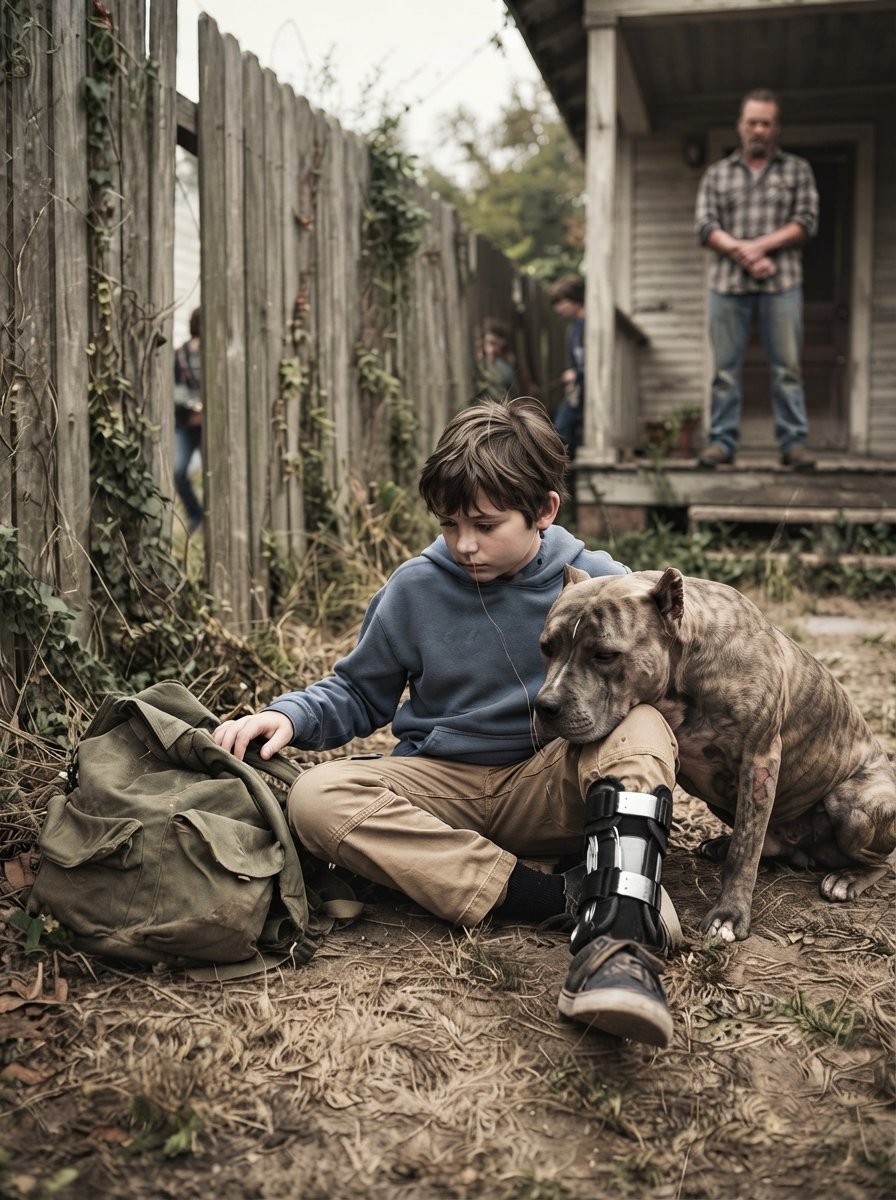
The same one Sam had once shoved aside to crawl into the yard everybody feared.
Tyler was helping him hold it level.
Sam was painting the new wood.
Buster lay in the grass supervising again.
I leaned against the gate.
“Thought that board was a historic landmark by now.”
Arthur grunted.
“Thought it was time.”
Tyler kept the board steady.
Sam dipped his brush and painted a line of blue across the fresh wood.
Not neat.
Not careful.
Just bright.
“What are you doing?” I asked.
“Mural,” he said.
Of course it became a mural.
By the next week, half the reading group had added something.
Lily painted a pink rabbit.
The stuttering boy painted a crooked rocket ship.
The hoodie girl painted stars.
Tyler painted a backpack with a zipper broken open.
Sam painted Buster.
Not pretty.
Not polished.
Big square head.
Missing ear.
Scars and all.
Arthur pretended to complain that the dog’s nose was too small.
Buster sneezed on the wet paint and made everyone laugh.
The fence that had once been a weapon became a story in daylight.
People walking by slowed down now for different reasons.
Not to whisper.
To look.
To read the sign.
To hear the children.
To figure out why laughter was coming from the scary yard.
Sometimes they came in.
Sometimes they didn’t.
Either way, the gate stayed open during reading hour.
Toward the end of summer, Clara brought over a donation of folding chairs and two outdoor lanterns.
She set them down on Arthur’s porch and said, “These are from a cautious mother who is trying not to confuse caution with control.”
Arthur considered her for a second.
Then nodded.
“That’s about the best sentence you’ve said to me.”
She laughed.
So did he.
That sound alone felt like proof of something.
Not that everybody can agree.
Not that fear disappears.
Just that people can grow around the places they once locked up.
The notebook Tyler had given Sam slowly filled.
Not with a full version of the bullying video.
Not with speeches.
With fragments.
Things Buster did.
Things Arthur said.
Bad days at school.
Good days too.
Drawings of the brace.
Drawings of the yard.
Questions about whether a person could be kind and ashamed at the same time.
One night Sam let me read a page.
Just one.
At the bottom, in his crooked blocky handwriting, he had written:
People looked at Buster and saw what happened to him.
I looked at him and saw what he decided after.
I sat on the edge of his bed a long time after that.
Because that was it.
That was the whole thing.
Not just about a dog.
About Arthur.
About Tyler.
About Clara.
About me.
About what we do with pain once it stops bleeding.
Do we sharpen it?
Hide it?
Perform it?
Sell it?
Project it onto the nearest creature that makes us uneasy?
Or do we make room for someone else to stand?
The night before school started again, Arthur hosted one last summer reading hour under string lights Clara insisted he hang.
The yard glowed soft gold.
Kids sprawled on blankets.
Parents talked in low voices by the fence.
Someone brought lemonade.
Someone else brought store-bought cookies nobody pretended were homemade.
Buster moved slowly from child to child collecting scratches like royalties.
Sam was reading aloud from one of the adventure books when he stopped and looked up.
“Can I ask something?” he said.
Nobody minded interruptions in Arthur’s yard.
That was another rule.
“Why do people get so weird about scars?”
The whole place went quiet.
Arthur, from his chair on the porch, answered first.
“Because scars prove something happened, and a lot of folks would rather judge the mark than face the story.”
Sam thought about that.
Then he turned to Clara.
“What about fear?”
She didn’t dodge.
“Fear likes shortcuts,” she said. “It thinks that makes it smart.”
Sam nodded slowly.
Then he looked at Tyler.
“What about guilt?”
Tyler picked at the label on his soda bottle.
“Guilt wants to hide,” he said. “Until hiding feels worse.”
Then Sam looked at me.
Maybe because I had been part of this too, even if my part wore nicer clothes.
“What about telling the truth?”
My chest tightened.
I met his eyes.
“The truth matters,” I said. “But nobody who got hurt owes the world a performance.”
Arthur lifted his mug a little.
“To that.”
The kids did not fully understand why the adults got quiet after that.
They didn’t need to.
Some wisdom is background music until you grow into the lyrics.
As the sky darkened, Lily fell asleep with her head on Buster’s side.
The hoodie girl finally took her sweatshirt off and tied it around her waist because nobody was staring.
The stuttering boy read three straight pages without getting stuck once.
Tyler and Sam argued about whether the giant sewer lizard could beat a pirate robot.
Arthur said no creature with self-respect would lose to a pirate robot.
The whole yard booed him.
He pretended to be offended.
I sat there under those borrowed lights and looked at all of it.
At the children who had once been lonely in different directions.
At the adults who had once mistaken fear for wisdom.
At the man with half a burned face laughing with his head thrown back.
At the dog everyone had called a monster, asleep in the middle of the grass while the smallest people in the yard trusted him with their bodies.
And I thought about the day Sam crawled through the loose board under that fence because three cruel boys had cornered him and the world had told him he was on his own.
He had gone into the place everyone feared most.
And found shelter.
That was the part nobody could get over.
Maybe because it said too much about us.
About how often the world points at the wrong danger.
About how many good things get left behind fences because they do not look easy to love.
When the reading hour ended, the kids scattered home in groups.
Lanterns swayed softly.
Crickets started up in the ditch.
Arthur was stacking cups when Sam limped over and leaned against him for one second.
Not long.
Just a second.
Arthur put a hand on the back of his neck.
No speech.
No lesson.
Then Sam crossed the yard to me.
On his rigid leg.
On his own time.
With Buster padding beside him close enough to help if needed and calm enough not to make a show of it.
That, more than anything, felt like the future.
Not independence that rejects every hand.
Not dependence twisted into shame.
Just trust.
Earned slowly.
Held carefully.
Given anyway.
As we walked home, I looked back once.
Arthur was standing by the fence mural in the porch light.
His scars caught gold.
Buster sat at his side like a shadow with a heartbeat.
For years, people had seen that house and warned each other there was a monster in the yard.
I understand now that they were right.
There was a monster in that yard.
It was every rumor.
Every shortcut.
Every cowardly silence.
Every easy judgment dressed up as common sense.
And little by little, one scarred man, one scarred dog, and one brave boy had taught the rest of us where it really lived.