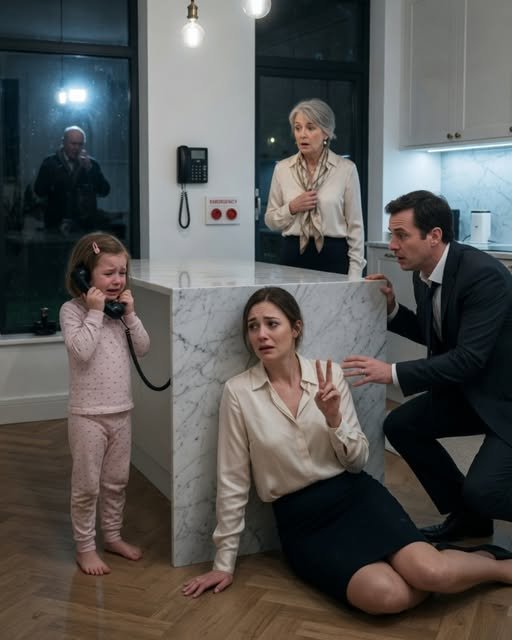
David told Emma to hang up. His voice tried to be sharp, but panic had split it. Margaret lowered her wineglass until it touched the counter with a small, betraying click.
Sarah’s father told Emma to step away from David and keep the phone where Sarah could hear him. Then he said what David had never known.
“The red button is not just a speed dial.”
The handset had saved the call audio automatically. It had also sent an emergency alert to Sarah’s father’s phone, with the time, the number dialed, and the first sixty seconds attached.
David stared at the phone as though it had become a person. Margaret whispered his name, and the polish disappeared from her voice. For once, she sounded like a woman who understood consequences.
Outside, engines rolled into the drive. Sarah’s father had not come alone. He had called emergency services before he finished answering Emma’s call, and he had stayed on the line so David could not rewrite the room.
The porch lights flooded through the glass. David stepped back, hands raised, already building his next version of events. Sarah could see it forming: the wet floor, the accident, the hysterical wife.
But Emma spoke first.
“Daddy pushed her,” she said, in the small, shaking voice of a child who had been told to say exactly what she saw.
That sentence broke something David could not fix.
The paramedics found Sarah on the floor with sweat-damp hair and a leg she could not move. The police found the bank alert still glowing beside her and the First Meridian transfer confirmation open on the screen.
At the hospital, Sarah’s fracture was documented. The intake notes recorded her statement, Emma’s statement, and the responding officer’s observations. The audio from the emergency handset was preserved before morning.
Sarah’s father brought her the trust folder the next day. Inside were the trust letter, account statements, transfer printouts, and old emails showing David’s long campaign to make the inheritance sound communal.
A forensic accountant later traced the transfer path from Sarah’s protected funds into the joint-account ledger and then toward accounts David controlled. Nothing about it looked accidental once the pages sat in order.
Margaret tried to call twice. The first message said Sarah was confused. The second said families should not involve police. The third never came, because Sarah’s father changed the hospital visitor list.
David’s attorney attempted the wet-floor story until the recording was entered. Then there was Emma’s voice, tiny and clear, saying, “Mommy looks like she’s going to die.”
There was David’s command to lie. There was Margaret’s sentence: “Look what you made him do.” There was the transfer confirmation time-stamped at 8:17 p.m.
In court, Sarah did not have to perform pain. She arrived with her medical records, her bank documents, and the recording. Facts did what begging never could.
David lost access to the house, then to Sarah’s accounts, then to the story he had been telling about himself. The court orders came one by one, each stamped, signed, and undeniable.
Margaret looked smaller in a courtroom than she had in a kitchen. Without the chandelier, the pearls, and the wineglass, her pity had nowhere to hide.
Sarah’s inheritance was restored through legal action. The divorce took longer than she wanted, but not longer than she could survive. Her father helped her move into a smaller house with brighter windows.
Emma chose the first thing for the new kitchen: a yellow stool so she could help make pancakes. The emergency phone came too, but it lived in a drawer now, not on display.
Healing did not arrive dramatically. It came in physical therapy appointments, school pickups, quiet mornings, and the first night Sarah slept without listening for David’s key.
Sometimes Emma still asked about the two fingers. Sarah told her the truth in words a child could carry: “It meant you were brave, and it meant help was coming.”
When my husband shoved me to the floor so hard he broke my leg, I gave my 4-year-old daughter our secret signal. That signal did not save us because it was clever. It saved us because we had practiced believing we deserved rescue.
An entire house had taught Sarah to stay small. But on that Tuesday night, with pain burning through her leg and fear watching from the stairs, calm became the weapon David never thought to take away.