
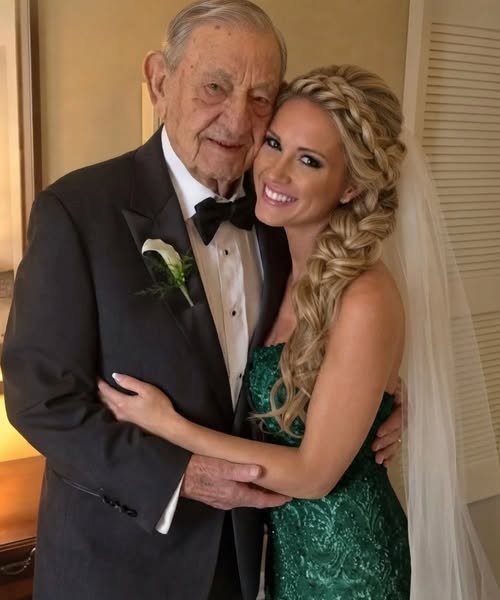
I should have walked away.
Instead, I looked at the man who had cooked soup with me, listened to every ridiculous dream I had ever shared, and allowed me to discover who he truly was after the luxury disappeared.
“Do I still get to marry you?” I asked.
“Only if you promise to read the first page of the charter.”
I looked down.
The first instruction read:
Learn every name you can.
“Fine,” I said.
The guests applauded, and the ceremony continued.
The Real Honeymoon
The morning after our wedding, Walter handed me a clipboard.
“Retired employee breakfast,” he announced.
“I thought honeymoons involved beaches.”
“Ours involves cinnamon rolls and forty-seven former machinists.”
At first, I treated the family charter like homework.
I checked boxes, timed every visit, and wore fashionable shoes on factory floors until a mechanic named Rosa handed me a pair of steel-toed boots.
“They’re ugly,” I complained.
“They’ll protect your feet.”
“What about my dignity?”
“That disappeared when you wore high heels near a forklift.”
Rosa eventually became one of my favorite people.
At a retirement breakfast, an elderly man named Arthur showed me endless photographs of his grandchildren.
At first, I smiled politely.
But as we prepared to leave, he held my hand.
“My wife died last winter,” he said quietly. “No one asks about the photographs anymore.”
The clipboard in my hand suddenly felt lighter.
I began to understand why Walter wanted me to learn people’s names.
People rarely remembered expensive gifts or formal speeches.
They remembered when someone listened.
They remembered when someone stayed ten extra minutes.
They remembered when someone treated their problems as if they mattered.
Learning to Care
A scholarship applicant named Luis once told me that his grandmother had cleaned Walter’s offices for forty years.
“Every winter, Mr. Walter checked her furnace himself,” Luis said.
“I sent someone,” Walter corrected him.
Luis smiled.
“You stayed until it worked.”
Months passed.
I began remembering employee birthdays without checking the calendar.
I visited retired workers without telling Walter.
I read hardship letters in his office and quietly cried over stories of illness, lost homes, family emergencies, and children who needed help.
One afternoon, Walter found me sitting alone among the letters.
He placed the old brass key on the desk beside me.
“What does it actually open?” I asked.
“The employee break room at our first factory.”
“That’s all?”
“It was the first key my grandfather trusted me with,” Walter explained. “I cleaned that room every Saturday for an entire year before he allowed me to manage anything else.”
I turned the scratched key over in my hand.
“Why did you give it to me?”
Walter smiled.
“Because you finally stopped asking what everything was worth.”
Walter’s Final Gift
Years later, Walter passed away peacefully in his sleep.
At his funeral, investors and wealthy business partners filled only two rows of the church.
The rest of the building was crowded with mechanics, janitors, secretaries, retired bakers, apprentices, scholarship students, and families whose names I knew.
After the service, a glamorous young woman approached me.
She glanced toward the company vehicles parked outside.
“What is it really like marrying into all this money?” she asked.
I laughed softly and led her into Walter’s office.
Then I handed her the leather portfolio.
Her smile widened when she opened it.
A few seconds later, the smile slowly disappeared.
That evening, I visited the company’s oldest factory.
Through a distant window, I could see the mansion glowing on the hill.
Years earlier, I had dreamed of owning that mansion.
Now, I barely noticed it.
After the last employees collected their coats and left for the night, I turned off the break-room lights and closed the door.
The small brass key turned smoothly in the lock.
Walter had never left me a yacht.
He had never given me complete ownership of the fortune.
He had left me something far more valuable.
He gave me a purpose.
He gave me a family.
Most importantly, he taught me that the greatest inheritance was not the ability to own every door.
It was having a reason to open those doors for other people.