
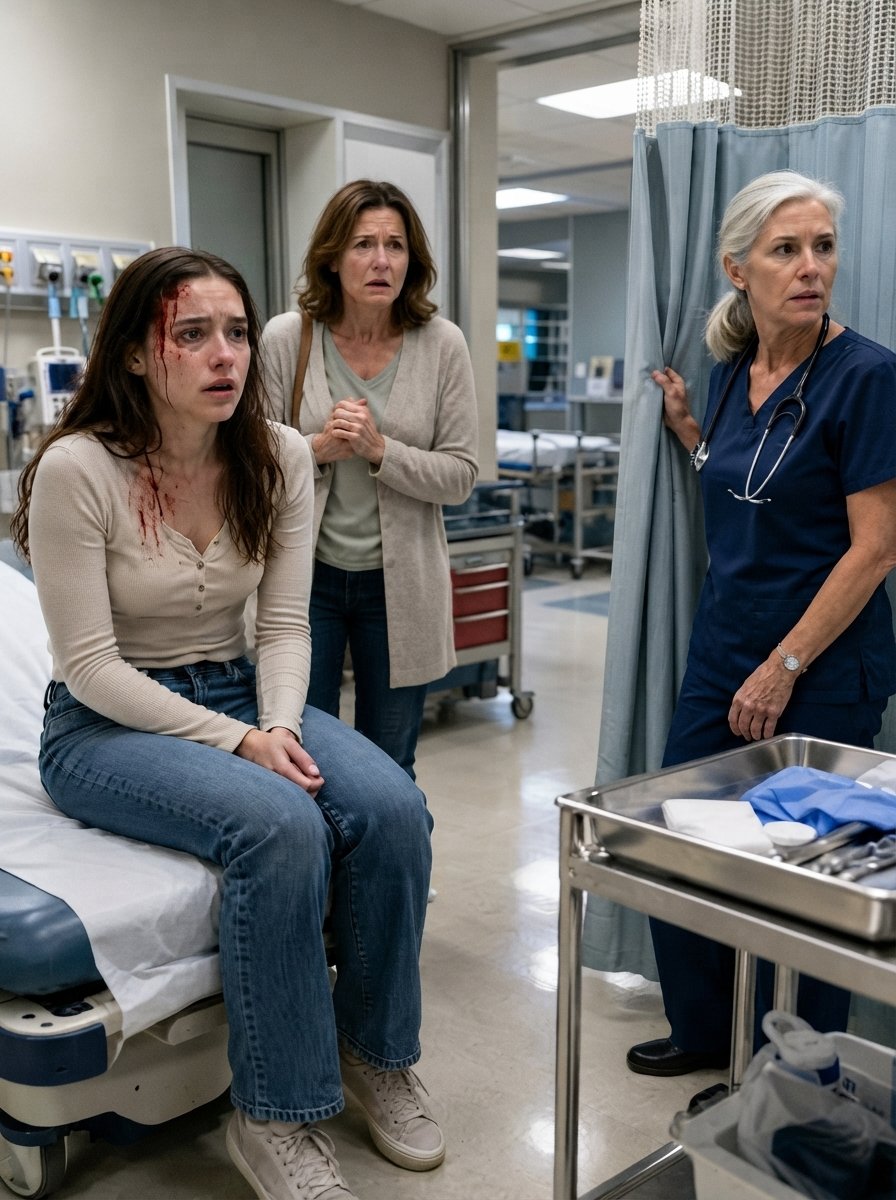
“I found the brake-fluid bottle in Logan’s room. I know what he’s planning.”
I whispered:
“No.”
Morales paused the recording.
“Your father’s crash investigation noted brake failure.”
I began crying before I realized I was crying.
“Logan killed him?”
The detective didn’t answer.
Not yet.
Instead, he opened the video.
The timestamp showed the night before Dad died.
Dad had apparently hidden the phone on a bookshelf in the living room.
The camera faced the kitchen.
Mom entered.
Then Logan.
Seventeen years old.
Thin.
Terrified.
Not angry.
Terrified.
Mom shut the kitchen door.
Logan whispered:
“I can’t do this.”
Mom replied:
“You already started it.”
My skin turned cold.
Logan shook his head.
“I only wanted to scare him.”
Mom stepped closer.
“He’s going to the police tomorrow.”
“Then let him!”
“He’ll destroy this family.”
Logan began crying.
Actually crying.
“I’m not touching the car.”
Mom stared at him.
Then she said six words that rearranged my entire childhood.
“You don’t have to. I will.”
The video ended.
No one spoke.
I couldn’t.
I couldn’t even feel the staples in my head anymore.
The truth came quickly after that.
Dad had discovered Mom had been stealing from the family business for years.
More than $180,000.
He planned to divorce her and report the theft.
Mom convinced Logan that Dad intended to send him to jail for various thefts and fights.
She fed his anger.
Encouraged his fear.
And when Logan backed out of sabotaging Dad’s brakes—
Mom did it herself.
Dad died the next morning.
Logan knew.
He had found Dad’s hidden phone after the funeral.
But instead of going to police, he hid it.
Why?
Because Mom told him he would be charged too.
She said he had discussed the plan.
She said nobody would believe a violent seventeen-year-old over his grieving mother.
So Logan kept quiet.
And over the next seven years, his rage grew worse.
He drank.
Fought.
Destroyed things.
Hurt me.
And every single time Mom protected him.
Not because she loved him more.
Because she needed him guilty.
Every violent incident strengthened the story she would tell if Dad’s death was ever investigated.
Logan was unstable.
Logan was dangerous.
Logan had threatened Dad.
Logan was the obvious killer.
She hadn’t been protecting my brother.
She had been building him into her alibi.
Two days after I left the hospital, Logan asked to see me.
He was being held on the assault charge while prosecutors decided what to do with the old case.
I almost refused.
Then I went.
He sat behind thick glass wearing an orange jumpsuit.
For the first time in my life, my brother looked small.
He picked up the phone.
So did I.
Neither of us spoke.
Finally, Logan said:
“I’m sorry.”
My jaw tightened.
“For which part?”
He closed his eyes.
“All of it.”
“You hurt me.”
“I know.”
“You choked me when I was nineteen.”
“I know.”
“You let me think Dad’s death was an accident.”
A tear slipped down his cheek.
“I know.”
Anger rose inside me.
“You don’t get forgiven because Mom was worse.”
He nodded.
“I know.”
That answer surprised me.
He didn’t defend himself.
Didn’t blame alcohol.
Didn’t blame Mom.
Didn’t say he hadn’t meant to.
He just said:
“What I did to you was mine.”
For once, someone in my family took responsibility.
I began crying.
Not because I forgave him.
I didn’t.
Maybe someday I would.
Maybe I never would.
But I finally understood something.
Responsibility wasn’t revenge.
Truth wasn’t betrayal.
And love without accountability wasn’t love at all.
I placed my hand against the glass.
After a moment, Logan placed his hand opposite mine.
Then he whispered:
“There’s one more thing.”
My stomach tightened.
“What?”
“Dad’s phone wasn’t hidden because I was scared Mom would find it.”
“Then why?”
His eyes filled again.
“I was saving it for you.”
I stared at him.
“What are you talking about?”
“Dad knew something might happen.”
Logan swallowed.
“He left a final recording that Mom never knew about.”
My pulse raced.
“What recording?”
Logan looked toward the guard.
Then back at me.
“He said it was for your twenty-sixth birthday.”
I had turned twenty-six three weeks earlier.
Detective Morales later recovered the file.
I listened to it alone in my apartment.
Dad’s voice came through the speaker.
“Em, if you’re hearing this, I’m sorry I’m not there.”
I broke instantly.
Then he said:
“There’s something I need you to know. You spent your whole childhood trying to keep peace in this house. That was never supposed to be your job.”
I covered my face.
His voice continued.
“Never confuse keeping the family together with keeping a secret.”
Then came the sentence I would remember forever.
“Sometimes the person who finally tells the truth isn’t the one who destroys the family. They’re the one who saves whatever is left of it.”
Mom was arrested that afternoon.
Not because Logan confessed.
Not because Dr. Reeves called the police.
Not even because Dad had hidden evidence.
She was arrested because seven years after my father died, a doctor looked at the blood running down my neck and refused to accept the same lie our family had survived on for years.
He didn’t mean to.
It was an accident.
Don’t make it bigger than it is.
Three sentences had buried the truth.
One sentence finally dug it up.
“We’re not covering for him this time.”
Except in the end, the person we had all been covering for was never Logan.
It was Mom.