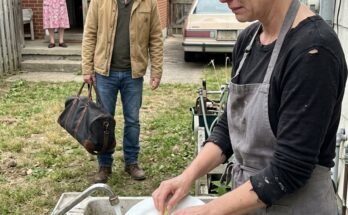
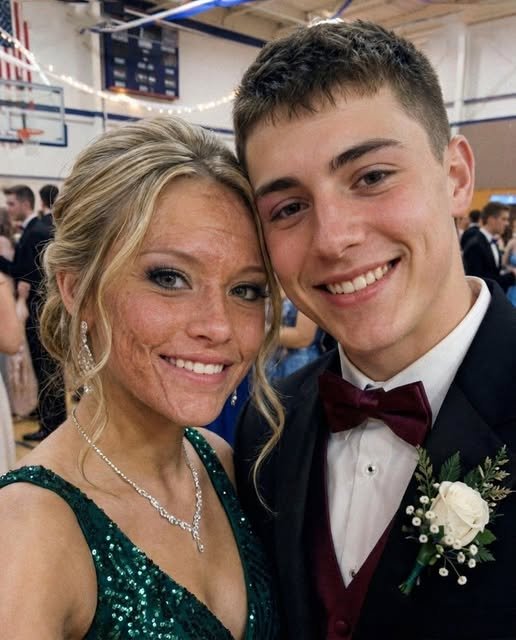
He looked exhausted, as though he had not slept all night.
The moment he saw me, all the color drained from his face.
“Cindy…”
I crossed my arms tightly.
“You were there on the night of the fire?”
No one spoke for several seconds.
Then Caleb stepped outside and closed the door behind him.
“Yeah,” he admitted quietly.
Hearing him say it made my stomach twist.
“What happened?”
Caleb looked down before answering.
“When I was nine, I saw Mason sneak out of our house late at night. He used to do things like that all the time. I followed him on my bicycle because I thought it would be exciting.”
He took a shaky breath.
“I lost sight of him for a while because he was riding his skateboard. But eventually, I saw him climbing out of a window at your house. A few minutes later, I noticed smoke coming from the kitchen.”
I stared at him, unable to speak.
“I became scared and rode home,” he continued. “The next morning, everyone was talking about the fire and what had happened to you.”
His voice cracked.
“I thought that if I told anyone what I saw, Mason’s life would be over.”
“So you stayed quiet?” I asked.
“I was nine years old, Cindy.”
His answer stopped me.
Caleb explained that Mason’s behavior became worse as he grew older. There were fights, juvenile detention, and eventually prison.
But Caleb never stopped thinking about that night.
His guilt became even stronger after we started attending the same school.
“At first, I tried to avoid you,” he admitted. “Every time I looked at you, I remembered the fire.”
But avoiding me eventually became impossible.
We passed each other in hallways. We attended the same classes, football games, and school events. Sometimes we were even assigned to the same group projects.
Over time, Caleb’s guilt began turning into something else.
Then he admitted something I had never expected.
Before prom, he had overheard several boys joking that no one would ever ask me to dance.
“I became angry,” he said. “I told them to stop. One of them almost hit me because of it.”
Taylor stood silently in the doorway, listening.
Caleb looked directly at me.
“I didn’t ask you to dance because I felt sorry for you. I asked you because I was tired of pretending that I didn’t care about you.”
His words caught me completely off guard.
He explained that after walking me home, he went to Taylor’s house because her parents were away and he needed advice.
Taylor was one of the few people who knew the truth.
“I planned to come to your house today,” Caleb said. “I was finally going to tell you everything.”
I studied his face for a long moment.
Then I asked the question that still bothered me most.
“Why would Mason do something like that?”
Caleb slowly shook his head.
“I honestly don’t know.”
Then something changed in his expression.
“But maybe it’s time we ask him ourselves.”
Facing Mason
An hour later, Caleb drove us to a correctional facility two towns away.
Taylor stayed in the car while Caleb and I went inside for visitation.
During the entire drive, my stomach remained twisted in knots.
After everything I had heard about Mason, I expected him to look frightening.
But when he entered the visitation room, he simply looked tired and much older than he should have.
The moment he saw me sitting beside Caleb, his expression collapsed.
No one spoke at first.
Finally, I leaned forward.
“Why did you do it?”
Mason stared at the table for several seconds. He seemed to understand that there was no reason to keep hiding the truth.
“It wasn’t intentional,” he said quietly.
Caleb became tense beside me.
Mason continued.
“When I was fourteen, I used to sneak around neighborhoods at night and do stupid things. That night, I noticed the garden gnome outside your house and walked over to look at it. Then I saw that the kitchen window was slightly open.”
He lowered his eyes.
“I climbed inside because I thought I could steal something small without anyone noticing.”
My hands tightened in my lap.
“While I was in the kitchen, I lit a cigarette. A few minutes later, I left it on the counter while I searched the living room.”
Hearing those words made me feel sick.
“Then I heard someone moving upstairs,” he continued. “I panicked. I climbed back out through the window and ran away.”
Caleb stared at him in disbelief.
“You didn’t mean to start the fire?”
Mason looked confused.
“I didn’t even know there had been a fire until the next morning.”
For nearly ten years, Caleb had believed that his brother had intentionally burned down my house.
The shock was written across his face.
Mason looked at me again, shame filling his eyes.
“I’m sorry, Cindy. I’m sorry for everything.”
Silence filled the visitation room.
Then he added quietly, “If you want to report what I did, I understand.”
I looked at him for a long time.
I had always imagined that if I ever met the person responsible for the fire, I would be filled with rage.
But sitting across from Mason, I mostly felt sadness.
I felt sad that one reckless decision made by a fourteen-year-old boy had damaged so many lives.
I felt sad that my mother and I had nearly died.
I felt sad that Caleb had spent almost ten years carrying guilt for something he had witnessed as a frightened child.
And I felt sad that Mason’s life had continued falling apart after that night.
Nothing he said could undo what happened.
But for the first time, I finally understood the truth.
Letting Go
Caleb and I left the facility without saying much.
The drive back to town was quiet.
Before going home, we stopped at the police station.
I found the officers who had visited my house that morning and told them everything Mason had confessed.
When they asked whether I wanted to press charges, I shook my head.
“No,” I said. “I don’t. And I’m sure my mother won’t, either.”
Mason was already serving time for another crime. Punishing him again would not restore our house, erase my scars, or return the years Caleb had spent living with guilt.
For almost ten years, I had allowed the fire to define me.
Every glance, every whisper, and every moment of insecurity had made me feel trapped inside the life that fire had created.
But that night at prom, Caleb helped me see myself differently.
And the next day, learning the truth helped me understand something even more important.
My scars would always be part of me.
But they did not have to control me.
The fire had changed my life once.
I would not allow it to keep changing my future.
For the first time in years, I felt free.
And somehow, neither the scars nor the fire had power over me anymore.