Three months later, Lisbon felt more like home than Connecticut had in years.
My neurologist even noticed that some of my symptoms had improved, something he believed might be partly connected to reduced stress and increased activity.
I walked more.
I ate better.
I made friends.
And then I met Maria.
She was another grandmother who regularly brought several of her grandchildren to a small café near my apartment.
One afternoon, I noticed her granddaughter, Anna, struggling with mathematics.
I offered to help.
That single afternoon slowly became a routine.
Soon, I was tutoring several neighborhood children in English and basic mathematics.
They began calling me A Americana—the American grandmother.
For the first time in years, people valued me for something other than my money.
Then James called.
“Myrtle, David and Zuri hired a private investigator.”
My stomach tightened.
“For what?”
“To locate you.”
Then he told me something even worse.
They had contacted authorities and suggested that my Parkinson’s might have made me mentally incompetent.
They were trying to frame my departure as the action of a confused elderly woman who needed to be brought home.
That hurt more than I expected.
Even after everything, David still saw me as something he had the right to control.
I told James to create protected education trusts for Emma and Jake.
Then I reduced the remaining monthly assistance to David’s household by half.
“They’ll become more aggressive,” James warned.
“Let them.”
Several months after I left the United States, they finally found me.
I was sitting at the café helping Anna with her schoolwork when I noticed an American man watching me.
After a few minutes, he approached politely.
“Mrs. Patterson?”
“Yes?”
“My name is Ryan Walsh. I’m a private investigator. Your son hired me.”
I looked at him calmly.
“I’m not missing.”
“I understand. He says he’s concerned about your wellbeing.”
“I have an attorney. He knows how to contact me.”
Walsh hesitated.
“Are you here voluntarily?”
I nearly laughed.
“For the first time in years, yes.”
Eventually, he asked whether I would be willing to speak to David.
I agreed on one condition.
The conversation would happen right there in the café, in public, with Walsh listening.
The moment David heard my voice, he exploded.
“Mom, what are you doing?”
“Living.”
“In Portugal? You don’t know anyone there!”
I looked around the café.
Maria was sitting nearby.
Anna was working on her homework.
The café owner waved to me from behind the counter.
Several families I had come to know greeted me regularly.
“I know plenty of people,” I replied.
Then Zuri joined the call.
“We’re sorry about Christmas,” she said. “The joke went too far. But you can’t punish us forever.”
“This isn’t punishment.”
“Then what is it?”
“A choice.”
David’s voice hardened.
“If you won’t come home willingly, I’ll have you declared incompetent. I’ll get guardianship if I have to.”
Something inside me became completely still.
“David, if you try that, you’re going to discover exactly how competent I am.”
“What is that supposed to mean?”
“It means I have records of every dollar I’ve spent supporting you for the past three years.”
Silence.
Then he said something that finally erased the last bit of guilt I still carried.
“You’re my mother. Helping us is your job.”
“No, David.”
My voice was calm.
“Helping you was my choice.”
I looked directly at Ryan Walsh.
“And now I’m making another one.”
I told David that all financial assistance to his household would end immediately.
Mortgage help.
Insurance.
School payments.
Everything.
The only exception would be the protected education trusts for Emma and Jake—money their parents could never access.
David’s tone changed instantly.
“Mom, please.”
“I’m not finished.”
I told him that if he made another attempt to have me declared incompetent, sent additional investigators after me, or tried to force me back to Connecticut, I would revise my estate completely and donate the remaining assets to charity.
Zuri began crying.
“We’ll lose the house.”
“Then perhaps you should have considered that before treating the person helping you keep it like an embarrassment.”
David called it blackmail.
“No,” I replied. “It’s consequences.”
Then I explained one more thing.
“If you insist that I’ve been mentally incompetent, perhaps my attorney should examine whether I was competent when I gave you all that money.”
David stopped talking.
For once, my son had nothing to say.
I handed the phone back to Walsh.
“I’m living here voluntarily. I’m receiving medical care. I manage my own finances, and I have absolutely no intention of returning.”
He nodded.
“I think I have everything I need.”
Within twenty-four hours, James cancelled every remaining automatic payment to David’s household.
Two weeks later, I received a letter from Emma.
Her careful handwriting nearly broke my heart.
Dear Grandma Myrtle,
Dad says we have to move because money is tight. Mom cries a lot. I don’t really understand everything, but I want you to know I never thought you were weird or embarrassing. I liked when you visited. I hope you’re happy in Portugal. Maybe someday I can visit.
Love, Emma.
P.S. Jake misses your cookies.
I cried over that letter.
Not because I regretted leaving.
I cried because I finally understood that leaving David and Zuri did not mean I had stopped loving my grandchildren.
They were children caught in circumstances they had not created.
My problem had never been with them.
It was with two adults who had mistaken generosity for obligation and kindness for weakness.
Months later, Anna handed me a school assignment she had written about someone important in her community.
She had chosen me.
“You’re family now, A Americana,” she said.
I stared at that little girl and realized she understood something it had taken me sixty-five years to learn.
Blood can make people relatives.
But blood cannot guarantee respect.
It cannot guarantee kindness.
And it certainly cannot guarantee love.
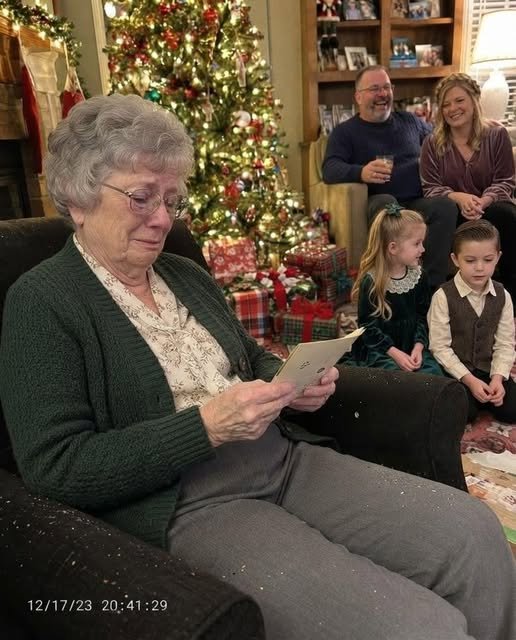
That Christmas card had said:
We don’t want a sick grandma.
In the end, I realized the cruelest truth of all.
David and Zuri had never really been afraid of having a sick grandmother around.
They were afraid of losing the healthy bank account attached to her.
I wanted something different.
I wanted people who enjoyed my company without calculating what I could provide for them.
I wanted to wake up without feeling like an inconvenience.
I wanted my remaining years to belong to me.
And in a small café in Lisbon, surrounded by people who affectionately called me their American grandmother, I finally found what I had been looking for.
The calls from Connecticut eventually stopped.
David and Zuri finally understood that their threats had failed.
Their guilt no longer controlled me.
Their financial dependence was no longer my responsibility.
And for the first time since Harold died, I felt completely free.
It turned out that freedom was the most valuable thing I had ever given myself.